Rust-Oleum Chalked vs Annie Sloan Chalk Paint
Rust-Oleum Chalked vs Annie Sloan chalk paint, compared on color depth, texture, coverage, sealing, and cost. Which one your furniture piece actually wants.

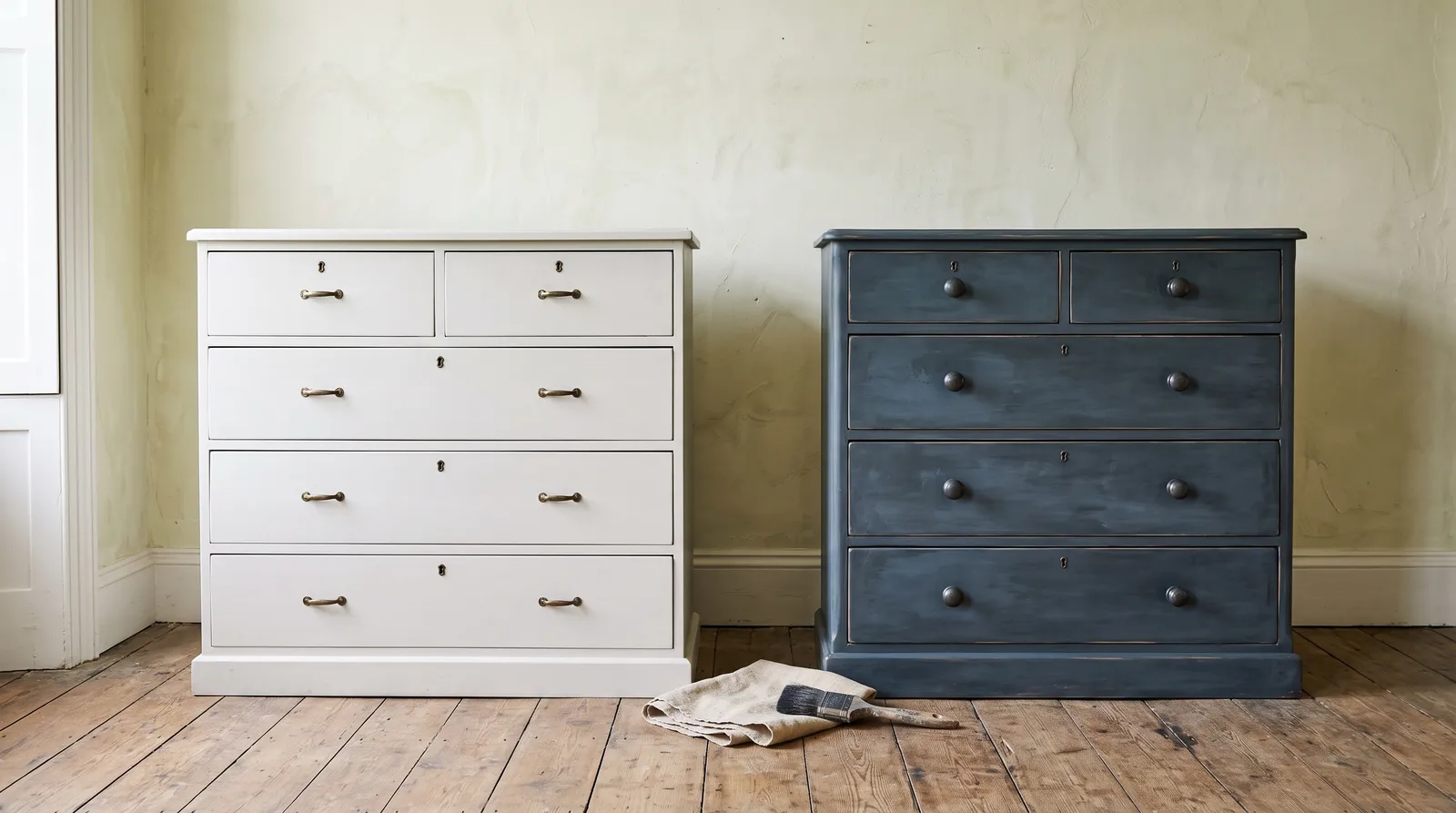
The 30-Second Answer
For most weekend furniture projects, buy Rust-Oleum Chalked. It costs roughly a third of what Annie Sloan does, it’s sitting on a shelf at the store you already drive past, and it lays down flatter and smoother than people expect. Annie Sloan earns her premium when the color is the point. Her pigments have depth that moves with the light instead of sitting still, and the paint carries brushwork the way a hand-painted piece should. A $50 thrift dresser wants Chalked. A piece you’ll still love in the living room in fifteen years wants Annie Sloan.
At a Glance
| Rust-Oleum Chalked | Annie Sloan Chalk Paint | |
|---|---|---|
| Color range | About 20 shades, mostly quiet neutrals | 40-plus shades, designed to intermix |
| Color depth | ✓ clean, flat, literal | ✓✓ layered, shifts through the day |
| Texture | ✓✓ self-levels, very smooth | ✓ thick, holds visible brushwork |
| Coats needed | 2, sometimes 3 on deep tones | 1–2 |
| Coverage | ~150 sq ft per 30 oz can | ~150 sq ft per liter |
| Sealing | Chalked topcoat, matte or satin, $12–16 | Soft Wax or Lacquer, $30–45 |
| Where to buy | Home Depot, Lowe’s, Walmart, Amazon | Stockists and the brand’s own site |
| Price per can | $18–24 | $44–50 |
| Spray version | ✓ 12 oz aerosol | ✗ none |
How to Tell Which One Is on a Piece
If you’ve inherited a painted piece and you’re trying to match it, stand it in raking afternoon light and look sideways along a flat panel. Annie Sloan leaves a soft topography, faint ridges where the brush moved, because the paint is thick and doesn’t fully relax. Rust-Oleum Chalked flattens itself out and reads as an even sheet of dead matte with no direction to it.
Color settles the rest. Annie Sloan’s mid tones carry a warm dustiness even in her greys, and they go softer and browner under a lamp at night. Chalked’s neutrals hold their value more literally. Aged Gray reads the same grey at 9am and 9pm.
Color & Undertone
This is where the two paints separate, and it isn’t close.
Annie Sloan built her palette as a mixing system, and it shows in how the colors sit against wood, brass, and linen. French Linen isn’t a greige so much as a grey with warm earth underneath it, and in a north-facing room it goes cool and stony while the same piece in western afternoon light warms into something almost mushroom. Emperor’s Silk and Napoleonic Blue have that saturated, slightly velvety density you normally only get from expensive wall paint. Put two Annie Sloan colors next to each other and they agree, because they were all drawn from the same handful of pigments.
Rust-Oleum’s range is smaller and more literal. Linen White, Chiffon Cream, Aged Gray, Country Gray, Charcoal, Coastal Blue, Blush Pink, Farmhouse Red. These are competent, pleasant, and easy to live with, and every one of them does exactly what its chip promises. What they don’t do is change character across the day. A Chalked neutral in a dim hallway looks like the chip in a dim hallway. There’s no undertone quietly working underneath.
For a small piece in a corner, that predictability is a gift. For a sideboard that anchors a room, it’s the difference between furniture and a focal point.
Winner: Annie Sloan, by a wide margin.
Texture & Finish
Annie Sloan is thick. Straight from the tin it’s closer to unwhipped cream than to wall paint, and it holds whatever the brush leaves behind. That’s the whole point of the classic look, brush marks and all, and with a round chalk brush you get a piece that reads hand-finished from across the room. Water it down 10 to 20 percent and it becomes a wash you can pull over raw wood so the grain shows through. It’s a flexible paint in the hands of someone who wants texture.
Rust-Oleum Chalked goes on thinner and levels itself. Brush marks soften and mostly vanish as it dries, leaving a smooth, uniform ultra matte that looks closer to a factory finish than a hand-painted one. On a mid-century dresser with clean lines, that’s exactly right. On a curvy French provincial piece, it can look a little anonymous.
The Chalked aerosol deserves its own line, because it changes what’s possible. Wicker chairs, spindled dining chairs, carved mirror frames, lampshade bases. Anything with a hundred little surfaces where a brush leaves puddles in the corners. Annie Sloan has no spray equivalent, and if you’re spraying at volume you’re into furniture paint sprayers and thinning conversations instead.
Winner: Rust-Oleum Chalked for smooth, modern surfaces and anything spindled. Annie Sloan for hand-brushed character.
Coverage & Hide
Annie Sloan covers in one to two coats, including light over dark, which is a real and repeatable advantage. The pigment load is high enough that a single coat of Old White over a walnut-stained dresser usually looks close to finished, with the second coat evening it out rather than rescuing it.
Rust-Oleum Chalked wants two coats as a baseline, and the deeper shades over dark wood sometimes want three. A 30 oz can stretches to roughly 150 square feet per coat, which is about a small dresser, so a mid-size piece in two coats is one can with a little left over.
Run the arithmetic and the price gap narrows without closing. Two cans of Chalked to get a big piece properly covered lands around $40. One liter of Annie Sloan lands around $46 and finishes the same piece with paint left in the tin. On small projects the shelf price wins outright. On a tall armoire it’s nearly a wash.
Winner: Annie Sloan on hide per coat, which is the fairer measure.
Sealing & Topcoat
Both paints are porous when the color coat dries, and both will take a water ring from a coffee mug if you stop there. Sealing isn’t optional on either.
Rust-Oleum’s Chalked Protective Topcoat is a water-based clear in matte or satin, runs $12 to $16, brushes on, dries fast, and doesn’t yellow. It’s the easy path. It flattens the chalky texture very slightly, which nobody notices unless they’re looking for it, and it holds up to a damp wipe-down.
Annie Sloan’s Soft Wax is the better finish and the harder one. Clear wax deepens the color and gives the surface a low, living glow that no water-based clear coat reproduces. Dark Wax dragged into carving and pulled back off the high spots is how those aged, layered pieces get made. It also costs $30 to $35 for 500ml, needs buffing, wants re-waxing every few years, and locks the piece out of any future recoat unless you strip it. Her Chalk Paint Lacquer is the durable alternative at around $45, and it’s what you’d use on a tabletop.
Chalked’s topcoat is easier and cheaper and does 90 percent of the job. Soft Wax does the last 10 percent, and that last 10 percent is why people fall in love with these finishes.
Winner: Annie Sloan on the finish itself. Rust-Oleum on cost and simplicity.
Availability & Cost
A 30 oz can of Chalked runs $18 to $24 at Home Depot, Lowe’s, and Walmart, and the 12 oz spray runs $8 to $12. You can decide to paint a nightstand at 10am and be painting by noon. The Rust-Oleum brand hub covers the rest of the line if you’re mixing products.
Annie Sloan is $44 to $50 a liter, sold through independent stockists and the brand’s own site. No big box carries it. The stockist model has one advantage that gets undersold: you see the real color on a real board, in real daylight, before you buy. Given how much her colors move under different light, that’s worth something.
Winner: Rust-Oleum Chalked, comfortably, on both price and access.
Verdict by Use Case
- Pick Rust-Oleum Chalked if: you’re flipping thrift furniture, painting kids’ pieces that will get repainted in three years, working on anything spindled or woven where the aerosol saves an hour, or you need paint today. Also pick it when you want a smooth modern matte rather than visible brushwork.
- Pick Annie Sloan if: the piece is staying. An heirloom dresser, a dining sideboard, a bedroom armoire that has to hold its own against wood floors and brass hardware. Pick it when you’re layering two colors and sanding through, when you want dark wax in the carving, or when the specific color is the reason you started.
- It’s basically a tie when: the piece is small, the color is a quiet white or soft grey, and it lives somewhere low-traffic. A painted white bookshelf looks the same in both, and one of them costs $20.
Where People Go Wrong
Buying Annie Sloan for a piece that’s getting resold. The margin on a flip doesn’t survive $46 tins plus $32 wax. Save her for what you’re keeping.
Expecting Chalked’s neutrals to have a personality. They’re clean and flat by design. If you wanted a grey that goes green in morning light, that’s a different paint.
Overworking Chalked as it sets. It levels beautifully if you leave it alone and looks dragged if you keep going back into it. Lay it on, tip it off, walk away.
Waxing before you’re sure. Wax is a one-way door. Once it’s on, recoating means stripping, and paint strippers on a piece you just painted is a bad afternoon.
Top Picks by Side
Going with Rust-Oleum Chalked? The best chalk paint round-up covers where Chalked sits against Dixie Belle, Behr, and the rest, plus which topcoats hold up.
Going with Annie Sloan? Same round-up ranks her against the premium field, and the best furniture paint guide weighs chalk finishes against the harder enamels if durability is creeping up your priority list.
Still deciding on chalk paint at all? Start with the chalk paint explainer, then read brush vs spray before you commit to a method on a carved piece.
FAQ
Can I put Annie Sloan Soft Wax over Rust-Oleum Chalked? Yes, and plenty of people do. Chalked is porous enough to drink wax the same way, and clear Soft Wax over it gives a warmer glow than the Chalked topcoat does. Dark Wax settles into carved detail nicely too. One rule: once wax goes on, nothing else sticks to that surface without stripping, so decide before you commit.
Is Rust-Oleum Chalked real chalk paint? It’s a chalk-style ultra matte furniture paint, not the 1990 Annie Sloan formula. In use it behaves the same. It grips raw wood, old varnish, and most slick surfaces without full sanding, it dries dead flat, and it sands back for distressing. The differences are texture and pigment depth, not handling.
How many coats does each one need? Annie Sloan usually covers in one to two, even light over dark. Rust-Oleum Chalked wants two as a rule, and deep shades over dark wood sometimes want three. Budget for that when you compare prices, because the coat count eats into the gap.
Which one is better for kitchen cabinets? Rust-Oleum Chalked with its water-based topcoat, if you’re set on chalk paint. Cabinets get wiped constantly and wax gives up fast there. Annie Sloan can do it with Chalk Paint Lacquer instead of wax, though the system costs more. For doors that take daily hands, look at the cabinet refinishing kits instead.
Do the two brands’ colors work together on one piece? Carefully. Annie Sloan’s palette was designed to intermix, so her colors share a warmth. Rust-Oleum’s shades are cleaner and cooler and don’t always join that family. If you’re layering two colors and sanding through, keep both layers in one brand so the exposed edge reads intentional.
Related
- Best chalk paint, brand by brand →
- Best furniture paint →
- What is chalk paint? →
- Best brushes for furniture →
- Rust-Oleum brand hub →
Buy the sample pot before you buy the liter. Annie Sloan’s colors do more in a room than a chip can show you, and the ones that disappoint are always the ones somebody bought from a photograph.