Paint-and-Primer-in-One vs Separate Primer: When Each Actually Works
The self-priming claim is real on some substrates and a lie on others. A jobsite-tested decision tree by surface, with the four cases where you still need a dedicated primer.

The 30-Second Answer
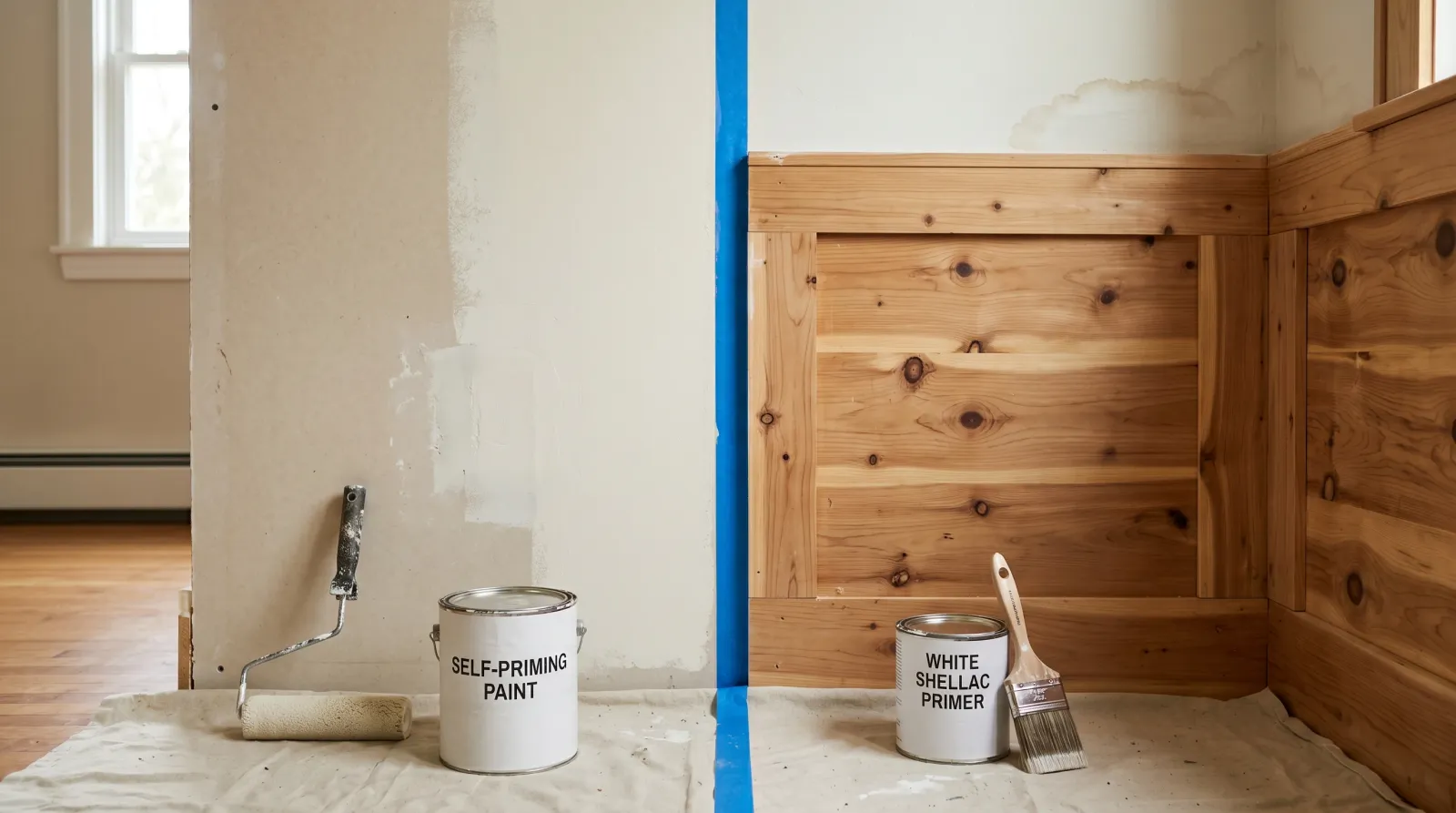
Self-priming paint is a real product. It is also a marketing claim wearing a chemistry coat. On a sound, scuff-sanded latex wall going to a similar color, two coats covers and bonds clean and you save a trip to the store. On bare wood, chalky alkyd siding, glossy oil trim, or a water-stained ceiling, the same can leaves you peeling in eighteen months. The label is selling you the easy case. The substrate decides whether the easy case is the case you actually have.
At a Glance
| Paint-and-Primer-in-One | Separate Primer + Topcoat | |
|---|---|---|
| Sound scuff-sanded latex | ✓✓ | ✓ (overkill) |
| Bare drywall | ✗ (porosity reads through) | ✓✓ (PVA sealer) |
| Bare wood / knots | ✗ (tannin bleed) | ✓✓ (shellac or oil) |
| Glossy oil trim | ✗ (no bite without sand) | ✓✓ (BIN bonds raw) |
| Chalky alkyd siding | ✗ (peels in 18 months) | ✓✓ (alkyd chalk primer) |
| Water-stained drywall | ✗ (ring ghosts back) | ✓✓ (shellac locks it) |
| Two-shade color shift | ✓ (3 coats) | ✓✓ (tinted primer + 2) |
| Trip to the store | 1 can | 2 cans |
| Cost per wall | $$ | $ + $$ |
How to Tell Which Side You Are On
Run two thirty-second tests before you open the can.
Alcohol-cotton wipe. Soak a cotton ball with denatured alcohol, rub a discreet spot for ten seconds. Color transfers, it is latex and you are probably in self-priming territory. No transfer, it is cured oil and you need BIN or a scuff-sand. This is the same test from the oil vs water-based comparison and it is the most useful test on the page.
The wet-finger test for chalk. On exterior siding, drag a wet finger across the surface. White residue on your finger means active chalking. Self-priming exterior paint will not bond through that residue. You need a chalky-surface primer first.
If either test sends you to the primer aisle, the rest of this article tells you which primer.
Adhesion on the Substrate You Actually Have
Self-priming paint is engineered to bond to the surface it was tested on. Sherwin-Williams and Behr both ran their adhesion tests on previously painted latex, lightly abraded, clean. On that surface, the higher solids and acrylic binder package grab and hold. The cans are not lying about that result.
Move to bare cedar and the result reverses. Tannins in the wood migrate up through latex film and show as yellow-brown bleed within weeks. Move to glossy oil trim and the latex has nothing to key into. The film looks bonded the day you finish and lifts in sheets the first time a fingernail catches an edge. Two years on north-facing siding is enough to expose every substrate the can was not tested on.
Winner: Separate primer. Across the substrates that actually fail, dedicated primer chemistry wins every test. Self-priming wins only the case it was built for.
Stain Blocking
There is no stain blocking in a paint-and-primer-in-one can. Manufacturers do not claim there is. The product is a topcoat with adhesion tuning. Water rings on a ceiling ghost right through it. Marker bleeds back. Tannins from cedar and pine surface within a month. Nicotine on a former smoker’s wall shows the second the topcoat cures.
This is the case where you reach for shellac. Zinsser BIN flashes off in 45 minutes, locks down everything water-soluble, and takes any topcoat over it the same hour. For severe water damage and exterior wood, Cover Stain is the call — see the shellac vs oil primer breakdown for the chemistry.
Winner: Separate primer. Decisively. Self-priming does not pretend to compete here.
Coat Count and Labor
The self-priming pitch is “two coats instead of three.” It is sometimes true.
Same-color repaint over sound scuff-sanded latex: two coats of self-priming covers what a separate primer plus two topcoats also covers. You save a coat and a trip.
Two-shade color shift: self-priming runs three coats, sometimes four on saturated colors. A tinted primer plus two topcoats lands at three coats with cleaner hide. The primer carries the color shift cheaper than topcoat does.
Bare anything: self-priming runs four-plus coats and still does not block tannin or seal porosity. The “labor savings” disappears and becomes a labor cost.
Winner: Self-priming on the easy case. Separate primer the moment the substrate or the color shift gets real.
Long-Term Film Integrity
This is the dimension the can label cannot show you because the test happens two years after the photo on the front.
A separate primer pairs a binder optimized for substrate adhesion with a topcoat binder optimized for weathering and wear. The primer is the foundation, the topcoat is the wear layer. Each layer does its job.
A paint-and-primer-in-one tries to do both jobs with one binder package. On the substrate it was tuned for, it holds. On any substrate it was not tuned for, the binder is a compromise and the film fails at the weakest interface first. I see this every spring on chalky exterior siding that homeowners self-primed two years ago. The paint comes off in sheets. The substrate looks like it was never coated.
Winner: Separate primer. Two specialized films beat one generalized film when the substrate is not the easy case.
Cost per Finished Wall
A gallon of premium self-priming paint runs $50-75. A gallon of dedicated primer is $25-40, plus a gallon of topcoat at $40-60.
On the easy case, self-priming is cheaper per finished wall — fewer gallons, same coverage. On any case that requires three or four coats of self-priming to hide or bond, the separate primer plus two topcoats wins on math and ends with a better film.
Winner: Self-priming on the easy case. Separate primer when the substrate forces extra coats.
Verdict by Use Case
- Pick paint-and-primer-in-one if: the surface is sound, previously painted latex; you have scuff-sanded with 220 grit; the color shift is mild; there are no stains, no chalking, no glossy oil; you want to make one trip to the store and finish the room in a weekend.
- Pick a separate primer if: the substrate is bare wood, bare drywall, glossy oil trim, chalky siding, or anything with a water ring, knot, or tannin bleed; the color shift is aggressive (white over deep blue, anything over red); you are recoating an exterior in zones 5 or 6 where freeze-thaw cycles will find every weak bond line.
- It is a tie when: the wall is sound, scuff-sanded, going one or two shades darker, and you happen to have a tinted primer on the truck. Either path gets you there in three coats. Pick on whichever can is open.
Top Picks by Side
Going with self-priming? The category leaders are Behr Marquee and SW Cashmere on the interior side, Behr Marquee Exterior on the outside. Match the can to the substrate it was built for and the system works. See the best interior paint round-up for the verified picks.
Going with separate primer? Match the primer to the problem. Bare drywall takes PVA. Bare wood takes a stain-blocking primer. Glossy oil takes shellac. Chalky siding takes an alkyd chalk primer. The full breakdown is in the primer round-up.