Estate Eggshell vs Modern Eggshell: Which Farrow & Ball Finish Does Your Woodwork Need?
Estate Eggshell vs Modern Eggshell on sheen, washability, cure time, price per liter, and color depth — plus the rename nobody warned you about. A plain-English verdict per surface.

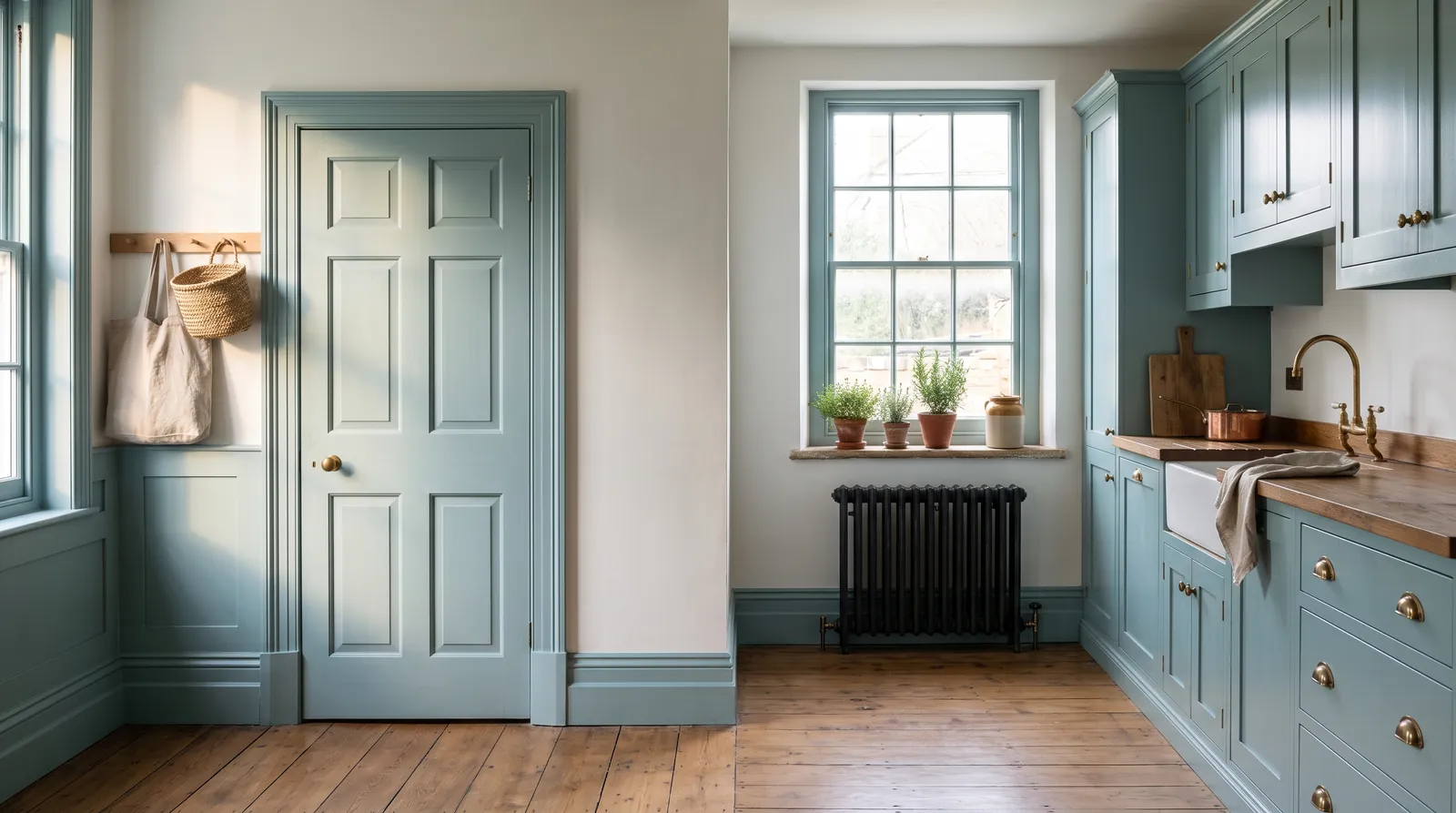
The 30-Second Answer
Pick the Estate finish (now sold as Flat Eggshell) at 20 percent sheen for baseboards, casings, doors, built-ins, and painted furniture — anywhere you want the woodwork to sit soft and quiet. Pick Modern Eggshell at 40 percent for radiators and metal, floors, stairs, and kitchen cabinets — anywhere the surface gets grabbed, kicked, or wiped every day.
Okay, so here’s the first thing you need to know before anything else: Estate Eggshell isn’t on the shelf anymore. Farrow & Ball retired it and replaced it with Flat Eggshell at the end of 2025. Same 20 percent sheen, same soft look, better formula underneath. If your search brought you here looking for Estate Eggshell, Flat Eggshell is the can you’re actually deciding about, and it’s the better version of the thing you wanted.
With that out of the way, the comparison is easier than the internet makes it sound. Both finishes come out of the same Farrow & Ball color archive. Same pigments, same depth, roughly the same price, roughly the same coverage. What changes is the sheen — how much light the dried surface throws back at you — and the toughness that comes with it. That’s the whole decision.
First, the Rename, Because It Changes Your Answer
Farrow & Ball had a known problem with Estate Eggshell, and it wasn’t the look. It was the cure. Cure means the point where the paint has fully hardened, which is different from dry — a surface can feel dry to your hand in two hours and still be soft enough to dent for weeks. Estate Eggshell stayed soft for close to four weeks. On a bookcase, fine. On a kitchen cabinet door people open forty times a day, not fine.
So F&B reformulated it. Flat Eggshell keeps the 20 percent sheen and the same applied look — the brand says the finished result is virtually indistinguishable — but it hardens in about two weeks instead of nearly four, and it’s now Class 1 scrubbable, which is the top washability rating a paint film gets. It’s also rated for floors and for kitchen and bathroom cabinets, jobs the old soft cure made risky.
Why this matters for your decision: the durability gap between the two eggshells used to be huge, and it isn’t anymore. The old advice — “use Modern if it needs to survive anything” — was written about a paint that no longer exists. The honest 2026 version is narrower and mostly about sheen. Our full Flat Eggshell review walks through exactly what changed.
If you have old Estate Eggshell stock in the garage, use it up on furniture and low-traffic trim and respect the long cure. Don’t put it on cabinets.
At a Glance
| Estate Eggshell (now Flat Eggshell) | Modern Eggshell | |
|---|---|---|
| Sheen | 20% — soft low satin | ~40% — brighter satin |
| Price (US gal) | $120–155 | $135–150 |
| Price per liter | ~$32–41 | ~$36–40 |
| Coverage | ~480 sq ft / gal per coat | ~480 sq ft / gal per coat |
| Touch dry / recoat | ~2h / ~4h | ~2h / ~4h |
| Full cure | ~2 weeks (old Estate: ~4) | Several weeks |
| Washability | Class 1 scrubbable, scuff and stain resistant | Scrubbable, scuff and stain resistant |
| Rated surfaces | Wood, metal, concrete, floors, kitchen and bath cabinets | Wood, trim, cabinets, doors, metal, radiators, floors, stairs, concrete |
| Brushing | Lays off cleanly; soft sheen forgives texture | Holds more of the stroke; roll or spray for a smooth face |
| Touch-ups | Blend well inside the cure window | Blend a little better long-term |
| Yellowing on whites | Holds tone | Built not to yellow |
| Sizes | 750ml, 2.5L, 5L | Sample pot, gallon, 5L |
| Our rating | 4.1 / 5 | 4.2 / 5 |
The Sheen Difference, in Plain English
Sheen is a percentage of how much light bounces off the dried paint instead of soaking into it. Twenty percent is low. Forty percent is about double that, which sounds enormous and in practice looks like the difference between a door that glows and a door that shines.
Stand in a room at four in the afternoon with the sun coming in sideways. That raking light is the honest test. A baseboard in the 20 percent finish takes the light and holds it — you see color first, surface second. The same baseboard at 40 percent gives you a clear highlight along the top edge. Neither one is wrong. One recedes, one announces itself.
Where the 40 percent genuinely earns its keep is metal. A radiator or a run of old cast-iron pipe painted in a chalky low-sheen finish can look dusty and cheap, like it needs wiping. Modern Eggshell’s satin makes the same radiator read warm and solid. That’s not a preference thing, that’s just what a matte film does on metal.
Where 20 percent wins is anywhere the woodwork is meant to disappear into the wall color. If you’re painting your baseboards the same color as your walls — and a lot of F&B rooms do exactly that — the gentler sheen step keeps it reading as one continuous move instead of two slightly different greys arguing with each other. Bump the trim to 40 percent and you’ve drawn a line around the room whether you meant to or not.
If sheen percentages still feel abstract, our sheen guide shows the whole ladder from matte to gloss with what each step actually looks like on a wall.
Winner: it’s a tie, and it’s the whole decision. Quiet woodwork, 20 percent. Metal and anything that should look solid, 40 percent.
Washability and Toughness
Here’s where the old advice has gone stale.
Modern Eggshell is the durability pick in the line and always has been. It’s scrubbable, scuff-resistant, and stain-resistant, and it’s the one F&B specifies for stairs and floors. A damp cloth with mild soap lifts fingerprints from around cabinet pulls and grease splashes near a stove without polishing the surface dull. We scored it 9 out of 10 on washability in our Modern Eggshell review.
Flat Eggshell now scores 8 out of 10, and it’s Class 1 scrubbable, which is the highest tier there is. That’s a real change. The finish that used to be the precious one you kept away from hands is now one you can wipe down.
So what’s actually left between them? Three things:
- Metal and stairs. Modern is the specified finish for radiators, pipes, and stair treads. Flat is rated for floors, but Modern is the one built for the hardest knocks.
- Touch-ups over time. A satin sheen forgives a spot repair better. Dab a chip on a Modern Eggshell door edge and it blends. Do the same on a fully cured Flat Eggshell surface and the repair can sit a shade flatter than the surround.
- Cure patience. Flat now hardens in about two weeks. Modern stays soft for several. On a floor or a stair, that difference is real — walk it too early and you’ll print it. There’s more on why dry and hard aren’t the same thing in our dry time vs cure time primer.
Winner: Modern Eggshell, but by much less than it used to.
Price Per Gallon and Per Liter
Nobody’s saving money here, and that’s worth saying plainly.
Flat Eggshell runs about $120 to $155 a US gallon. Modern Eggshell runs about $135 to $150. A US gallon is 3.8 liters, so you’re at roughly $32 to $41 a liter for either one. Coverage is the same on both, around 480 square feet per gallon per coat, so the cost of doing a given surface is effectively identical.
Two things that catch people out. First, the primer. Neither finish is self-priming on bare wood, fresh metal, or a big color jump, and F&B sells its primer and undercoat in light, mid, and dark tones so the base color is already close to your topcoat. Skip that and a deep color like Hague Blue eats a third coat to read evenly. Budget the primer as a real line item, not an afterthought.
Second, availability. F&B isn’t at Home Depot and almost never discounts. You order direct or from an authorized stockist, which means no 7pm run for one more quart. Order a bit more than you think, and order sample pots before you commit to a gallon.
Winner: tie. The price gap between the two is noise.
Color Depth — Does the Sheen Change the Color?
Yes, a little, and this surprises people who assume a color is a color.
Both finishes carry the same F&B pigment load, which is the actual reason the brand costs what it costs. But sheen changes how that pigment reads. A higher-sheen surface holds an undertone more honestly — Modern Eggshell’s satin lets a complicated color like Pigeon keep its quiet grey-green instead of flattening out. A very low sheen absorbs more light, which is what gives Flat Eggshell that soft drape everyone describes on woodwork, but it can also mute a saturated color half a step.
The other thing sheen does is chase the sun. A 40 percent finish in a south- or west-facing room can read almost lacquered for an hour in late-afternoon light, and half a tone warmer than it did at noon. In a north-facing room, the same door stays cool and deep all day. The 20 percent finish shifts far less.
Practical version: paint a sample door or a big piece of card in your actual color, prop it where the real surface will live, and look at it at the hour you actually use the room. If it goes glossier than you like at 5pm, that’s your answer for the lower sheen.
Winner: Modern Eggshell on undertone honesty. Flat Eggshell on softness.
The UK and US Naming Confusion
This part trips up almost every American shopper, so let’s untangle it.
In the US, eggshell is a wall sheen. It’s the step above flat you’d roll onto a bedroom, somewhere around 10 to 25 percent depending on the brand. At Farrow & Ball, an English company, eggshell means something completely different: it’s the finish for wood, metal, and concrete. The wall paints are the emulsions — Estate Emulsion for quiet rooms, Modern Emulsion for kitchens and hallways.
So if you walk into a showroom and ask for eggshell for your living room walls, you’ll be handed a trim paint. Ask for emulsion for walls, eggshell for woodwork.
The second half of the confusion is the Estate and Modern prefixes. They aren’t sheen names. They’re ranges. Estate means the traditional, softer, more period-correct version. Modern means the tougher, washable version. That logic runs through the whole line: Estate Emulsion is the delicate matte wall paint, Modern Emulsion is the scrubbable one. Once you see it as two families rather than four unrelated products, the whole F&B line-up makes sense.
And one more: an American reading “Modern Eggshell” expects something close to US eggshell sheen. It isn’t. At 40 percent it’s what most US brands would call satin. If you’re cross-shopping sheens between brands, our eggshell vs satin comparison covers what those labels mean where you live.
What Each One Is Like to Brush
Don’t skip this — it’s the part that shows up in the finished result.
Flat Eggshell is the friendlier of the two under a brush. We scored its workability 8 out of 10. It lays off cleanly with a good 2-inch sash brush, and because the sheen is low, a small lap mark or a bit of brush texture doesn’t flash the way it would on something shinier. For a first-timer painting a set of baseboards, this is the forgiving one.
Modern Eggshell scored 6 out of 10, and the reason is that it doesn’t self-level. Self-leveling means the paint flows out as it dries so the brush marks melt away. A waterborne alkyd like Benjamin Moore Advance does that beautifully. Modern Eggshell holds more of the stroke, and up close in raking light you’ll see fine texture. The fix is a fine microfiber roller or a sprayer, not a brush and optimism. If you’re doing kitchen cabinets by hand and expecting a factory face, this is the honest warning.
Winner: Flat Eggshell for brush work. Modern Eggshell only if you can roll or spray it.
When Neither One Is the Right Answer
Three situations where the honest advice is to spend your money elsewhere.
You want a factory-smooth brushed cabinet face. Benjamin Moore Advance at $80 to $95 a gallon self-levels like oil, cures hard enough for a working kitchen, and costs roughly half. You give up the exact F&B pigments. If the color you fell for is a soft neutral, a BM color-match gets you most of the way. For the full field, see our best kitchen cabinet paint round-up.
You’re doing a whole house of woodwork. At $32 to $41 a liter, trim for an entire house is a genuinely large number. F&B earns its money on a few surfaces you look at — a paneled door, a run of built-ins, a kitchen island. Our best interior trim paint round-up covers what to use on the other twelve rooms.
You want a mirror-gloss statement door. Neither eggshell gets you there. That’s Farrow & Ball Full Gloss at around 95 percent sheen, and it demands flawless prep.
The Verdict by Surface
- Baseboards, casings, and window trim: Flat Eggshell. The gentle sheen step from wall to trim is the F&B look, and it brushes more forgivingly.
- Interior doors: either. Flat if the door should sit quiet, Modern if it’s a grabby door in a busy hallway.
- Kitchen cabinets: Modern Eggshell if you can roll or spray it and want the harder, brighter face. Flat Eggshell if you want the soft matte cabinet look and will respect the two-week cure. Both are rated for it now.
- Radiators, pipes, and interior metal: Modern Eggshell. Not close.
- Floors and stairs: Modern Eggshell, and give it the full cure before you walk it.
- Painted furniture, dressers, bookcases: Flat Eggshell. The drape is the whole point on a piece you look at.
- Bathroom trim and vanities: Modern Eggshell for the damp and the wiping.
- Front doors and exterior joinery: neither — use F&B Exterior Eggshell.
Top Picks by Side
Going with the Estate finish? Buy Flat Eggshell, not old Estate stock — the reformulation fixed the one honest reason to say no. Our Flat Eggshell review has the full spec sheet, sub-scores, and where it falls down. Pair it with the matched-tone F&B primer on bare or knotty wood.
Going with Modern Eggshell? The Modern Eggshell review covers the self-leveling weakness in detail and what to use instead if a brushed face matters more than the color. If you’re cabinet-shopping and open to other brands, start with best kitchen cabinet paint.
Not sure the F&B premium is worth it at all? That’s a fair question and we answer it honestly on the Farrow & Ball brand hub, including where a Benjamin Moore color-match is genuinely close enough.
FAQ
What is the difference between Estate Eggshell and Modern Eggshell? Sheen, mostly. Estate sits at 20 percent — a soft, low satin that lets woodwork recede. Modern sits at about 40 percent, a brighter satin with a harder film. Same color deck, same coverage, same price bracket. Use the low sheen on trim, doors, and furniture; the higher sheen on metal, floors, stairs, and busy cabinets.
Is Estate Eggshell discontinued? Yes. Farrow & Ball replaced it with Flat Eggshell at the end of 2025 — same 20 percent sheen and virtually the same applied look, but it cures in about two weeks instead of nearly four and is now Class 1 scrubbable.
Is Modern Eggshell more durable than Estate Eggshell? It’s still the tougher film, and it’s the specified choice for radiators, metal, and stairs. But the reformulated Flat Eggshell is Class 1 scrubbable and rated for floors and cabinets, so the gap is much narrower than the old advice suggests.
How much does Farrow & Ball eggshell cost per liter? Roughly $32 to $41 a liter for either finish. Flat Eggshell runs $120 to $155 a US gallon, Modern Eggshell $135 to $150, and a US gallon is 3.8 liters.
Why is it called eggshell if it’s not a wall paint? Because Farrow & Ball is English. At F&B, eggshell means the wood-and-metal finish and emulsion means the wall paint. In the US, eggshell is a wall sheen. Ask for emulsion for walls, eggshell for woodwork.
Related
- Farrow & Ball Flat Eggshell (formerly Estate Eggshell) — full review
- Farrow & Ball Modern Eggshell — full review
- Farrow & Ball brand hub and full line-up
- Eggshell vs satin: which sheen for which surface
- The sheen guide, matte to gloss
- Best interior trim paint, tested and ranked
- Best kitchen cabinet paint
Ask a Question