Wayfinding Paint for Facilities: Specifier's Guide (2026)
Wayfinding paint specified by zone: floor markings, OSHA safety color-coding, and anti-slip walkway coatings compared by DFT, COF, VOC, and dry-to-traffic windows for warehouses and plants.

Disclosure: Affiliate links to retailers and manufacturer-direct programs. Recommendations are spec-driven, not commission-driven.
Use Case
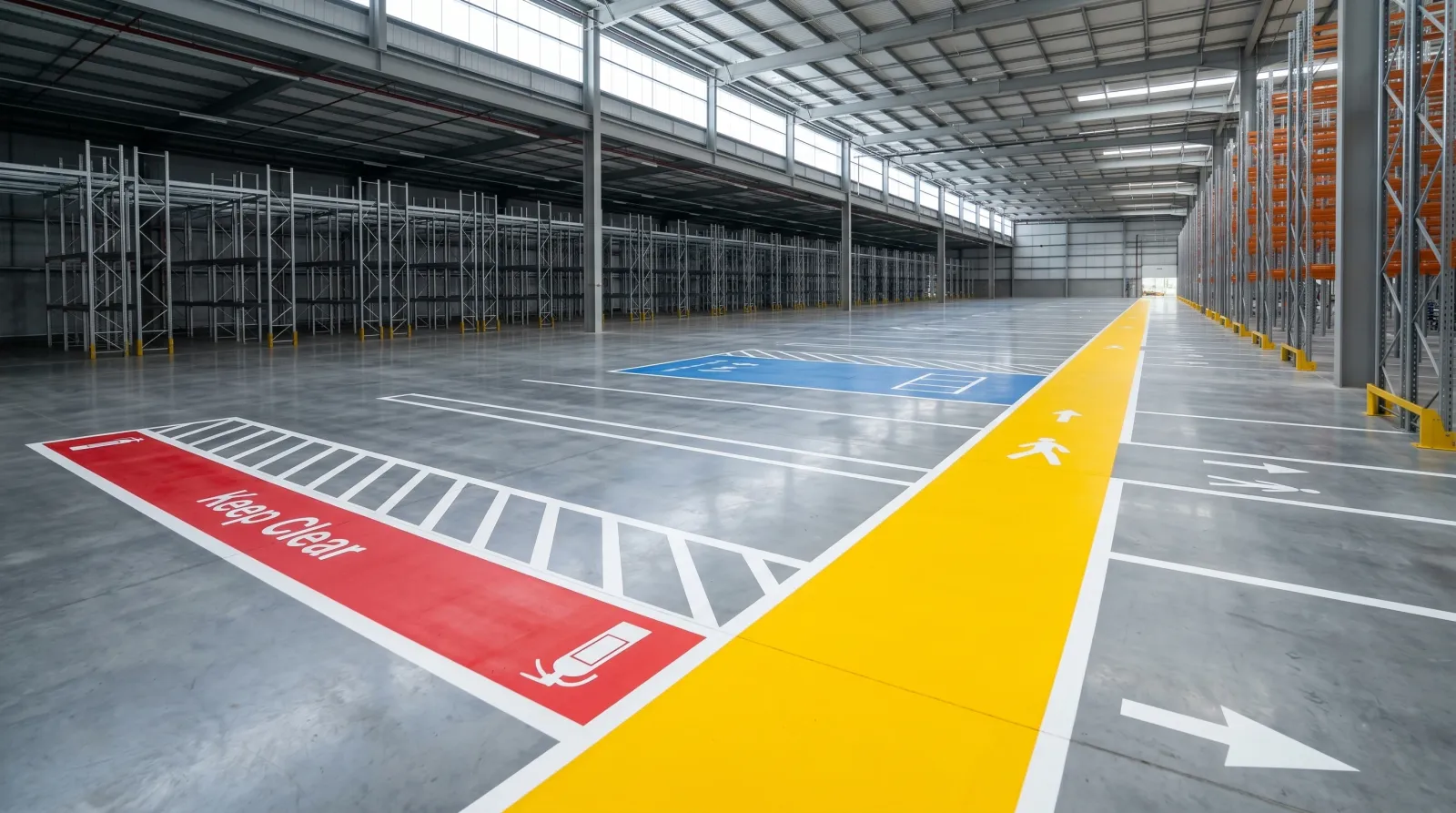
Wayfinding paint is the floor and surface marking system that tells people and equipment where to go, where to stop, and what to keep clear. In a warehouse or plant it is the yellow pedestrian lane that separates foot traffic from forklifts, the red keep-clear field around an eye-wash station, the blue staging square for inbound pallets, and the diagonal hatch in front of an electrical panel. The asset is the floor, but the function is safety compliance and traffic control. A facility that lets these lines fade is exposed at the next OSHA walkaround under 1910.22 and at the next insurance audit, and it loses the visual discipline that a 5S program depends on.
The environment punishes a marking film. Forklift tires put point loads and turning shear on the same six-inch line thousands of times a week. Pallet jacks scrape it. Floor scrubbers abrade it with brushes and detergent. In freezer-adjacent and wash-down zones the line sees thermal cycling and standing water. Service life tracks directly to traffic and chemistry: a waterborne acrylic line in a main forklift aisle survives 12 to 24 months, the same paint in a low-traffic office or breakroom corridor holds 4 to 6 years, and an epoxy or polyaspartic marking system in a heavy aisle runs 3 to 7 years before a recoat.
The spec writer’s job is to match chemistry to zone, not to paint the whole floor with one product. The yellow lane in a battery-charging room sees acid and needs an epoxy. The same color in a back office needs nothing more than acrylic. Get the zone-to-system map right and the rest of the spec, color code and DFT and cure window, falls into place.
Zone-to-System Recommendation Matrix
A distribution center is not one floor. Map the system to the duty the zone actually sees.
| Zone | Duty | Recommended system | Why |
|---|---|---|---|
| Main forklift aisles | Heavy point load, turning shear | System B epoxy or System C polyaspartic marking | Acrylic abrades off the turn radius inside a year |
| Pedestrian walkways | Foot traffic, slip risk when wet | System A acrylic with broadcast anti-slip in the lane | Needs COF, not high build |
| Battery-charging / chem areas | Acid, solvent splash | System B epoxy marking | Acrylic chalks and lifts under acid |
| Loading-dock edges | Salt, water, hot tire | System B epoxy, red/yellow | UV and thaw chloride degrade waterborne acrylic |
| Office / breakroom corridors | Light foot only | System A acrylic | Anything heavier is overspec’d |
| Cooler / freezer floors | Thermal cycling, low cure temp | Low-temp polyaspartic or MMA marking | Waterborne won’t coalesce below 50°F |
Spec Requirements
| Spec | Value |
|---|---|
| Dry film thickness (DFT) | 3–4 mils per coat, 6–8 mils total (acrylic); 8–12 mils total (epoxy marking system); 8–20 mils (broadcast anti-slip walkway) |
| Coverage @ DFT | 300–400 sq ft/gal at one acrylic coat; 100–150 lf of 4-in line per gallon |
| VOC | under 100 g/L waterborne acrylic; under 250 g/L waterborne epoxy; under 340–490 g/L solvent-borne, restricted under SCAQMD Rule 1113 and the thirteen OTC states |
| Standards | ASTM D2047 (static COF), ASTM D4060 (Taber abrasion), ASTM D4541 / D7234 (pull-off adhesion), OSHA 1910.144 + ANSI Z535.1 (color) |
| Substrate prep | Concrete to ICRI CSP 2–3 by grind or shotblast; deglossed existing coating; SSPC-SP1 solvent-clean to remove oil before any profile |
| Moisture vapor emission ceiling | under 3 lb / 1,000 sq ft / 24 hr (ASTM F1869 calcium chloride) or under 75% RH (ASTM F2170) before epoxy |
| Service temp | 40–100°F for waterborne after cure; polyaspartic and MMA rated for freezer-floor service |
| Cure to service | Foot 1–2 hr / forklift 24–72 hr (acrylic); foot 8–12 hr / forklift 3–7 days (epoxy); foot 2–4 hr / full next day (polyaspartic) |
| Dew point / humidity | Substrate at least 5°F above dew point; relative humidity at or below 85% during application and cure |
| Slip resistance | Static COF at or above 0.5 wet/dry (ANSI A1264.2) in any walkway or ramp marked surface |
The moisture-vapor test is the line item most facility managers skip and most epoxy failures trace back to. Concrete passes water vapor upward from the slab and the water table beneath it. Coat an epoxy marking over a slab emitting more than 3 lb of moisture and the vapor pressure builds under the film until it disbonds in blisters, usually inside the first season. Acrylic floor paint is breathable enough to tolerate a damp slab, which is one practical reason a low-traffic corridor can stay on acrylic. Epoxy cannot, so the calcium-chloride or in-situ RH test is mandatory before any epoxy marking goes down on a slab without a known vapor barrier.
ICRI CSP profile drives both adhesion and cost. CSP 2, the profile of a light diamond grind, is the floor for acrylic and most epoxy marking work. CSP 3 from a heavier grind or light shotblast is the spec for epoxy in heavy forklift aisles where the bond has to resist turning shear. Going to CSP 4 or higher over-profiles a marking line, wastes abrasive, and leaves a texture that holds dirt. The spec calls for the profile the chemistry needs and no more.
System Chemistry Compared
Pick the chemistry per zone before you pick the brand.
| Class | Pot life | Recoat window | Service temp | UV stability | $/sq ft band (line area) | Best for |
|---|---|---|---|---|---|---|
| Waterborne acrylic | N/A (single-component) | 1–2 hr | 40–100°F | Moderate (chalks outdoors) | $0.40–0.90 | General aisles, offices, pedestrian lanes |
| Waterborne epoxy | 2–4 hr | 8–16 hr | 50–100°F | Low (ambers in sun) | $1.20–2.50 | Heavy aisles, chem and battery areas |
| Polyaspartic | 15–45 min | 1–3 hr | down to 0°F | High (no amber) | $2.00–3.50 | Fast-turn aisles, coolers, no-shutdown jobs |
| MMA (methyl methacrylate) | 10–20 min | 30–60 min | down to -20°F | High | $3.00–5.00 | Freezers, hot-fast turnarounds |
Waterborne acrylic is the default for general wayfinding. It is single-component, low odor, low VOC, foot-traffic-ready in an hour, and forgiving of a damp slab. Its weakness is abrasion: forklift turning shear grinds it off a heavy aisle inside 12 to 24 months. For office corridors, breakroom paths, and pedestrian lanes that see foot traffic and the occasional pallet jack, acrylic is the right answer and anything heavier wastes budget.
Epoxy buys abrasion and chemical resistance at the cost of cure time and a hard moisture limit. It is the spec for battery-charging rooms, chemical-handling zones, and main forklift aisles that have to hold a crisp line for years. The trade is a 3-to-7-day return to full service and the mandatory moisture test.
Polyaspartic is the chemistry that solves the shutdown problem. It returns an aisle to foot traffic in 2 to 4 hours and to full forklift service the next day, cures below freezing, and holds color under UV without ambering. The penalty is a 15-to-45-minute pot life that forces small batches and a trained crew. For a 24/7 distribution center that cannot close an aisle for a week, the polyaspartic premium pays for itself in avoided downtime. The deeper trade-offs between these floor chemistries are laid out in the polyaspartic floor coatings specifier guide.
Recommended Systems
System A — Sherwin-Williams ArmorSeal Tread-Plex (Waterborne Acrylic)
The general-wayfinding standard. Single-component waterborne acrylic, low VOC, fast foot-traffic return, OSHA safety colors. Right for office corridors, pedestrian lanes, light-traffic aisles, and any in-house crew with a striping machine.
| Layer | Product | DFT |
|---|---|---|
| Surface prep | Shotblast or diamond-grind to ICRI CSP 2–3; degloss aged coatings; solvent-wipe | — |
| Marking coat 1 | ArmorSeal Tread-Plex waterborne acrylic (safety colors) | 3–4 mils |
| Marking coat 2 | Tread-Plex second pass on high-traffic lines | 3–4 mils |
| Total | 6–8 mils |
Sherwin-Williams ArmorSeal Tread-Plex product page · Search on Amazon
Two coats matter on any line a forklift crosses. A single 3-mil pass looks finished on day one and wears through to the concrete at the crossing point within a season. Broadcast a fine anti-slip aggregate into the wet film on pedestrian-lane and ramp lines to hold the COF above 0.5 when the floor is wet.
System B — Rust-Oleum Concrete Saver Safety Marking (Waterborne Epoxy)
Two-component epoxy marking for heavy aisles, battery-charging rooms, and chemical zones. Abrasion and chemical resistance that acrylic cannot match, with the moisture and cure constraints that come with epoxy.
| Layer | Product | DFT |
|---|---|---|
| Surface prep | Etch or grind to ICRI CSP 2; verify MVE under 3 lb / 1,000 sq ft / 24 hr | — |
| Primer (bare concrete) | Concrete Saver 5100 System epoxy primer | 4–6 mils |
| Marking coat | Concrete Saver Safety Marking epoxy (yellow / red / blue / white) | 4–6 mils |
| Total | 8–12 mils |
Rust-Oleum Concrete Saver product page · Search on Amazon
Pot life is the field discipline that makes or breaks this system. Once the two components mix, the clock runs 2 to 4 hours and viscosity climbs the whole time. Mix only what a crew lays in 90 minutes. Epoxy ambers under UV, so reserve it for interior floors; a yellow epoxy line by a daylit dock door shifts toward buff within a year.
System C — PPG Aexcel / Amercoat Floor Marking (Waterborne With Anti-Slip Walkway Build)
PPG’s industrial floor and pavement marking line, used where the same crew handles both interior wayfinding and exterior dock striping. Strong on the anti-slip walkway build because the broadcast-aggregate plus urethane lock-coat sequence ports straight from PPG’s deck-coating practice.
| Layer | Product | DFT |
|---|---|---|
| Surface prep | Grind to ICRI CSP 2–3; spot-prime oil-contaminated areas | — |
| Marking coat 1 | Aexcel waterborne floor-marking paint; broadcast aggregate in walkway lanes | 4–6 mils |
| Anti-slip topcoat (walkways) | Clear urethane lock-coat over broadcast aggregate | 3–4 mils |
| Total | 8–10 mils (walkway zones) |
PPG Protective & Marine products · Search on Amazon
PPG industrial distribution is thinner in the Mountain West than in the Midwest and Mid-Atlantic. Verify local 5-gal supply before writing Aexcel into a project with a hard occupancy date. The anti-slip topcoat is what separates a walkway line from a slip hazard; specify it on every marked pedestrian lane and ramp.
Systems Compared
| System | Total DFT | $/sq ft installed (line area) | Service life | Best for |
|---|---|---|---|---|
| A — SW Tread-Plex acrylic | 6–8 mils | $0.40–0.90 | 1–2 yr heavy aisle / 4–6 yr light | General aisles, offices, pedestrian lanes |
| B — Rust-Oleum epoxy | 8–12 mils | $1.20–2.50 | 3–5 yr | Heavy aisles, battery and chem zones |
| C — PPG waterborne + anti-slip | 8–10 mils | $1.50–3.00 | 3–5 yr | Walkways, ramps, mixed interior/exterior |
Read service life as a function of traffic, not the can. The same acrylic that lasts five years in a breakroom corridor lasts twelve months on a turn radius in the main forklift aisle. Over a 10-year horizon, an epoxy aisle line recoated twice often costs less total than an acrylic line recoated five or six times, once you load each recoat’s labor and the cost of closing the aisle. Run the total-cost-of-ownership math per zone before defaulting the whole floor to the cheapest can.
Application & Contractor Path
In-house maintenance can handle System A on a sound, sealed floor. A walk-behind striping machine, a chalk-line layout, and a long weekend cover a small facility. The work the crew has to respect is layout and prep: a crooked or under-prepped line is worse than no line because it reads as neglect.
Systems B and C on bare or contaminated concrete are contractor work. Specify a contractor with SSPC-QP1 certification (industrial coating application over complex structures) or the marking manufacturer’s certified-applicator credential. The skills that justify the contractor are the moisture-vapor test, the ICRI profile call, pot-life management on the epoxy and polyaspartic, and broadcast-aggregate technique on the anti-slip lanes. None of those forgive a first-timer.
Route the spec through the manufacturer rep. Sherwin-Williams ProIndustrial, Rust-Oleum Industrial, and PPG Protective & Marine all field reps who will pull the right product data sheet, confirm primer compatibility with your existing floor, and often run a free adhesion mock-up on your slab. That mock-up is the cheapest insurance on the project. For the underlying floor system that these lines often sit on, see the warehouse epoxy floor coatings guide, and for the substrate basics, the concrete floor prep and paint guide.
Failure Modes & How to Prevent Them
Lines worn through on the turn radius. The straight runs look fine but the paint is gone to bare concrete where forklifts pivot. Cause is under-spec chemistry or single-coat acrylic in a heavy aisle. Prevention is matching the zone: epoxy or polyaspartic in turning aisles, two coats minimum, and a recoat schedule keyed to traffic rather than calendar.
Disbondment in blisters. The film lifts in bubbles over an area, peels in sheets when scraped, and the underside is damp. Cause is epoxy over a slab emitting too much moisture vapor with no test run first. Prevention is the ASTM F1869 calcium-chloride or F2170 in-situ RH test before any epoxy, and an acrylic or a vapor-barrier primer where the slab reads wet.
Delamination off a glossy host coating. A marking line laid over intact cure-and-seal or aged epoxy peels off in long ribbons under traffic. Cause is no mechanical bite. Prevention is to degloss the line path by grinding or sanding to a matte profile and to confirm adhesion with an ASTM D4541 pull-off or a crosshatch tape pull before committing the whole floor.
The painted line becomes the slip hazard. A glossy marking lane stays slick when wet and a worker goes down on the very lane meant to keep them safe. Cause is high-gloss marking paint with no anti-slip in a walkway. Prevention is broadcast aggregate or an anti-slip additive in every pedestrian lane and ramp, verified to a static COF at or above 0.5 wet (ASTM D2047). The anti-slip walkway coating systems guide covers the aggregate and lock-coat detail.
Color drift and chalking. Yellow shifts to buff, red goes pink, and a finger swipe comes up with pigment. On waterborne acrylic outdoors this is UV chalking; on epoxy near a daylit door it is ambering. Prevention is reserving epoxy for interior runs, putting a UV-stable polyaspartic or urethane where daylight hits, and re-specifying off-spec consumer floor paint out of the bid. For the chalking mechanism on exterior films, see the chalking paint fix.
Where to Buy / Spec
| Channel | Best for |
|---|---|
| Manufacturer-direct (SW ArmorSeal, Rust-Oleum Concrete Saver, PPG PMC) | Spec’d projects, rep support, primer-compatibility confirmation |
| Industrial distributor (Grainger, Fastenal, local coatings dealer) | Bulk 5-gal marking paint, aggregate, striping consumables |
| Pro retail (Sherwin-Williams stores) | Local 5-gal pickup, contractor pricing, color-match safety colors |
| Amazon Business | Aerosol and small-batch stocking for touch-ups and small floors |