Secondary Containment Coatings: Specifier's Guide (2026)
Chemical-resistant secondary containment coating systems compared by DFT, immersion rating, and EPA SPCC compliance. ICRI CSP prep, crack bridging, and the contractor path.

Disclosure: Affiliate links to retailers and manufacturer-direct programs. Recommendations are spec-driven, not commission-driven.
Use Case
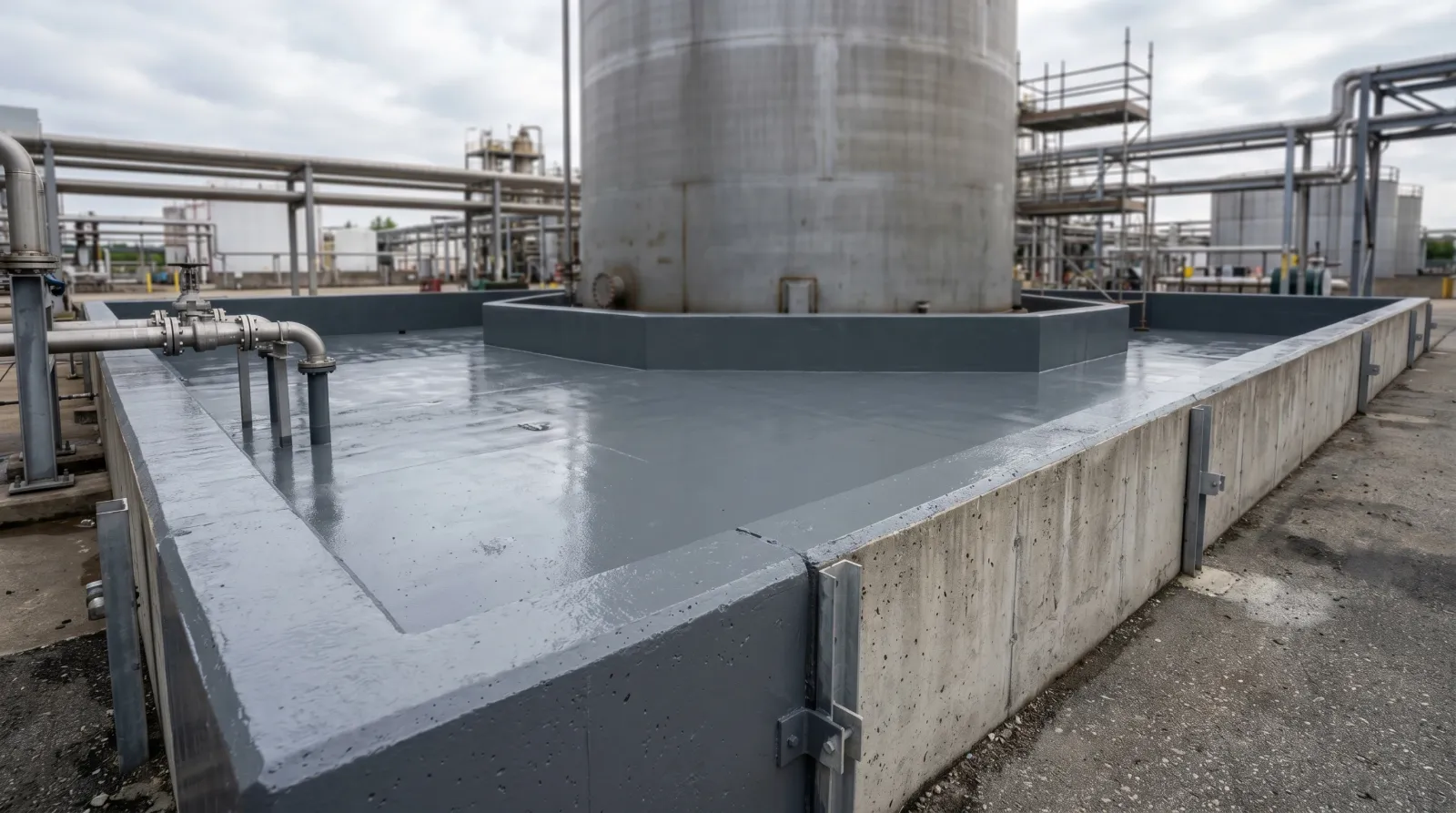
A secondary containment coating is the lining that turns a concrete berm, dike, sump, or tank farm floor into a leak-proof basin. The asset is the containment structure built around bulk storage: an above-ground tank holding diesel, a chemical day-tank, a drum-storage curb, a transformer pad, a loading rack sump. When the primary vessel leaks, the containment has to hold the spill long enough to clean it up without the chemical reaching soil or storm drains. Bare concrete will not do that. Concrete is porous, it cracks at every cold joint, and most stored chemicals either soak through it or attack the cement matrix directly.
The spec gets written wherever EPA’s SPCC rule (40 CFR 112) or a state equivalent applies: petroleum bulk storage, chemical processing, water treatment, power generation, manufacturing with hazardous-liquid inventory. The rule requires the containment to hold the largest single tank volume plus freeboard for precipitation, and to be “sufficiently impervious” to contain a release until cleanup. The coating is how a porous slab becomes sufficiently impervious.
Service life runs 10 to 20 years on a correctly prepped slab with chemistry matched to the stored product. The two variables that move that number are the chemical compatibility of the lining against what it actually contains and the surface preparation under it. A general-purpose epoxy in a strong-acid berm fails in a year. A premium novolac over an unprepared, moisture-loaded slab fails almost as fast. The chemistry chart and the prep spec carry this coating, not the brand on the pail.
Spec Requirements
The spec block, before any product name. The numbers shift with the stored chemical and the substrate condition; the categories do not.
| Spec | Value |
|---|---|
| Dry film thickness (DFT) | 20–125 mils total; 30–60 mils typical for a reinforced concrete berm |
| Coverage @ DFT | 25–80 sq ft / gal depending on solids and build |
| VOC | 0–100 g/L for 100% solids epoxy and novolac; up to 340 g/L for solvent-borne primers (CARB / SCAQMD Rule 1113) |
| Standards | ASTM C267 (chemical resistance), ASTM D543 (immersion), ASTM D7234 (pull-off adhesion ≥250 psi over concrete), ASTM F1869 (MVE ≤3 lb/1000sf/24h) |
| Substrate prep — concrete | ICRI CSP 3–5 by abrasive blast or shotblast; CSP 5 for high-build and immersion service |
| Substrate prep — steel sumps | SSPC-SP10 near-white blast for immersion; SSPC-SP6 commercial blast minimum |
| Crack & joint treatment | Rout and fill static cracks; detail expansion joints with reinforced flexible sealant before lining |
| Service temp | -20°F to 200°F continuous (epoxy); 250°F+ for novolac in hot-spill service |
| Cure to service | Foot traffic 24h · containment ready 7 days · full chemical / immersion resistance 7–14 days |
| Application ambient | Substrate ≥5°F above dew point; relative humidity <85%; air and substrate 50°F–90°F |
| Holiday inspection | Wet-sponge (low-voltage) or spark (high-voltage) per NACE SP0188 — zero holidays accepted |
Three numbers govern whether this lining holds. The DFT relative to the immersion service, the chemical compatibility against the exact stored product, and the moisture environment of the slab at application. A continuous, holiday-free film is the whole point of the section. A coating with one pinhole over a hairline crack is not a containment; it is a leak path with a warranty sticker.
System Chemistry Compared
Pick the chemistry class against the stored chemical before naming a product. Four classes cover almost every containment spec.
| Chemistry | Pot life | Recoat | Service temp | UV stable | $/sq ft installed | Best for |
|---|---|---|---|---|---|---|
| 100% solids epoxy | 20–40 min | 8–24h | -20°F to 200°F | No (chalks outdoors) | $4–9 | Fuels, oils, mild chemicals, most petroleum SPCC berms |
| Epoxy novolac | 20–30 min | 8–16h | -20°F to 250°F | No | $8–16 | Strong acids, solvents, aggressive chemistry, hot spills |
| Vinyl ester | 15–30 min | 4–12h | -20°F to 220°F | No | $10–20 | Concentrated acids, oxidizers, the harshest immersion |
| Polyurea / polyaspartic | 5–30 sec to 30 min | 1–4h | -40°F to 250°F | Yes | $7–14 | Fast return-to-service, crack bridging, freeze-thaw tank pads |
For a diesel or fuel-oil containment, 100% solids epoxy is the right and cheapest answer. For a sulfuric, hydrochloric, or strong-solvent berm, step up to epoxy novolac or vinyl ester. For an exterior tank pad that has to bridge moving cracks and return to service in a day, a fast-set polyurea earns its premium. Match the manufacturer’s ASTM C267 chemical-resistance chart to the exact chemical, concentration, and spill temperature. Do not let “chemical resistant” on a data sheet stand in for that chart.
Recommended Systems
Three multi-coat stacks at different chemistry tiers. System A is the workhorse for petroleum and mild-chemical SPCC containment. Systems B and C are for aggressive chemistry that strips standard epoxy. Verify the manufacturer’s immersion rating against your stored product before bid.
System a — Sherwin-Williams Dura-Plate 235 With Sher-Glass FF (fuel / Mild-Chemical Berm)
Service life 12–18 years. Total DFT 32–58 mils. The fiberglass-reinforced build coat bridges shrinkage cracks and adds the mechanical strength a containment floor needs across cold joints.
| Layer | Product | DFT |
|---|---|---|
| Primer | Sherwin-Williams Dura-Plate 235 (penetrating coat) | 4–6 mils |
| Build / reinforcement | Sher-Glass FF fiberglass-reinforced epoxy | 20–40 mils |
| Topcoat | Dura-Plate 235 chemical-resistant epoxy | 8–12 mils |
Sherwin-Williams ProIndustrial Dura-Plate page
System B — Carboline Plasite 4500 (strong-Acid / Solvent Novolac)
Service life 15–20 years in aggressive immersion. Total DFT 24–46 mils across primer and two lining coats. Plasite 4500 carries published ratings against concentrated acids and a wide solvent band, which is why it shows up in chemical-plant containment where standard epoxy would dissolve.
| Layer | Product | DFT |
|---|---|---|
| Primer / surfacer | Carboline Carboguard 1340 penetrating epoxy | 4–6 mils |
| Lining (coat 1) | Carboline Plasite 4500 S epoxy novolac / vinyl ester | 10–20 mils |
| Lining (coat 2) | Carboline Plasite 4500 S | 10–20 mils |
System C — Tnemec Series 282 Tneme-Glaze Over Series 218 (high-Build Novolac)
Service life 15–20 years. Total DFT 80–165 mils with the high-build surfacer. The Series 218 MortarClad surfacer fills bugholes and rebuilds a worn or honeycombed slab into a coatable profile before the novolac glaze goes down. Spec this where the existing concrete is rough, spalled, or previously attacked.
| Layer | Product | DFT |
|---|---|---|
| Surfacer | Tnemec Series 218 MortarClad epoxy surfacer | 60–125 mils |
| Lining (coat 1) | Series 282 Tneme-Glaze epoxy novolac | 10–20 mils |
| Lining (coat 2) | Series 282 Tneme-Glaze | 10–20 mils |
Systems Compared
| System | Total DFT | $/sq ft installed | Service life | Best for |
|---|---|---|---|---|
| A — S-W Dura-Plate / Sher-Glass FF | 32–58 mils | $6–11 | 12–18 yrs | Fuel, oil, mild-chemical SPCC berms; crack bridging |
| B — Carboline Plasite 4500 | 24–46 mils | $11–20 | 15–20 yrs | Strong acids, solvents, aggressive immersion |
| C — Tnemec 282 over 218 | 80–165 mils | $14–26 | 15–20 yrs | Rough or spalled slabs; high-build restoration |
Pricing assumes a 2,000+ sq ft containment through a manufacturer-rep certified industrial coatings contractor with abrasive blast prep, crack detailing, holiday inspection, and DFT log included. Small drum-curb retrofits run 30–60% higher per square foot because mobilization and prep equipment do not scale down. DIY installation on an unregulated curb drops material cost but gives up the immersion warranty and the inspection record SPCC wants to see.
Application & Contractor Path
This is not a facility-crew product class on any regulated containment. The work requires abrasive blast or shotblast to ICRI CSP 3–5, crack and joint detailing, a continuous holiday-free film, and a documented holiday inspection and DFT log that survives an EPA audit. Specify a contractor with SSPC-QP1 certification for industrial coatings and a NACE/AMPP CIP Level 2 inspector on the job for the holiday test and adhesion pulls.
Three questions before signing the contractor:
- What holiday inspection method and acceptance criteria will you use? The answer should be wet-sponge or spark test per NACE SP0188 with zero accepted holidays, not “visual.”
- How are the cold joints and cracks detailed before lining? A contractor who plans to roll coating straight over a moving crack is planning the first failure.
- Who issues the DFT and holiday report at closeout? That report is the document that goes in the SPCC plan. No report, no defensible containment.
The manufacturer rep network on all three systems (Sherwin-Williams, Carboline, Tnemec) includes a free pre-bid review: chemical-compatibility confirmation against your stored product, a DFT schedule, and a substrate-prep spec. Use it before the blast crew mobilizes. Catching a chemistry mismatch on the drawing costs an email. Catching it after the lining is in immersion costs a strip-and-recoat plus a reportable release.
For small unregulated jobs (a parts-washer curb, a single drum spill pallet under cover), a 100% solids epoxy kit (Rust-Oleum Concrete Saver 9100 system, Sherwin-Williams General Polymers) is the right product class. Expect a shorter service life and no immersion warranty. See the Rust-Oleum industrial line overview for the consumer-accessible end of this chemistry.
Failure Modes
Five failures cover the bulk of containment lining rejections and field claims.
- Moisture-driven blistering. Cause: slab-on-grade with no vapor barrier driving moisture vapor under an impermeable lining. Prevention: ASTM F1869 or F2170 moisture test before coating; install a moisture-tolerant epoxy primer or vapor-barrier coat if MVE exceeds 3 lb/1000sf/24h. This is the number-one failure on grade-level berms. Concrete efflorescence at the slab surface is an early warning. See the concrete efflorescence diagnosis for the field signs.
- Chemical attack on the wrong chemistry. Cause: a general-purpose epoxy spec’d into strong-acid or solvent service. Prevention: match the manufacturer’s ASTM C267 chart to the exact chemical, concentration, and spill temperature; step up to novolac or vinyl ester when the chart says so. Watch for alkali attack on the cement at the coating edge too; the alkali burn failure guide covers that mechanism.
- Holidays over cracks and cold joints. Cause: thin film bridging a hairline crack pinholes during cure, leaving a leak path. Prevention: rout and fill static cracks, detail expansion joints with reinforced flexible sealant, then holiday-test the whole film. Reinforced build coats (Sher-Glass FF) bridge shrinkage cracks the topcoat alone cannot.
- Inadequate surface profile. Cause: acid etch or a light grind that leaves a sealed concrete face. Prevention: abrasive blast or shotblast to ICRI CSP 3–5; CSP 5 for high-build immersion linings. A sealed slab gives the coating only a chemical bond, which lets go under thermal and chemical stress.
- Application below dew point. Cause: coating applied when the substrate is within 5°F of dew point, trapping condensation between coats. Prevention: sling psychrometer or surface thermometer in continuous use; dew point logged at every coat. Humidity below 85%.
Moisture and chemistry mismatch account for most of the containment failures I review. Both are decided in the spec phase, not the field. The pre-bid drawing review with the manufacturer rep catches both for free.
Where to Buy / Spec
| Channel | Best for | Link |
|---|---|---|
| Manufacturer-direct (S-W Industrial, Carboline, Tnemec) | Spec’d projects, chemical-compatibility review, warranty | S-W Dura-Plate · Carboline · Tnemec |
| Industrial distributor (Rawlins US, KTA-Tator) | Multi-manufacturer bids, contractor accounts | Distributor account, project pricing |
| Pro retail (Sherwin-Williams stores) | Small curbs, touch-up, local pickup | S-W store locator |
| Amazon Business | Unregulated drum curbs, spill-pallet coating | Search by manufacturer |
Manufacturer-direct is the recommended channel on any SPCC-regulated containment. The rep’s pre-bid chemical-compatibility confirmation against your stored product is worth more than any retail discount, because it is the document that defends the spec when the auditor asks why this coating.
FAQ
Questions are answered in the FAQ block above (contractor requirement, EPA “sufficiently impervious,” acid service, moisture testing, reinspection interval).