Chemical Plant Floor Coatings: Specifier's Guide (2026)
Chemical plant floor coatings compared by DFT, chemical resistance, and zone. Novolac epoxy, urethane cement, ASTM immersion data, ICRI CSP prep, and the contractor path.

Disclosure: Affiliate links to retailers and manufacturer-direct programs. Recommendations are spec-driven, not commission-driven.
Use Case
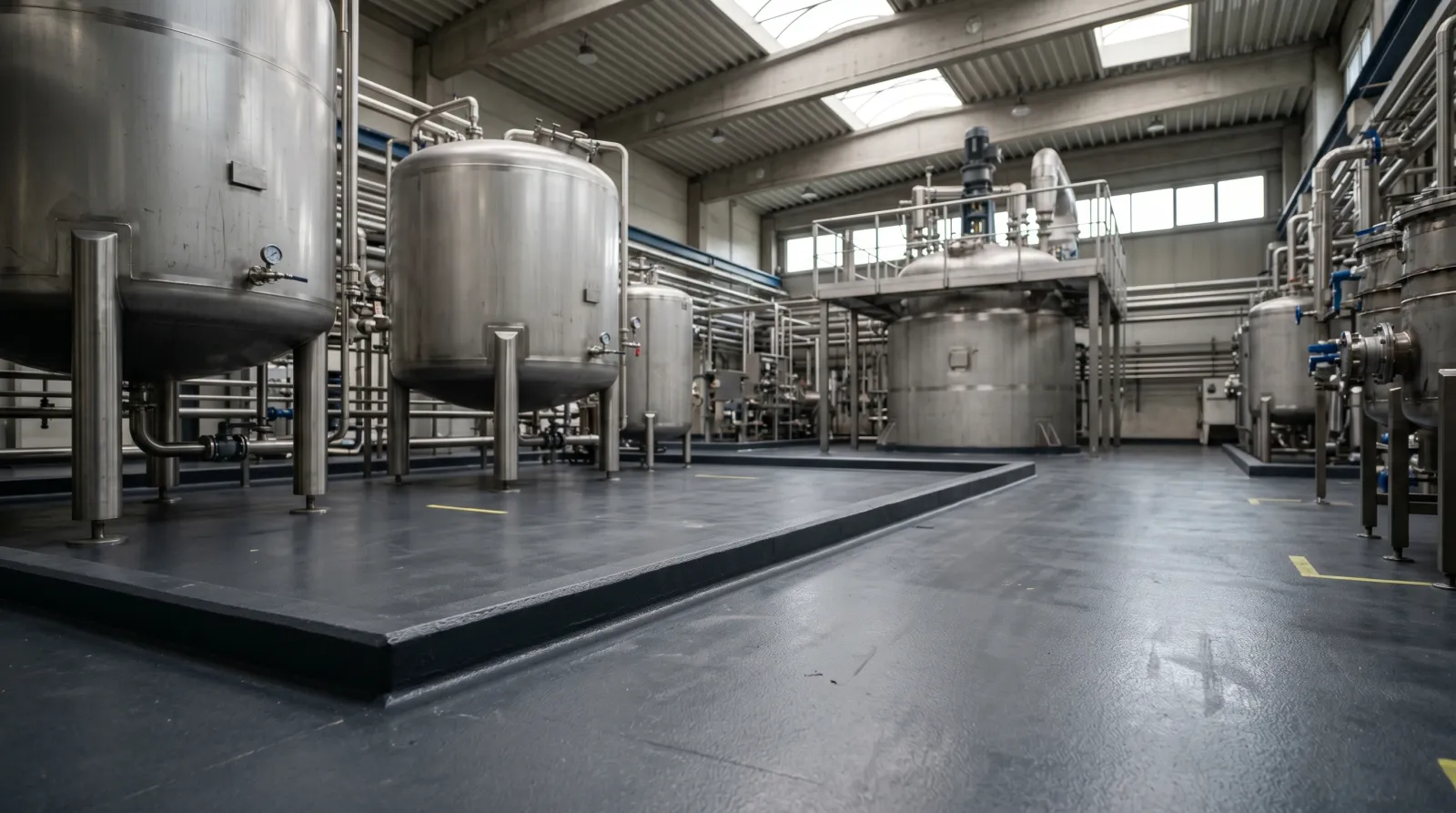
A chemical plant floor has to survive what gets spilled on it. Sulfuric and hydrochloric acid in pickling and plating, sodium hydroxide and other caustics in process rooms, solvents in blending and coating lines, oxidizers, and the thermal shock of steam wash-down. The coating is the last barrier between an aggressive reagent and the structural concrete underneath. Once acid reaches bare concrete it dissolves the cement paste, and a slab that takes a year to attack costs six figures to repair and pull out of service.
The spec gets written into chemical manufacturing, pharmaceutical and fine-chemical production, electroplating and metal finishing, battery and electronics fabrication, water and wastewater treatment, and any process room with secondary containment under code. The driver is the safety data sheet for every chemical that floor will ever see, the operating temperature of spills and wash-down, and the impact load from drums, totes, and forklift traffic.
Service life tracks the exposure. A thin-film novolac on a low-spill corridor delivers 8 to 12 years. An aggregate-filled novolac in a process room sees 10 to 15. A troweled urethane cement floor in a wash-down zone runs 15 to 20 years through daily thermal cycling. Containment linings holding standing chemical are inspected on a cycle and recoated on condition rather than a fixed interval. As with every floor system, service life is decided more by surface preparation and moisture control than by topcoat brand. Skip the prep and a premium novolac fails in two years.
Zoned Recommendation Matrix
A chemical plant is not one floor. The reagent, the temperature, and the standing-liquid risk change room to room, and the spec changes with them.
| Zone | Recommended system | Why |
|---|---|---|
| Acid / solvent process room | System A (novolac epoxy, aggregate build) | Concentrated-acid and solvent immersion resistance |
| Wash-down / steam-clean area | System B (urethane cement, troweled) | Thermal-shock and moisture tolerance |
| Secondary containment / bund | System A or C lined at 60–125 mils | Standing-chemical immersion; holiday-inspected |
| Drum / tote handling, forklift aisle | System B or aggregate-filled novolac | Impact and abrasion under wheeled traffic |
| Process walkways | Thin-film novolac (System A topcoat only) with anti-slip | Light spill, OSHA slip resistance |
| Lab / QC room | Thin-film chemical-resistant epoxy | Reagent spot-spills, easy decontamination |
For a single-zone asset (a standalone containment basin, a one-process plating room) pick one system and write it wall to wall. Multi-zone is the rule for any operating chemical plant.
Spec Requirements
The spec block, before any product name. Numbers shift by manufacturer and zone; the categories do not.
| Spec | Value |
|---|---|
| Dry film thickness (DFT) | 12–25 mils (walkway) · 30–60 mils (process build) · 60–250 mils (containment / urethane cement) |
| Coverage @ DFT | Varies by build; aggregate-filled novolac at 30 mils ≈ 40–55 sq ft/gal |
| VOC | <100 g/L waterborne primer; 0–50 g/L 100%-solids novolac; verify SCAQMD Rule 1113 / CARB on solvent-borne primers |
| Chemical resistance | ASTM C267 immersion data required for every reagent on the SDS list; request the manufacturer’s chemical-resistance chart and match it line by line |
| Standards | ASTM C267 (chemical), ASTM F1869 (MVE ≤3 lb/1000sf/24h), ASTM D7234 (adhesion), ASTM C413 (absorption), ASTM D2047 (COF) |
| Substrate prep | ICRI CSP 4–5 (aggressive shotblast or scarify) for chemical-resistant build systems; CSP 6 under troweled urethane cement |
| Surface prep | SSPC-SP13 / NACE 6 concrete prep; HEPA-vacuum twice; SSPC-SP1 solvent clean |
| Service temp | Novolac: -20°F to 180°F · Urethane cement: -40°F to 250°F (steam-clean rated) |
| Cure to service | Foot traffic 12–24h · forklift 3–7 days · full chemical immersion resistance 7–14 days |
| Dew point / humidity | Substrate ≥5°F above dew point; ambient RH <85% during all coats |
| OSHA 1910.22 | Static COF ≥0.5 dry (ASTM D2047); aggregate broadcast on all wet and process zones |
Three numbers govern whether the floor holds: the chemical-resistance chart matched to the actual reagent list, the moisture vapor emission rate of the slab, and the DFT relative to the spill and impact load of each zone. The reagent match is the one most often skipped, and it is the one that dissolves the floor.
System Chemistry Compared
Pick the chemistry class before the product. Four chemistries cover almost every chemical-plant spec.
| Chemistry | Pot life | Recoat | Service temp | UV stable | $/sq ft installed | Best for |
|---|---|---|---|---|---|---|
| Novolac epoxy | 20–40 min | 8–24h | -20°F to 180°F | No (ambers; topcoat if exposed) | $6–14 | Concentrated acid, solvent, immersion |
| Standard epoxy | 30–45 min | 8–24h | -20°F to 160°F | No | $4–9 | Mild chemical, general process floors |
| Urethane cement | 20–30 min | 6–12h | -40°F to 250°F | Yes | $9–20 | Thermal shock, wash-down, damp slabs |
| Vinyl ester | 15–30 min | 4–8h | -20°F to 220°F | Partial | $14–28 | Severe acid containment, oxidizers |
Novolac epoxy is the workhorse for concentrated acids and solvents and gives the cleanest decontaminable finish. Urethane cement is the answer where steam, hot spills, or a damp slab rule out epoxy. Vinyl ester goes into the most aggressive containment, concentrated oxidizers and high-temperature acid, where even novolac runs out of margin. Standard epoxy belongs only on low-spill corridors and lab floors, never in a room handling concentrated reagent.
Recommended Systems
Three full multi-coat stacks at different exposure points. Match the chemistry to your reagent list and floor temperature before you bid.
System a — General Polymers Novolac Epoxy (acid / Solvent Process)
Service life 10–15 years in process exposure. Total DFT 39–71 mils.
| Layer | Product | DFT |
|---|---|---|
| Primer | General Polymers 3579 Epoxy Primer (or 4685 MVE primer if F1869 fails) | 4–6 mils |
| Build coat | GP 3744 Chemical-Resistant Novolac Epoxy (aggregate-filled) | 20–40 mils |
| Topcoat | GP 3744 Novolac second coat with anti-slip broadcast | 15–25 mils |
| Total | 39–71 mils |
The novolac backbone is what buys the concentrated-acid and solvent resistance that a bisphenol-A epoxy can’t reach. Request the General Polymers chemical-resistance chart and confirm every reagent on the plant’s SDS list before specifying. Sherwin-Williams General Polymers product page.
System B — Sika Sikafloor PurCem (urethane Cement, Wash-Down / Thermal)
Service life 15–20 years through daily steam cleaning. Total build 170–290 mils (about 7 to 11 mm with seal coat).
| Layer | Product | DFT |
|---|---|---|
| Primer / scratch coat | Sikafloor-21 PurCem self-priming slurry | Integral |
| Body coat | Sikafloor-29 PurCem mortar (troweled) | 150–250 mils (6–9 mm) |
| Topcoat | Sikafloor-31 PurCem seal coat with aggregate | 20–40 mils |
| Total | 170–290 mils |
Urethane cement is the chemistry that tolerates a damp or green slab and survives thermal shock from steam wash-down. It bonds where epoxy disbonds. Specify PurCem in any zone that sees hot spills, daily high-pressure cleaning, or a slab that won’t dry to epoxy’s moisture window. Sika Sikafloor PurCem product page.
System C — Tnemec Tneme-Glaze Novolac (severe Containment / Lining)
Service life 12–20 years in containment. Total DFT 39–71 mils as a floor; built heavier (60–125 mils) as a containment lining with holiday inspection.
| Layer | Product | DFT |
|---|---|---|
| Primer | Tnemec Series 201 Epoxoprime | 4–6 mils |
| Build / lining coat | Tnemec Series 282 Tneme-Glaze novolac | 20–40 mils |
| Topcoat | Tnemec Series 280 Tneme-Glaze chemical-resistant finish | 15–25 mils |
| Total | 39–71 mils |
Tnemec’s Tneme-Glaze line carries deep immersion data and is a common spec on secondary containment and tank-farm bund floors where the lining has to hold standing chemical between inspections. For a containment basin, build the lining to 60–125 mils and require a low-voltage or high-voltage holiday inspection per the reagent. Tnemec product page.
Systems Compared
| System | Total DFT | $/sq ft installed | Service life | Best for |
|---|---|---|---|---|
| A · GP Novolac | 39–71 mils | $7–14 | 10–15 yrs | Acid / solvent process rooms |
| B · Sika PurCem | 170–290 mils | $10–20 | 15–20 yrs | Wash-down, thermal shock, damp slabs |
| C · Tnemec Tneme-Glaze | 39–125 mils | $9–18 | 12–20 yrs | Containment linings, tank-farm bunds |
Cost includes prep (shotblast to CSP 4–5), primer, build, topcoat, coving, and contractor labor. Containment linings built heavy with holiday inspection run at the top of the band. DIY application is not a viable path for any of these systems in an operating plant.
Surface Preparation: Where the Result Is Decided
A chemical-floor failure investigation almost always lands on prep, not product. Aggressive concrete profiling matters more here than on a dry warehouse floor, because the coating has to resist not just abrasion but immersion that will exploit any weak bond line.
| Method | ICRI CSP profile | Cost ($/sf) | Best for |
|---|---|---|---|
| Diamond grinding | CSP 2 | $0.50–1.00 | Lab floors, thin-film only; too smooth for chemical build |
| Shotblasting | CSP 3–4 | $0.75–1.50 | Standard for novolac build systems |
| Aggressive shotblast | CSP 4–5 | $1.00–2.00 | Chemical-resistant build floors; opens the matrix |
| Scarification | CSP 5–6 | $1.50–3.00 | Old coating removal, troweled urethane cement bond |
Chemical-resistant build systems want CSP 4 or 5, deeper than the CSP 3 a typical warehouse epoxy calls for. The reason is mechanical key: an immersion-rated coating that bonds only chemically to a sealed surface will lift the first time reagent finds the edge. Troweled urethane cement goes one step further, to CSP 6, because the mortar needs a coarse profile to lock into.
After blasting, vacuum twice with HEPA (bulk first, fines second) and solvent-clean per SSPC-SP1. Detail the coving where the floor meets walls, tank skirts, and equipment pads. A coved base turns the floor-to-wall joint into a sealed, cleanable radius instead of a 90-degree crack that traps spilled chemical and undercuts the coating. Skipping the cove is the single most common detailing failure I see on chemical floors. The flat field looks perfect and the failure starts at the wall.
Moisture Testing Is Not Optional
Concrete moves vapor continuously, and epoxy is not vapor-permeable. Vapor that reaches the underside of a cured novolac has nowhere to go and lifts the coating in disc-shaped blisters. Two acceptable test methods:
- ASTM F1869, calcium chloride dome. A pre-weighed dish of calcium chloride sealed under a plastic dome for 60–72 hours. Re-weigh, calculate MVE in lb/1000sf/24h. Pass: ≤3 lb. Slabs over a few years old commonly read 4–8 lb.
- ASTM F2170, relative humidity probe. A sleeve drilled to 40% of slab depth, sealed, equilibrated 72h, probed with an RH meter. Pass: ≤75% RH. Slower, more accurate.
If the test fails, two paths exist. Install a moisture-vapor-mitigation primer (General Polymers 4685, Sika MVE barrier) under the epoxy build, or specify urethane cement, which tolerates higher slab moisture than any epoxy and bonds to green concrete. For new construction over a slab that hasn’t fully cured, urethane cement is often the cleaner answer than waiting 60 days for an epoxy moisture window.
Matching the Coating to the Reagent List
The number that separates a chemical floor from an ordinary one is the ASTM C267 immersion rating. Every major manufacturer publishes a chemical-resistance chart with three columns per reagent: continuous immersion, intermittent contact, and splash-and-spill. Match the plant’s SDS list against that chart line by line.
A few rules that hold across the charts:
- Concentrated sulfuric and hydrochloric acid: novolac or vinyl ester, not standard epoxy.
- Sodium hypochlorite and oxidizers: vinyl ester for continuous, novolac for splash.
- Solvents (acetone, MEK, toluene): novolac handles splash; continuous solvent immersion needs the manufacturer’s specific solvent-rated line.
- Hot caustic and steam: urethane cement, which holds where epoxy thermally shocks off.
When a reagent shows “not recommended” for continuous immersion but “acceptable” for splash, that distinction maps to your zones. A walkway that sees occasional splash can run the lighter chemistry; a containment floor holding standing chemical cannot. Write the immersion column into the containment spec and the splash column into the process-floor spec.
Application & Contractor Path
This is not a DIY product class. Specify a contractor with SSPC-QP1 certification for industrial coatings, a manufacturer-authorized applicator letter for the specific product line, and NACE/AMPP CIP Level 2 inspection on any containment lining. Coved-base detailing, troweled urethane cement, and holiday inspection of immersion linings are specialty skills that general flooring crews don’t carry.
Three questions before signing a bid:
- Will the contractor pull and document the ASTM F1869 or F2170 moisture test before coating, and what’s the remediation path if it fails? A bid that omits moisture testing is a bid that plans to fail.
- How is per-coat DFT verified, and on containment linings, what holiday-inspection method (low-voltage wet sponge or high-voltage spark) is used? A lining with a pinhole is a lining that leaks.
- Has the crew detailed coved bases and equipment-pad terminations on a comparable chemical floor in the last 18 months?
The manufacturer-rep network on all three systems (General Polymers, Sika, Tnemec) offers a free pre-bid review: reagent-list match against the chemical-resistance chart, DFT schedule by zone, and a moisture-mitigation recommendation. Use it. Catching a reagent mismatch at the spec stage costs an hour. Catching it after the floor dissolves costs the slab.
Failure Modes & How to Prevent Them
- Chemical attack from a reagent mismatch. Cause: a standard or under-rated epoxy specified against a reagent the chart never cleared. The floor softens, blisters, or dissolves. Prevention: match the full SDS list to the ASTM C267 chart, immersion column for containment, splash column for process floors.
- Disbondment from moisture. Cause: high MVE under a non-permeable epoxy lifts the coating off in months. Prevention: ASTM F1869 or F2170 before coating; MVE-mitigation primer or urethane cement if the slab fails.
- Edge and joint failure at the cove. Cause: no coved base, so spilled chemical pools in the floor-to-wall crack and undercuts the coating. Prevention: detail a coved base at every wall, tank skirt, and equipment pad; seal control joints with a chemical-resistant filler.
- Thermal shock delamination. Cause: hot spills or steam wash-down on an epoxy floor that can’t take the thermal cycling. Prevention: specify urethane cement in any zone that sees steam cleaning or spills above 140°F.
- Slip injury under chemical sheeting. Cause: a smooth novolac that tests fine dry turns slick the moment a caustic films it. Prevention: aggregate broadcast sized to the zone; static COF ≥0.5 dry per ASTM D2047, more aggressive in wet process areas.
- Inadequate profile. Cause: CSP 2–3 prep under an immersion-rated build leaves too little mechanical key. Prevention: CSP 4–5 for novolac build, CSP 6 under troweled urethane cement.
Reagent mismatch and missing coves account for most of the chemical-floor rejections I review. Both are designed-in failures, preventable entirely in the spec and detailing phase.
Where to Buy / Spec
| Channel | Best for | Link |
|---|---|---|
| Manufacturer-direct (S-W General Polymers, Sika, Tnemec) | Spec’d projects, reagent-chart match, rep support, warranty | S-W General Polymers · Sika PurCem · Tnemec |
| Industrial distributor (Rawlins US, ICA, KTA-Tator) | Bulk, contractor accounts, mixed-system bids | Distributor account with project pricing |
| Pro retail (Sherwin-Williams stores) | Small touch-up, repair kits, local pickup | S-W store locator |
| Amazon Business | Repair kits, small-scope lab floors | Search by manufacturer |
Manufacturer-direct is the recommended channel on any chemical floor above the lab-room scale. The rep’s reagent-list review and DFT schedule are worth more than any retail discount on the pail.
FAQ
See the FAQ entries in the page metadata, surfaced as expandable questions on the rendered page.