Potable Water Tank Coatings: NSF/ANSI 61 Specifier's Guide (2026)
Potable water tank lining systems compared. NSF/ANSI 61 certified epoxies, DFT and holiday inspection, SSPC-SP10 prep, return-to-service cure, and contractor path.

Disclosure: Affiliate links to retailers and manufacturer-direct programs. Recommendations are spec-driven, not commission-driven.
Use Case
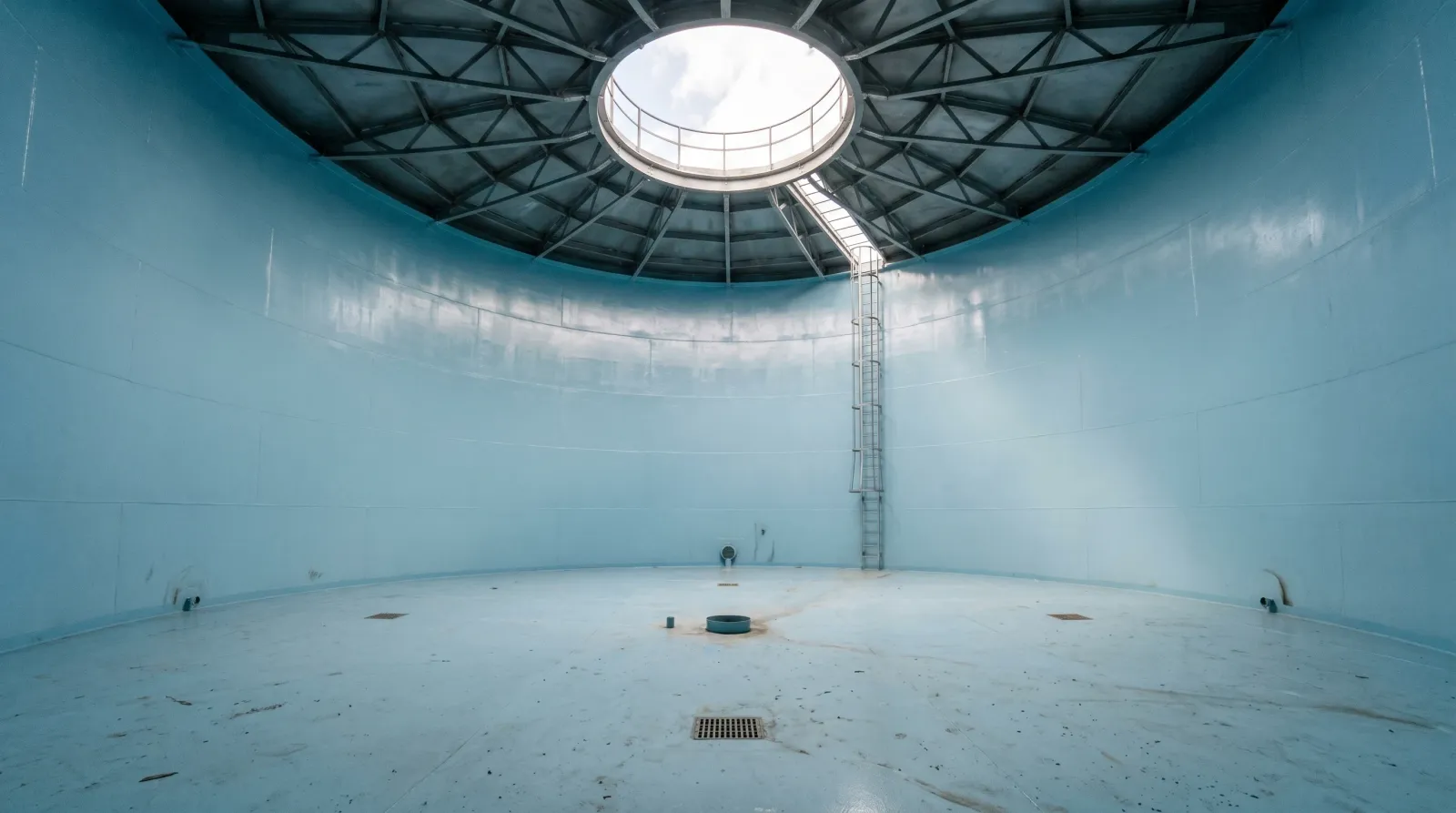
A potable water tank lining has one job that no other interior coating shares: it sits in continuous immersion against the drinking water for a public system, and it cannot put anything into that water. The coating has to resist constant immersion, the disinfection residual (chlorine or chloramine), occasional drawdown and refill cycling, and the abrasion of sediment, all while staying inert enough to pass NSF/ANSI 61 toxicology testing. The asset is the welded or bolted steel reservoir, the standpipe, the elevated tank, the ground storage tank, or the concrete clearwell that holds finished water before it enters the distribution system.
The spec gets written into municipal water utilities, rural water districts, industrial process-water and fire-protection-water storage that ties into a potable line, and any tank a state drinking-water program regulates. AWWA D102 is the governing standard for steel tank coating systems. It defines the interior and exterior coating systems by inside-coating-system number, sets the surface prep, and references NSF/ANSI 61 for the wet interior. The interior wet surface (the part below the high-water line and the underside of the roof, where condensation forms) is the demanding zone. The exterior shell is a more conventional weathering and UV problem.
Service life for a properly applied immersion-grade epoxy lining runs 15 to 20 years before recoat, sometimes longer on a tank with stable water chemistry and a clean drawdown pattern. That number collapses to 3 to 6 years when the prep falls short of near-white blast, when soluble salts are left on the steel, or when the film goes in below the spec’d DFT. The lining fails from the substrate out, and the failure shows up as under-film blistering and rust tubercles long before anyone opens the tank for a five-year inspection.
Spec Requirements
The spec block, before any product name. Numbers shift by manufacturer and by the NSF listing for the specific product; the categories are fixed.
| Spec | Value |
|---|---|
| Dry film thickness (DFT) | 16–40 mils total; immersion epoxy at 8–16 mils per coat, two-coat minimum; reinforced/edge-retentive systems to 40 mils |
| Coverage @ spec’d DFT | 65–130 sq ft per gallon per coat at 10 mils, depending on solids by volume |
| VOC | <100 g/L for high-solids and 100% solids potable epoxies; 250–340 g/L for solvent-borne immersion epoxies under SCAQMD Rule 1113 / CARB SCM industrial maintenance category |
| Certifications | NSF/ANSI 61 (and NSF/ANSI 600 toxicology); AWWA D102 inside coating system; AWWA C210/C222 where the spec references pipe-and-fitting standards |
| Substrate prep — steel | SSPC-SP10 / NACE No. 2 near-white blast; 2–4 mil angular profile; soluble salts below SSPC Guide 15 limit |
| Substrate prep — concrete | Abrasive blast or grind to ICRI CSP 3–CSP 5; verify moisture-vapor emission and surface pH before coating |
| Stripe coat | Required on all welds, edges, bolt heads, nuts, and pitted areas before the first full coat |
| Service temp | Continuous immersion to 120°F for most potable epoxies; verify the product’s wet service limit |
| Ambient at application | 50°F to 90°F; relative humidity <85%; substrate ≥5°F above dew point |
| Recoat window between coats | 6–24 hours per manufacturer TDS; do not exceed the maximum recoat or the spec calls for a re-prep |
| Cure to service | Per NSF/ANSI 61 listing — typically 3–7 days at 70°F plus a fill-and-dump rinse; not the cure-to-handle figure |
| Holiday inspection | Low-voltage wet sponge or high-voltage spark test per ASTM D5162 / NACE SP0188 at 100% of the wet interior |
Three numbers decide whether the lining lasts. The blast profile and soluble-salt level under the film, the DFT measured against the spec across the whole wet interior, and the cure completed to the NSF listing before the tank goes back into service. Miss the prep and it blisters. Miss the DFT and it holidays through. Miss the cure and it fails the bacteriological clearance.
System Chemistry Compared
A short list of chemistries carries NSF/ANSI 61 certification for tank immersion. Most municipal interiors land on one of two epoxy families. Polyurethane and polyurea show up on specific assets, and zinc-rich primers appear under epoxy on bare steel that needs galvanic protection.
| Chemistry | Pot life @ 70°F | Recoat window | Wet service temp | UV stability | $/sq ft band | Best for |
|---|---|---|---|---|---|---|
| High-solids amine epoxy | 2–4 hours | 6–24 hours | to 120°F immersion | Poor — interior only, chalks if exposed | $3–7 | Standard potable interior lining, steel and concrete |
| 100% solids / edge-retentive epoxy | 20–45 min (plural-component) | Tight, plural spray | to 140°F immersion | Poor — interior only | $6–12 | High-build single-coat linings, fast return to service |
| Polyurethane / polyurea (NSF-listed) | 10–30 sec to minutes (sprayed) | Immediate, hot-applied | to 140°F immersion | Good with topcoat | $8–16 | Fast-cure recoat, rehab where downtime is the constraint |
| Zinc-rich epoxy primer (under epoxy) | 2–4 hours | per TDS | n/a (primer only) | n/a | adds $1–3 | Galvanic protection of bare steel under the lining |
High-solids amine epoxy is the workhorse and the lowest-cost compliant answer for most ground-storage and elevated tanks. The 100% solids and polyurea systems buy you a faster return to service when the tank is the only one feeding a town and downtime is the real cost driver. None of the interior chemistries handle UV; the exterior shell is a separate aliphatic-polyurethane or fluoropolymer topcoat problem.
Recommended Systems
Three full multi-coat immersion-lining stacks at different price-performance points. All three products below carry NSF/ANSI 61 certification for potable immersion. Verify the current listing and the cure-to-service schedule against your tank’s surface-to-volume ratio before bid.
System A — Tnemec Series N140 Pota-Pox Plus (high-Solids Epoxy)
| Layer | Product | DFT |
|---|---|---|
| Stripe coat | Series N140 Pota-Pox Plus (welds, edges, pits) | 4–6 mils |
| Full coat 1 | Series N140 Pota-Pox Plus epoxy | 8–10 mils |
| Full coat 2 | Series N140 Pota-Pox Plus epoxy (contrasting color) | 8–10 mils |
| Total | 16–20 mils over the field, more at stripe-coated edges |
Service life 15–20 years. Pota-Pox Plus is one of the longest-listed NSF/ANSI 61 potable epoxies in the AWWA D102 market, and the contrasting-color second coat is built into Tnemec’s recommended schedule for visible thin-spot control. The Series N140 chemistry tolerates the wider application window an in-field tank crew actually works in. Tnemec Series N140 Pota-Pox Plus product page.
System B — Sherwin-Williams Macropoxy 5500 / Dura-Plate 235 (high-Build Epoxy)
| Layer | Product | DFT |
|---|---|---|
| Stripe coat | Dura-Plate 235 multi-purpose epoxy | 4–6 mils |
| Full coat 1 | Macropoxy 5500 high-solids epoxy | 8–12 mils |
| Full coat 2 | Macropoxy 5500 (contrasting color) | 8–12 mils |
| Total | 16–24 mils field |
Service life 15–20 years. Macropoxy 5500 carries NSF/ANSI 61 certification and runs through the Sherwin-Williams Protective & Marine rep network, which puts a local store and a field rep behind the spec on most municipal projects. The high-solids formulation builds the two-coat DFT in fewer passes than a standard epoxy, which shortens crew time inside the tank. Sherwin-Williams Protective & Marine product line.
System C — Carboline Carboguard 891 / Plasite 4500 (immersion Epoxy)
| Layer | Product | DFT |
|---|---|---|
| Stripe coat | Carboguard 891 immersion-grade epoxy | 4–6 mils |
| Full coat 1 | Carboguard 891 epoxy | 8–10 mils |
| Full coat 2 | Carboguard 891 epoxy (contrasting color) | 8–10 mils |
| Total | 16–20 mils field |
Service life 15–20 years. Carboguard 891 is an NSF/ANSI 61 listed immersion epoxy with a strong record on rehab work, and Carboline’s Plasite 4500 sits a tier above it for the harshest process-water and high-temperature potable applications. Carboline’s rep network handles the holiday-inspection protocol and the soluble-salt testing as part of the spec support. Carboline product catalog.
Systems Compared
| System | Total DFT | $/sq ft installed | Service life | Best for |
|---|---|---|---|---|
| A — Tnemec Series N140 Pota-Pox Plus | 16–20 mils | $5–9 | 15–20 years | Standard municipal steel and concrete potable tanks |
| B — Sherwin-Williams Macropoxy 5500 | 16–24 mils | $5–10 | 15–20 years | High-build two-coat, strong local rep support |
| C — Carboline Carboguard 891 / Plasite 4500 | 16–20 mils | $5–9 | 15–20 years | Rehab and harsher process-water potable service |
Pricing assumes a full tank-interior scope through an SSPC-QP1 contractor with SP10 blast, stripe coat, two full coats, holiday inspection, and NSF cure included. It excludes the access cost (containment, scaffolding or rigging on an elevated tank, dehumidification) which on a tall standpipe or elevated tank often exceeds the coating cost itself. Small partial-recoat scopes run well above this band per square foot.
Application and Contractor Path
Interior potable tank lining is not a maintenance-crew job and not a DIY product. The wet interior is a confined space under OSHA 1910.146, the abrasive blasting and the solvent vapor require forced ventilation and respiratory protection under 1910.134, and the NSF certification only holds if the film goes in to spec and cures to the listing. Specify a contractor who holds:
- SSPC-QP1 certification for industrial coatings work in the field (QP2 if hazardous-coating removal is in scope).
- An AMPP (formerly NACE/SSPC) certified coating inspector for the in-process DFT and the holiday detection.
- A documented confined-space program: entry permits, atmospheric monitoring, attendant, and rescue plan.
Four contractor-qualifying questions before signing:
- What soluble-salt test and limit will you hold the blasted steel to before coating? An SSPC Guide 15 answer with a conductivity or Bresle method means they understand why immersion linings blister. Silence on this is the warning sign.
- How will you confirm and document the SP10 profile? Replica tape readings at a stated frequency, recorded in the inspection log, keyed to the wet interior.
- What holiday-detection method, and at what voltage? ASTM D5162 / NACE SP0188 governs. The voltage scales with the DFT; the wrong setting either misses pinholes or burns false holidays into good film.
- What is the documented NSF cure schedule and rinse cycle before return to service? They should hand you the listing and the date math before they pour the first kit.
The manufacturer-rep network on all three systems (Tnemec, Sherwin-Williams P&M, Carboline) includes a pre-bid review of the tank drawings and the existing-coating condition, a recommended inside-coating-system number per AWWA D102, and on-site support during the holiday inspection. Use it. A primer or soluble-salt problem caught before the crew enters the tank costs a phone call. The same problem found at the next five-year inspection costs a full re-line.
Failure Modes & How to Prevent Them
Five failures cover the bulk of premature potable-lining rejections and recoats.
- Osmotic blistering from soluble salts under the film. Cause: chlorides or ferrous salts left on the steel after blast, drawing water through the film by osmosis in continuous immersion. Prevention: SP10 near-white blast, soluble-salt testing to SSPC Guide 15 with a salt remover if needed, and a re-test before coating. This is the leading failure mode on immersion linings. For what under-film blisters look like and how to read them, see the coating blister diagnosis guide.
- Holidays and pinholes through the film. Cause: thin spots over weld seams and edges, missed stripe coat, or atomized film that did not wet a sharp edge. Prevention: stripe-coat every weld, edge, and bolt head before the full coats; contrasting-color second coat; 100% holiday detection per ASTM D5162. Repair every detected holiday before the next coat.
- DFT below spec across the wet interior. Cause: crew applied to a target wet film without checking dry film, or coverage stretched to save material. Prevention: in-process DFT readings on a stated grid, recorded by the inspector, with low areas recoated before return to service.
- Return to service before the NSF cure is complete. Cause: the tank is the only one feeding a town and the operator rushed the refill. Prevention: hold the cure-to-service schedule from the NSF listing, run the fill-and-dump rinse, and do not sample for clearance until the cure date. An early fill risks leaching, taste-and-odor complaints, and a failed bacteriological clearance that means draining and starting over.
- Roof-underside and headspace corrosion. Cause: condensation and chlorine off-gassing attack the underside of the roof and the dry interior above the high-water line, a zone crews underspec because it never sees liquid. Prevention: coat the full interior including the roof underside, ventilation column, and overflow to the same system; this is the most-skipped zone and the one that drives the next recoat.
Soluble-salt blistering is the failure I review most on tank interiors, and it is almost always a prep shortcut, not a product defect. The product carries the NSF listing. The prep carries the service life.
Where to Buy / Spec
| Channel | Best for | Path |
|---|---|---|
| Manufacturer-direct rep network | Spec’d municipal and AWWA D102 projects; NSF listing match and inspection support | Tnemec / Sherwin-Williams P&M / Carboline rep locator |
| Pro retail (Sherwin-Williams P&M store) | Local pickup, contractor pricing, field rep on call | Local S-W Protective & Marine commercial store |
| Industrial distributor | Multi-manufacturer bids, mixed interior/exterior scope | Distributor account with project-specific pricing |
| Amazon Business | Small fittings, stripe-coat touch-up kits, ancillary supplies — not the primary tank lining | Amazon Business account |
Manufacturer-direct is the recommended channel on any full tank-interior scope. The rep services (pre-bid drawing review, NSF listing confirmation, soluble-salt and holiday-inspection support) are worth more than any retail discount on the kit, and they keep the certification chain documented for the state drinking-water program.