Epoxy Pool Paint: Concrete & Plaster Specifier's Guide (2026)
Epoxy pool paint compared by DFT, recoat, and service life for concrete and plaster pools. Acid-etch prep, dew point limits, cure to water, and the contractor path.

Disclosure: Affiliate links to retailers and manufacturer-direct programs. Recommendations are spec-driven, not commission-driven.
Use Case
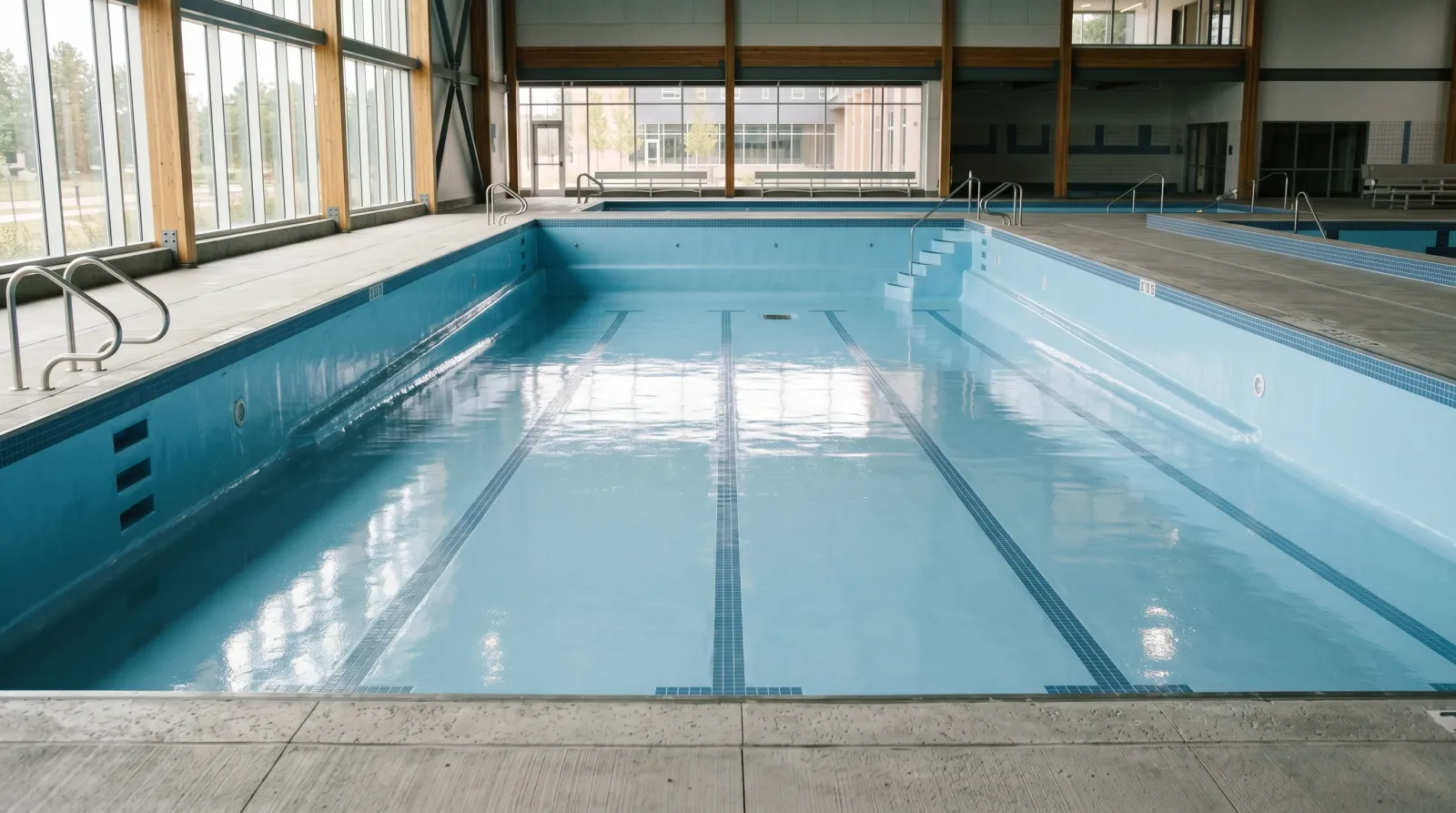
Epoxy pool paint is the immersion-grade coating specified for the interior shell of a concrete, gunite, or plaster swimming pool: the basin floor, the walls, and the waterline band that takes the worst of the chemistry and the UV. It is also written into fountains, splash pads, wading pools, and concrete spa shells. The asset is a water-retaining structure under constant chemical load: free chlorine, fluctuating pH, cyanuric acid, and in saltwater systems a chloride-rich electrolyte. The coating has to hold color, resist chalking, and stay bonded through a full season of immersion and a winter of empty freeze-thaw.
Three pool-paint chemistries compete for this job. Epoxy is the longest-lived of the three. A correctly applied two-coat epoxy system delivers 5 to 7 years on a commercial pool and 7 to 8 on a residential one. Chlorinated-rubber paint, the old municipal standby, lasts 2 to 3 years and recoats easily. Acrylic water-based pool paint lasts 1 to 2 years and exists mainly because it can go onto a slightly damp surface and skip the solvent. For a facility manager weighing repaint downtime against material cost, epoxy wins on service life and loses on flexibility. Once a pool is in epoxy, it stays in epoxy.
The shell is a single-zone asset, so this guide skips the zoned matrix that a warehouse or hospital needs. The one zone distinction that matters is immersion versus deck: the basin is smooth epoxy, and the surrounding walking surface is a separate anti-slip system covered in the anti-slip pool deck coating guide. The spec calls for treating them as two coatings, not one.
Where epoxy is the wrong answer: a pool with a high water table or hydrostatic pressure behind the shell. Epoxy is impermeable. Water driven against the back of the film blisters it off regardless of how clean the prep was. Those pools need the moisture source addressed or a more vapor-tolerant chemistry, not a premium epoxy over a wet substrate.
Spec Requirements
The numbers below are the categories a pool-coating spec has to settle before a product name goes on the page. Exact values shift by manufacturer; the line items do not.
| Spec | Value |
|---|---|
| Dry film thickness (DFT) | 8–14 mils total system, two coats at 4–7 mils dry each |
| Coverage @ DFT | 150–250 sq ft / gal per coat (lower on rough plaster, higher on steel-troweled concrete) |
| VOC | <340 g/L solvent-borne epoxy; <100 g/L water-based acrylic. Verify SCAQMD Rule 1113 and CARB SCM for California and OTC-state jobs |
| Standards | ASTM D4060 (abrasion), ASTM D4541 (pull-off adhesion), ASTM D522 (mandrel flexibility), ASTM D4585 (condensation resistance) |
| Certification relevance | NSF/ANSI 50 governs recreational-water-facility equipment; confirm the specific product carries any listing the AHJ requires |
| Substrate prep — concrete / plaster | Acid etch to a CSP 2 profile (10% muriatic or sulfamic), neutralize, rinse to clean, dry 3–5 days. ICRI CSP 2 is the target; rougher than CSP 3 holds water and shows through |
| Substrate prep — old coating | SSPC-SP1 solvent clean, then scuff-sand or sandblast back to bare on any chemistry mismatch |
| Moisture | Substrate visibly and tested dry; plastic-sheet overnight test must show no condensation before coating |
| Service temp | Air and substrate 50°F to 90°F during application; cured film serviceable through immersion and empty winter freeze-thaw |
| Cure to service | 5–7 days air cure before filling with water at 70°F; longer in cool or humid conditions |
| Dew point | Substrate ≥5°F above dew point during application and through the full recoat and cure window |
| OSHA 1910.22 | Applies to the deck and steps (static COF target via aggregate broadcast), not the immersed basin |
Two numbers carry the install: the substrate has to be dry, and the substrate temperature has to stay above the dew point through cure. Pools sit in the ground at a stable, cool temperature. On a humid morning the shell is a condensing surface, and a film rolled over a shell that is sweating below the dew point will blister no matter how good the paint is.
System Chemistry Compared
Three chemistries cover almost every pool repaint. The choice is driven by what is already on the shell and how much downtime the owner can absorb.
| Chemistry | Pot life | Recoat window | Service temp | UV stable | $/sq ft installed | Best for |
|---|---|---|---|---|---|---|
| Epoxy (this guide) | 30–45 min | 8–24h between coats | Immersion + empty freeze-thaw | Moderate (chalks slowly) | $1.50–3.50 | Longest service life; bare concrete or existing epoxy |
| Chlorinated rubber | N/A (single-part) | 2–4h | Immersion | Low (fades faster) | $1.00–2.00 | Fast municipal repaints, easy recoat, frequent cycles |
| Acrylic water-based | N/A (single-part) | 2–4h | Immersion | Moderate | $0.75–1.50 | Damp-tolerant prep, low VOC, shortest service life |
Epoxy is a two-part, catalyzed system: once the resin and hardener are mixed the clock starts, and a batch past its pot life thickens and ropes on the roller. That working-time constraint is the trade for the chemical resistance and the 5-to-7-year life. Chlorinated rubber is forgiving and fast but fades and needs recoating on a tighter cycle. Acrylic is the choice only when the substrate will not dry enough for epoxy or a job needs the low VOC, and the spec accepts a 1-to-2-year repaint interval in exchange.
The compatibility rule overrides the performance ranking. Epoxy bonds to bare substrate or to clean, etched epoxy. It does not bond to chlorinated rubber or acrylic. A pool already painted in rubber either gets recoated in rubber or sandblasted back to bare before epoxy goes on. Identify the existing chemistry before specifying anything.
Recommended Systems
Three full two-coat epoxy stacks at different price-performance points. All three are real, immersion-rated pool epoxies. The first coat is thinned slightly per the product data sheet on bare substrate to wet out and key into the etched profile; the second coat builds the film to spec.
System A — Sherwin-Williams ProIndustrial Pool & Deck Epoxy
| Layer | Product | DFT |
|---|---|---|
| First coat (thinned bond coat) | S-W Pool & Deck Epoxy, thinned per TDS | 3–4 mils |
| Topcoat | S-W Pool & Deck Epoxy, full second coat | 4–6 mils |
| Total | 7–10 mils |
Service life 6–8 years on a residential shell, 5–7 commercial. The Sherwin-Williams rep network and the contractor-pricing channel through their commercial stores are the reason to spec this on a managed property, where the same buyer who orders the building’s other coatings can source the pool through one account. Sherwin-Williams ProIndustrial product line.
System B — Rust-Oleum EpoxyShield Premium Pool Paint
| Layer | Product | DFT |
|---|---|---|
| First coat | Rust-Oleum EpoxyShield Premium Pool Paint (two-part) | 4–5 mils |
| Topcoat | EpoxyShield Premium Pool Paint, second coat | 4–5 mils |
| Total | 8–10 mils |
Service life 5–7 years. The widely available two-part pool epoxy, stocked at home centers and on Amazon Business in kit form, which makes it the practical pick for a smaller residential or HOA pool where the owner is sourcing the material directly. Rust-Oleum EpoxyShield product page.
System C — Ramuc Type EP Epoxy (Kelley Technical Coatings)
| Layer | Product | DFT |
|---|---|---|
| First coat | Ramuc Type EP epoxy | 4–6 mils |
| Topcoat | Ramuc Type EP epoxy, second coat | 4–6 mils |
| Total | 8–12 mils |
Service life 7–8 years; the longest track record of the three on commercial and competition pools. Ramuc is a pool-specific coatings house, not a general-line manufacturer, and Type EP is the product municipal aquatic facilities have repainted with for decades. Spec it when the asset is a high-use commercial or municipal pool and the buyer wants a coating designed only for water. Ramuc / Kelley Technical Coatings pool paints.
Systems Compared
| System | Total DFT | $/sq ft installed | Service life | Best for |
|---|---|---|---|---|
| A — S-W Pool & Deck Epoxy | 7–10 mils | $2.50–3.50 | 5–8 yrs | Managed properties on a Sherwin-Williams account |
| B — Rust-Oleum EpoxyShield | 8–10 mils | $1.50–2.50 | 5–7 yrs | Residential, HOA, owner-sourced kits |
| C — Ramuc Type EP | 8–12 mils | $2.50–3.50 | 7–8 yrs | Commercial, municipal, competition pools |
Installed cost covers acid etch, neutralize, dry, two coats, and labor on a typical 1,500-to-7,000-square-foot shell. Owner-applied installs drop material-and-labor cost substantially but carry the full prep-and-weather failure risk. The per-square-foot numbers are low against a floor coating because there is no shotblasting and no high-build, but the downtime cost (a commercial pool closed for 10 to 14 days through prep and cure) usually dominates the budget conversation, not the can.
Application & Contractor Path
Honest call: a residential pool under 800 square feet is within reach of a careful owner-applicator who treats the prep and the weather window as the job rather than the painting. Acid etch, neutralize, rinse, dry, then two coats inside the recoat window with the substrate above the dew point. The paint is the easy part.
Commercial, municipal, hotel, and HOA pools are a contractor scope. The drivers are liability, a fixed reopening date, and the size of the shell. Specify a commercial pool-coating contractor who:
- Carries references on immersion epoxy work, not just deck or general concrete coatings.
- Documents the acid-etch profile, the neutralization, and the dry-down before coating.
- Warrants the installed system, not just the labor, with the substrate condition recorded.
- Can hold the schedule against weather — epoxy on a pool shell is a dry-window job, and a contractor who paints through a humid morning to make a date is the contractor whose pool blisters.
The manufacturer-rep path is the same as on any industrial coating. Sherwin-Williams ProIndustrial and Ramuc both field reps who will review the existing coating, confirm chemistry compatibility, and recommend the prep before a gallon is ordered. Use that review to settle the single question that sinks most pool repaints: what is already on this shell, and will the new epoxy bond to it.
Failure Modes & How to Prevent Them
Five failures cover the bulk of pool-epoxy rejections and early repaints.
- Blistering from a wet substrate. Water vapor moving up through an impermeable epoxy film lifts it in domes. Cause: coating before the shell dried, or a high water table behind it. Prevention: the 3-to-5-day dry-down and the overnight plastic-sheet test before coating; address hydrostatic sources before specifying epoxy at all. See the paint blistering diagnosis and fix for the broader mechanism.
- Peeling from chemistry mismatch. New epoxy over old chlorinated rubber or acrylic releases in sheets within a season. Cause: topcoating an incompatible base. Prevention: identify the existing coating by solvent test, recoat in the same chemistry, or sandblast to bare and start the epoxy system clean.
- Adhesion loss from skipped acid etch. Epoxy rolled onto sealed, un-etched concrete or fresh plaster has only a chemical grip and lets go under immersion. Cause: no profile. Prevention: acid etch to a CSP 2 profile, neutralize fully, and rinse to a clean surface that no longer feels slick.
- Chalking and color fade at the waterline. UV and chlorine degrade the resin at the air-water line first. Cause: the most exposed band of the pool. Prevention: full-spec DFT, a quality immersion epoxy, and a realistic 5-to-7-year repaint expectation rather than treating fade as a defect.
- Application below the dew point. Condensation forms between coats or under the film on a cool shell during a humid morning, and the system blisters or fails to bond between coats. Prevention: substrate temperature ≥5°F above dew point through application and the full recoat window, tracked with a sling psychrometer and surface thermometer.
The first two failures account for most of the repaints I see on pools. Both are settled before a brush is wet — by drying the shell and by identifying the old coating. A premium epoxy cannot fix a substrate that was painted wet or painted over the wrong base.
Where to Buy / Spec
| Channel | Best for | Link |
|---|---|---|
| Manufacturer-direct (S-W ProIndustrial, Ramuc) | Spec’d commercial pools, rep compatibility review, warranty | S-W ProIndustrial · Ramuc pool paints |
| Pool-coatings distributor | Municipal and competition pools, bulk pricing | Regional aquatic-coatings dealer accounts |
| Pro retail (Sherwin-Williams stores) | Contractor pricing, local pickup, mixed-coating accounts | S-W store locator |
| Amazon Business | Residential and HOA pools, owner-sourced kits | Rust-Oleum EpoxyShield Pool kit by manufacturer |
Manufacturer-direct is the channel for any commercial pool above 2,000 square feet — the rep’s pre-spec compatibility check is worth more than any discount on the can, because it catches the chemistry mismatch that would otherwise peel the whole job. For a small residential pool, the Rust-Oleum kit through Amazon Business or a pro retail counter is the practical source.