Pool Deck Anti-Slip Coatings: Specifier's Guide (2026)
Pool deck anti-slip coatings compared by DFT, COF, and service life. ICRI CSP prep, ASTM standards, chlorine resistance, and the contractor path that holds up wet.

Disclosure: Affiliate links to retailers and manufacturer-direct programs. Recommendations are spec-driven, not commission-driven.
Use Case
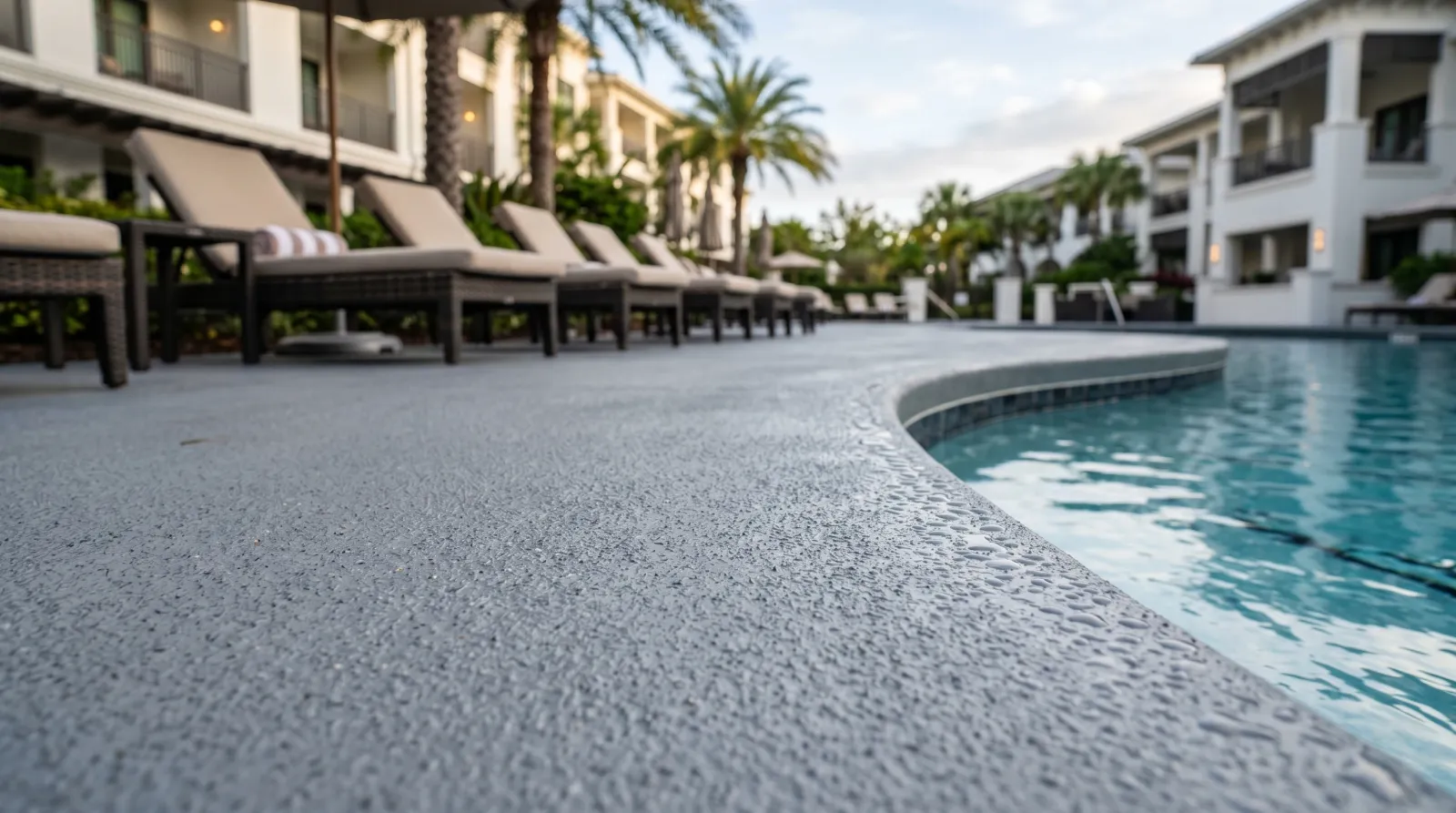
A pool deck anti-slip coating has the hardest combined-exposure job of any horizontal coating a property manager will spec. The surface is wet most of the day, walked barefoot, dosed with chlorine or bromine, splashed with muriatic acid during shock treatment, baked by full UV with no shade, and cycled through freeze-thaw in any climate that drops below freezing. All of that on a slab that sits on grade with a pool full of water sitting beside it, pushing moisture up from below. The coating that survives this is a system, not a product.
These get specified across hotel and resort decks, HOA and apartment community pools, municipal aquatic centers, fitness-club natatoriums, and waterpark surrounds. The deck is a walking-working surface under OSHA 1910.22, and around the pool it is also an accessible route under ADA. A slip-and-fall claim on a wet deck is the liability that drives the spec, which is why the controlling number is wet slip resistance, not appearance.
Service life expectations: 3–5 years for a single-coat acrylic anti-slip refresh on a sound deck, 6–10 years for a textured multi-coat acrylic or aliphatic urethane system, and 10–15 years for a cementitious micro-topping with a broadcast aggregate and a UV-stable sealer. Service life here is dominated by two things ahead of topcoat selection: substrate prep and how honestly the deck was tested for moisture before the first coat went down. Skip either and a premium product chalks and delaminates inside two summers.
Where a coating is the wrong call: a deck with structural cracking or active heave needs slab repair first, not a coating over the failure. A deck reading high MVE with no mitigation budget should get a breathable cementitious overlay, not a film-forming acrylic that will blister. And a deck that needs to stay open through the season cannot take a full system; plan the install for the off-season closure window.
Spec Requirements
The spec block, before recommending product. The two numbers that get litigated are the wet DCOF and the MVE rate.
| Spec | Value |
|---|---|
| Dry film thickness (DFT) — total system | 12–40 mils; cementitious overlays run 1/8-inch to 1/4-inch build |
| Coverage at spec’d DFT | 80–150 sq ft/gal per coat for acrylic; texture and overlay reduce yield sharply |
| VOC limit | <100 g/L (SCAQMD Rule 1113 industrial maintenance); CARB SCM-compliant SKUs available |
| Wet slip resistance | DCOF ≥0.42 wet per ANSI A326.3 (the controlling spec for a barefoot wet deck) |
| Dry slip resistance | Static COF ≥0.5 dry per OSHA 1910.22 / ASTM D2047 |
| Standards | ASTM C1028/A326.3 (DCOF), ASTM D4060 (abrasion), ASTM G154 (UV), ASTM F1869 (MVE), ASTM D7234 (adhesion) |
| Substrate prep — concrete | ICRI CSP 3 (textured systems); CSP 2 minimum (single-coat acrylic); shotblast or diamond-grind |
| Moisture vapor emission ceiling | 3 lb/1000 sq ft/24h (ASTM F1869); above 3 lb requires MVE-tolerant primer or breathable overlay |
| Service temperature (cured) | -20°F to 160°F surface; deck sees full solar gain |
| Cure to foot traffic | 24 hours at 75°F, 50% RH |
| Cure to full service / wet barefoot | 5–7 days; do not reopen swimmers on a green film |
| Ambient at application | 50°F to 95°F; humidity <85%; substrate ≥5°F above dew point |
Two prep notes that change the bid. ICRI CSP 2 is the floor for any deck coating, because a power-troweled or float-finished pool deck carries laitance that an acid etch alone will not remove. Diamond-grind or light shotblast to open the surface. The MVE ceiling is not optional on a pool deck the way it sometimes gets waived on an interior floor. Water is sitting in the pool beside the slab, so the vapor drive is constant and higher than a typical on-grade floor.
System Chemistry Compared
Before naming systems, the chemistry-class comparison every specifier should run for a wet, UV-loaded, chlorinated deck.
| Chemistry | Pot life | Recoat window | UV stability | Wet DCOF achievable | $/sq ft installed | Best for |
|---|---|---|---|---|---|---|
| Acrylic (water-based) | N/A (1K) | 2–4 hr | Good; mild chalk | 0.42–0.60 with additive | $2–5 | Refresh coats, budget decks, fast reopen |
| Aliphatic urethane | 30–60 min | 2–6 hr | Excellent; no amber | 0.45–0.65 with aggregate | $5–9 | Premium decks, resort surrounds |
| Polyaspartic | 20–45 min | 30 min–4 hr | Excellent | 0.45–0.60 with quartz | $6–10 | Fast-cycle commercial, tight closure window |
| Cementitious micro-topping | 20–40 min working | overlay + sealer | Sealer-dependent | 0.50–0.70 (texture built in) | $7–14 | Worn decks, full resurface, longest life |
| Standard epoxy | 1–4 hr | 8–24 hr | Poor; ambers and chalks | 0.40–0.55 | $4–7 | Primer layer only on a pool deck, never topcoat |
Acrylic is the value answer and reopens fastest, with mild chalking as the trade. Aliphatic urethane and polyaspartic win on UV and chemical hold, at a higher price. A cementitious micro-topping resurfaces a worn or spalled deck and builds the anti-slip texture into the material itself, which is the longest-lived approach. Standard epoxy belongs in the primer here and nowhere near the wearing surface. It ambers under UV and goes chalky under chlorine, and a chalked surface is a slip surface.
Recommended Systems
Three full multi-coat stacks at different price-performance points. All three reference the same ICRI CSP 2–3 prep and the same 3 lb MVE ceiling. The anti-slip mechanism differs by system: loaded additive in the acrylic, broadcast aggregate in the urethane, and built-in texture in the cementitious overlay.
System a — Sika Cementitious Overlay With UV-Stable Sealer (premium, Longest Life)
| Layer | Product | DFT |
|---|---|---|
| Primer | Sikafloor-161 epoxy primer | 4–6 mils |
| Anti-slip overlay | Sika decorative micro-topping with broadcast quartz | 1/8-inch build |
| Sealer | Sikafloor UV-stable aliphatic sealer (two coats) | 4–6 mils |
| Total | overlay + ~10 mils sealer |
Service life 10–15 years. The texture lives in the cementitious overlay, so wear does not strip the anti-slip the way it strips a surface-broadcast topcoat. This is the spec for a resort or municipal deck that has spalled or lost its profile and needs a full resurface, not a recoat. Sika flooring and coatings.
System B — Sherwin-Williams H&C Textured Acrylic System (mid-Tier)
| Layer | Product | DFT |
|---|---|---|
| Primer / crack repair | ArmorSeal 1K HS Epoxy Sealer | 2–3 mils |
| Textured base | H&C Concrete Textured Resurfacer (knockdown trowel) | 10–20 mils build |
| Topcoat | H&C SharkGrip-loaded acrylic sealer (two coats) | 4–6 mils |
| Total | 16–29 mils |
Service life 6–10 years. The knockdown texture base gives the anti-slip profile and the SharkGrip-loaded sealer locks it in while staying barefoot-comfortable. This is the workhorse spec for a hotel or HOA deck in sound condition that needs profile plus color. Sherwin-Williams floor coatings.
System C — Rust-Oleum Acrylic Anti-Slip Refresh (budget, Fast Reopen)
| Layer | Product | DFT |
|---|---|---|
| Primer | Concrete Saver 5400 Epoxy Primer | 3 mils |
| Textured topcoat (first pass) | Rust-Oleum Wet Look Anti-Slip acrylic | 4–6 mils |
| Textured topcoat (second pass, additive broadcast) | Rust-Oleum acrylic + Anti-Slip additive | 4–6 mils |
| Total | 11–15 mils |
Service life 3–5 years. This is the spec when the deck is sound, the budget is fixed, and the closure window is short. Two-coat acrylic with an anti-slip additive broadcast, reopening to foot traffic at 24 hours. Plan to recoat on a 3-to-4-year cycle; the additive texture wears under barefoot traffic and sunscreen faster than a built-in overlay. Rust-Oleum Concrete Saver.
Systems Compared
| System | Total DFT | $/sq ft installed | Service life | Best for |
|---|---|---|---|---|
| A — Sika cementitious overlay | overlay + ~10 mils | $8.00–13.00 | 10–15 years | Spalled/worn decks, full resurface, resort + municipal |
| B — SW H&C textured acrylic | 16–29 mils | $5.00–8.00 | 6–10 years | Hotel/HOA decks in sound condition, profile + color |
| C — RO acrylic refresh | 11–15 mils | $2.50–4.50 | 3–5 years | Budget refresh, fast reopen, sound slab |
Installed pricing assumes a 3,000+ sq ft scope through a contractor with shotblast or grind prep included. Small decks under 1,000 sq ft run 30–60% higher per foot on every system because mobilization and prep equipment do not scale down. The cementitious overlay looks expensive at install and is the cheapest option over a 15-year horizon once you account for the recoat cycle the acrylic systems require.
Application & Contractor Path
This is a split call. A single-coat acrylic anti-slip refresh on a previously coated, sound deck (System C territory) can be installed by a competent commercial painting crew that controls dew point and surface temperature and honors the recoat window. Anything with a textured base, a broadcast aggregate, or a cementitious overlay is a specialist job. The texture has to be consistent across the whole deck, the recoat window on the sealer is tight, and a barefoot wet surface that fails its DCOF spec is a liability the property owner inherits.
Spec a contractor with SSPC-QP1 certification for the protective-coatings work, and for cementitious overlays look for the manufacturer’s installer-certified roster. Sika, Sherwin-Williams, and Rust-Oleum all maintain rep networks that publish certified-installer lists by region.
Three contractor-qualifying questions before you sign:
- Will you provide a wet DCOF reading on the cured deck per ANSI A326.3? A contractor who cannot or will not test the finished surface wet is guessing at the one number that defends the install in a slip-and-fall claim.
- What is the dew-point protocol? The substrate must sit at least 5°F above dew point during every coat. A pool deck holds dew late into the morning. A crew without a sling psychrometer and surface thermometer should not be on the bid list.
- How is MVE measured? ASTM F1869 calcium chloride test in three locations minimum. On a deck beside a full pool, this is the step that separates a 10-year install from a one-summer blister.
The manufacturer rep path is worth using here. Most majors send a rep for a free pre-bid site visit, and that visit catches the moisture problem and the slope-to-drain problem before the bid lands.
Failure Modes & How to Prevent Them
Five failures account for nearly every premature pool deck coating claim. Each one is preventable in the specification phase, not after the swimmers are back.
- Blistering and delamination from moisture vapor. Cause: high MVE driven by the water table and the adjacent pool, no mitigation. The film lifts in disc-shaped blisters the first hot week. Prevention: ASTM F1869 test pre-bid; specify an MVE-tolerant epoxy primer or a breathable cementitious overlay above 3 lb/1000 sq ft/24h.
- Loss of anti-slip under barefoot wear and sunscreen. Cause: a surface-broadcast additive worn flat by foot traffic and lubricated by sunscreen and tanning oil, dropping the wet DCOF below 0.42. Prevention: build the texture into the material (cementitious overlay or knockdown base) rather than relying only on a surface additive; schedule DCOF re-testing at the maintenance interval.
- Chalking and amber from UV plus chlorine. Cause: an aromatic binder, usually standard epoxy used as a topcoat, breaking down under combined solar and chlorine load. A chalked surface is slick when wet. Prevention: keep epoxy in the primer; specify aliphatic urethane, polyaspartic, or UV-stable acrylic at the wearing surface.
- Intercoat or interfacial delamination from poor prep. Cause: float-finish laitance left in place, acid etch only, profile under CSP 2. The coating peels at the edges within a year. Prevention: diamond-grind or shotblast to ICRI CSP 2–3; verify with an ASTM D7234 pull-off above 200 psi on textured systems.
- Cracking telegraphing through the coating. Cause: a film-forming coating bridged over an active slab crack or control joint, then split as the slab moved. Prevention: rout and fill cracks, honor control joints with a flexible sealant, and never coat over active heave. A coating is not a structural repair.
The first two modes, moisture vapor and worn anti-slip, generate most of the field claims I see on pool decks. Both are settled at the spec table. Test the slab honestly and build the texture into the system, and the deck holds its rated life.
Where to Buy / Spec
| Channel | Best for | Path |
|---|---|---|
| Manufacturer-direct rep (Sika, S-W, Rust-Oleum Industrial) | Spec’d projects above 2,000 sq ft, full system warranty, pre-bid site visit | Sika flooring · S-W floor coatings |
| Industrial distributor | Bulk material, contractor accounts, broadcast aggregate | Regional Rust-Oleum / Sika distributor |
| Pro retail (Sherwin-Williams stores, BM Pro) | Smaller decks, local pickup, contractor pricing | Walk-in, account-holder pricing |
| Amazon Business | Anti-slip additive, single-coat refresh material, fleet stocking | Search by manufacturer |
Manufacturer-direct is the recommended channel above 2,000 square feet. The rep network includes a free pre-bid site visit on most majors, and on a pool deck that visit pays for itself by catching the MVE and slope-to-drain problems before they become warranty claims.
FAQ
See the frontmatter for the full Q&A a facility buyer asks: whether maintenance staff can roll it on, the wet DCOF the deck has to meet, chemical resistance, slab moisture, and the reopen timeline.