Rubber Pool Paint: Specifier's Guide for Plaster, Concrete & Gunite (2026)
Rubber pool paint specs for plaster, concrete and gunite: DFT, recoat windows, acid-etch prep, dew point limits, plus three multi-coat systems and the contractor path.

Disclosure: Affiliate links to retailers and manufacturer-direct programs. Recommendations are spec-driven, not commission-driven.
Use Case
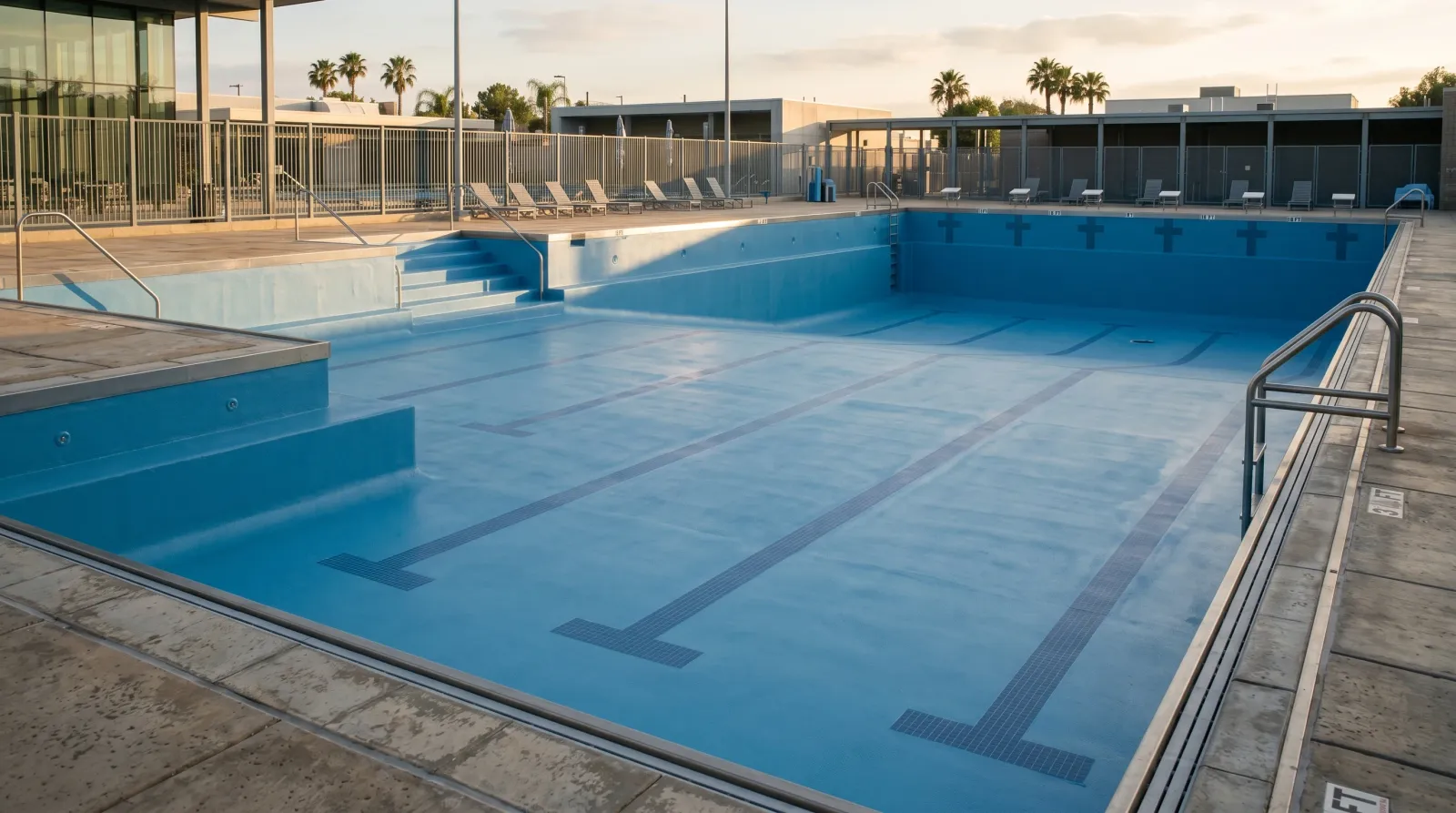
Rubber pool paint is a maintenance coating for the interior basin of plaster, concrete, and gunite swimming pools. The asset is a water-immersed concrete shell that takes constant hydrostatic pressure from one side, chlorinated or salt water on the other, UV at the waterline, and a freeze-thaw cycle in any climate that drains seasonally. The coating job is cosmetic and protective at once: hide the gray of aged plaster, seal surface porosity so the basin holds water without weeping, and present a cleanable film that resists algae and chemical etch for a few seasons at a time.
Two chemistries share the “rubber” label. Chlorinated rubber is the older solvent-borne resin, prized for water resistance and a hard, slick finish that releases dirt. Synthetic rubber (an acrylic-modified rubber resin, sometimes sold as “rubber-base” or “synthetic rubber base”) is the modern stand-in where chlorinated rubber is restricted or discontinued. Both go down as a brush-and-roller film, both want bare prepped concrete or a same-chemistry recoat, and both are specified where the owner wants the lowest installed cost per square foot and accepts a shorter recoat cycle in exchange.
This is the recoat-every-few-seasons play, not the fifteen-year tank-lining play. Service life for a rubber-base system runs two to four seasons depending on water chemistry, sun exposure, and how well the basin was prepped. The spec calls for it on municipal and HOA pools, hotel and apartment pools, and older residential basins already carrying a rubber film, where stripping to bare for an epoxy conversion is not in the budget. Where the owner wants ten-plus years and will fund the prep, an epoxy pool coating is the correct call instead. Rubber paint earns its place on the cost line and on the calendar: it goes on fast, it goes over itself, and it gets the pool back in service inside a week.
Spec Requirements
| Spec | Value |
|---|---|
| Dry film thickness (DFT) | 5–7 mils dry per coat; two coats; 10–14 mils total |
| Coverage @ DFT | 175–250 sq ft / gal first coat (porous plaster pulls more); 250–350 sq ft / gal second coat |
| VOC | 340–420 g/L solvent-borne chlorinated rubber; CARB / SCAQMD counties restrict above 340 g/L (verify before specifying, or switch to a water-thinned synthetic rubber line) |
| Standards | ASTM D4541 (adhesion pull-off), ASTM D2486 (scrub), ASTM D522 (mandrel elongation for flexibility over hairline cracks) |
| Substrate prep (bare) | Acid-etch with 10–15% muriatic acid to a profile like 80-grit sandpaper; equivalent to ICRI CSP 2; neutralize, rinse, dry |
| Substrate prep (recoat) | Same-chemistry film only; scrub, sand gloss, rinse; confirm with a solvent-rub test |
| Cure time on new concrete | 30 days minimum cure of gunite or plaster before coating |
| Service temp (application) | 50°F to 90°F substrate and air; never below 50°F |
| Dew point / humidity | Substrate ≥5°F above dew point; no rain forecast 24h after final coat |
| Cure to service | Recoat at 12–24h between coats; fill pool 5–7 days after final coat (full solvent flash-off) |
The two specs that owners underspecify are cure-before-fill and the recoat compatibility check. Chlorinated rubber holds its solvent for days. Fill the pool at 48 hours to save a weekend and you trap solvent under the film, which softens the coating and pulls it off the wall in sheets within the first season. The compatibility check is the other one: rubber paint over an unknown old coating is a coin flip, and it lands on “peel” more often than owners expect.
System Chemistry Compared
Three pool-coating chemistries compete for the same drained basin. Pick the class before you pick a can.
| Class | Recoat window | Fill after final | Service life | UV / waterline | $/sq ft installed | Best for |
|---|---|---|---|---|---|---|
| Chlorinated rubber (this guide) | 12–24h | 5–7 days | 2–4 seasons | Fair; chalks at waterline | $0.75–$1.75 | Lowest-cost recoat over existing rubber film |
| Synthetic rubber base | 12–24h | 5–7 days | 2–4 seasons | Fair to good | $0.85–$2.00 | CARB/SCAQMD counties; rubber recoats where chlorinated is restricted |
| Acrylic / water-based | 4–8h | 3–5 days | 2–3 seasons | Good | $0.70–$1.50 | Fast turnaround, easy cleanup, shortest service life |
| Epoxy (not rubber) | 12–16h | 7–10 days | 7–10 years | Good but chalks | $2.50–$5.00 | Long-life basins where prep and downtime are funded |
For a basin already wearing a rubber film, stay in the rubber family. Switching to epoxy means stripping to bare plaster, which doubles the prep cost and the downtime. For a county that restricts solvent VOC, a synthetic rubber-base or acrylic line gets you the same recoat cycle without the compliance fight. Reach for epoxy only when the owner has decided to convert the pool to a long-life coating and will fund the strip, the etch, and a ten-day downtime.
Recommended Systems
System A — Chlorinated Rubber, Maximum Water Resistance
Service life: 3–4 seasons. Total DFT 10–12 mils. The hardest, slickest finish; best dirt and algae release. Specify only where solvent VOC limits allow.
| Layer | Product | DFT |
|---|---|---|
| Etch / condition | Muriatic acid etch + Ramuc surface conditioner | 0 mils (penetrant) |
| First coat | Ramuc Type EP Chlorinated Rubber | 5–6 mils |
| Topcoat | Ramuc Type EP Chlorinated Rubber (second coat) | 5–6 mils |
Ramuc pool paint product page →
System B — Synthetic Rubber Base, VOC-Compliant
Service life: 2–4 seasons. Total DFT 10 mils. The default where chlorinated rubber is restricted or discontinued, and the easiest of the three to apply.
| Layer | Product | DFT |
|---|---|---|
| First coat | Rust-Oleum Zinsser Synthetic Rubber Base Pool Paint | 5 mils |
| Topcoat | Rust-Oleum Zinsser Synthetic Rubber Base Pool Paint (second coat) | 5 mils |
Rust-Oleum / Zinsser product catalog →
System C — Rubber-Base Recoat, Budget Cycle
Service life: 2–3 seasons. Total DFT 10–12 mils. For an existing rubber-coated basin getting a routine refresh, not a conversion. Kelley Technical Coatings (Olympic) is the long-running specialist here.
| Layer | Product | DFT |
|---|---|---|
| First coat | Olympic Patio Tones Rubber-Base Pool Paint | 5–6 mils |
| Topcoat | Olympic Patio Tones Rubber-Base Pool Paint (second coat) | 5–6 mils |
Kelley Technical Coatings (Olympic) →
Systems Compared
| System | Total DFT | $/sq ft installed | Service life | Best for |
|---|---|---|---|---|
| A — Chlorinated rubber | 10–12 mils | $1.25–$1.75 | 3–4 seasons | Best water resistance; non-restricted counties |
| B — Synthetic rubber base | 10 mils | $1.00–$1.50 | 2–4 seasons | CARB/SCAQMD compliance; easiest application |
| C — Rubber-base recoat | 10–12 mils | $0.85–$1.25 | 2–3 seasons | Routine refresh of an existing rubber basin |
Installed cost includes acid etch, neutralize, rinse, two coats, and applicator labor. A DIY crew on a small basin drops cost roughly 40%, and on rubber paint that math is defensible, because the application itself is forgiving. The savings evaporate if the crew skips the etch or fills the pool early. Note the narrow spread between the three systems: rubber-base pool paint is a low-cost class across the board, and the real money is in surface prep and downtime, not the can.
Application & Contractor Path
Rubber pool paint sits on the DIY-capable end of this pillar. A competent maintenance crew with rollers, a respirator rated for solvent vapor, and a free week of dry weather can coat a small basin. That is the honest call, and it separates this coating from the epoxy and tank-lining classes that genuinely require a certified applicator.
The steps that decide the result are not the rollout:
- Drain and clean. Pressure-wash the basin. Scrape any loose or flaking old coating to a sound edge.
- Etch. On bare plaster or concrete, scrub a 10–15% muriatic acid solution onto the surface, let it fizz, and work it with a stiff brush until the profile reads like 80-grit paper. Wear acid-rated PPE.
- Neutralize and rinse. Flush with a soda-ash or TSP rinse to bring pH back up, then rinse to clean water. Acid residue under the film is a peel waiting to happen.
- Dry. Let the basin dry fully. Damp plaster reads dry on the surface and holds water in the pores. Give it 24–72 hours of dry weather.
- Coat. Roll two thin coats at 5–6 mils each, not one heavy coat. Keep a wet edge. Respect the 12–24h recoat window.
- Cure before fill. Hold the pool empty 5–7 days after the final coat so the solvent flashes off completely.
For pools over roughly 1,000 square feet of surface, municipal or commercial basins under a maintenance contract, or any pool with an unknown prior coating, specify a pool-coating contractor. There is no SSPC-QP1 or NACE credential typical for this class the way there is for tank linings; the relevant qualification is documented pool-coating experience and a willingness to run a solvent-rub compatibility test before quoting. The manufacturer rep path runs through Ramuc, Kelley Technical (Olympic), and Rust-Oleum technical service, all of whom will field a compatibility and color question by phone. If the substrate is bare masonry you have never coated, the masonry prep and primer guide covers the etch-and-neutralize sequence in more detail.
Failure Modes & How to Prevent Them
- Blistering from trapped moisture. Solvent flash-off or substrate moisture lifts the film into disc-shaped blisters within the first fill. Prevention: hold the pool empty 5–7 days after the final coat, and confirm the substrate is dry before coating. New gunite or plaster cures 30 days minimum. The mechanism is the same one behind paint blistering on any sealed substrate.
- Peeling over an incompatible coating. Rubber paint over epoxy or an unknown film delaminates in sheets. Prevention: run a xylene solvent-rub test. If the old film softens, recoat in kind. If it stays hard and glossy, strip to bare and re-etch before coating.
- Adhesion failure from skipped etch. Rubber paint over sealed, troweled, or unetched plaster has no mechanical key and slides off under water pressure. Prevention: acid-etch to an 80-grit profile (ICRI CSP 2 equivalent), then neutralize and rinse.
- Waterline chalking and fade. Chlorinated rubber chalks at the air-water interface where UV is strongest, leaving a dusty band. Prevention: expect it, and budget the waterline as the first zone to refresh. A synthetic rubber-base or acrylic line holds color slightly better at the waterline.
- Efflorescence bleed-through. Salt deposits push out of the concrete and break the film from beneath, common on basins that sat empty and wet. Prevention: clean off the white crystalline deposits before coating and confirm the source of water intrusion. The diagnosis runs parallel to efflorescence on masonry.
- Cold-application failure. Below 50°F the solvent will not flash and the film will not coalesce, leaving a soft, tacky coat. Prevention: coat only when substrate and air hold 50–90°F, with the substrate at least 5°F above dew point.
Total Cost of Ownership
The installed cost is only the first season. Over a six-year horizon on a 2,000 square foot basin:
| System | Installed $/sf | Recoat interval | 6-year recoats | TCO (6yr, $/sf) |
|---|---|---|---|---|
| A — Chlorinated rubber | $1.50 | 3–4 yrs | 1 | $2.25–$3.00 |
| B — Synthetic rubber base | $1.25 | 2–4 yrs | 1–2 | $2.50–$3.75 |
| C — Rubber-base recoat | $1.10 | 2–3 yrs | 2 | $2.75–$3.30 |
| Epoxy (reference) | $3.50 | 7–10 yrs | 0 | $3.50 |
Across six years the rubber systems and an epoxy conversion land close together on total cost. The difference is cash flow and downtime: rubber paint spreads the spend across small seasonal recoats with a one-week pool closure each time, while epoxy is one large outlay and a ten-day closure up front. For an HOA or a hotel that cannot lose ten pool-days in season, the rubber recoat cycle wins on the calendar even when the dollars are a wash. For a municipal pool drained every winter anyway, the recoat slots into the off-season at no operational cost.
Where to Buy / Spec
| Channel | Best for | Link |
|---|---|---|
| Manufacturer-direct (Ramuc, Kelley/Olympic, Rust-Oleum) | Spec’d projects, color and compatibility support | Ramuc · Kelley Technical |
| Pool-supply distributor (Leslie’s Pro, regional pool wholesalers) | Bulk gallons, contractor accounts, local pickup | (regional) |
| Pro retail (Sherwin-Williams, paint specialty stores) | Smaller basins, color match | (store locator) |
| Amazon Business | Small jobs, multi-property stocking | (search by manufacturer) |
Spec language to drop into a maintenance RFP: “Provide and apply two coats of [chlorinated / synthetic] rubber-base pool paint per manufacturer data sheet (Ramuc Type EP or approved equal). Bare substrate to be acid-etched to an 80-grit profile, neutralized, and rinsed; existing coating to be tested for compatibility by solvent rub prior to recoat. Apply at 5–6 mils dry per coat, 50–90°F, substrate minimum 5°F above dew point. Hold basin empty 5–7 days after final coat before fill. Material warranty minimum one year; applicator to warrant adhesion two seasons.”