Cleanroom Coatings for Pharma Facilities: Specifier's Guide (2026)
Cleanroom coating systems for pharma walls, ceilings, and floors compared by DFT, VOC, and cleanability. ISO 14644, USP 797, ICRI CSP prep, and the contractor path.

Disclosure: Affiliate links to retailers and manufacturer-direct programs. Recommendations are spec-driven, not commission-driven.
Use Case
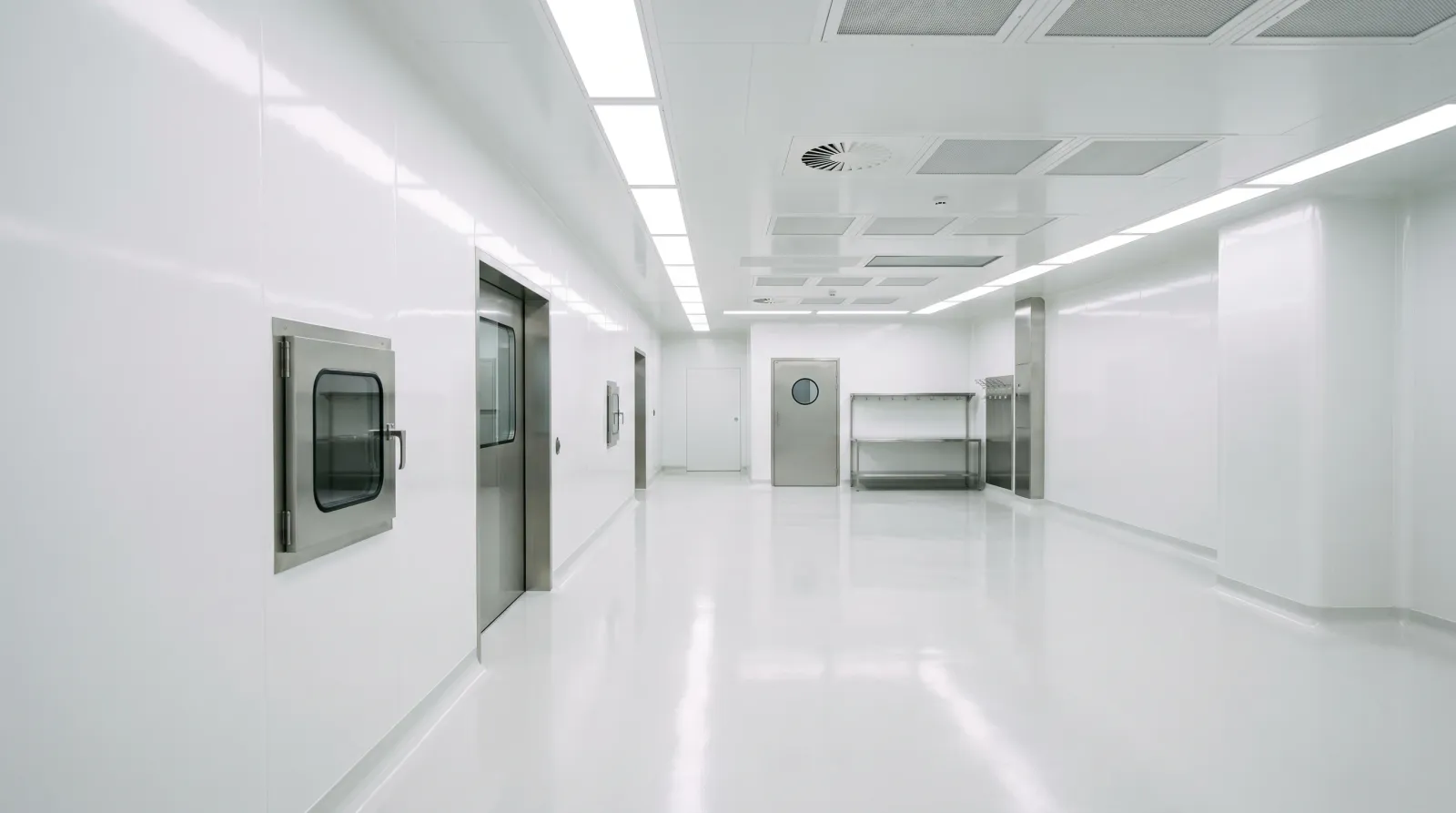
A pharma cleanroom coating has one job that no architectural finish has to do: hold a particle count. The surfaces in a classified space are part of the contamination-control system. They must be smooth, non-porous, non-shedding, chemically resistant to a punishing disinfectant rotation, and cleanable to a validated standard, year after year, through hundreds of wash-down cycles. A wall finish that chalks, a floor that pinholes, or a cove that cracks does not just look bad. It releases particles and viable contamination into the air stream and pulls the room out of its ISO 14644 classification.
The spec gets written into pharmaceutical manufacturing suites, sterile fill-finish lines, USP <797> sterile compounding pharmacies, USP <800> hazardous-drug rooms, biotech and cell-therapy labs, medical-device assembly, and the gowning and material-airlock spaces that feed them. ISO 14644-1 sets the cleanliness class (Class 5 through Class 8 for most pharma work), and FDA 21 CFR Part 211 cGMP requires that surfaces in contact with the production environment be cleanable and maintained. The coating is what makes a poured slab and a gypsum or block wall meet that requirement.
Service life for a waterborne epoxy wall and ceiling system in a conditioned, positive-pressure suite is 8 to 12 years before a refresh coat. A properly installed high-build epoxy or urethane-cement floor with coved bases runs 10 to 20 years. The number that ends service life early is rarely wear. It is the disinfectant. The sporicidal chemistry that keeps the room sterile also attacks the coating, and the finish that cannot survive the cleaning SOP fails at the surface long before it fails at the substrate.
Zoned Recommendation Matrix
A cleanroom suite is not one surface. Walls, ceilings, floors, and coves see different stresses and carry different specs. The system map for a typical sterile manufacturing suite:
| Zone / surface | Cleanliness driver | Recommended system | Why |
|---|---|---|---|
| Classified walls (Class 5–7) | Disinfectant resistance, no shedding | Waterborne epoxy, 2 coats over filled and sanded substrate (System A or B) | Smooth, non-porous, survives quat and peroxide rotation |
| Classified ceilings | Same as walls plus overhead exposure | Same waterborne epoxy finish | Continuous film with the wall; no separate sealant line |
| Production floor (dry process) | Abrasion, chemical spill, cleanability | High-build epoxy with integral cove (System A or B floor) | Monolithic, seamless, coved to the wall |
| Wet process / wash bay / autoclave | Thermal shock, standing water, slope | Urethane cement with fine aggregate (specialty) | Survives steam, hot water, and thermal cycling that cracks epoxy |
| Floor-to-wall junction | Particle trap if square | Coved base, 4-inch radius minimum | Eliminates the 90-degree corner that cannot be cleaned |
| Gowning / anteroom (unclassified or Class 8) | Lighter duty | Pre-catalyzed waterborne epoxy (System C) | Lower cost where the class allows it |
For a single small compounding room under USP <797>, one wall-and-ceiling system and one floor system covers the space. For a multi-suite manufacturing facility, the wet-process zones break out of the epoxy spec and into urethane cement, and that distinction needs to be drawn at the drawing stage, not discovered when the autoclave room floor cracks in year two.
Spec Requirements
The spec block, before naming product. The categories hold across manufacturers; the exact numbers track the specific product data sheet and the room’s cleanliness class.
| Spec | Value |
|---|---|
| Wall / ceiling DFT | 4–6 mils dry, two coats, over filled and sanded substrate |
| Floor DFT | 12–25 mils high-build epoxy; 30–250 mils for self-leveling or urethane cement systems |
| Coverage @ DFT | 150–250 sq ft/gal walls and ceilings at spec’d DFT |
| VOC | <100 g/L wall and ceiling; <50 g/L low-odor amine-free floor epoxies under SCAQMD Rule 1113 and CARB |
| Standards | ISO 14644-1 class, USP <797>/<800>, FDA 21 CFR 211, ASTM D4060 (abrasion), ASTM D5402 (MEK chemical resistance), ASTM D3273 (mold) |
| Substrate prep (concrete floor) | SSPC-SP13 mechanical (shotblast) to ICRI CSP 3; CSP 4 under high-build or self-leveling systems |
| Substrate prep (block / gypsum wall) | Skim-fill, block-fill, and sand to a continuous non-porous surface; SSPC-SP1 solvent clean |
| Moisture ceiling (floors) | ASTM F1869 ≤3 lb/1,000 sq ft/24h; ASTM F2170 ≤75% internal RH |
| Service temp | -20°F to +180°F epoxy; -40°F to +250°F urethane cement (wet zones) |
| Cure to service | Foot traffic 24h · full cleanability and chemical cure 7 days |
| Ambient at application | 50°F to 90°F; relative humidity <85%; substrate ≥5°F above dew point |
| Slip resistance | OSHA 1910.22 static COF ≥0.5 on floors, balanced against cleanability per zone |
Three requirements separate a cleanroom coating from a generic industrial finish: the surface has to be continuous and non-porous (filled substrate, no pinholes, coved corners), it has to survive the disinfectant SOP (confirm chemical resistance against the actual cleaning agents, not a generic rating), and the floor moisture has to be inside the ceiling before the system goes down. Miss the disinfectant check and the room passes qualification, then degrades through the first year of cleaning.
System Chemistry Compared
Three chemistries cover almost every pharma cleanroom surface. The choice is driven by the zone and the cleaning regime, not by price alone.
| Chemistry | Pot life | Recoat window | Service temp | UV stability | $/sq ft installed | Best for |
|---|---|---|---|---|---|---|
| Waterborne / pre-catalyzed epoxy | 2–4 h | 4–16 h | -20°F to 180°F | Moderate (interior only) | $3–7 (walls) | Classified walls and ceilings; low odor; the default |
| High-build / self-leveling epoxy | 20–45 min | 8–24 h | -20°F to 180°F | Low (yellows in sun) | $6–14 (floors) | Production floors, monolithic seamless slabs |
| Urethane cement | 20–30 min | 8–12 h | -40°F to 250°F | Good | $12–25 (floors) | Wet zones, autoclave and wash bays, thermal cycling |
Waterborne epoxy is the right answer for nearly every classified wall and ceiling. Its low odor and low VOC matter in an occupied, HVAC-controlled facility where solvent fumes contaminate adjacent operating suites. High-build epoxy owns the dry production floor on cost and cleanability. Urethane cement is the only correct call for any floor that sees steam, hot water, or thermal shock, because epoxy cracks under the thermal cycling and a cracked floor is a contamination breach.
Recommended Systems
Three full systems at different price-performance points. Each pairs a wall-and-ceiling finish with a floor build, because a cleanroom is specified as a continuous shell. Verify the specific product data sheet and disinfectant-compatibility chart against your cleaning SOP before bid.
System A: Sherwin-Williams ProIndustrial (Pre-Catalyzed Epoxy Walls, ArmorSeal Floor)
| Layer | Product | DFT |
|---|---|---|
| Wall/ceiling primer | Pro-Cryl Universal Acrylic Primer | 2–3 mils |
| Wall/ceiling finish | ProIndustrial Pre-Catalyzed Waterbased Epoxy (2 coats) | 4–6 mils |
| Floor primer | ArmorSeal 1K HS (moisture-mitigating where MVE fails) | 2–4 mils |
| Floor topcoat | ArmorSeal 1000 HS Epoxy (2 coats, integral cove) | 12–20 mils |
| Total (floor system) | 14–24 mils |
Service life 8–12 years on walls, 10–15 on floors under cleanroom traffic. The pre-catalyzed epoxy gives a hard, scrubbable, low-sheen wall surface that holds up to a quaternary ammonium and hydrogen peroxide disinfectant rotation. Sherwin-Williams runs a dense rep and store network, which shortens the path on touch-up and warranty. Sherwin-Williams ProIndustrial product page.
System B: Tnemec (Series 113 Walls, Series 282 Floor)
| Layer | Product | DFT |
|---|---|---|
| Wall/ceiling primer | Series 1028 Enduratone or Series 151 Elasto-Grip FC | 2–4 mils |
| Wall/ceiling finish | Series 113 Tneme-Tufcoat waterborne epoxy (2 coats) | 4–8 mils |
| Floor primer | Series 201 Epoxoprime (moisture-mitigating) | 4–8 mils |
| Floor topcoat | Series 282 Tneme-Glaze high-build epoxy (coved) | 15–30 mils |
| Total (floor system) | 19–38 mils |
Service life 10–15 years walls, 15–20 floors. Tnemec carries the longest documented track record in pharma and institutional immersion-grade coatings, and its disinfectant-resistance documentation is the most thorough of the three for sporicidal cleaning regimes. Specify Tnemec when the facility runs an aggressive peracetic acid or peroxide cycle and the validation team wants chemical-resistance data keyed to the specific agent. Heavier price band; chosen on documentation depth and immersion-grade durability. Tnemec product line.
System C: PPG (Pitt-Glaze WB1 Walls, Aquapon Floor)
| Layer | Product | DFT |
|---|---|---|
| Wall/ceiling primer | Seal Grip universal primer (or self-priming) | 2–3 mils |
| Wall/ceiling finish | Pitt-Glaze WB1 pre-catalyzed acrylic epoxy (2 coats) | 4–6 mils |
| Floor primer | Aquapon WB EP base coat | 4–6 mils |
| Floor topcoat | Aquapon WB EP waterborne epoxy floor coating | 10–14 mils |
| Total (floor system) | 14–20 mils |
Service life 8–12 years walls, 8–12 floors. Pitt-Glaze WB1 is the value play on classified walls and a common spec for gowning rooms, anterooms, and Class 8 support space where the cleaning regime is lighter than a fill-finish suite. The waterborne floor build keeps odor and VOC low for occupied-facility work. Specify System C for the lower-class zones in a multi-suite facility and reserve System A or B for the critical production rooms. PPG Protective & Marine product page.
Systems Compared
| System | Total DFT (floor) | $/sq ft installed | Service life | Best for |
|---|---|---|---|---|
| A: Sherwin-Williams ProIndustrial | 14–24 mils | $6–11 | 8–15 years | Broad spec, strong rep/store network, fast warranty path |
| B: Tnemec Series 113 / 282 | 19–38 mils | $9–16 | 10–20 years | Aggressive disinfectant SOPs, immersion-grade durability, deepest documentation |
| C: PPG Pitt-Glaze / Aquapon | 14–20 mils | $5–10 | 8–12 years | Gowning, anterooms, Class 8 support zones, lower-class space |
Pricing covers prep, primer, build, topcoat, integral cove, and certified-applicator labor on a classified-space scope above 2,000 square feet. Wet-process zones that require urethane cement run $12–25 per square foot on the floor and are priced separately. Small single-room compounding scopes run 30–60% higher per square foot because the mobilization and the classified-space protocols do not scale down.
Application & Contractor Path
A classified cleanroom coating is not a DIY product and is not a job for a general commercial painting crew. The deliverable is a pinhole-free, coved, monolithic film that passes a particle count, applied under contamination-control protocols inside an active or soon-to-be-validated facility. Specify a contractor with the following:
- SSPC-QP1 certification for industrial coatings, plus documented cleanroom, pharma, or USP <797>/<800> project history. Ask for two reference projects that passed requalification.
- A NACE/AMPP CIP Level 2 inspector for DFT verification and holiday inspection (the low-voltage spark test that finds pinholes in the film).
- Manufacturer-applicator certification on the specific product line being installed.
Three contractor-qualifying questions before signing:
- How do you form and inspect the floor-to-wall cove? A square corner cannot be cleaned and will fail a swab test. The cove has to be a continuous radius, integral with both the floor and the wall film.
- What is your holiday-inspection protocol on the floor? A pinhole in a cleanroom floor is a contamination reservoir. Low-voltage holiday detection per the manufacturer’s TDS, documented per square foot, is the standard.
- How do you stage the work against the facility’s pressure cascade and HVAC? Solvent and dust migrate. The application sequence has to protect adjacent classified suites that may still be in operation.
The manufacturer rep networks on all three systems include a pre-construction review of the room finish schedule, the disinfectant SOP, and the moisture test results. Use it. Catching a disinfectant incompatibility on the data sheet costs an email. Catching it after the room is coated and the first peracetic-acid cycle softens the wall costs a requalification and a re-coat.
For a small, unclassified gowning anteroom below Class 8, a qualified commercial crew applying System C is defensible. The classified production space is not that job.
Failure Modes & How to Prevent Them
Five failures cover the bulk of cleanroom coating rejections and early-service problems.
- Disinfectant attack on the wall film. Cause: the finish was selected on a generic chemical-resistance rating, not against the facility’s actual sporicidal SOP. Quaternary ammonium, hydrogen peroxide, and peracetic acid each load the film differently. Prevention: confirm chemical resistance per ASTM D5402 against the specific cleaning agents in the SOP, including dwell time, before product selection.
- Floor delamination from moisture vapor. Cause: the slab was coated without an ASTM F1869 or F2170 test, and vapor lifted the floor in disc-shaped blisters. Pharma slabs are prone to this because tight humidity control drives vapor toward the slab underside. Prevention: moisture test before any floor system, and install a moisture-mitigating primer if the slab reads above 3 lb/1,000 sq ft/24h or 75% internal RH.
- Cracked cove or floor at wet-process zones. Cause: standard epoxy was specified where steam, hot water, or thermal cycling occurs. Epoxy cracks under thermal shock, and a crack is a contamination breach. Prevention: spec urethane cement, not epoxy, in autoclave rooms, wash bays, and any zone that sees hot water or sloped drainage.
- Pinholes and porosity in the film. Cause: substrate was not fully filled and sanded, or the film was applied too thin to bridge the surface porosity. Prevention: block-fill and skim the substrate to a continuous non-porous surface, hit the spec’d DFT in two coats, and run holiday inspection to catch what the eye misses.
- Chalking and gloss loss reading as shedding. Cause: a coating with poor interior weathering or an under-cured film breaks down at the surface and releases particles. Prevention: specify a finish documented for interior cleanroom service, hit the full chemical cure (7 days) before the room goes into disinfectant rotation, and verify cure before requalification.
The disinfectant failure is the one that catches facilities off guard. The room passes its initial classification, then degrades through the first six months of cleaning because the finish was never matched to the cleaning chemistry. That match is a pre-selection step, not a field fix.
Where to Buy / Spec
| Channel | Best for | Path |
|---|---|---|
| Manufacturer-direct rep (S-W, Tnemec, PPG) | Spec’d classified projects, disinfectant-compatibility review, warranty | S-W ProIndustrial · Tnemec · PPG PMC |
| Industrial distributor | Multi-manufacturer projects, mixed wall/floor/wet-zone bids | Distributor account with project-specific pricing |
| Pro retail (S-W stores, BM Pro) | Touch-up, small support-room scopes, local pickup | Store locator with contractor pricing |
| Amazon Business | Maintenance touch-up stocking, gowning-room consumables | Search by manufacturer line |
Manufacturer-direct is the recommended channel on any classified-space project. The rep review of the finish schedule against the disinfectant SOP and the moisture test results is worth more than any retail discount on the can, because it is the step that keeps the room in classification through the first year of cleaning.
FAQ
See the questions a facility buyer actually asks, answered in the spec terms above. The short version: classified space needs a certified applicator, the floor needs a moisture test, and the wall finish has to be matched to the disinfectant SOP before it is selected.