Metal Roof Paint: Commercial Specifier's Guide (2026)
Metal roof paint compared by chemistry for standing-seam, R-panel, and corrugated steel. SSPC-SP prep, DFT in mils, rust control, and the contractor path.

Disclosure: Affiliate links to retailers and manufacturer-direct programs. Recommendations are spec-driven, not commission-driven.
Use Case
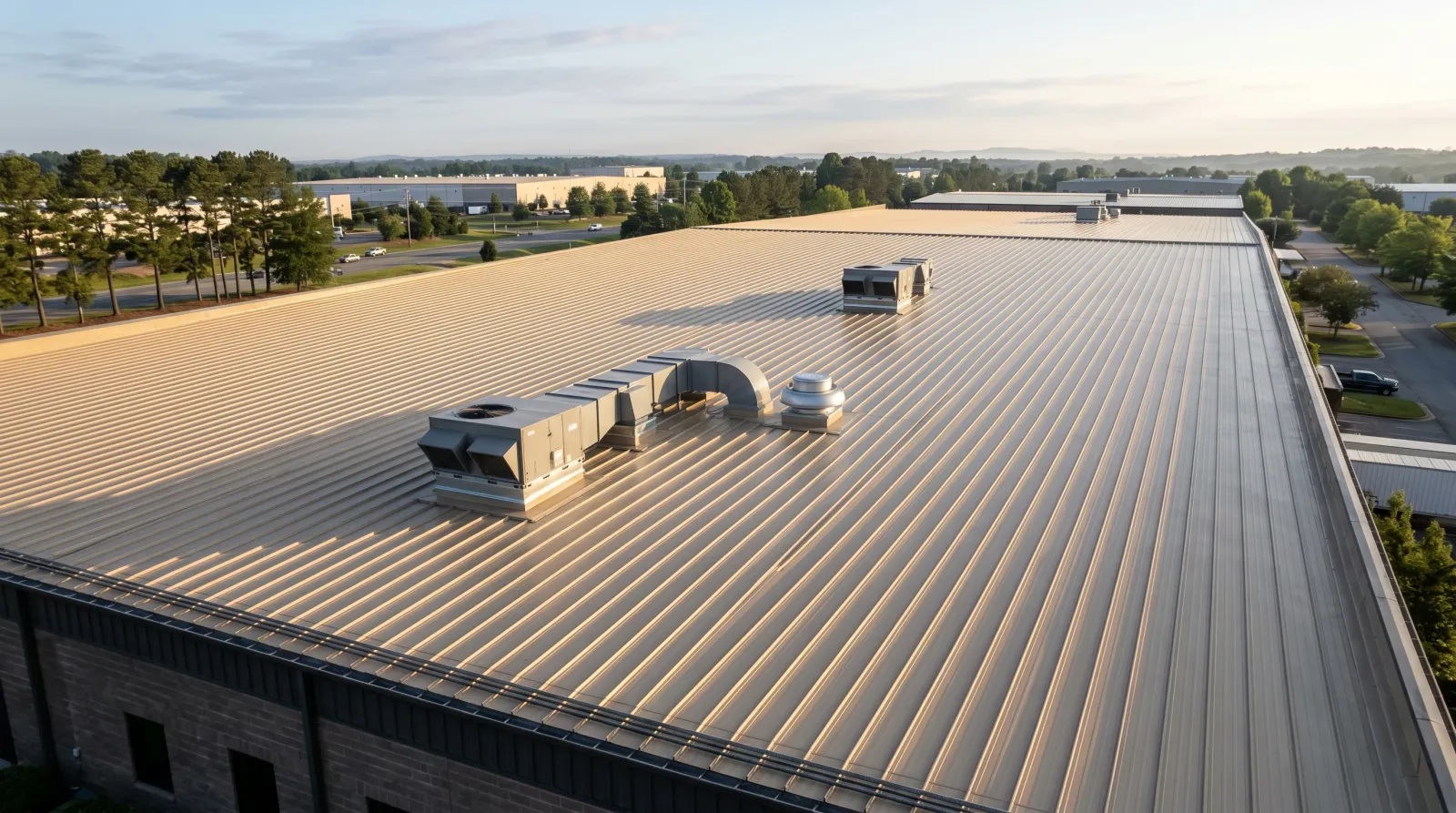
Metal roof paint is a direct-to-metal coating system spec’d to repaint and protect an exposed-fastener or standing-seam metal roof that has faded, chalked, or started to corrode but is still structurally sound. The asset is the steel or aluminum roof on a warehouse, distribution center, agricultural building, light-manufacturing plant, big-box retail box, or a metal-clad institutional building. The original factory finish was a coil-applied polyester (SMP) or fluoropolymer (PVDF/Kynar 500) baked onto the panel at the mill. That finish weathers, the gloss falls off, the color shifts, and the cut edges and fasteners begin to rust. Field repainting restores the surface in place instead of re-roofing it.
The economic case is repaint-versus-replace. Tearing off and re-paneling a metal roof runs $9 to $16 per square foot. A direct-to-metal repaint over a sound deck runs $1.50 to $4 per square foot installed and resets the corrosion and appearance clock by 10 to 20 years. The condition that makes the repaint valid is the same one that makes it cheap: the panels and structure are sound, the corrosion is surface-level, and the leaks (if any) are at fasteners and seams that can be re-detailed, not at failed panels. Paint does not fix a perforated panel or a structural deck problem.
Two outcomes drive the spec. The first is corrosion control: a rust-inhibitive primer and a flexible topcoat that move with the panel through thermal cycling and keep oxygen and chloride off the steel. The second is appearance and energy: a uniform, color-stable finish, often a cool-color pigment that drops rooftop temperature and qualifies for cool-roof rebates. Service life tracks chemistry and dry mil thickness. A waterborne acrylic DTM at 6 to 8 dry mils holds 10 to 15 years on a clean, well-primed roof. A silicone-modified acrylic or a fluoropolymer field finish pushes color and chalk retention further. Where the roof also needs to stop leaking, the job crosses over from a repaint into an elastomeric restoration at 20 to 30 dry mils.
Spec Requirements
The spec block governs the bid. The numbers move with chemistry, substrate condition, and whether the scope is a straight repaint or an elastomeric restoration. A roof is a single-zone asset, so one system is written across the deck rather than a zone matrix.
| Spec | Value |
|---|---|
| Dry film thickness (DFT), DTM repaint | 5–12 mils total: 2–3 mils primer plus two finish coats at 2–4 mils each |
| Dry film thickness, elastomeric crossover | 20–30 mils total dry over a rust-treated, primed deck |
| Coverage @ spec’d DFT | DTM finish 250–400 sq ft/gal per coat (panel profile and overspray loss drive the low end); elastomeric 1.0–1.5 gal per 100 sq ft per coat |
| VOC | <100 g/L waterborne acrylic DTM under SCAQMD Rule 1113; solvent-borne alkyd and silicone-modified run 150–340 g/L, so verify CARB and SCAQMD before a California bid |
| Standards | ASTM B117 salt fog (corrosion), ASTM D3359 adhesion, ASTM D4214 chalk rating, ASTM D4587 accelerated weathering, ASTM D4145 coil bend; ASTM D6083 if an elastomeric crossover is spec’d |
| Cool-roof rating | CRRC-listed reflectance/emittance; ENERGY STAR Roof Products for qualifying cool-color finishes; SRI from ASTM C1549/C1371 |
| Substrate prep, light/moderate rust | SSPC-SP2 hand-tool or SSPC-SP3 power-tool clean to tight, sound metal; remove chalk and dirt by low-pressure wash; full dry |
| Substrate prep, heavy/pitted rust | SSPC-SP6 commercial blast on the corroded areas; rust-inhibitive or rust-converting primer over the cleaned steel |
| Galvanized / aluminum panels | Degloss and remove white rust and mill oil; self-etching or galvanized-rated DTM primer; no alkyd direct on galv (saponification risk) |
| Seam and fastener detailing | Re-fasten backed-out screws (oversized/gasketed); seal laps and fastener heads; embed polyester at seams on any watertight or warranted system |
| Ambient at application | Air and substrate 50°F to 100°F; substrate ≥5°F above dew point; panel temperature checked, not air temperature, on a metal roof |
| Cure to service | Rain-resistant 1–8 hr depending on chemistry; full cure 7–14 days before foot traffic or ponding exposure |
Four numbers decide the outcome: the SSPC prep grade against the corrosion level, the primer matched to the metal (galvanized, aluminum, or weathered steel), total dry mils against the warranty tier, and the panel-temperature-versus-dew-point window during application. Get the prep grade wrong and the film lifts off residual scale. Put an alkyd straight on galvanized and it saponifies and peels. Spray below the dew point on a cold panel at dawn and the film never bonds.
System Chemistry Compared
Four chemistries carry almost every commercial metal-roof repaint or restoration spec. The choice is driven by whether the roof needs to stop leaking, how much color and chalk retention the owner wants, and the budget, before any product name comes up.
| Chemistry | Recoat window | Watertight build | Corrosion / UV | $/sq ft installed | Best for |
|---|---|---|---|---|---|
| Waterborne acrylic DTM | 2–4 hr | 🔴 Color/corrosion refresh only; not a membrane | 🟢 Good corrosion control, holds color, low VOC | $1.50–3.00 | Faded sound roofs, cool-color repaints, lowest VOC, California bids |
| Silicone-modified acrylic (SMA) | 4–8 hr | 🔴 Refresh only | 🟢 Better chalk/color retention than straight acrylic | $2.00–3.50 | Higher-end appearance, harsh-UV climates, longer color life |
| Solvent-borne alkyd / urethane | 6–16 hr | 🔴 Refresh only | 🟡 Tough film; chalks faster; high VOC; no alkyd on galv | $1.75–3.25 | Steel panels where adhesion over tight rust matters; non-CARB regions |
| Silicone / acrylic elastomeric | 2–24 hr | 🟢 20–30 mil seamless membrane, stops leaks | 🟢 Excellent; silicone holds ponding | $3.00–5.00 | Roofs that leak at seams/fasteners and need to be made watertight |
Waterborne acrylic DTM wins the straight repaint on cost and on VOC compliance, and it is the chemistry the spec calls for on a California job. Silicone-modified acrylic buys longer color and chalk retention where appearance matters or UV is severe. Solvent-borne alkyd and urethane still earn a place on weathered steel where adhesion over tight residual rust is the priority and the region allows the VOC, but keep alkyd off galvanized panels. The moment the roof has to stop leaking, the job crosses into elastomeric, and you should price the elastomeric roof coating restoration instead of a thin repaint.
Recommended Systems
Three full multi-coat stacks at different chemistry and price points. Each is a real manufacturer system, not a single can. Confirm the substrate-specific primer (steel, galvanized, or aluminum) and the warranty tier against the manufacturer’s published system before bid.
System A: Sherwin-Williams Acrylic DTM Repaint (cool-Color, Low-VOC)
| Layer | Product | DFT |
|---|---|---|
| Rust treatment / primer | S-W Pro-Cryl Universal Acrylic Primer (DTM) | 2–3 mils |
| Seam / fastener detail | Acrylic seam sealant, polyester embedded at laps and screws | spot |
| Finish coat 1 | S-W SWR Acrylic Metal Roof Finish (cool color) | 3–4 mils |
| Finish coat 2 | S-W SWR Acrylic Metal Roof Finish (cool color) | 3–4 mils |
| Total | 8–11 mils |
Service life 10 to 15 years on a clean, well-primed roof. The Pro-Cryl universal acrylic primer bonds direct to weathered steel, galvanized, and aluminum, which removes the substrate-guessing on a mixed-panel roof. The SWR acrylic finish carries cool-color pigments for rebate-qualifying reflectance without forcing stark white. Lowest VOC of the three and the path that clears SCAQMD on a California bid. This refreshes color and controls corrosion; it does not make the roof watertight. Sherwin-Williams roof coatings.
System B: Rust-Oleum Industrial Metal Roof System (steel, Rust-Inhibitive)
| Layer | Product | DFT |
|---|---|---|
| Rust-inhibitive primer | Rust-Oleum 3279 Metal Primer / Rusty Metal Primer on corrosion | 2–3 mils |
| Finish coat 1 | Rust-Oleum 5400 acrylic / silicone-modified metal roof finish | 2–3 mils |
| Finish coat 2 | Rust-Oleum 5400 acrylic / silicone-modified metal roof finish | 2–3 mils |
| Total | 6–9 mils |
Service life 8 to 12 years. The Rust-Oleum path leads with rust-inhibitive priming, which is the differentiator on a corroded steel roof: treat the rust to SSPC-SP3, lock it down with the metal primer, then build the silicone-modified finish for color and chalk retention. Widely stocked through industrial distribution and 5-gal pails, which makes it the practical choice for in-house crews on smaller accessible roofs and for fleet stocking across multiple buildings. Steel-first; on galvanized, confirm the galvanized-rated primer. Rust-Oleum roof coatings.
System C: Henry 587 Tropi-Cool Silicone Restoration (watertight Crossover)
| Layer | Product | DFT |
|---|---|---|
| Rust-inhibitive primer | Henry 167 Rust Inhibitive Primer | 2–3 mils |
| Base coat | Henry 587 Tropi-Cool silicone, polyester embedded at seams/fasteners | 10–15 mils |
| Topcoat | Henry 587 Tropi-Cool silicone (white) | 10–15 mils |
| Total | 22–33 mils |
Service life 15 to 20 years. This is the crossover system for a metal roof that has stopped being just faded and started to leak at the seams and fasteners. The 167 rust-inhibitive primer treats the corrosion, then a 100% silicone builds a seamless 20-plus-mil membrane with polyester reinforcement at every lap and screw. It costs more than a repaint because it does more: it makes the roof watertight and survives ponding at the low spots. ENERGY STAR-listed and CRRC-rated white for cool-roof rebate and Title 24. Henry 587 Tropi-Cool product page.
Systems Compared
| System | Total DFT | $/sq ft installed | Service life | Best for |
|---|---|---|---|---|
| A. S-W Acrylic DTM repaint | 8–11 mils | $1.75–3.25 | 10–15 years | Faded sound roofs, cool-color, low-VOC/California bids |
| B. Rust-Oleum metal roof system | 6–9 mils | $1.50–3.00 | 8–12 years | Corroded steel, rust-inhibitive prime, in-house and fleet jobs |
| C. Henry 587 Tropi-Cool silicone | 22–33 mils | $3.25–5.00 | 15–20 years | Roofs that leak at seams/fasteners and need to be watertight |
Pricing assumes a 20,000-plus sq ft scope through an approved applicator on a substrate in restorable condition. Heavy prep moves the number more than the coating does: blasting pitted corrosion to SSPC-SP6, re-fastening hundreds of backed-out screws, and re-detailing seams add $0.50 to $2.00 per square foot and are the line items most often underbid. Run the numbers over the service-life horizon. A $2.50 acrylic repaint at 13 years costs about $0.19 per square foot per year. A $4 silicone restoration at 18 years runs about $0.22 per square foot per year and includes the watertight membrane. Both beat a $12 re-panel at 30 years, near $0.40 per square foot per year, before any cooling-load savings on the cool-color or white finish.
Application and Contractor Path
A metal-roof repaint is within reach of a trained in-house crew on a small, accessible, single-story roof where the scope is color refresh and light rust control. Spot-treat the rust to SSPC-SP3, prime, and roll or spray two finish coats, with fall protection per OSHA 1910.28 in place the whole time. That is an honest DIY-adjacent scope for a property with one small metal building.
A full repaint or any watertight restoration that carries a manufacturer warranty is a contractor-installed system. The warranty attaches to a documented adhesion test (ASTM D3359), rust treated to the spec’d SSPC grade, a wet-mil log proving the dry build, seam reinforcement where the system calls for it, and a manufacturer field inspection at closeout. A maintenance crew cannot produce that documentation, so the warranty does not attach to their work no matter how clean the spray looks.
Spec a contractor with one of the following:
- Manufacturer-approved applicator status on the specific product line (Sherwin-Williams approved applicator, Rust-Oleum industrial applicator, Henry-certified roofing contractor). Approval is what unlocks the system warranty.
- SSPC-QP1 certification for the surface-prep and coating work on a steel roof, or a current state roofing/general contractor license carrying the workers-comp and liability coverage for rooftop work.
- A documented OSHA 1910.28 / 1926.501 fall-protection program for crews working at the roof edge, around skylights, and over any fragile or translucent panels.
Three contractor-qualifying questions before signing:
- What SSPC grade are you taking the rust to, and how is it verified? SP2/SP3 on light corrosion, SP6 on pitted steel. The prep grade, not the paint, decides whether the film stays bonded.
- What is the wet-mil target per coat, and how is dry build verified? Under-application is the top cause of premature chalk-through and warranty denial. A wet-mil gauge logged per roof section is the answer.
- Who files the manufacturer closeout inspection? That report activates the warranty. A contractor who cannot deliver a signed inspection keyed to the system leaves the owner with paint on a roof and no coverage behind it.
Every manufacturer on this list runs a free pre-bid roof survey through the rep network: panel and fastener condition, corrosion mapping, leak assessment, and a system recommendation with the warranty tier. Use it. The survey is where a leaking roof gets routed to the silicone restoration instead of being underbid as a thin repaint that fails the first wet season.
Failure Modes
Five failures cover the bulk of premature metal-roof-coating rejections and warranty claims.
- Coating over loose rust and scale. Cause: priming and painting before the corrosion was cleaned to tight, sound metal. The rust keeps spreading under the film and lifts it in plates within a season. Prevention: SSPC-SP2/SP3 on light corrosion, SSPC-SP6 on pitted steel, then a rust-inhibitive primer over the cleaned surface. See why exterior coatings chalk and corrode once the surface is left untreated.
- Alkyd or wrong primer on galvanized panels. Cause: an oil/alkyd coating or a non-galvanized primer applied direct to galvanized steel. The film saponifies against the zinc and peels in sheets. Prevention: degloss and remove white rust and mill oil; use a self-etching or galvanized-rated DTM primer; keep alkyd off galv entirely. The same chemistry governs prepping galvanized steel for paint.
- Under-application below the warranty mil thickness. Cause: the crew sprayed thin to stretch material across more panel area. The finish chalks and fades through early and the warranty denies on the mil log. Prevention: wet-mil target written into the contract, wet-mil gauge logged per section, manufacturer field verification at closeout.
- Mistaking a leak for a fade. Cause: a thin repaint spec’d on a roof that is actually leaking at backed-out fasteners and open laps. Paint does not bridge those, and the building keeps leaking under fresh color. Prevention: re-fasten with oversized/gasketed screws, seal and reinforce the seams, and where the leaks are real, step up to a silicone or acrylic elastomeric restoration that builds a watertight membrane.
- Application below dew point on a cold panel. Cause: spraying onto a metal roof at dawn when the panel sits within 5°F of the dew point, or onto a chalk- and dirt-covered surface that was never washed. The film never develops adhesion and delaminates. Prevention: low-pressure wash and full dry; sling psychrometer in use; measure panel temperature, not air temperature, and hold it 5°F above dew point through the cure window.
Loose-rust failures and dew-point delamination account for most of the field rejections I review on metal roofs. Both are caught at the prep stage and the application log. Neither is a field improvisation.
Where to Buy / Spec
| Channel | Best for | Path |
|---|---|---|
| Sherwin-Williams commercial store | Acrylic DTM cool-color repaints; local contractor network and rep support | S-W roof coatings |
| Rust-Oleum industrial / distributor | Rust-inhibitive metal roof systems; 5-gal pails for in-house and fleet jobs | Rust-Oleum roof coatings |
| Henry Company rep / distributor | Silicone restoration where the metal roof must be made watertight | Henry 587 Tropi-Cool page |
| Amazon Business / distributor | Repair-scope material, primer and detail sealant, fleet stocking across buildings | Business account with project pricing |
Manufacturer-direct through an approved applicator is the recommended channel on any warranted repaint or restoration above 5,000 sq ft. The rep network bundles the corrosion survey, the adhesion test, the system spec matched to the panel metal, and the closeout inspection. Those services carry the warranty; a retail discount on the pail does not.
FAQ
See the frontmatter for the full Q&A: contractor requirement, how much rust to remove, whether paint stops leaks, the warranty terms, and the cool-color energy payback.