Marine Deck Paint: Anti-Slip Specifier's Guide (2026)
Anti-slip marine deck coatings compared by DFT, COF, and aggregate grade. Fiberglass and steel prep specs, two-part polyurethane vs epoxy systems, and the contractor path.

Disclosure: Affiliate links to retailers and manufacturer-direct programs. Recommendations are spec-driven, not commission-driven.
Use Case
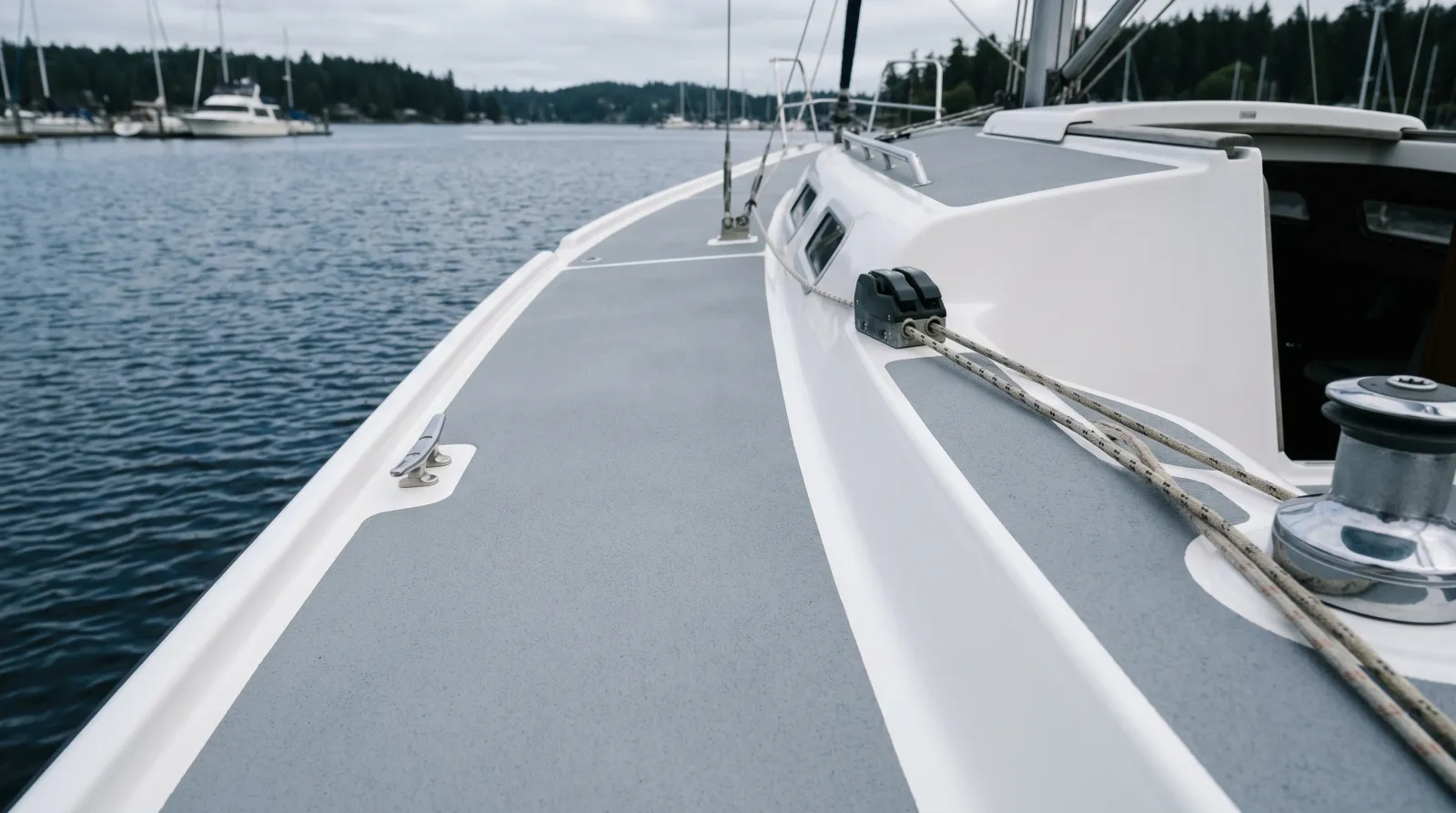
Marine deck paint has one non-negotiable job: keep a person upright on a wet, moving, salt-fouled surface, and keep doing it after UV, freeze-thaw, and washdown chemistry have worked the film for several seasons. The asset is the working deck of a vessel — fiberglass cockpit soles and side decks on recreational and charter boats, painted steel decking on commercial workboats and barges, and the foredeck non-skid that takes the worst of foot traffic and ground tackle. The spec writer is balancing three things at once: slip resistance that meets a coefficient-of-friction target, a film tough enough to survive abrasion from boots and gear, and adhesion to a substrate that flexes and stays damp.
Service life runs by substrate and chemistry. A one-part polyurethane non-skid on a recreational fiberglass deck holds 2–4 years before the aggregate polishes smooth in the traffic paths and the deck goes slick under spray. A two-part polyurethane or epoxy non-skid system on the same deck runs 4–7 years. On blasted-and-primed commercial steel, a full epoxy build with broadcast aluminum-oxide aggregate and a UV-stable seal coat reaches 7–10 years before recoat, and the failure usually shows up first as aggregate wear in the high-traffic lane, not film loss.
The regulatory pressure is real on commercial vessels. OSHA 1910.22 sets a static coefficient-of-friction floor for any walking-working surface, and the Coast Guard’s 46 CFR survey holds inspected commercial vessels to slip-resistance on working decks. A charter operator who lets the foredeck non-skid polish to glass is exposed on both fronts. The spec writer picks a chemistry that meets the COF target, holds adhesion to the deck material, and clears the local VOC ceiling. Get those three right and the rest of the spec follows.
Spec Requirements
| Spec | Value |
|---|---|
| Dry film thickness (DFT) | 6–14 mils total; 2–5 mils per coat plus an aggregate-loaded non-skid course |
| Coverage @ DFT | 100–150 sq ft/gal (one-part non-skid); 80–120 sq ft/gal (epoxy build with aggregate) |
| VOC | under 250 g/L waterborne; under 340 g/L two-part polyurethane; solvent grades restricted under CARB / SCAQMD |
| Standards | ASTM D2047 (static COF), ASTM F1679 (variable-incidence wet slip), ASTM D4060 (Taber abrasion), ASTM D3359 (adhesion) |
| Slip target | OSHA 1910.22 static COF ≥0.5 dry; wet-deck working surface 0.6+ via aggregate broadcast |
| Substrate prep (fiberglass) | Dewax fully (solvent wash), sand to 80–220 grit, epoxy-prime bare glass |
| Substrate prep (steel) | SSPC-SP10 near-white blast, 2–3 mil anchor profile, coat before flash rust |
| Service temp | 35°F to 150°F in service; apply above 50°F |
| Cure to service | Foot traffic 24h; full cure 5–7 days (one-part), 7–14 days (two-part) |
| Dew point / humidity | Substrate ≥5°F above dew point; RH ≤85% through the cure window |
These specs are not interchangeable. ASTM D2047 is the James-machine static COF test most owners cite, but it runs dry on a clean panel and a deck is rarely either. ASTM F1679 puts a variable-incidence tribometer on a wetted surface, which is the condition that actually injures crew; specify it when the deck is a working surface and you need to defend the slip rating. ASTM D4060 (Taber abrasion) is what separates a non-skid that holds its grip from one that polishes smooth in the cockpit sole inside one season. And ASTM D3359 cross-hatch adhesion is the test that catches a dewax failure before the whole deck delaminates: a clean dewax and proper profile reads 4B–5B, a waxy gelcoat reads 0B–1B and tells you the film will peel.
The VOC line moves by jurisdiction. Two-part polyurethanes deliver the longest service life and the best gloss-and-grip retention, but they sit at the high-VOC end and a yard in California’s South Coast district or an OTC state will route you to a compliant high-solids or waterborne grade. Marine maintenance coatings fall in a different federal category than architectural paint, but the local air-district rule still governs what the applicator can legally spray. Verify the VOC on the product data sheet against the project’s rule before the spec goes out.
System Chemistry Compared
Pick the chemistry first, then the brand.
| Class | Pot life | Recoat | Service temp | UV stable | $/sq ft installed | Best for |
|---|---|---|---|---|---|---|
| One-part polyurethane non-skid | n/a (single-component) | 16–24h | 35–150°F | Yes | $1.50–3.00 | Fiberglass recreational decks, owner-applied |
| Two-part polyurethane non-skid | 4–6h | 6–24h | 35–160°F | Yes (best gloss/grip hold) | $3.50–6.00 | Charter and commercial fiberglass, long service life |
| Epoxy + broadcast aggregate | 30–45 min | 8–24h | 35–180°F | No (needs UV seal coat) | $4.00–8.00 | Steel commercial decks, heavy traffic |
| Polyaspartic non-skid | 15–30 min | 1–2h | -40–200°F | Yes | $6.00–12.00 | Fast-turnaround commercial, can’t sit in the yard |
One-part polyurethane is the right call for most recreational fiberglass decks. There is no pot-life clock, the prep is sand-and-dewax, and the pre-loaded fine non-skid clears the OSHA dry-COF floor on a deck that stays mostly dry under foot. Where it falls short is wet grip and abrasion life. The fine polymer bead polishes in the traffic lane, and a deck that sees daily boarding and washdowns goes slick at the gangway in two to three seasons.
Two-part polyurethane buys back that abrasion life and holds its grip and color far longer, at the cost of a pot-life clock and a higher VOC. For steel, epoxy is the structural answer because it bonds to a blasted profile and carries a heavy aggregate load, but epoxy chalks and yellows in sun, so it always takes a UV-stable polyurethane or polyaspartic seal coat over the aggregate course. Polyaspartic earns its premium only when the vessel cannot tolerate the downtime of a multi-day epoxy cure.
Recommended Systems
System A: Steel Commercial Deck, Long-Life
For painted steel working decks on workboats, barges, and commercial vessels. Service life 7–10 years. Total DFT 9–13 mils. This is a blast-and-build system, not an owner job.
| Layer | Product | DFT |
|---|---|---|
| Surface prep | SSPC-SP10 near-white blast to 2–3 mil profile; coat before flash rust | — |
| Primer | Sherwin-Williams Pro-Cryl Universal Primer (or epoxy primer) | 2–3 mils |
| Build coat | Tile-Clad HS Epoxy with broadcast aluminum-oxide aggregate | 4–6 mils |
| Topcoat | Acrolon 218 HS polyurethane (UV-stable seal over aggregate) | 3–4 mils |
Sherwin-Williams ProIndustrial product page
The aggregate course is what does the work; the seal coat is what keeps the epoxy from chalking under UV and locks the aggregate into the film. Skip the seal coat and the deck looks fine for a season, then the epoxy ambers and the unsealed aggregate sheds underfoot. Carboline and Tnemec build the same stack with marine-grade product lines (Carboline Carboguard plus Carbothane, Tnemec Series 161 plus 1075) where a vessel spec calls for those names.
System B: Fiberglass Deck, Charter / Commercial
For charter-boat and light-commercial fiberglass decks that need real wet grip and a longer recoat cycle than a one-part finish gives. Service life 4–7 years. Total DFT 6–10 mils.
| Layer | Product | DFT |
|---|---|---|
| Surface prep | Dewax fully, sand to 80–120 grit, epoxy-prime bare glass | — |
| Non-skid coat 1 | Pettit EZ-Decks polymer-bead non-skid (or two-part polyurethane with broadcast aggregate) | 3–4 mils |
| Non-skid coat 2 | Pettit EZ-Decks (second coat) | 3–4 mils |
Pettit Marine EZ-Decks product page
Pettit EZ-Decks carries the non-skid in the can, so the grip is consistent without a separate broadcast step, which suits a deck with curves and tight nonskid borders. For a deck under heavier boots, upgrade to a two-part polyurethane base with a broadcast aggregate course and a clear non-skid seal; that path hits the higher wet-COF target and resists the traffic-lane polish that ends a one-part deck.
System C: Fiberglass Deck, Owner-Applied
For recreational fiberglass side decks, cockpit soles, and foredecks where the owner is doing the work and the deck stays mostly dry under foot. Service life 2–4 years. Total DFT 4–6 mils.
| Layer | Product | DFT |
|---|---|---|
| Surface prep | Dewax with 202 Solvent Wash; sand to 220 grit; prime bare areas | — |
| Non-skid coat 1 | Interlux Interdeck slip-resistant deck finish | 2–3 mils |
| Non-skid coat 2 | Interlux Interdeck (second coat) | 2–3 mils |
Interlux Interdeck product page
Interdeck is the most forgiving entry in this guide. One part, no pot life, fine non-skid already in the can, and it clears the dry-COF floor. The honest limit is wet grip and abrasion. On a charter gangway or a foredeck that sees daily ground-tackle handling, Interdeck polishes smooth faster than the spec sheet implies. Right scope: owner boats, dry-foot decks, and the annual touch-up.
Systems Compared
| System | Total DFT | $/sq ft installed | Service life | Best for |
|---|---|---|---|---|
| A — Steel epoxy build | 9–13 mils | $5–8 | 7–10 yrs | Commercial steel decks, heavy traffic |
| B — Fiberglass two-coat | 6–10 mils | $3–6 | 4–7 yrs | Charter / commercial fiberglass |
| C — One-part fiberglass | 4–6 mils | $1.50–3 | 2–4 yrs | Owner-applied, dry-foot recreational decks |
Cost for Systems A and B includes prep, primer, non-skid course, and applicator labor. System C is a material-and-owner-labor figure. The steel system carries the highest installed cost because the SSPC-SP10 blast is the single most expensive line item on the job, and it is also the line item that decides whether the system reaches its service life.
Application & Contractor Path
Honest read: System C is owner-feasible on a small fiberglass deck. Systems A and B are not.
A one-part non-skid over properly dewaxed and sanded fiberglass is an experienced owner’s job. The prep is mechanical and chemical, not equipment-heavy, and a careful owner who masks clean borders and respects the dewax step gets a deck that lasts its 2–4 years. The work that needs a yard is the steel system. SSPC-SP10 near-white blast requires containment and abrasive-blast equipment, two-part epoxy runs against a 30–45 minute pot-life clock, and broadcasting aggregate evenly into a wet film is a learned skill. Specify a contractor with SSPC-QP1 certification (industrial coatings) or NACE Level 2 inspection credentials for any steel deck or any commercial vessel under survey.
The manufacturer rep network is the path for spec support. Pettit and Interlux both run technical-service lines that will confirm the dewax solvent and recoat windows for a given gelcoat; Sherwin-Williams ProIndustrial, Carboline, and Tnemec reps support the steel-deck stacks and will pull the right primer for the blast profile. On a commercial job, get the rep on the QC log for the blast-profile and dew-point sign-off; it is cheaper than re-blasting a flash-rusted deck.
For the broader system context across hull, topsides, and deck, the marine paint systems overview lays out where deck non-skid sits relative to topside enamel and bottom paint. Land-based working surfaces follow the same COF logic in the anti-slip walkway coatings guide.
Failure Modes & How to Prevent Them
Dewax failure on fiberglass. The new non-skid fish-eyes during application or peels in sheets within a season, and the deck underneath looks clean. The cause is mold-release wax left on the gelcoat. Sanding before dewaxing only drives the wax into the scratch profile, so the film never bonds. Prevention is a full solvent dewax (Interlux 202, or the manufacturer’s specified wash) with clean rags flipped often, done before any sanding, verified by a water-break test and a cross-hatch adhesion pull reading 4B or better.
Aggregate polish in the traffic lane. The deck holds grip everywhere except the path crew actually walk, which goes slick first. The cause is under-spec’d non-skid for the traffic load, usually a fine one-part finish where the deck needed a broadcast aggregate course. Prevention is matching the chemistry to traffic. Specify a broadcast aluminum-oxide or polymer aggregate and the 0.6+ wet-COF target on any working gangway or foredeck, not the dry-COF floor.
Flash rust under the coating on steel. Brown bleed-through and early adhesion loss on a freshly blasted steel deck. The cause is coating over steel that flash-rusted between blast and primer, which on a humid deck can happen in under four hours. Prevention is sequencing the blast and prime in the same shift, holding the substrate above the dew point, and re-blasting any area that rusts before priming. The QC log carries the dew-point and time-to-prime record.
Blistering from trapped moisture. Disc-shaped blisters lift the non-skid after the boat goes back in the water. The cause is launching or running washdowns before the system fully cured, trapping water under a film that is not yet vapor-tight, or coating below the dew point. Prevention is holding the full cure window before launch (5–7 days one-part, 7–14 days two-part) and never coating within 5°F of the dew point. The same mechanism drives general coating blistering on any substrate.
UV chalking on unsealed epoxy. A steel-deck epoxy ambers and chalks within a year, and the aggregate sheds underfoot. The cause is leaving the epoxy aggregate course unsealed. Epoxy is not UV-stable. Prevention is the UV-stable polyurethane or polyaspartic seal coat over the aggregate, which is a required layer in System A, not an optional one.
Where to Buy / Spec
| Channel | Best for |
|---|---|
| Manufacturer-direct (Pettit, Interlux, Sherwin-Williams ProIndustrial) | Spec’d vessel jobs, rep support, data-sheet confirmation |
| Marine distributor (West Marine Pro, Defender, Jamestown Distributors) | Non-skid, primers, dewax solvent, aggregate for yards and owners |
| Industrial distributor (Sherwin Industrial, Carboline / Tnemec rep network) | Steel-deck epoxy stacks, bulk, contractor accounts |
| Amazon Business | One-part non-skid and dewax solvent for small recreational decks |
Specifier’s Bid Language
“Provide and install slip-resistant marine deck coating system. Fiberglass: full solvent dewax, sand to 80–120 grit, epoxy-prime bare laminate, apply two-coat non-skid per Pettit EZ-Decks or Interlux Interdeck specification (or approved equal), total DFT 6–10 mils. Steel: SSPC-SP10 near-white blast to 2–3 mil profile, prime and coat in the same shift before flash rust, two-part epoxy build with broadcast aluminum-oxide aggregate and UV-stable polyurethane seal coat, total DFT 9–13 mils. Wet-deck static COF ≥0.6 per ASTM D2047 on all working surfaces; verify per ASTM F1679 where vessel is under USCG survey. Substrate ≥5°F above dew point and RH ≤85% through cure. Cross-hatch adhesion per ASTM D3359 reads 4B minimum. Contractor SSPC-QP1 certified for steel scope. Warranty: minimum 3 years adhesion, 5 years on steel epoxy build.”
The 3-year adhesion warranty is the floor for a properly prepped fiberglass deck. Reputable yards warrant 5 years on a blasted-and-sealed steel system. Push back on any bid that warrants steel-deck adhesion under 3 years, because that is a tell the bidder is planning to short the blast.