How to Paint Fiberglass — Doors, Bathtubs, and Boats
Fiberglass paints up clean if you wipe it with acetone, scuff to 220, prime with Stix, and roll two coats of DTM acrylic. Tubs and boats need different chemistry.

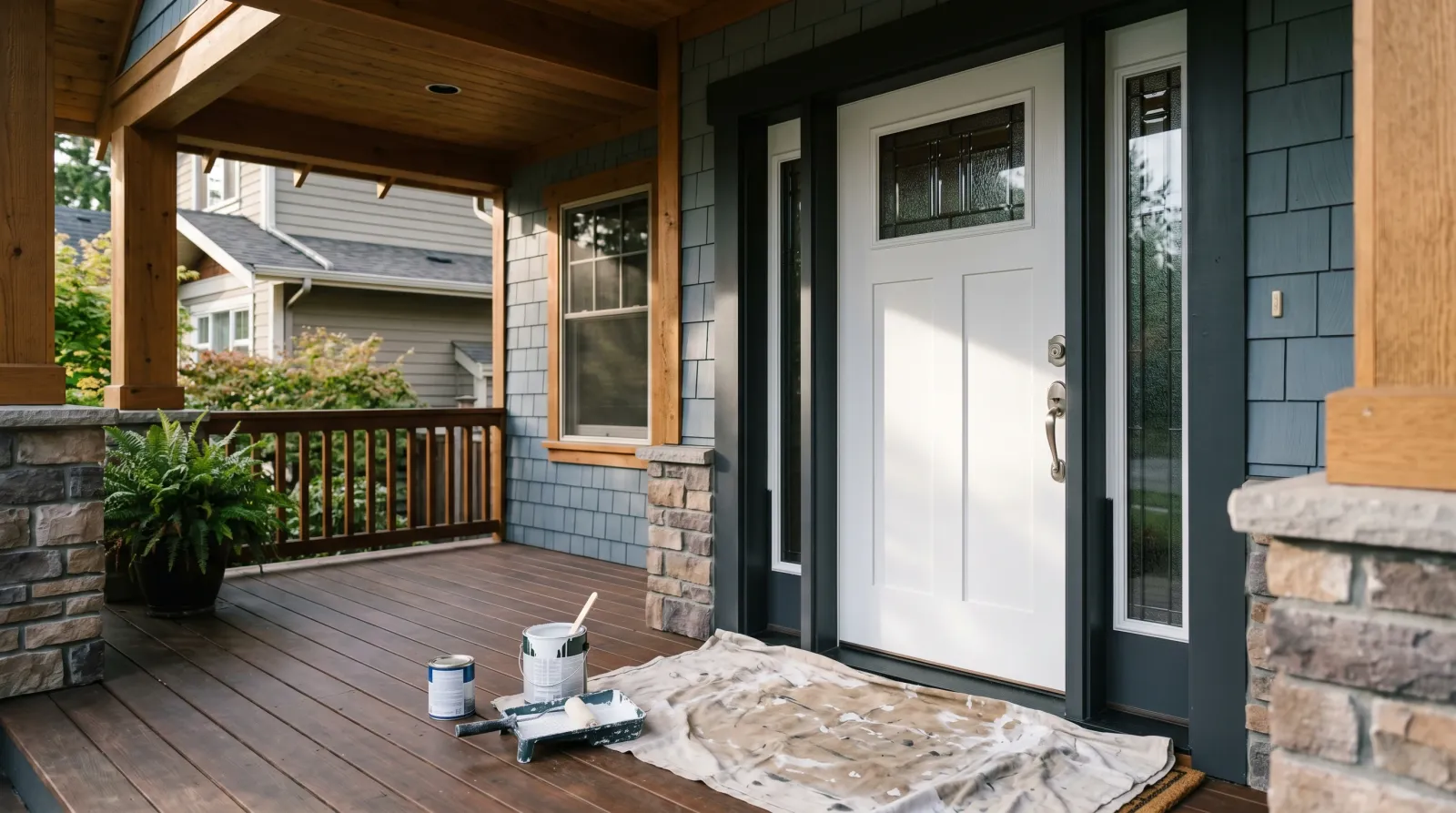
Fiberglass is glass. Paint hates glass. That’s the whole problem in one sentence, and the whole rest of this guide is the workaround.
TL;DR
- Clean: wipe twice with acetone on a clean rag, then dish soap rinse
- Scuff: 220-grit sponge, dull the whole face
- Prime: INSL-X Stix bonding primer, one full coat
- Paint: DTM (direct-to-metal) acrylic, two coats. Not on tubs or boats.
- Cure: 14 days before you slam the door, scrub the panel, or trailer the hull
What Is Fiberglass?
Fiberglass (properly Fiber-Reinforced Plastic, or FRP) is woven glass cloth saturated in polyester or epoxy resin and cured into a hard shell. The outside layer is gel-coat: a pigmented resin skin, smoother and harder than the structural laminate underneath. That gel-coat is what you’re painting onto. It’s chemically inert, non-porous, and engineered to shed water.
Three places you’ll meet it on a residential job: entry doors (steel-frame core with a fiberglass skin), bathtubs and shower surrounds (one-piece molded units), and boat hulls. Same substrate, three completely different service environments. One paint can’t do all three.
Tools and Materials
Materials
- Acetone (one quart for a door, more for a hull)
- Lint-free wiping rags (microfiber or shop towels)
- Dish soap and clean water
- 220-grit sanding sponge (180 if the gel-coat is chalky)
- Painter’s tape (FrogTape Multi-Surface)
- INSL-X Stix bonding primer (door and shower surround)
- DTM acrylic topcoat (Sherwin-Williams DTM Acrylic, Benjamin Moore Ultra Spec HP DTM) for the door
- Two-part epoxy tub refinish kit (Rust-Oleum Tub & Tile, Ekopel 2K) for tubs only
- Topside marine polyurethane (Interlux Brightside, Pettit Easypoxy) for boats only
Tools
- 4-inch high-density foam roller (door and tub)
- 2-inch Wooster Silver Tip angled sash brush for cut-in
- Tack cloth
- Painter’s plastic + masking tape
- Disposable nitrile gloves
- Respirator (acetone fumes, epoxy fumes)
Why Fiberglass Is Tricky
Three things make fiberglass different from the wood or steel door it’s pretending to be.
It’s non-porous. There’s nothing for paint to soak into. Adhesion is purely mechanical bite plus chemical bond from the primer. Skip the scuff and the chemistry has nothing to grab.
It’s mold-released. Fresh-from-factory fiberglass carries a thin film of mold-release wax left over from the manufacturing tooling. Acetone strips it. Don’t skip the acetone wipe even on a brand-new door. That wax is the most common cause of paint peeling off a fiberglass entry six weeks after install.
It moves with temperature. A dark fiberglass door in summer sun hits 140°F skin temperature and the panel expands measurably. A rigid topcoat cracks; a flexible DTM acrylic moves with it. This is why house paint outlasts oil enamel on fiberglass. The modern waterborne acrylic stays flexible where the old alkyd goes brittle.
Step 1 — Acetone Wipe
Pour acetone onto a clean rag, not the other way around. Wipe the whole surface in one direction, flip to a clean section of rag, wipe again. Third clean rag for the final pass. You’re pulling off mold-release wax, hand oils, and any silicone from window cleaner or furniture polish.
Two passes minimum, three on a door that’s been mounted a decade. The rag should come up gray on the first pass and white on the third. That’s how you know the surface is clean. Open a window. Wear gloves.
Follow with a dish-soap rinse to flash any acetone residue, then dry with a clean towel.
Step 2 — Scuff to 220
220-grit sanding sponge, by hand, two passes across the whole face in a uniform direction. You’re not removing gel-coat. You’re breaking the gloss so the primer has mechanical tooth.
The face should go from glossy to evenly dull. If you can see your reflection after sanding, you didn’t sand enough. If white fiber pattern is showing through, you sanded way too hard. Ten minutes on an entry door, 90 minutes on a small boat hull.
Vacuum the dust. Wipe with a tack cloth. Mask hinges, hardware, weather-stripping, and (on a tub) every adjacent surface.
Step 3 — Bonding Primer
This is the step that decides the project.
INSL-X Stix is the right call on fiberglass nine times out of ten. Waterborne acrylic-urethane bonding primer, grabs slick non-porous substrates without a solvent flash, dries in 90 minutes to topcoat. Roll it on with a 4-inch high-density foam roller in one full coat, cut in the panel edges and stiles with a 2-inch angled brush. Stix is a thin primer by design, not a build coat.
Zinsser BIN (shellac) works too and dries in 45 minutes, but shellac isn’t UV-stable. Save BIN for interior fiberglass doors.
Generic latex primer (Bulls Eye 1-2-3, KILZ Original, anything labeled “all-purpose”) does not bite gel-coat. Don’t use it. The Stix can looks similar on the shelf; read the label and pay the four dollars extra. That four dollars is the difference between a ten-year paint job and an eighteen-month one.
Step 4 — Paint (Doors Only — Skip Ahead for Tubs and Boats)
Two coats of DTM acrylic over the dried Stix. Sherwin-Williams DTM Acrylic in the gloss or semi-gloss you want; Benjamin Moore Ultra Spec HP DTM is the equivalent. Flexible waterborne acrylics engineered to bond direct to metal and slick substrates, which is exactly what a primed fiberglass door is.
Foam roller for the flat panels, 2-inch angled sash brush for the recessed details and stiles. Cut in first, roll while the cut-in is still wet, don’t stop in the middle of a panel. Stopping mid-panel is how you get lap marks, and lap marks show up the second the morning sun hits a south-facing door.
Two coats. Always two coats. The first coat looks fine and isn’t. The second coat is where mil thickness comes from, and mil thickness is what survives eight summers of UV.
Recoat after four hours. Re-hang the next morning. Don’t slam it for two weeks. For the SKU call, see the exterior door paint round-up; same picks land here.
The Tub Detour — Not the Same Job
A fiberglass bathtub is not a fiberglass door with water on it. A door sees rain. A tub sees daily hot-water immersion, soap film, abrasion from feet and brushes, and 100°F+ surface temperature for fifteen minutes every morning. House paint peels off a tub. So does cabinet paint. So does trim enamel. The chemistry that survives the bath environment is two-part epoxy refinish, and it ships as a kit.
Rust-Oleum Specialty Tub & Tile Refinishing Kit, Ekopel 2K, Homax Tough as Tile. The kit includes its own etcher (don’t substitute), its own primer, and a two-part epoxy topcoat. Mix per the can, roll on with the dense foam roller in the kit, stay out of the bathroom for 72 hours while the film cures glass-hard.
A kitted refinish on a sound fiberglass tub lasts five to seven years. A bargain “tub spray paint” can lasts about three months. Don’t shortcut this one.
The Boat Detour — Marine Paint Is Its Own Universe
If you’re holding a roller over a fiberglass hull, put down the house paint. A boat hull above the waterline is a topside surface, and topside marine paint is engineered for what house paint can’t survive: constant moisture, salt or chlorine immersion, UV bounced off the water, and structural flex with wave loading.
Above the waterline: Interlux Brightside (one-part polyurethane, $50/qt, easiest to roll, fair gloss retention), Pettit Easypoxy (similar to Brightside, slightly better leveling), Awlgrip 2-part LPU (spray-only, the yacht-finish standard, toxic without proper rig). Below the waterline is antifouling. Separate paint, separate prep, separate annual cycle.
Don’t use exterior house paint on a hull. Don’t use porch enamel on a hull. Don’t use DTM acrylic on a hull. They all chalk inside one season and peel inside two.
Step 5 — Cure
A primed-and-topcoated fiberglass door is touch-dry at 2 hours, dry-to-handle at 24, and fully cured at 14 days. Don’t slam it for two weeks. Don’t power-wash it for 30 days. The film keeps hardening for the whole month.
A refinished tub is no-water-contact for 72 hours per the kit label. No bath for a week. No abrasive cleaner ever. The epoxy film tolerates soft sponge and mild detergent only.
A repainted topside hull is splash-ready in 24 hours and fully cured in 30 days. Don’t trailer it dry across rough roads for the first week; the new film catches micro-scratches that show up under raking light.
Common Mistakes
- Skipping the acetone wipe. Mold-release wax stays on the panel, primer slides off it, topcoat peels in sheets at month six. Two passes minimum, three on a weathered door.
- Latex primer instead of Stix or BIN. Generic primers don’t bite gel-coat. Use a bonding primer or do the job again next year.
- House paint on a tub. A tub is daily immersion, not a wall. Use a refinish kit or don’t paint it.
- House paint on a boat. Topside marine polyurethane exists for a reason. Skip it and you’ll repaint the hull every spring.
- Dark color on a south-facing door. Skin temperature climbs to 140°F+ in summer, the panel expands, the topcoat goes brittle. Stay light on south-facing exposures or accept the four-year repaint cycle.
- Painting a hot panel. Direct afternoon sun on a south-facing door cooks the wet film, causes flash-drying, leaves brush marks and holidays. Work in shade or on an overcast day.
Maintenance and Longevity
A properly primed and DTM-acrylic-topcoated entry door lasts eight to twelve years before the sheen reads chalky. South-facing in zone 5 or warmer: closer to six. Dark colors south-facing: closer to four. Wash once a year with dish soap and a soft sponge. No abrasive pad, no close-range pressure washer, no bleach.
A refinished fiberglass tub lasts five to seven years with soft-sponge cleaning. The film fails first at the drain and around the faucet, where standing water and metal-on-epoxy abrasion concentrate. Ghost rings mean refresh time; the rest of the tub is usually fine.
A topside-painted hull lasts two to four seasons in salt water, four to six in freshwater storage. The fiberglass under the paint is the expensive part; the paint is the sacrificial layer protecting it. Repaint before the gel-coat shows through, not after.
Where This Goes Wrong in Two Years
The fiberglass door that was painted with quality acrylic but no bonding primer. The wax was still on the panel. The latex grabbed for a month, then the first hot summer day pushed the panel out, the primer-less paint had no bite, and the whole topcoat sheeted off in strips around month eighteen. The fix is to strip back to gel-coat with chemical stripper, wipe twice with acetone, scuff to 220, prime with Stix, and start over. You only get to skip that primer step once.
Ask a Question