Freezer Paint and Cold-Storage Coatings: Specifier's Guide (2026)
Freezer paint and cold-storage coating systems compared by DFT, service temp, and cure-at-temperature. Wall, ceiling, floor, and panel specs with USDA and NSF notes.

Disclosure: Affiliate links to retailers and manufacturer-direct programs. Recommendations are spec-driven, not commission-driven.
Use Case
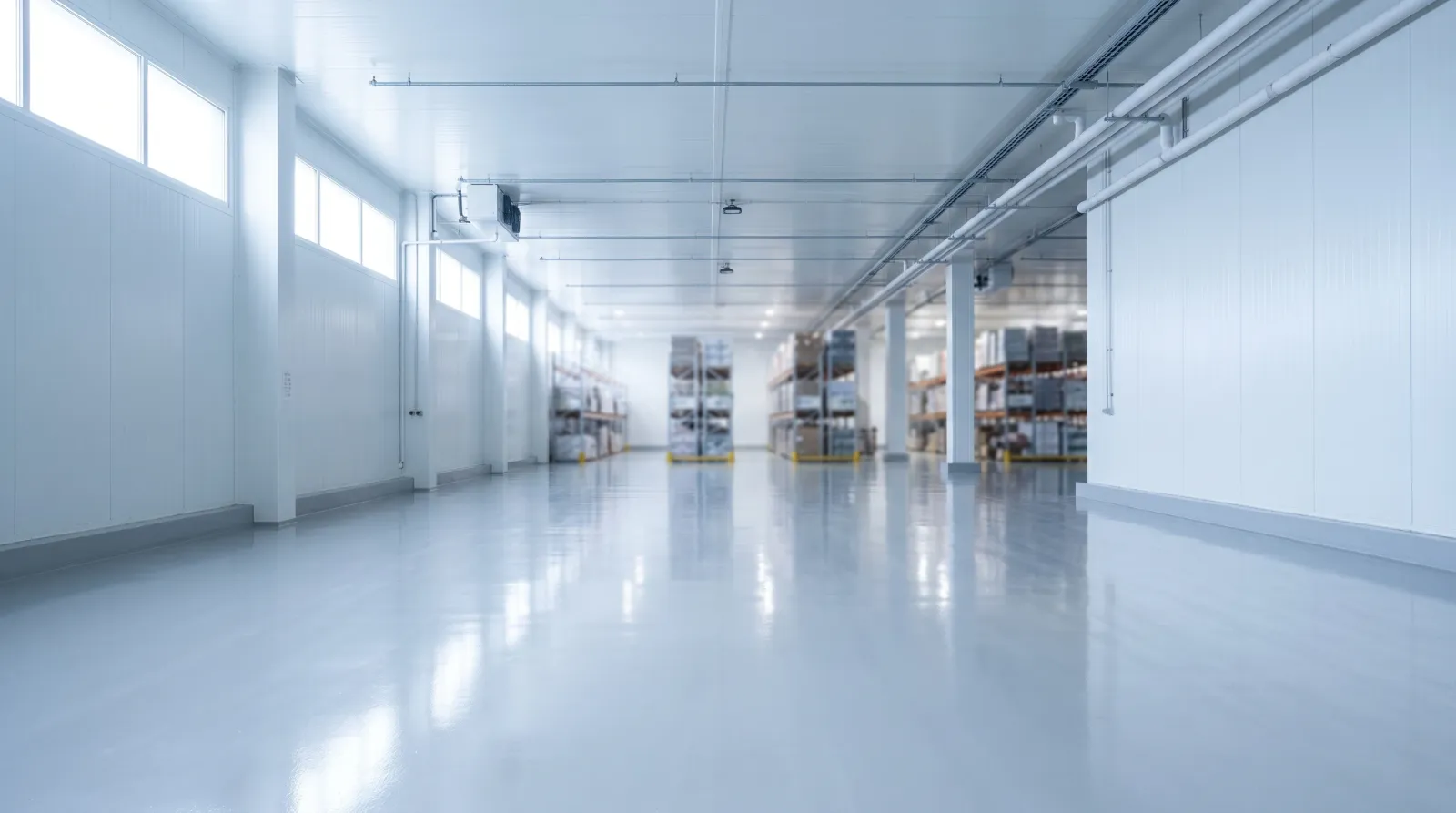
A cold-storage coating has to do something most paint never faces: stay bonded and flexible while the asset cycles from setpoint to defrost and back, often several times a day, for fifteen years. The asset is the freezer envelope. That means the insulated metal panel walls and ceilings, the slab on grade or the structural floor, the rack uprights, the door frames, and the exterior face of the panels where warm humid plant air meets a cold surface. Each of those surfaces sees a different load, so a freezer room is a multi-zone asset even though it reads as one white box.
The service environment is the hard part. Wall and ceiling panels sit at minus 10 to minus 20 degrees on the cold face. Blast freezers and IQF tunnels run colder. The floor takes wheeled traffic, dropped product, hot-water or steam sanitation in a food plant, and thermal shock every time a door opens to a 70-degree dock. Warm moist air migrating toward the cold panels condenses and frosts, which loads any film with a vapor-drive problem that ordinary paint cannot survive.
Service life expectations: 10 to 15 years for a properly specified waterborne epoxy wall and ceiling film, 15 to 20 years for a troweled urethane cement floor, and 3 to 5 years for an under-spec’d job that used a standard interior coating because the buyer treated “freezer paint” as a single product off a shelf. There is no single product. There is a system per zone, and the cold service temperature is what separates the system from a coating that debonds on the first defrost. The floor side is covered in depth in the freezer floor coating guide; this guide takes the whole envelope, with the floor as one zone of several.
Zoned Recommendation Matrix
A freezer box is not monolithic. The right system depends on the surface, the temperature it sees, and whether food contact is in play.
| Zone | Recommended system | Why |
|---|---|---|
| Interior wall / ceiling panels | System A or B (waterborne epoxy film) | Cleanable, USDA/NSF on select SKUs, holds at service temp |
| Floor (slab, traffic) | Urethane cement or MMA (see floor guide) | Thermal shock, abrasion, steam-clean survival |
| Panel exterior (warm/humid side) | Anti-condensation or DTM epoxy | Sweat control, corrosion on the warm dewing face |
| Rack uprights, door frames, steel | System C (DTM epoxy mastic) | Corrosion under frost and condensate |
| Anteroom / dock transition | Standard industrial epoxy + anti-slip | Warmer zone; chloride and grit from the dock |
For the cold face, the spec calls for a coating rated to the service temperature, not the room’s average. A panel that reads minus 18 on a probe needs a film that stays bonded at minus 18, regardless of what the thermostat says the room air is.
Spec Requirements
| Spec | Value |
|---|---|
| Dry film thickness (DFT), walls/ceilings | 5–10 mils total (2.5–5 mils per coat, two coats) |
| Dry film thickness (DFT), floor | 125–250 mils troweled body coat + 10–15 mil seal (see floor guide) |
| Coverage @ DFT (wall film) | 150–250 sq ft / gal per coat |
| VOC | <100 g/L (CARB / SCAQMD Rule 1113 industrial-maintenance compliant) |
| Standards | ASTM D2247 (humidity), ASTM E96 (vapor permeance), ASTM D7234 (adhesion), ASTM C722 (floor thermal shock), ASTM F1869 (MVE) |
| Substrate prep, insulated metal panel | SSPC-SP1 solvent clean + abrade (Scotch-Brite / light SP3) to break factory gloss |
| Substrate prep, CMU / block wall | Fill voids with block filler to ICRI CSP 1–2 equivalent; no pinholes |
| Substrate prep, steel (racks, frames) | SSPC-SP6 commercial blast or SSPC-SP11 power-tool to bare metal |
| Substrate prep, floor | Shotblast to ICRI CSP 3–4; ASTM F1869 MVE ≤3 lb/1000sf/24h before coating |
| Service temp | -20°F to +120°F at the panel/floor surface (system-dependent) |
| Cure to service | Wall film 24h light, 7 days full at 70°F; floor 24–48h before pull-down |
| Dew point / humidity | Substrate ≥5°F above dew point; RH <85% during application and cure |
| OSHA 1910.22 (floor) | Static COF ≥0.5; aluminum oxide or quartz broadcast in traffic zones |
The number that governs the wall and ceiling job is the cure-at-temperature window. You cannot paint a running freezer. The room has to come up to the coating’s minimum application temperature, hold there through full cure, then return to setpoint. Build that defrost-and-warm window into the project schedule before you bid the coating, because the downtime is the expensive part.
System Chemistry Compared
Before naming products, choose the chemistry for the surface. Four classes cover the freezer envelope.
| Chemistry | Pot life | Recoat | Service temp | UV / weather | $/sq ft installed | Best for |
|---|---|---|---|---|---|---|
| Waterborne epoxy (walls/ceilings) | 2–4 hr | 4–16 hr | -20°F to 120°F | Interior only | $2–5 | Cleanable panel and CMU interiors, food plants |
| DTM epoxy mastic (steel/exterior) | 2–4 hr | 8–24 hr | -20°F to 200°F | Fair (topcoat for UV) | $3–7 | Rack steel, door frames, panel exterior |
| Urethane cement (floor) | 30 min | 12 hr | -40°F to 250°F | Yes | $12–25 | Wet food-plant floors, thermal shock |
| MMA (floor, fast cure) | 5–15 min | 1 hr | -40°F to 200°F | Yes | $14–28 | 24/7 boxes that cannot defrost long |
Waterborne epoxy is the answer for the cold interior panels and CMU. It cleans up, carries food-plant acceptance on select SKUs, and stays bonded at service temperature once it has cured warm. The floor is a separate decision driven by downtime tolerance: urethane cement when you can defrost for a few days, MMA when the box cannot come offline long enough for anything slower. Steel and the warm panel exterior take a DTM epoxy mastic because the failure there is corrosion, not abrasion.
Recommended Systems
Three full stacks. System A and B cover the cold interior walls and ceilings, the largest surface in any freezer. System C covers the steel and the warm panel exterior where corrosion is the risk. The floor stacks live in the dedicated floor guide.
System a — Sherwin-Williams Pro Industrial (interior Walls and Ceilings)
| Layer | Product | DFT |
|---|---|---|
| Primer / block filler | ProIndustrial Heavy Duty Block Filler (CMU) or ProCryl Universal Primer (metal) | 2.5–5 mils |
| Intermediate | Pro Industrial Pre-Catalyzed Waterbased Epoxy | 2.5–4 mils |
| Topcoat | Pro Industrial Pre-Catalyzed Waterbased Epoxy (second coat) | 2.5–4 mils |
Service life 12–15 years on cold panel and CMU interiors. The pre-catalyzed waterborne epoxy carries USDA acceptance and NSF/ANSI 51 listings on select colors, which is what gets it through a food-plant audit. Coverage runs 150–250 sq ft per gallon per coat. Sherwin-Williams Pro Industrial product page.
System B — Tnemec Series 287 / 113 (interior Walls and Ceilings)
| Layer | Product | DFT |
|---|---|---|
| Primer | Series 151 Elasto-Grip FC (metal) or Series 215 Surfacing Epoxy (CMU) | 3–5 mils |
| Intermediate | Series 287 Enviro-Pox waterborne epoxy | 3–4 mils |
| Topcoat | Series 113 Tneme-Tufcoat or Series 287 (second coat) | 3–4 mils |
Service life 15+ years. Tnemec’s Series 215 Surfacing Epoxy is the differentiator on CMU walls. It fills the block voids and pinholes that otherwise become condensation traps, giving the topcoat a smooth, cleanable, pinhole-free face. Specify System B when the wall is concrete block rather than insulated metal panel, or when the food-safety spec is strict enough that the surfacing step earns its cost. Tnemec product locator.
System C — Rust-Oleum 9800 DTM Epoxy Mastic (steel and Panel Exterior)
| Layer | Product | DFT |
|---|---|---|
| Primer | 9800 System Epoxy Mastic (self-priming on prepared steel) | 4–6 mils |
| Topcoat | 9800 System Epoxy Mastic (second coat) or DTM Acrylic | 3–5 mils |
Service life 8–12 years on rack uprights, door frames, and the warm exterior face of the panels where condensate corrodes steel and edges. The 9800 epoxy mastic is surface-tolerant and bonds over SSPC-SP11 power-tool prep when a full blast is not practical inside an occupied plant. For the warm dewing exterior face, pair it with an anti-condensation overcoat; the anti-condensation coating guide covers that sweat-control layer in detail. Rust-Oleum 9800 System product page.
Systems Compared
| System | Total DFT | $/sq ft installed | Service life | Best for |
|---|---|---|---|---|
| A. S-W Pro Industrial | 7.5–13 mils | $2–4 | 12–15 yrs | Cold interior panels and CMU, food plants |
| B. Tnemec 287/113 | 9–13 mils | $3–6 | 15+ yrs | CMU walls, strict food-safety spec |
| C. Rust-Oleum 9800 | 7–11 mils | $3–7 | 8–12 yrs | Rack steel, door frames, panel exterior |
Pricing assumes a contractor install with the room warmed to application temperature, prep included. Add the defrost-and-warm downtime to the project cost; on a working box it often exceeds the coating itself. Floor systems are priced separately in the floor guide at $12–28 installed depending on chemistry.
Application and Contractor Path
The honest call: walls and ceilings can be an in-house scope on a small box; the floor cannot. If your maintenance crew can warm the room, degrease and abrade the panels, and roll two coats of a waterborne epoxy above dew point, the wall side is within reach. The floor is troweled or broadcast work that needs a flooring contractor with cold-condition experience.
For any USDA-inspected plant, spec a contractor on every surface. The documentation is the point. An inspector wants the SDS, the USDA/NSF acceptance letter for the exact SKU and color, the DFT log, and the cure record. An in-house crew rarely produces that paper trail, and a missing record can hold up a re-inspection.
Required credentials when you do spec out:
- SSPC-QP1 for the industrial coatings contractor on steel and panels.
- NACE/AMPP CIP Level 2 inspector for DFT and adhesion verification on a large scope.
- Flooring contractor with documented urethane cement or MMA cold-install experience for the floor.
The manufacturer rep network on all three lines (Sherwin-Williams ProIndustrial, Tnemec, Rust-Oleum Industrial) will review the room conditions and write the application-temperature and cure schedule into the submittal. Use that review to lock the defrost window before the crew mobilizes. A crew that shows up to a minus-18 box with no warm-up plan loses the day and the material.
Failure Modes
Cold-storage coatings fail in a small number of repeatable ways. Each one is preventable in the spec.
- Painting the box cold. Cause: someone tried to coat a running freezer or a slab below the product minimum. The film never cures, stays soft, and peels in sheets. Prevention: warm the room to the coating’s minimum application temperature and hold it through full cure before pull-down. Build the defrost window into the schedule.
- Condensation under the film. Cause: panel surface within 5°F of dew point during application traps moisture behind the coating. The film blisters from behind on the first defrost. Prevention: sling psychrometer in continuous use; substrate ≥5°F above dew point; RH below 85%.
- Vapor-drive blistering. Cause: a low-permeance film over a cold panel acts as a vapor trap as warm moist air drives toward the cold face. Prevention: specify a coating with the manufacturer’s published permeance for cold-side service, and control the warm-side dewing with an anti-condensation system on the exterior.
- Brittle debond under thermal cycling. Cause: a standard interior or general-industrial coating went glass-brittle below minus 20 and cracked on the defrost swing. Prevention: specify a system rated to the actual surface service temperature, not the room average.
- Pinhole corrosion on steel and edges. Cause: rack uprights and door frames coated thin or over poorly prepped metal rust under persistent condensate. Prevention: SSPC-SP6 or SP11 prep, full DFT on a DTM epoxy mastic, and attention to edges where film pulls thin.
The two failures I review most on cold-storage jobs are painting the box too cold and condensation trapped behind the film. Both come from skipping the defrost-and-warm window to save downtime, and both cost more in re-prep than the window would have cost in operations.
Where to Buy / Spec
| Channel | Best for | Link |
|---|---|---|
| Manufacturer-direct (S-W ProIndustrial, Tnemec, Rust-Oleum) | Spec’d projects, USDA/NSF letters, rep review | S-W ProIndustrial · Tnemec · Rust-Oleum Industrial |
| Industrial distributor (Rawlins US, regional coatings) | Bulk, contractor accounts, mixed-system bids | Distributor account with project pricing |
| Pro retail (Sherwin-Williams stores) | Small boxes, local pickup, contractor pricing | S-W store locator |
| Amazon Business | Touch-up, small-box wall coatings, fleet stocking | Search by manufacturer SKU |
Manufacturer-direct is the recommended channel on any food-plant or USDA-inspected box. The rep delivers the acceptance letters and writes the cold-application schedule into the submittal, which together are worth more than any retail discount on the pail.
FAQ
See the frontmatter for the full Q&A set covering DIY scope, application temperature, peeling causes, USDA/NSF compliance, and how freezer coatings differ from standard industrial epoxy.