Fiberglass Hull Paint: Marine Topside and Antifouling Specifier's Guide (2026)
Fiberglass hull paint compared by zone: topside polyurethane, bottom antifouling, boot stripe. DFT, prep grit, ablative vs hard, VOC limits, and the contractor path.

Disclosure: Affiliate links to retailers and manufacturer-direct programs. Recommendations are spec-driven, not commission-driven.
Use Case
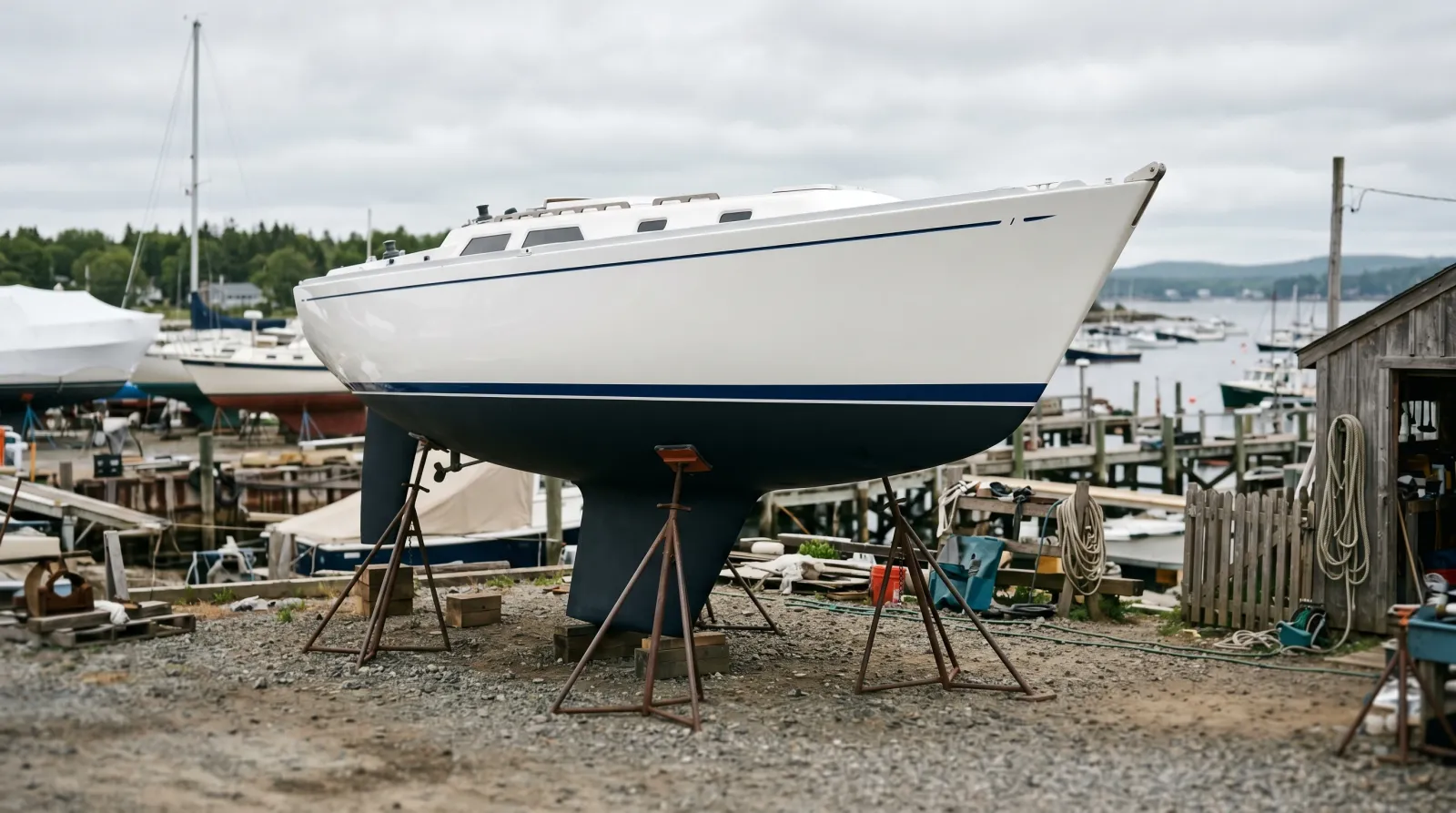
A fiberglass hull repaint is three jobs on one asset, and the spec fails when an owner treats it as one. Above the waterline, the topside coating has to hold gloss and color through UV, salt spray, dock rash, and wash-down chemicals while staying flexible enough to ride the laminate as it flexes underway. Below the waterline, the bottom coating has a single job the rest of the boat does not share: stop marine growth from colonizing the hull and dragging the boat down on fuel and speed. Between them sits the boot stripe, a narrow band at the waterline that takes the worst of both worlds and almost always gets underspecified.
The asset is any gelcoat or composite hull: production sailboats and powerboats, commercial workboats, charter fleets, and the aging laminate that has lost its factory shine and started to chalk. Gelcoat is the pigmented polyester or vinylester surface layer molded into the hull, not paint. When it chalks past the point that compounding and waxing recover it, or when the owner wants a color change, paint becomes the spec.
Service life splits by zone. A sprayed two-part linear polyurethane topside (Awlgrip, Interlux Perfection, Imron) holds Class A gloss for 8 to 12 years in temperate service, longer under cover, shorter on a south-facing slip in subtropical sun. A one-part polyurethane topside runs 3 to 6 years. Antifouling is an annual-to-biennial consumable: ablative copolymers are formulated to wear away over one to two seasons, and even hard antifoulings lose biocide release and need a fresh coat on a one- to three-year cycle depending on water temperature and fouling pressure. The barrier coat under the antifouling, applied once over a properly dried laminate, is expected to last the life of the hull.
Zoned Recommendation Matrix
A hull is not a monolithic surface. The waterline divides it into two coating environments that share almost no requirements. Spec by zone.
| Zone | Environment | Recommended system | Why |
|---|---|---|---|
| Topside (above waterline) | UV, salt spray, abrasion, intermittent wetting | Two-part polyurethane over epoxy primer (System A or B) | Gloss and color retention; flexibility over flexing laminate |
| Boot stripe (at waterline) | Constant wet-dry cycling, the harshest UV-plus-immersion band | Two-part polyurethane, often a contrast color | Worst combined exposure; underspecifying here shows first |
| Bottom (below waterline) | Continuous immersion, biofouling, hydrostatic permeation | Epoxy barrier coat plus antifouling (System B or C) | Blister prevention plus biocide; never a topside paint |
| Underwater metals (running gear, struts) | Galvanic exposure, immersion | Separate metal-specific antifouling (Pettit Zinc Coat, Interlux Trilux 33) | Copper antifouling on aluminum drives galvanic corrosion |
One hard rule for the matrix: never carry copper-based antifouling onto aluminum hulls, outdrives, or running gear. Copper and aluminum in seawater form a galvanic cell that eats the aluminum. Aluminum lower units and pontoon hulls take a copper-free antifouling (Interlux Trilux 33, Pettit Vivid free of cuprous oxide). Confirm the substrate metal before the antifouling SKU goes on the order.
Spec Requirements
The spec block before the product names. Numbers shift by manufacturer and by zone; the categories hold.
| Spec | Topside | Below waterline |
|---|---|---|
| Dry film thickness (DFT) | 3–6 mils total, 2 coats at 1.5–3 mils | Barrier 10–20 mils; antifouling 4–8 mils per coat, 2–3 coats |
| Coverage @ DFT | 250–400 sq ft/gal (2-part urethane) | 400–500 sq ft/gal barrier; 300–500 sq ft/gal antifouling |
| VOC | 340–490 g/L solvent-borne; check CARB / SCAQMD Rule 1106 | 330–400 g/L; check Rule 1106 |
| Standards | ASTM D3359 / D4541 adhesion; ASTM D523 60-degree gloss | ASTM D870 immersion; ASTM D714 blister rating; EPA FIFRA biocide registration |
| Substrate prep — new gelcoat | Dewax (solvent wash), sand 220–320 grit | Dewax, sand 80 grit, barrier coat |
| Substrate prep — existing sound paint | Scuff 220–320 grit, solvent wipe | Scuff 80–120 grit |
| Substrate prep — bare laminate | Fair, prime with epoxy primer | Grind to sound laminate, dry to moisture-meter target, barrier coat |
| Moisture before barrier coat | n/a | Laminate moisture below the barrier manufacturer’s accept threshold; a marine moisture meter reads it |
| Service temp at application | 50°F to 90°F | 50°F to 90°F |
| Cure to service / launch | 12–24 hrs to recoat; full cure 5–7 days before heavy use | Antifouling: minimum 16-hour and maximum overcoat-before-launch window per TDS |
| Dew point / humidity | Substrate ≥5°F above dew point; RH below 85% | Same; no application over a damp hull |
Three numbers carry the topside job: the dewax before sanding, the substrate held above dew point during cure, and the recoat window between the two finish coats. The bottom job hinges on a different three: the laminate moisture reading before the barrier coat, the barrier DFT total, and the launch window on the antifouling. Antifoulings have a maximum dry time before launch as well as a minimum. Wait too long after the last coat and the paint can lose activation; the TDS publishes both ends of the window.
System Chemistry Compared
Topside and bottom run on different chemistry families. Match the family to the zone and the use pattern before any product name.
| Chemistry | Zone | Recoat window | Service exposure | UV stability | $/sq ft (material) | Best for |
|---|---|---|---|---|---|---|
| Two-part linear polyurethane | Topside | 12–24 hr | UV, salt, abrasion | Excellent (8–12 yr gloss) | $1.50–4.00 | Mirror-finish topsides, color change, long cycle |
| One-part polyurethane | Topside | 16–24 hr | UV, salt | Good (3–6 yr) | $0.60–1.50 | Owner-applied roll-and-tip, budget repaints |
| Epoxy barrier coat | Below waterline | per TDS, 3–5 hr | Immersion, permeation | n/a (overcoated) | $0.80–1.80 | Blister prevention on new and dried bottoms |
| Ablative copolymer antifouling | Below waterline | 4–16 hr | Immersion, biofouling | n/a | $1.50–4.50 | Annual haul, trailered, intermittent-use boats |
| Hard / modified-epoxy antifouling | Below waterline | 4–16 hr | Immersion, biofouling | n/a | $1.50–4.50 | High-speed powerboats, raced hulls, burnishable finish |
Two-part polyurethane wins the topside on gloss life and is the spec for any finish the owner expects to defend at resale. One-part trades durability for an owner-friendly application and lower respiratory hazard. Below the waterline the barrier coat and the antifouling are not interchangeable; the barrier stops water, the antifouling stops growth, and a proper bottom carries both.
Recommended Systems
Three full multi-coat stacks at different price-performance points. System A is a sprayed topside reference; System B is a full above-and-below stack from one manufacturer; System C is a value bottom-and-topside stack. Match the system to the zone you are coating.
System a — Awlgrip HDT Topside (sprayed Two-Part, Class A finish)
| Layer | Product | DFT |
|---|---|---|
| Fairing / surfacer | Awlfair LW fairing compound (as needed) | as required to fair |
| Primer | 545 Epoxy Primer | 2–4 mils |
| Topcoat | Awlgrip HDT polyester urethane (2 coats) | 2–3 mils |
| Total (over primer) | 4–7 mils |
The topside benchmark. Awlgrip HDT sprayed over a faired and primed hull holds Class A gloss 8 to 12 years and is the reference finish on premium production and refit work. It is a sprayed two-part linear polyurethane carrying isocyanates; spray application demands a supplied-air respirator and a controlled enclosure, which is why this stack is an applicator-certified job, not an owner job. Awlgrip topcoat product page.
System B — Interlux Full Hull (topside Perfection plus Micron Antifouling)
| Layer | Product | DFT |
|---|---|---|
| Barrier coat (bottom) | InterProtect 2000E epoxy barrier (4–5 coats) | 10–20 mils |
| Tie/primer (topside) | Epoxy Primekote / Pre-Kote | 2–3 mils |
| Topcoat (topside) | Perfection two-part polyurethane (2 coats) | 2–3 mils |
| Antifouling (bottom) | Micron CF copper ablative (2–3 coats) | 4–6 mils per coat |
| Total topside | 4–6 mils | |
| Total bottom | 18–38 mils |
A complete above-and-below specification from a single manufacturer, which keeps the compatibility chain clean. Perfection brush-and-roll holds gloss 5 to 8 years and is the most owner-applied two-part topside on the water. Micron CF is a copolymer ablative that self-polishes and works on both power and sail. The InterProtect barrier underneath is the blister-prevention layer; spec the full 10–20 mil build on any bottom being stripped to laminate. Interlux Micron CF product page.
System C — Pettit Value Stack (easypoxy Topside plus Trinidad Hard Antifouling)
| Layer | Product | DFT |
|---|---|---|
| Barrier coat (bottom) | Protect HS Epoxy Barrier Coat 4700/4701 (3–4 coats) | 10–16 mils |
| Topcoat (topside) | Easypoxy / EZ-Poxy one-part polyurethane (2 coats) | 1.5–2 mils |
| Antifouling (bottom) | Trinidad SR hard copolymer (2 coats) | 4–8 mils |
| Total topside | 3–4 mils | |
| Total bottom | 14–24 mils |
The value path. Easypoxy is a one-part polyurethane an owner can roll and tip with a forgiving open time, holding gloss 3 to 5 years. Trinidad SR is a high-copper hard antifouling spec’d for powerboats and busy sailboats in high-fouling water, burnishable for race prep. Lower material cost and lower respiratory hazard than the sprayed two-part path; shorter topside service life is the trade. Pettit antifouling product page.
Systems Compared
| System | Total DFT | $/sq ft installed | Service life | Best for |
|---|---|---|---|---|
| A — Awlgrip HDT topside | 4–7 mils (topside) | $8–18 | 8–12 yr topside | Class A sprayed finish, refits, resale-grade topsides |
| B — Interlux full hull | 4–6 topside / 18–38 bottom | $5–12 | 5–8 yr topside, 1–2 yr antifouling | Single-source above-and-below spec, owner or yard applied |
| C — Pettit value stack | 3–4 topside / 14–24 bottom | $3–8 | 3–5 yr topside, 1–3 yr antifouling | Budget repaints, powerboats, owner roll-and-tip |
Installed pricing assumes yard labor on a 30 to 40-foot hull with fairing kept to spot repair, not full hull. A full-fairing topside (correcting print-through or major laminate waviness) can double the topside number; fairing labor, not paint, is the cost driver on a premium topside.
Over a 12-year horizon, the sprayed two-part topside in System A often costs less per year than two cycles of a one-part finish, because the one-part needs stripping and recoating twice in the same window. Antifouling is a recurring line item in every system; budget it annually regardless of which topside you spec.
Application and Contractor Path
The honest split runs through the topside chemistry. Antifouling and one-part topside finishes are within reach of an experienced owner or a general yard crew working brush-and-roll. A sprayed two-part linear polyurethane topside is not. Awlgrip, Perfection, and Imron sprayed for a Class A finish carry isocyanates that require a supplied-air respirator, skin protection, and a controlled spray enclosure. Spraying these without containment is a respiratory-hazard violation and produces overspray that coats every boat in the yard.
For a sprayed topside, spec a contractor who carries:
- Manufacturer applicator certification on the specific line (Awlgrip Certified Applicator, AkzoNobel yacht-coatings training).
- A documented spray enclosure and supplied-air program, not a cartridge respirator.
- A reference hull you can inspect for print-through, sags, and gloss uniformity at a low angle.
Three qualifying questions before signing a topside spray contract:
- How will the hull be contained, and where does overspray go? A yard without a tented enclosure cannot spray two-part urethane responsibly.
- What is the fairing scope, and is it priced separately? Fairing is where topside budgets run over; get it itemized.
- Who controls the recoat window between the two finish coats? Two-part urethane has a tight overcoat window; miss it and the second coat needs a scuff sand, which costs a day.
The manufacturer rep networks on Awlgrip, Interlux, and Pettit run technical hotlines and publish hull-specific system sheets that pair the right primer, barrier, topcoat, and antifouling for your laminate and use pattern. Use the rep to confirm the barrier-to-antifouling compatibility and the moisture-meter accept threshold before the bottom job starts.
Failure Modes
Five failures cover most fiberglass-hull paint rejections and early breakdowns.
- Topside lifting from skipped dewax. Cause: gelcoat carries mold-release wax and silicone residue; sanding without a solvent dewax first drives the contaminant into the scratch pattern and the paint never bonds. Prevention: solvent-wash with the manufacturer’s dewaxer (Awlgrip T0340, Interlux 202) before any sanding, wiping in one direction with clean rags changed often, then sand.
- Osmotic blistering below the waterline. Cause: water permeates the gelcoat into uncured resin or laminate voids, forming acidic blisters. Prevention: a 10–20 mil epoxy barrier coat over a laminate dried to the manufacturer’s moisture-meter target; never barrier-coat a wet hull. On an already-blistered hull, grind, dry, and re-laminate before barrier coating. See the paint blistering diagnosis and repair guide for the full sequence.
- Antifouling on the wrong substrate. Cause: copper antifouling applied to aluminum running gear or an aluminum hull drives galvanic corrosion that pits the metal. Prevention: confirm the substrate metal; spec a copper-free antifouling (Interlux Trilux 33, Pettit Vivid copper-free) on aluminum.
- Launching outside the antifouling window. Cause: the boat launched too soon (paint not cured) or too late (ablative lost activation sitting in the yard). Prevention: follow the TDS minimum-and-maximum overcoat-before-launch window; a hull that overshoots the maximum needs a fresh coat before splash.
- Topside chalking and gloss loss from a one-part finish run past its cycle. Cause: a one-part polyurethane held in service beyond its 3 to 5-year gloss life chalks and goes flat under UV. Prevention: budget the recoat on schedule, or spec a two-part finish on the front end if the cycle matters. The exterior chalking fix guide covers the wash-and-recoat recovery steps.
Skipped dewax and wet-hull barrier coating account for most of the topside and bottom failures I see at haul-out. Both are preventable in the prep phase, before any paint opens.
Where to Buy / Spec
| Channel | Best for | Path |
|---|---|---|
| Amazon Business | Antifouling and one-part topside restock, fleet stocking | Marine-coatings storefront, business pricing |
| Manufacturer-direct | Spec’d refits, sprayed two-part topside, system sheets | Awlgrip topcoat page · Interlux Micron CF · Pettit antifouling |
| Marine distributor (West Marine Pro, Defender, Jamestown) | Bulk antifouling, full hull kits, contractor accounts | Pro account with project pricing |
| Local chandlery / boatyard store | Same-day pickup, color match, local rep | In-yard purchase with applicator support |
Manufacturer-direct is the channel for any sprayed two-part topside or full barrier-and-antifouling spec, because the rep matches the compatibility chain and the moisture threshold to your hull. Distributor and chandlery channels carry the antifouling restock and one-part topside an owner or yard crew applies year to year.
FAQ
Can I paint over old antifouling, or do I have to strip it? You can recoat over a sound, compatible antifouling after an 80 to 120-grit scuff and a solvent wipe. Strip when the buildup is heavy enough to flake, when you are switching from a hard paint to an ablative (or the reverse) without a tie coat, or when the old coat is failing. Confirm compatibility on the manufacturer’s antifouling-over-antifouling chart before recoating; mixing incompatible chemistries lifts the new coat.
What’s the warranty on a topside repaint? Material warranties on two-part topside systems run 1 to 5 years against manufacturing defect. The finish quality and service life depend almost entirely on prep and application, which is why a manufacturer-certified applied system carries more weight than the can warranty. Antifouling carries a season-of-protection performance claim rather than a film warranty; read it as a fouling-control expectation, not a coating-failure guarantee.
Does the laminate need a specific moisture level before I barrier-coat? Yes. Each barrier-coat manufacturer publishes a moisture-meter accept threshold; a hull above it is too wet, and the barrier will trap moisture and blister. On a stripped or repaired bottom, dry the laminate (covered, ventilated, often weeks) until a marine moisture meter reads within the manufacturer’s range before the first barrier coat goes on.
Is fiberglass hull paint OSHA-compliant to spray indoors? Two-part linear polyurethanes carry isocyanates regulated under the OSHA hazard communication and respiratory-protection standards. Spraying them requires a supplied-air respirator, a controlled enclosure, and a written respiratory program. A general boatyard cartridge respirator is not adequate for isocyanate spray. One-part topside and antifouling brush-and-roll work has lower exposure but still calls for solvent-rated gloves and ventilation.
Can I use exterior house paint or industrial enamel on a hull? No. Topside marine polyurethanes are formulated for the flex, salt, and UV of a hull and for adhesion to gelcoat after a proper dewax. House paint and generic enamels lack the flexibility and immersion resistance and will chalk, crack, or lift. Below the waterline, only an EPA-registered antifouling controls biofouling; no general-purpose coating substitutes for it.