Engine Block Paint: High-Temp Coating Specifier's Guide (2026)
Engine block paint compared by service temperature, DFT, and fluid resistance. Ceramic vs silicone-ceramic vs enamel for cast iron and aluminum blocks, with the prep spec that decides whether it survives the first heat cycle.

Disclosure: Affiliate links to retailers and manufacturer-direct programs. Recommendations are spec-driven, not commission-driven.
Use Case
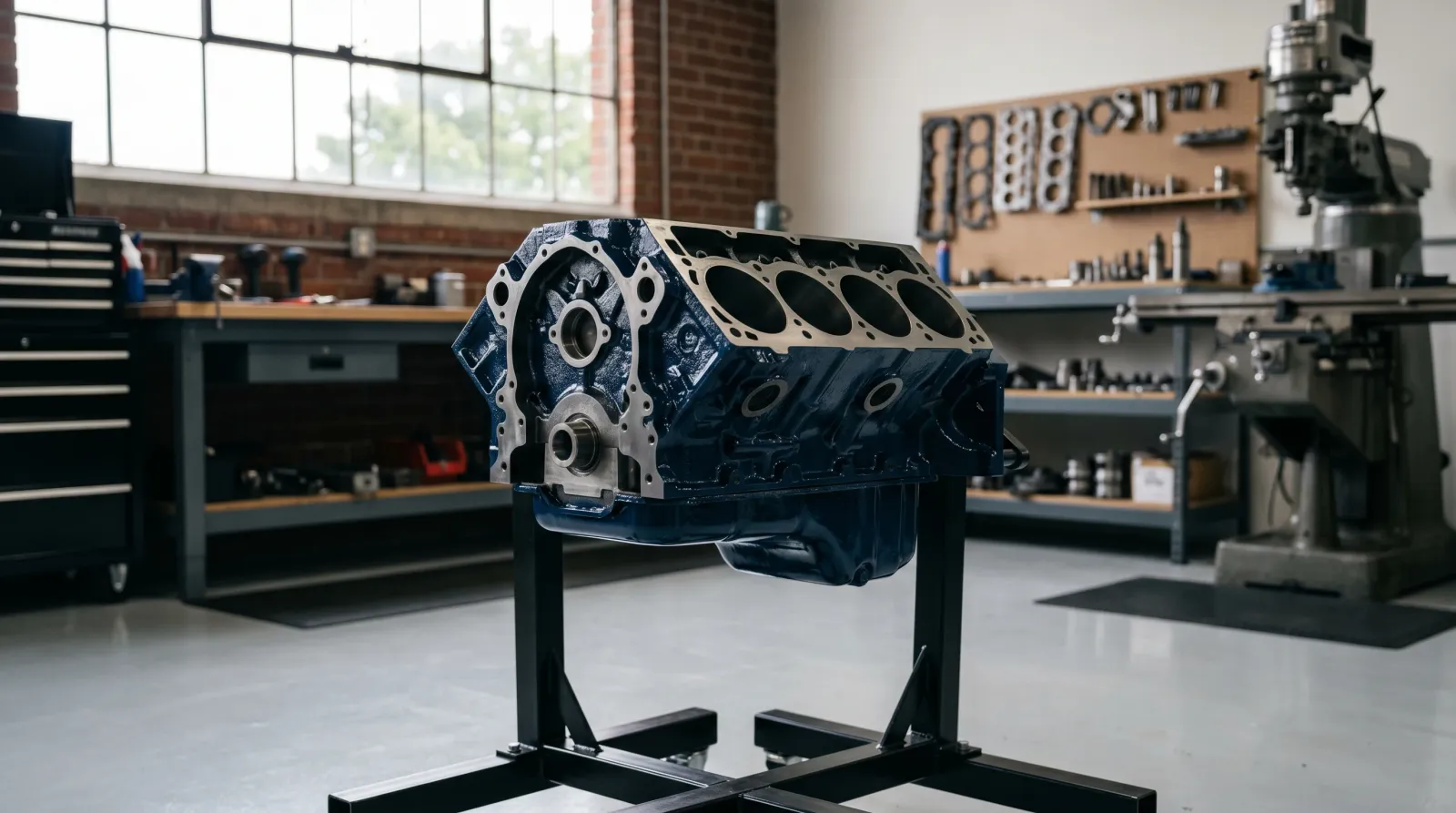
Engine block paint is a high-temperature, fluid-resistant coating for the exterior of a cast-iron or aluminum internal-combustion block: the casting, the heads, the timing cover, the oil pan, and the accessory brackets that bolt to them. The asset cycles between ambient and roughly 180°F to 250°F at the coolant jacket every time the engine runs, with localized hot zones near the exhaust ports that climb past 300°F. The job is corrosion protection on bare machined iron or aluminum, a durable color finish that survives oil mist and coolant weep, and a film that flexes through that thermal cycle without cracking off the casting.
The buyers split into three groups. Production rebuilders and remanufacturers coat blocks by the rack and need a fast-cure, consistent-color system that runs through a spray booth and an oven. Restoration and performance shops match a factory color (Chevy orange, Ford blue, Pontiac silver-blue, Mopar hemi orange) and need a finish that holds gloss and reads correct at a show. Fleet and industrial-engine maintenance operations recoat blocks on generators, pumps, and stationary power units where corrosion control matters more than color. All three are buying the same coating class for the same reason: standard automotive or industrial enamel cannot survive the heat cycle and the fluid exposure a block sees in service.
What kills a coating here is rarely peak temperature alone. It is the combination of thermal cycling, oil and coolant attack, and the bare-metal substrate. A block heats, the iron or aluminum expands, the film expands with it, then both contract on shutdown. A binder that cannot accommodate that movement cracks at the bond line. Add oil mist condensing on the casting and a coolant weep running down the side, and an ordinary enamel softens and releases within a season. The spec calls for a heat-stable ceramic or urethane-modified binder, a matched prep to bare bright metal, fluid resistance to ASTM D1308, and no foreign primer trapped underneath. Get those right and a block coating delivers the life of the rebuild, 8 to 12 years on a street engine and the full service interval on an industrial unit.
Spec Requirements
The spec block before any product name. Numbers move by chemistry and manufacturer; the categories do not.
| Spec | Value |
|---|---|
| Dry film thickness (DFT) | 1.5–3 mils per coat; 3–6 mils total for a primer-plus-topcoat ceramic system |
| Coverage @ DFT | 60–110 sq ft/gal at 2 mils dry; aerosol cans cover 8–15 sq ft each (one engine = 2–3 cans) |
| VOC | under 340 g/L water-based and CARB-compliant aerosol; 420–520 g/L solvent-borne under SCAQMD Rule 1151 / 1113 |
| Standards | ASTM D2485 (heat resistance), D4541 (pull-off), D3359 (cross-cut), D870 (water immersion), D1308 (oil/coolant/fuel resistance) |
| Continuous service temp | 250°F minimum; 500°F intermittent headroom for hot zones near exhaust ports |
| Substrate prep — ferrous (cast iron) | SSPC-SP1 solvent clean, then SSPC-SP3 power-tool or media blast to bright bare metal; SP5/SP6 blast preferred |
| Substrate prep — aluminum | SSPC-SP1 degrease, scuff to 320–600 grit or blast, then self-etching primer — the oxide layer must be cut |
| Primer | Matched heat-rated engine primer (ferrous) or self-etching primer (aluminum); or self-priming direct-to-metal urethane (POR-15) — no standard automotive primer |
| Fluid resistance | Tested against oil, glycol coolant, fuel; brake-fluid resistance noted separately (brake fluid strips most enamels) |
| Initial cure | Air-cure to handle 1–4 hours; full cure by oven bake (200°F–400°F) or the engine’s first run cycle |
| Ambient at application | 60°F–90°F; relative humidity <85%; substrate ≥5°F above dew point |
| Recoat window | 30 min–1 hour wet-on-wet for ceramic aerosol; up to 7 days before bake/run-cure |
Two numbers govern the result. The continuous service temperature on the TDS has to clear the hottest metal the block reaches, measured at the casting near the exhaust ports with a contact thermometer, not estimated from the coolant gauge. And the prep grade decides the bond. A ceramic enamel over bare blasted iron holds for the life of the rebuild; the same enamel over a greasy casting or an un-etched aluminum oxide layer releases on the first heat cycle no matter how good the binder is.
State VOC variation matters because engine enamel still sells heavily in solvent-borne form. Bulk solvent-borne engine enamel runs 420 to 520 g/L and is restricted under SCAQMD Rule 1151 in the South Coast district and comparable OTC-state automotive-refinishing rules. CARB-reformulated aerosols land under the consumer-product aerosol-coating cap, and water-based engine coatings pass California review. Verify the specific product SDS against the project’s jurisdiction before a bulk order. The bulk can legal in Texas may not be permitted on a Los Angeles County production line.
System Chemistry Compared
Pick the binder against the block metal, the operating temperature, and the fluid exposure, then pick the brand.
| Chemistry | Continuous service temp | Recoat / cure | UV / gloss retention | $ per engine (material) | Best for |
|---|---|---|---|---|---|
| Ceramic-modified engine enamel | 250°F–500°F | Wet-on-wet 30–60 min; bake or run-cure | Good (holds gloss and color) | $25–60 | Restoration, show finish, factory-color match — the default block answer |
| Urethane-modified direct-to-metal | up to 300°F | Recoat 1–2 hr; full cure 3–5 days | Good (oil-resistant, hard film) | $40–90 | Industrial blocks, corrosion-first applications, self-priming on bare metal |
| Standard silicone-modified high-heat | 500°F–1200°F | Cure bake required | Fair (limited color range) | $15–35 | Wrong tool for blocks; reserve for headers and manifolds |
| Acrylic / water-based engine | up to 200°F | Air-cure 1–2 hr | Fair | $20–45 | Low-output or display engines, low-VOC jobs, color-finish driven |
| Powder coat (high-temp polyester) | up to 400°F | Oven cure 400°F, 15–20 min | Excellent | $80–200 (shop) | Production rebuilders and show blocks with oven capacity |
Ceramic-modified engine enamel is the right answer for most blocks. The ceramic-filler binder cures hard, flexes through the heat cycle, resists oil and coolant after cure, and holds factory color and gloss better than a plain enamel. Urethane-modified direct-to-metal (POR-15) earns its place where corrosion protection on a marginal casting matters more than show gloss, and where a self-priming single product simplifies the system. The trap on this page is standard high-heat stove or grill paint: it survives the temperature, so a buyer reaches for the cheap aerosol they already know, then it has no fluid resistance and brake fluid or an oil weep strips it in a year. Powder coat wins on durability where a shop has an oven big enough to bake a block, and loses on accessibility for in-field work.
Recommended Systems
Three full systems at different price-performance points. All three are real, widely stocked product lines. Verify the exact SKU, color, and service temperature against the manufacturer TDS before ordering.
System A — VHT Engine Enamel with Ceramic (the Default Restoration Stack)
| Layer | Product | DFT |
|---|---|---|
| Surface prep | SSPC-SP1 solvent clean + SP3/SP5 blast to bare bright metal; 600-grit scuff on aluminum | — |
| Primer | VHT Engine Enamel Primer (ferrous or aluminum) | 1–1.5 mils |
| Topcoat | VHT Engine Enamel with Ceramic (gloss color or cast aluminum) | 1.5–2.5 mils |
| Total | 2.5–4 mils |
The volume answer for restoration and color-match work. VHT (now under the Sherwin-Williams / Dupli-Color umbrella) rates its ceramic engine enamel to 550°F continuous and carries a wide factory-color range that reads correct at a show. The ceramic filler gives the film hardness and gloss retention that a plain enamel cannot, and full cure comes from the engine’s first heat cycle or a 200°F oven bake. Run the matched VHT engine primer on bare ferrous and a self-etching primer on aluminum; never stack it over a cold automotive primer. VHT Engine Enamel product page · Search on Amazon
System B — POR-15 Engine Enamel (Corrosion-First, Self-Priming)
| Layer | Product | DFT |
|---|---|---|
| Surface prep | SSPC-SP1 degrease + media blast or POR-15 Metal Prep etch on bare metal | — |
| Topcoat (direct-to-metal) | POR-15 Engine Enamel (self-priming urethane-modified, two coats) | 2–3 mils |
| Total | 2–3 mils |
The answer when corrosion protection on a rough or pitted casting outweighs show gloss. POR-15 Engine Enamel is a self-priming direct-to-metal urethane rated to 300°F continuous, formulated to resist oil, gasoline, and antifreeze after cure, and built to bond to bare metal without a separate primer. The hard urethane film is the most fluid-tough on this list and the right call on industrial and stationary engine blocks where the unit weeps oil and sees decades of service. Color range is narrower than VHT; this is a durability buy, not a factory-color buy. POR-15 Engine Enamel product page · Search on Amazon
System C — Eastwood Ceramic Engine Paint (Production / Show Stack)
| Layer | Product | DFT |
|---|---|---|
| Surface prep | Media blast to SSPC-SP5/SP6 white-to-commercial blast; solvent wipe | — |
| Primer | Eastwood Self-Etching Primer (aluminum) or epoxy primer (ferrous) | 1–1.5 mils |
| Topcoat | Eastwood Ceramic Engine Paint (high-temp ceramic-modified) | 1.5–2.5 mils |
| Total | 2.5–4 mils |
The spec’d-shop answer for production rebuilders and show-quality finishes. Eastwood’s ceramic engine paint is built for spray-booth application over a properly primed, blasted block, rated past 500°F, and supported by a full restoration-products line (etch primers, engine-color matches, clear topcoats) so the chain from bare casting to final color is one supplier’s tested system. Specify this stack where a shop sprays blocks in volume, wants an epoxy or self-etch primer base, and runs an oven for cure. Eastwood Ceramic Engine Paint page · Search on Amazon
Systems Compared
| System | Total DFT | $ per engine (material) | Service life | Best for |
|---|---|---|---|---|
| A — VHT Engine Enamel with Ceramic | 2.5–4 mils | $25–50 | 8–12 years | Restoration, factory-color match, show finish |
| B — POR-15 Engine Enamel | 2–3 mils | $40–80 | 10–15 years | Industrial / stationary blocks, corrosion-first, self-priming |
| C — Eastwood Ceramic Engine Paint | 2.5–4 mils | $35–70 | 8–12 years | Production rebuilders, spray-booth shops, oven cure |
Pricing is material only for a single V8-size block; aerosol jobs land at the low end, sprayed bulk and primer at the high end. Labor (teardown, blast, mask, spray, cure) dwarfs material on every block, which is why the system choice matters more than the can price. The TCO case favors System B on a stationary industrial engine with a 15-year horizon: the harder urethane film skips a mid-life recoat, and pulling an industrial block for a redo carries downtime cost that swamps the material delta. On a restoration where color match is the deliverable, System A is the answer and the gloss-retention edge of the ceramic filler is the point.
Application & Contractor Path
A single block is within reach of a competent shop or a careful enthusiast with the right prep. This is one of the few high-temp categories where in-house application holds up, provided the bare-metal prep and the no-foreign-primer rules are followed. The block comes out of the vehicle, gets degreased and blasted to bright metal, masked at the gasket surfaces and bores, primed with a matched engine or self-etch primer, sprayed in light coats, and cured by an oven bake or the engine’s first run cycle. Coat the metal cool; the running engine bakes the film to full hardness on its own.
The work moves to a dedicated shop when the scope is a production rack of blocks, a powder-coat finish is specified, or the engine is a stationary industrial unit that cannot be pulled casually. For volume rebuild and industrial work, specify a coater with:
- A controlled spray environment meeting OSHA 1910.107 spray-finishing ventilation requirements, not a driveway.
- Media-blast capability to reach bright bare metal (SSPC-SP5/SP6) on the casting before primer.
- Oven cure capacity if a powder coat or a baked ceramic finish is on the spec.
Manufacturer technical support on VHT, POR-15, and Eastwood includes color-match data, primer-compatibility guidance, and cure-schedule confirmation by phone or TDS. Use it before a production run. The most expensive block-coating failure is a wrong primer or a missed etch step discovered after the engine is back together, and a five-minute call to the manufacturer’s tech line catches that before a casting gets sprayed.
A hot-work note for any in-vehicle recoat: spraying a solvent-borne engine enamel near a warm engine or fuel line is a fire hazard governed by OSHA 1910.252 and 1910.107. Cool the engine, disconnect the battery, ventilate the bay, and keep ignition sources clear, or pull the block and spray it on a stand.
Failure Modes & How to Prevent Them
Five failures cover the bulk of engine-block coating peels and premature finishes.
- Coating sprayed over a greasy casting. The single most common failure. Cast iron and aluminum blocks hold oil in the porous surface and the machined pockets, and any film over residual oil releases on the first heat cycle. Prevention: SSPC-SP1 solvent degrease, then media blast or power-tool clean to bright bare metal, then a final solvent wipe. A casting that looks clean is not clean until it has been degreased and blasted. See the workflow for prepping and painting cast iron before any color goes down.
- No etch on aluminum. Coating bonds to the aluminum oxide layer instead of the metal, and the oxide sheds the whole film. Prevention: scuff and self-etching primer, or an acid etch, on every aluminum block, head, and timing cover. Aluminum is not iron; the galvanized and non-ferrous prep approach explains why a reactive etch is the step that keeps a coating from sliding off a passive oxide surface.
- Foreign primer carbonizes and lifts the topcoat. A standard automotive or industrial primer left under a ceramic engine enamel chars at operating temperature and releases the system. Prevention: use only a matched heat-rated engine primer, a self-etch primer on aluminum, or a self-priming direct-to-metal product (POR-15). No general-purpose primer under a heat coat.
- Wrong coating class — fluid attack. A generic high-heat stove or grill aerosol survives the temperature but has no fluid resistance, and an oil weep or a brake-fluid spill strips it within a year. Prevention: specify a purpose-built engine enamel tested to ASTM D1308 against oil, coolant, and fuel; confirm fluid resistance on the TDS, not the marketing.
- Blistering from solvent or moisture entrapment. The film bubbles after the first heat cycle where coating went on too thick, too fast, or over a damp casting. Prevention: respect the per-coat DFT, let each light pass flash before the next, keep the casting above dew point, and never recoat over a surface still warm from blasting or wet from solvent. The paint blistering diagnosis page walks the cause tree when a blister shows up after cure.
Greasy prep and the missing aluminum etch account for most of the field peels I review. Both are decided before the first coat and both are free to prevent. The third repeat offender, the wrong coating class, is a spec mismatch: a hardware-store heat aerosol bought because it was cheap and rated for the temperature, with no fluid resistance to survive what a block actually leaks.
Where to Buy / Spec
| Channel | Best for | Path |
|---|---|---|
| Amazon Business | Aerosol stocking, single-engine restoration, color-match cans | Search on Amazon |
| Manufacturer-direct (POR-15, Eastwood, VHT) | Bulk quarts and gallons, matched primers, tech support, color data | POR-15 Engine Enamel page |
| Restoration distributor (Summit Racing, Jegs, Eastwood) | Performance and restoration shops, full system + primers | Eastwood Ceramic Engine Paint |
| Pro retail (auto-paint jobber, Sherwin-Williams Automotive) | Local pickup, spray-grade bulk, production-shop accounts | Jobber account with color-match and reducer support |
Manufacturer-direct and restoration distributors are the channel for production and bulk work; the color-match data and matched-primer chain are worth more than any aerosol discount. Amazon Business and the jobber counter cover single-engine and in-house touch-up. For the broader heat-coating context on warm ferrous assets, see the 200F high-temp paint specifier guide, and for the industrial brand behind much of the high-heat aerosol shelf, the Rust-Oleum industrial line review.
FAQ
See the frontmatter for the full Q&A. The short version: match the rated continuous service temperature to the hottest metal near the exhaust ports, degrease and blast to bare bright metal, etch every aluminum surface, use only a matched engine primer or a self-priming product, and let the first run cycle bake the film to full hardness.