Dock and Pier Paint: Marine Specifier's Guide (2026)
Dock paint specs by substrate: pressure-treated wood decking, steel pilings, and concrete piers. DFT, immersion-grade systems, splash-zone failure modes, and the contractor path for marine work.

Disclosure: Affiliate links to retailers and manufacturer-direct programs. Recommendations are spec-driven, not commission-driven.
Use Case
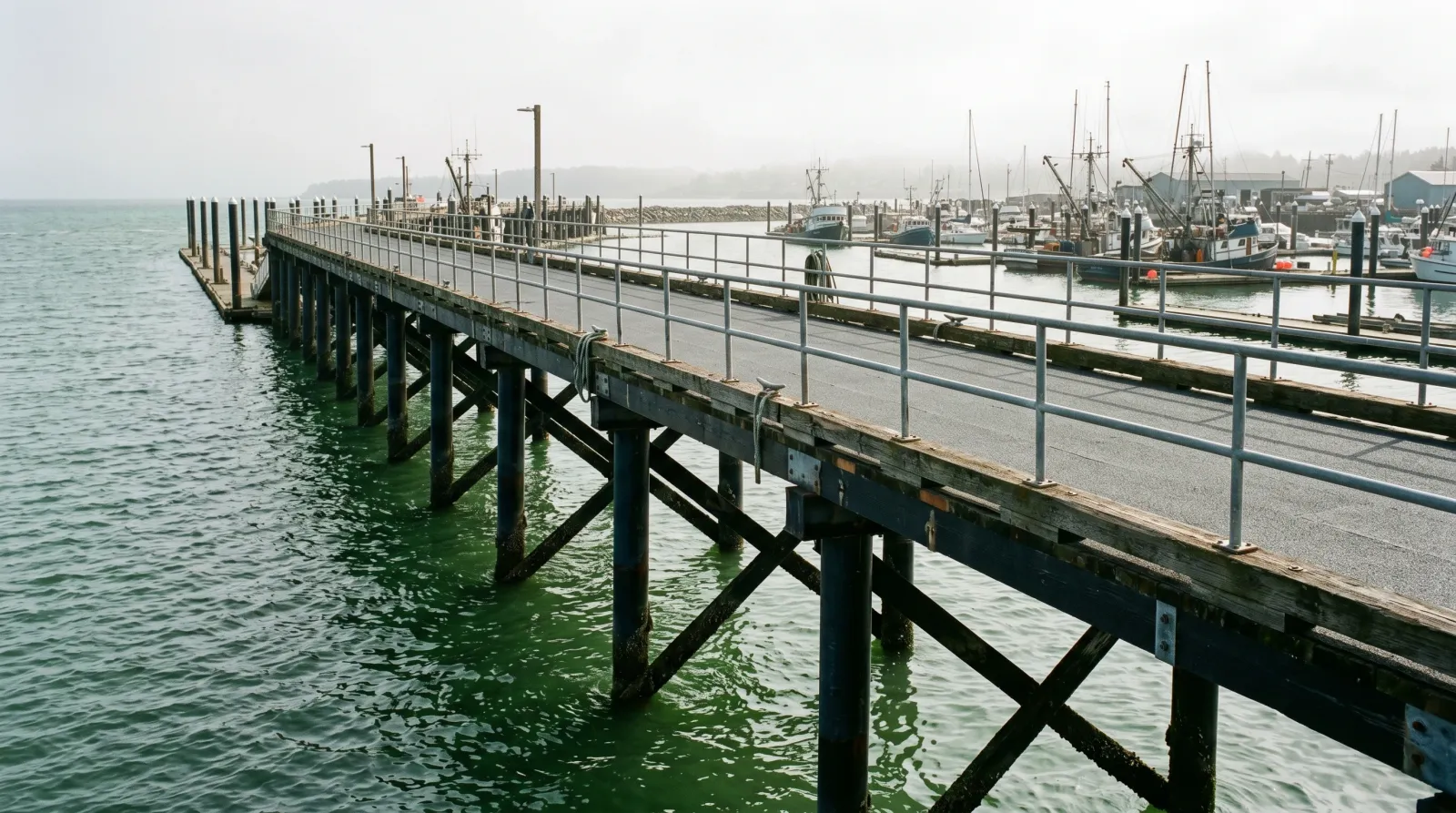
A dock or pier is three coating jobs stacked on one structure. The walking deck is a wood or composite surface that has to stay slip-resistant under standing salt water and foot traffic. The pilings are steel, concrete, or treated timber driven through the most corrosive exposure on the waterfront, the tidal and splash zone, where wet/dry cycling and dissolved oxygen attack metal faster than full immersion does. The substructure and framing live in salt fog year-round. One product does not cover all three, and the common spec error is treating a dock like a deck and brushing topside enamel on a steel piling that needs a 35-mil immersion epoxy.
Assets that pull this spec: marina finger piers and main walkways, municipal fishing piers, fuel docks, commercial fishing wharves, ferry landings, and the boardwalks and observation piers a parks department owns. Owners range from a marina operator to a port authority to a property manager with a waterfront amenity. Expected service life drives the chemistry choice. A timber deck enamel gives 2–4 years before recoat in a sun-and-salt climate. A blasted-and-coated steel piling system holds 8–15 years in the atmospheric zone and 5–8 in the tidal zone before the first maintenance coat. Concrete pier caps coated with an immersion epoxy run 10+ years.
The spec writer’s job is to zone the structure by exposure, match a system to each zone, and write a prep grade that the coating can actually bond to. The deck and the piling fail for different reasons, so they get specified separately.
Zone Recommendation Matrix
A dock is a multi-zone asset. Coat by exposure, not by one blanket product.
| Zone | Exposure | Recommended system | Why |
|---|---|---|---|
| Timber / composite deck | Foot traffic, standing salt water, UV | System C marine enamel + anti-slip aggregate | Recoatable, slip-rated, no blast needed |
| Railings, above-deck framing | Salt fog, UV, splash | System A epoxy/urethane (atmospheric grade) | UV-stable topcoat over corrosion-resistant primer |
| Steel piling, atmospheric zone | Salt fog, condensation | System A epoxy/urethane, 12–16 mils | Barrier + UV protection above high tide |
| Steel piling, splash/tidal zone | Wet/dry cycling, oxygen, abrasion | System B coal tar / high-build epoxy, 30–40 mils | Highest film build at the worst exposure |
| Concrete pier cap / seawall | Carbonation, chloride ingress | System B epoxy over ICRI CSP 3 profile | High-build immersion barrier |
The splash zone is where most piling systems fail first, so it carries the heaviest film. Do not average the structure down to one DFT. A 16-mil system that is right above high tide is thin where the tide actually works the steel.
Spec Requirements
| Spec | Value |
|---|---|
| DFT, timber deck enamel | 3–5 mils dry total (two coats over primer) |
| DFT, steel piling atmospheric | 12–16 mils dry (epoxy build + urethane topcoat) |
| DFT, steel piling splash/tidal | 30–40 mils dry (high-build or coal tar epoxy) |
| Coverage @ DFT | Deck enamel 250–350 sq ft/gal; high-build epoxy 60–110 sq ft/gal at spec build |
| VOC | Under 100 g/L (waterborne deck acrylic); 250–340 g/L (solvent-borne marine epoxy, restricted under SCAQMD Rule 1113 and OTC states) |
| Standards | ASTM D4541 (pull-off adhesion ≥300 psi on steel), ASTM B117 (salt-fog ≥2,000 hr for piling systems), ASTM D4060 (Taber abrasion, deck), ASTM G154 (QUV weathering, topcoat) |
| Substrate prep — steel | SSPC-SP10 / NACE 2 near-white blast, 2–3 mil angular profile (atmospheric / immersion); SSPC-SP6 commercial blast acceptable only on low-exposure framing |
| Substrate prep — concrete | Abrasive blast or grind to ICRI CSP 3; verify moisture vapor emission below coating maximum before immersion epoxy |
| Substrate prep — wood | Clean, mildew-wash, sand; PT lumber dried to ~15% moisture content (pin meter) before priming |
| Service temp | -20°F to 200°F dry service (epoxy/urethane); continuous salt immersion for tidal-zone coats |
| Cure to service / immersion | 7–10 days full cure before salt immersion at 75°F (epoxy); longer below 60°F |
| Dew point / humidity ceiling | Steel temp ≥5°F above dew point; ≤85% RH during application and cure |
| Slip resistance | OSHA 1910.22(a) walking-working surface; target static COF ≥0.60 wet on coated deck |
These specs are exposure-specific and not interchangeable. SSPC-SP10 near-white is the prep grade that immersion epoxy needs; drop to SSPC-SP6 commercial blast on a tidal piling and the residual mill scale becomes the failure plane inside two years. The 2–3 mil angular profile gives the high-build epoxy mechanical key; a smoother profile from worn abrasive lets a 35-mil film disbond in sheets. On concrete, the moisture vapor emission check is not optional on a pier cap that sits over water. Coat a concrete substrate that is still driving vapor and the immersion epoxy blisters from behind, regardless of how clean the surface looked.
The dew-point rule is the one a barge crew breaks. Steel that sits 4°F above dew point at 9 a.m. condenses an invisible moisture film as the tide and air shift, and the epoxy bonds to water instead of steel. Hold a 5°F margin and check it through the recoat window, not just at the first pass.
System Chemistry Compared
Pick the chemistry by zone before you pick the brand.
| Class | Pot life (75°F) | Recoat window | Service exposure | UV stability | $/sq ft band | Best for |
|---|---|---|---|---|---|---|
| Marine alkyd / acrylic enamel | n/a (single component) | 4–16 hr | Atmospheric, foot traffic | Good (acrylic), fair (alkyd) | $0.40–0.90 | Timber and composite decks, railings |
| Amine-cured epoxy (high-build) | 2–4 hr | 8–24 hr | Immersion, splash, tidal | Poor (chalks) — needs topcoat | $1.20–2.50 | Steel piling, concrete pier, splash zone |
| Coal tar epoxy | 3–5 hr | 16–48 hr | Immersion, tidal, buried | Poor — immersion only | $1.10–2.20 | Tidal-zone steel, submerged piling |
| Aliphatic polyurethane | 2–4 hr | 8–16 hr | Atmospheric topcoat | Excellent | $0.90–1.80 | UV topcoat over epoxy on visible steel |
Epoxy is the barrier; urethane is the sunscreen. Amine-cured epoxy delivers the corrosion resistance and film build a piling needs, but it chalks and fades under UV. In the atmospheric zone where the steel is visible and sun-exposed, an epoxy primer/build coat carries an aliphatic polyurethane topcoat that holds gloss and color. In the tidal and submerged zone, UV is not a factor, so the system stays on epoxy or coal tar epoxy and skips the urethane.
Coal tar epoxy is the long-standing tidal-zone workhorse and still specs on commercial wharves, but it is black, it has a long recoat window, and some jurisdictions restrict it. Where the spec or the region won’t allow coal tar, a high-build pure epoxy (Carboline Bitumastic-grade equivalents) covers the same exposure. The deck is a different problem entirely: it sees foot traffic and UV but not immersion, so a single-component marine enamel that recoats easily beats a two-part epoxy that locks the maintenance crew out of an annual touch-up.
Recommended Systems
System A — Sherwin-Williams Epoxy/Urethane (Steel Piling, Atmospheric Zone)
The atmospheric-zone standard for visible steel: a fast-cure epoxy build coat under a UV-stable acrylic polyurethane. ASTM B117 salt-fog and ASTM D4541 adhesion documented on the data sheets.
| Layer | Product | DFT |
|---|---|---|
| Surface prep | Abrasive blast to SSPC-SP10 near-white, 2–3 mil profile | — |
| Primer / build | Macropoxy 646 Fast Cure Epoxy (two coats in splash zone) | 10–16 mils dry |
| Topcoat | Acrolon 218 HS Acrylic Polyurethane | 3–5 mils dry |
| Total (atmospheric) | 13–21 mils dry |
Macropoxy 646 product page · Sherwin-Williams industrial line overview
Macropoxy 646 is the most-specified marine and industrial epoxy in North America, and it earns the spot on surface tolerance and cure speed. It still wants an SP10 blast in the splash zone; the “surface tolerant” claim covers SP6 on low-exposure framing, not on a tidal piling. Two coats below high tide, one above. The Acrolon topcoat is what keeps the structure from chalking to gray inside a year.
System B — Pettit Targuard Coal Tar Epoxy (Splash / Tidal / Submerged Zone)
The immersion-zone build. Coal tar epoxy at high film thickness over a near-white blast, for the steel that the tide actually works. Also the system for concrete pier caps over an ICRI CSP 3 profile.
| Layer | Product | DFT |
|---|---|---|
| Surface prep (steel) | Blast to SSPC-SP10; concrete abrade to ICRI CSP 3 | — |
| Build coat 1 | Targuard Coal Tar Epoxy | 16–20 mils dry |
| Build coat 2 | Targuard Coal Tar Epoxy | 14–20 mils dry |
| Total (tidal/immersion) | 30–40 mils dry |
Pettit protective coatings · How to prep and paint rusted metal
Targuard is black and immersion-only; it has no business in the visible atmospheric zone where a chalked black coat looks like a failure even when it isn’t. Hold the high build in the tidal band specifically. Holiday inspection matters here: a single pinhole in a 35-mil immersion film becomes a corrosion cell, so spec a low-voltage wet-sponge holiday test on the cured coat before the structure goes back in service.
System C — Rust-Oleum Marine Enamel (Timber / Composite Deck)
The deck and railing system. A marine wood primer under two coats of topside enamel, with anti-slip aggregate broadcast into the deck field. In reach of an in-house maintenance crew.
| Layer | Product | DFT |
|---|---|---|
| Surface prep | Clean, mildew-wash, sand; PT lumber dried to ~15% MC | — |
| Primer | Marine Wood & Fiberglass Primer | 2–3 mils dry |
| Topcoat (×2) | Marine Topside Paint + anti-slip aggregate in deck field | 2–3 mils dry per coat |
| Total | 6–9 mils dry |
Rust-Oleum Marine Coatings · Rust-Oleum industrial line overview
The deck spec lives or dies on the anti-slip step. Broadcast aluminum-oxide or polymer aggregate at 0.5–1.0 lb/gal into the wet topcoat, then back-roll a lock coat so the grit stays put under boots and dock carts. Gloss enamel alone on a wet salt-washed deck fails OSHA 1910.22 slip resistance and is a claim waiting to happen. For the deeper bare-wood prep sequence, see the guide on painting pressure-treated wood.
Systems Compared
| System | Total DFT | $/sq ft installed | Service life | Best for |
|---|---|---|---|---|
| A — SW epoxy/urethane | 13–21 mils | $3.50–6.50 | 8–15 yr (atmospheric) | Visible steel piling, railings, framing |
| B — Pettit coal tar epoxy | 30–40 mils | $4.50–8.00 | 5–8 yr (tidal), 10+ yr (submerged) | Splash/tidal steel, concrete pier caps |
| C — Rust-Oleum marine enamel | 6–9 mils | $1.20–2.20 | 2–4 yr | Timber/composite deck, railings |
Installed cost includes prep, which dominates the steel systems. The blast is most of the $/sq ft on Systems A and B; the paint is the minority of the number. On a deck, the prep is a crew with a sander, so System C reads cheap and recoats on a routine maintenance budget. Over a 15-year horizon, the steel that gets a proper SP10 blast and a full-build epoxy once costs less than the dock that gets a thin “surface tolerant” pass every three years and rusts through the substructure underneath.
Application and Contractor Path
The deck and the steel split cleanly on whether you self-perform.
Deck and railings (System C): in-house is reasonable. A facility maintenance crew with a pressure washer, orbital sander, mildew wash, and the marine enamel can do the timber deck on a low-tide, dry-forecast window. The skill is in the prep and the anti-slip broadcast, not the brushwork. Read the moisture content on PT lumber before you prime.
Steel piling and immersion zones (Systems A and B): spec a contractor. This is not in-house work. The job needs SSPC-SP10 abrasive blasting over water, containment to keep spent abrasive and coating debris out of the waterway, application inside a tight dew-point and tide window, and holiday inspection on the cured immersion film. Spec a marine coatings contractor carrying SSPC-QP1 (field application of complex industrial coatings), and QP2 where lead or other hazardous existing coatings must be removed over water. On the immersion-zone scope, require a NACE/AMPP-certified coating inspector (CIP Level 2 or higher) to sign off prep grade, profile, DFT, and the holiday test.
The manufacturer rep path is worth using before the bid goes out. Sherwin-Williams, Pettit, Carboline, and Sika all field marine and protective-coatings reps who will write a zone-by-zone spec for the structure, confirm the immersion approval on the tidal coat, and name approved applicators in the region. On a fuel dock or any structure with a chemical-exposure question, get the rep’s written compatibility sign-off before you commit the topcoat.
Failure Modes and How to Prevent Them
Tidal-zone rust-through under intact-looking paint. The piling looks coated in the atmospheric zone, then fails at the waterline where the steel is thinnest. Cause is under-build and under-prep in the splash zone: an SP6 blast and a 16-mil film carried straight down from the atmospheric spec into the tidal band where it needed SP10 and 35 mils. Prevention is to zone the spec and put the heaviest film where the tide works the steel, verified with a wet-sponge holiday test.
Deck enamel blistering within a season. Round blisters lift across the deck field, worst in the sun. Cause is coating PT lumber that was still wet, or sealing a deck after a hard rain without a dry-down. Trapped moisture vapor pushes the film off the wood. Prevention is a pin-meter reading at or below 15% moisture content before priming, and a dry-forecast application window. The mechanism is the same one covered in the guide on diagnosing paint blistering.
Topcoat chalking to gray on visible steel. The atmospheric-zone steel fades and chalks on a finger swipe inside a year. Cause is an epoxy left exposed without a UV-stable topcoat; amine-cured epoxy chalks under sun by design. Prevention is the aliphatic polyurethane topcoat in System A. Do not value-engineer the urethane out of the visible-steel spec to save a coat.
Slip failure on a wet deck. The deck reads fine dry and turns to ice under standing salt water. Cause is gloss enamel applied with no anti-slip aggregate, or aggregate broadcast without a lock coat so it walked off in a season. Prevention is aggregate at 0.5–1.0 lb/gal into the wet topcoat plus a back-rolled lock coat, targeting static COF ≥0.60 wet per OSHA 1910.22(a). The companion detail is in the loading dock anti-slip guide.
Disbondment from a slick blast profile. The high-build immersion epoxy comes off the steel in sheets at the next inspection, substrate bright underneath. Cause is a worn-abrasive blast that hit the SP10 cleanliness but not the 2–3 mil angular profile, so the thick film had no mechanical key. Prevention is profile verification with replica tape (Testex) on the blasted steel, not just a visual near-white call.
Where to Buy / Spec
| Channel | Best for |
|---|---|
| Manufacturer-direct (Macropoxy 646, Pettit protective coatings, Carboline / Sika marine reps) | Spec’d piling and immersion projects, rep zone-spec support, immersion approval letters |
| Industrial / marine distributor (Fisheries Supply, Defender, protective-coatings dealers) | Bulk epoxy, coal tar epoxy, anti-slip aggregate for contractor accounts |
| Pro retail (Sherwin-Williams stores) | Local 5-gal pickup, contractor pricing, deck-enamel restock |
| Amazon Business | Marine topside enamel and primer for in-house deck maintenance |
FAQ
See the frontmatter for the buyer questions a procurement reviewer asks: contractor requirement, system warranty, pressure-treated dock lumber timing, OSHA slip resistance, and the splash-zone piling system.