Loading Dock Anti-Slip Coatings: Specifier's Guide (2026)
Anti-slip loading dock paint compared by DFT, COF, and zone. OSHA 1910.22 slip ratings, ICRI CSP profiles, aggregate broadcast, and the contractor path that survives forklift traffic.

Disclosure: Affiliate links to retailers and manufacturer-direct programs. Recommendations are spec-driven, not commission-driven.
Use Case
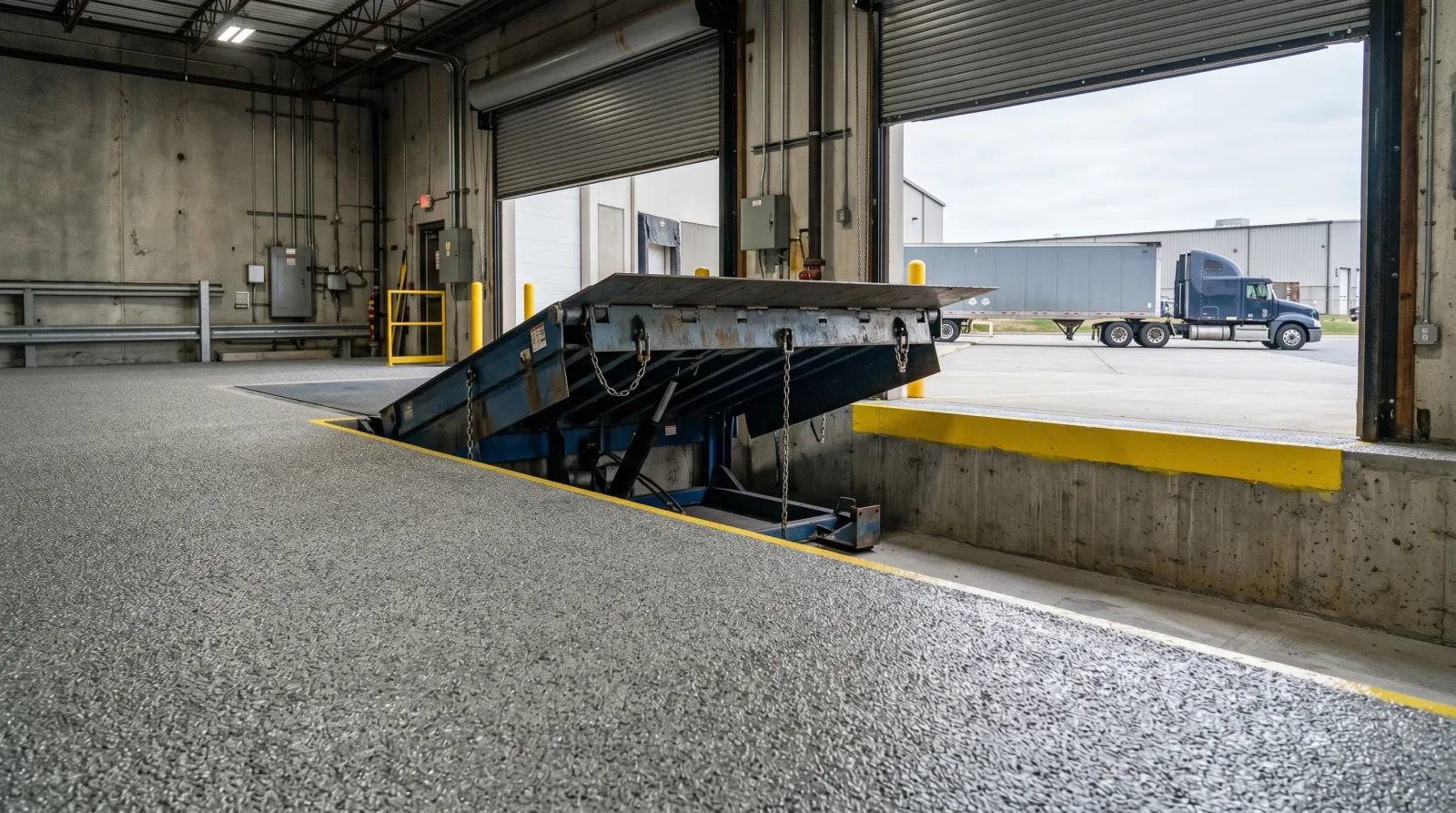
A loading dock anti-slip coating has a harder job than any other industrial floor on the property. The same 400 square feet sees rain and snow blowing in through open bays, condensation dripping off cold trailers in summer, hydraulic oil from the leveler, diesel drip from idling tractors, de-icing chloride tracked in on tires, forklift and pallet-jack traffic, and the steel hinge of a dock plate slamming down a hundred times a shift. The surface is wet more often than it’s dry, and a wet dock floor is where the OSHA recordables happen. Slip-and-fall on a dock generates more lost-time claims per square foot than the warehouse aisle behind it.
The coating is specified across distribution centers, food and beverage plants, retail backrooms, cold-storage receiving, and municipal warehouses. The asset is rarely monolithic. The dock floor field, the leveler pit, the truck-well approach ramp, and the dock-edge impact line each see a different load, and a single product across all of them either overspends on the floor or underspecs the pit.
Service life expectations run 2–3 years for a budget single-coat roll-on, 5–8 years for a broadcast-aggregate epoxy system on the floor field, and 10–15 years for a troweled urethane cement or epoxy mortar in the high-abuse zones. As with every floor system, service life is set by surface preparation and moisture management more than by topcoat brand. Skip the moisture test on a below-grade dock and even a premium system blisters off in a season.
Zoned Recommendation Matrix
A dock isn’t one surface. Map the system to what each zone actually sees:
| Zone | Recommended system | Why |
|---|---|---|
| Dock floor field | System A (broadcast-aggregate epoxy) | Wheeled traffic + wet traction at OSHA COF |
| Leveler pit / dock plate hinge | System C (urethane cement / epoxy mortar) | Steel impact, hydraulic oil, thermal shock |
| Truck-well approach ramp | System A with coarser 16-mesh aggregate | Wet incline, highest slip-fall exposure |
| Dock-edge safety line | Industrial-Choice safety yellow (separate stripe) | OSHA 1910.144 edge visibility |
| Interior staging behind dock | System B (mid-tier, finer texture) | Drier, lighter traffic, easier cleaning |
| Cold-storage dock | Urethane cement, NOT standard epoxy | Sub-zero cure, thermal cycling |
Treat the ramp as the controlling zone for slip liability. It combines a wet surface, an incline, and pedestrian crossover with wheeled equipment. Spec the coarsest aggregate the housekeeping plan can tolerate there, even if the dock floor field gets a finer broadcast.
Spec Requirements
| Spec | Value |
|---|---|
| Dry film thickness (DFT) | 10–30 mils total; 6–10 mils per coat plus broadcast aggregate; 1/8-inch for troweled mortar in impact zones |
| Coverage @ DFT | 80–160 sq ft / gal for roll/spray builds; less for slurry |
| VOC | under 100 g/L (water-based epoxy/urethane, CARB / SCAQMD compliant); solvent-borne high-build restricted under SCAQMD Rule 1113 |
| Standards | ASTM D2047 (static COF), ASTM F1679 / F2508 (dynamic COF), ASTM F1869 (MVE ≤3 lb/1000sf/24h), ASTM D4060 (abrasion), ASTM D7234 (adhesion) |
| Substrate prep | ICRI CSP 3 for the floor field (shotblast); CSP 4 in the leveler pit and ramp for high-build / mortar |
| Surface prep | SSPC-SP1 solvent clean + SSPC-SP13 mechanical (shotblast); degrease hydraulic/diesel contamination first |
| Service temp | -20°F to +180°F (epoxy); urethane cement to -40°F for cold-storage docks |
| Cure to service | Foot traffic 24h · forklift 5–7 days · full chemical resistance 14 days |
| Dew point / humidity | Substrate ≥5°F above dew point during all coats; ambient RH ≤85% |
| OSHA 1910.22 | High-traction surface; static COF ≥0.5 dry; aggregate broadcast on all ramps and wet faces |
The slip number is the spec that defines this coating, and the wet number is the one that matters. A dock floor coated to a 0.6 static COF dry can drop below 0.4 wet if the only texture is a fine slip-resistant additive suspended in the resin. Rain and condensation flood the micro-texture and the surface goes greasy. The fix is broadcast aggregate (aluminum oxide or silica) that stands proud of the resin and keeps a mechanical bite when wet. The trade-off is housekeeping: a coarse broadcast holds dirt and resists a squeegee, so match aggregate grade to how the dock gets cleaned. For a food-plant dock washed nightly, a 30-mesh aluminum oxide is the ceiling; for a salt-tracked retail dock cleaned weekly, a coarser 16-mesh holds up to the abuse.
System Chemistry Compared
Pick the chemistry class before the brand. These are the chemistries that fit a dock:
| Class | Pot life | Recoat | Service temp | UV stable | $/sq ft installed | Best for |
|---|---|---|---|---|---|---|
| Epoxy + aggregate | 30–45 min | 8–24h | -20°F to 180°F | No (yellows / chalks outdoors) | $5–10 | Covered dock floor field |
| Polyaspartic + aggregate | 15–30 min | 1–2h | -40°F to 200°F | Yes | $9–16 | Fast-turnaround docks, sun-exposed ramps |
| Urethane cement | 30 min | 12h | -40°F to 250°F | Yes | $12–25 | Leveler pits, cold storage, washdown |
| MMA (methyl methacrylate) | 5–15 min | 1h | -40°F to 200°F | Yes | $14–28 | 24/7 docks that can’t tolerate >24h downtime |
For a covered dock floor that sees rubber-wheeled forklift traffic, broadcast-aggregate epoxy is the right answer and the most common spec. For a dock that faces direct sun (an open truck-well ramp), epoxy chalks and the topcoat should be polyaspartic or a UV-stable urethane to hold color and gloss. For the leveler pit, the dock plate hinge, and any cold-storage receiving area, urethane cement is the only chemistry that takes the steel impact and thermal shock without cracking. MMA earns its premium only on docks that genuinely cannot give up more than one day of operation.
Recommended Systems
System a — Broadcast-Aggregate Epoxy (Floor Field)
The dock-floor standard. Service life 5–8 years under forklift traffic with a wet-rated COF. Total DFT 14–21 mils plus aggregate.
| Layer | Product | DFT |
|---|---|---|
| Primer | Sherwin-Williams ArmorSeal 1K HS Sealer | 2–3 mils |
| Build coat | Sherwin-Williams ArmorSeal 1000 HS Epoxy | 6–8 mils |
| Topcoat (aggregate broadcast) | ArmorSeal 1000 HS with 16–30 mesh aluminum oxide | 6–10 mils |
Sherwin-Williams ProIndustrial ArmorSeal product page →
The broadcast is where this system lives or dies. Aggregate broadcast to refusal (until the wet resin won’t absorb any more) into the build coat, then lock it down with the topcoat. A single seeded coat with aggregate stirred into the resin gives uneven traction and bald spots where the grit settled. Seed to refusal, sweep the loose grit, then seal.
System B — Mid-Tier Roll-On Anti-Slip (Staging / Light Dock)
Service life 3–5 years on lighter traffic. Total DFT 10–14 mils. Right for the staging area behind the dock and low-volume docks without steel-wheeled traffic.
| Layer | Product | DFT |
|---|---|---|
| Primer | Rust-Oleum Concrete Saver Multi-Surface Primer | 2 mils |
| Topcoat (aggregate) | Rust-Oleum Concrete Saver SafeStep Anti-Slip Coating | 8–12 mils |
Rust-Oleum Industrial product page →
SafeStep carries its own suspended aggregate, which makes it roll-applied and contractor-light. The catch is the same as any seeded coating: the grit isn’t broadcast proud, so the wet COF is lower than a broadcast system. Don’t spec it on a ramp or a wet face. It earns its place on a covered, drier staging slab.
System C — Urethane Cement / Epoxy Mortar (Impact Zones)
Service life 10–15 years. The leveler pit, dock plate hinge, and cold-storage receiving. Total system 1/8-inch to 1/4-inch troweled.
| Layer | Product | DFT |
|---|---|---|
| Primer | Tnemec Series 201 Epoxoprime | 4–6 mils |
| Slurry / build | Tnemec Series 237SL Power-Top aggregate slurry | 1/8-inch trowel |
| Topcoat | Tnemec Series 287 Enviro-Pox sealer | 4–6 mils |
Urethane cement tolerates thermal shock that cracks epoxy. A trailer backs in at 95°F ambient, the leveler drops onto a slab the truck’s refrigeration unit has chilled, and the temperature swing fractures a rigid epoxy at the bond line. The urethane-cement matrix moves with the slab. It’s the only chemistry to spec where steel meets concrete on a dock.
Systems Compared
| System | Total DFT | $/sq ft installed | Service life | Best for |
|---|---|---|---|---|
| A | 14–21 mils + aggregate | $6–10 | 5–8 yrs | Dock floor field, wet ramps |
| B | 10–14 mils | $3–5 | 3–5 yrs | Staging, light covered dock |
| C | 1/8-inch trowel | $12–22 | 10–15 yrs | Leveler pit, impact, cold storage |
Cost includes prep (shotblast), primer, build, topcoat, aggregate, and contractor labor. DIY roll-on drops cost roughly 40% but won’t clear the wet COF target and won’t survive wheeled traffic. The leveler pit is the zone where owners try to save and shouldn’t. A $20/sf urethane-cement pit on 60 square feet is $1,200. The same pit recoated every two years because epoxy keeps cracking off the hinge is a recurring shutdown that costs more than the pit ever did.
Application & Contractor Path
This is not a DIY product class for an active dock. Specify a contractor with SSPC-QP1 certification (industrial coatings) or NACE / AMPP Level 2 inspection credentials. Surface prep alone (shotblast to ICRI CSP 3, CSP 4 in the pit) requires equipment most facility crews don’t own, and the aggregate broadcast technique is where inexperienced applicators leave bald spots that fail the COF target. The manufacturer rep network is the path in: Sherwin-Williams ProIndustrial reps, Tnemec coating consultants, and the SSPC/AMPP contractor lookup database all field-verify the spec and inspect the broadcast.
For a small DIY-scale dock pad (under 300 square feet, light foot traffic, no forklift), Rust-Oleum Concrete Saver SafeStep is the right product class. Expect 2–3 year service life rather than the 5–15 a pro install delivers, and don’t put it on the ramp.
Failure Modes & How to Prevent Them
- Delamination from moisture vapor. Dock slabs are usually at-grade or below-grade with no vapor barrier, so MVE lifts the coating in disc-shaped blisters. Prevention: ASTM F1869 calcium chloride test before install. If MVE is above 3 lb/1000sf/24h, install an MVE barrier primer (Sika MVE Stop, Tnemec Series 201).
- Slip failure when wet. A coating that passes static COF dry drops below the wet target because the texture is a fine additive, not broadcast aggregate. Prevention: broadcast 16–30 mesh aggregate to refusal, spec to the dynamic wet COF (ASTM F2508), and test the ramp specifically.
- Cracking at the dock plate hinge. Rigid epoxy fractures under the steel impact and thermal shock of the leveler. Prevention: spec urethane cement or troweled epoxy mortar in the pit and hinge zone, not the floor-field epoxy.
- Oil-contaminated bond line. Hydraulic fluid from the leveler and diesel drip soak into bare concrete and act as a release layer. Prevention: degrease per SSPC-SP1, then shotblast. A degreaser-only clean over saturated concrete still fails; the contaminated layer has to be mechanically removed.
- Application below dew point. Docks run cold and damp; coat a slab within 5°F of dew point and moisture condenses between coats and blisters the system. Prevention: track substrate temperature against dew point on the contractor’s QC log and hold all coats at a 5°F margin.
- Aggregate worn smooth. Forklift traffic polishes the broadcast over time and the COF decays. Prevention: plan a recoat of the topcoat-plus-aggregate on the wear path at year 4–5 before the substrate shows; it’s a refresh, not a tear-off.
Where to Buy / Spec
| Channel | Best for | Link |
|---|---|---|
| Manufacturer-direct (S-W Industrial, Tnemec, Rust-Oleum) | Spec’d projects, rep support, COF data, warranty | S-W ProIndustrial · Tnemec flooring · Rust-Oleum Industrial |
| Industrial distributor (Sherwin Industrial, Rawlins US) | Bulk product, aggregate, contractor accounts | (regional) |
| Pro retail (Sherwin-Williams stores, BM Pro) | Smaller jobs, local pickup, contractor pricing | (S-W store locator) |
| Amazon Business | Small dock pads, fleet stocking | (search by manufacturer) |
Specifier’s Bid Language
“Provide and install a broadcast-aggregate epoxy anti-slip system on the dock floor field per Sherwin-Williams ArmorSeal 1000 HS specification (or approved equal). Total DFT 14–21 mils plus 16–30 mesh aluminum oxide broadcast to refusal. Substrate prep: shotblast to ICRI CSP 3 (CSP 4 in leveler pit), HEPA-vacuum twice, degrease and solvent-clean per SSPC-SP1. ASTM F1869 MVE test required prior to coating; if MVE >3 lb/1000sf/24h, install Tnemec Series 201 or approved equal barrier primer. Leveler pit and dock-plate zone: troweled urethane cement / epoxy mortar (Tnemec 237SL or approved equal) at 1/8-inch minimum. Slip resistance: static COF ≥0.5 dry (ASTM D2047) and dynamic COF ≥0.42 wet (ASTM F2508), tested on the installed ramp. Contractor to be SSPC-QP1 certified. Warranty: minimum 5 years on adhesion and wear.”
Push back on bids that warranty wear at less than 3 years on the floor field, or that quote a single seeded coat in place of a broadcast on the ramp. Both are tells that the bidder is under-speccing the traction.
FAQ
(See the questions and answers in the frontmatter faq block — contractor requirement, OSHA COF, moisture testing, downtime, and dock-plate impact.)