Auto Shop Floor Coatings: Oil and Chemical Resistant Specifier's Guide (2026)
Three multi-coat systems for an auto shop floor, compared by DFT, oil and chemical resistance, and service life. ICRI CSP prep, MVE limits, OSHA anti-slip, and the contractor path.

Disclosure: Affiliate links to retailers and manufacturer-direct programs. Recommendations are spec-driven, not commission-driven.
Use Case
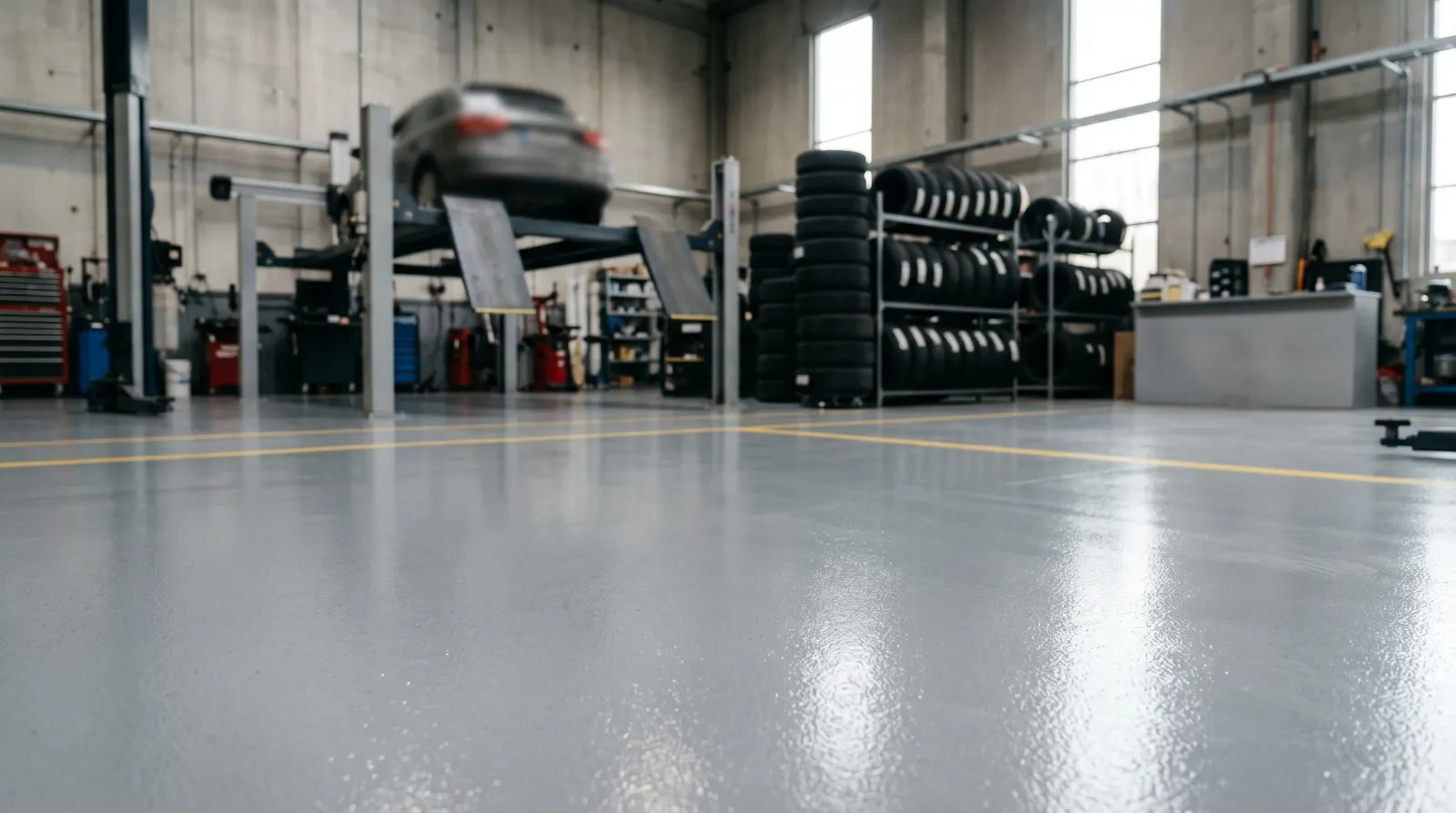
An auto shop floor takes a harder chemical load than almost any other commercial slab. The same 4,000 square feet sees motor oil, gear oil, hydraulic fluid, brake fluid, gasoline, antifreeze, battery acid near the charging bench, and tire rubber dragged across it every working day. Layer on point loading from jack stands, the wheeled abrasion of floor jacks and parts carts, and hot tire pickup where a vehicle parks straight off the road in summer. The spec calls for a system, not a single product.
Service life expectations: 3–5 years for a budget single-coat build, 7–10 years for a mid-tier two-coat system with aggregate, and 12–15 years for a high-build epoxy stack under a urethane or polyaspartic topcoat. Service life tracks surface preparation more than topcoat selection. A premium product over an acid-etched slab fails in two years; a mid-tier product over a properly shotblasted CSP 3 profile delivers its rated life.
The assets that get this spec: independent repair shops, dealership service departments, fleet maintenance garages, tire and lube franchises, motorsport shops, and municipal vehicle bays. Each carries a slightly different mix. A transmission shop drips more fluid; a tire shop drags more abrasion; a fleet diesel bay sees the most thermal cycling. Match the system tier to what the busiest zone actually sees, not to the showroom out front.
Where a shop floor coating loses the spec entirely: a wash bay or detail bay with sustained water and caustic dwell needs urethane cement at the joints, not an epoxy or polyaspartic film. Coat the dry bays with this guide; switch chemistries at the wash bay door.
Zoned Recommendation Matrix
A shop is not a monolithic slab. The right tier depends on what each zone sees:
| Zone | Recommended system | Why |
|---|---|---|
| Service bays / lifts | System A (premium, aggregate broadcast) | Sustained oil and hydraulic fluid dwell, anti-slip under drips |
| Drive aisle / approach | System A or B | Hot tire pickup, chloride from de-icing salt off the road |
| Parts room / storage aisles | System B (mid-tier) | Pallet-jack and cart abrasion, point loading from shelf legs |
| Battery charging bench | System A + chemical-resistant novolac topcoat | Sulfuric acid resistance |
| Customer waiting / office | System C (budget, smooth) | Light foot traffic, ease of cleaning |
| Wash / detail bay | Urethane cement, NOT epoxy or polyaspartic | Sustained water and caustic dwell at the joints |
For a single-bay shop on one continuous pour, skip the matrix and run System A or B across the whole slab.
Spec Requirements
The spec block, before any product name:
| Spec | Value |
|---|---|
| Dry film thickness (DFT) — total system | 12–28 mils, including primer + build + topcoat |
| Coverage at spec’d DFT | 80–160 sq ft/gal per coat (varies by build formulation) |
| VOC limit | <100 g/L (SCAQMD Rule 1113 industrial maintenance); CARB SCM-compliant SKUs available |
| Chemical resistance | ASTM D1308 spot resistance to motor oil, gasoline, brake fluid, antifreeze, dilute sulfuric acid |
| Standards | ASTM D4060 (abrasion), ASTM F1869 (MVE ≤3 lb/1000sf/24h), ASTM D7234 (pull-off adhesion) |
| Substrate prep — concrete | ICRI CSP 3 shotblast for service bays; CSP 2 diamond-grind acceptable for office/waiting |
| Surface prep sequence | SSPC-SP1 solvent clean, then SSPC-SP13 mechanical (shotblast), then HEPA vacuum twice |
| Moisture vapor emission ceiling | 3 lb/1000 sq ft/24h (ASTM F1869); above 3 lb requires MVE barrier primer |
| Service temperature (cured) | -20°F to 200°F continuous (varies by topcoat chemistry) |
| Cure to service | Foot traffic 24h · light vehicle 72h · full chemical resistance 7–14 days |
| Ambient at application | 50°F to 90°F; humidity <85%; substrate ≥5°F above dew point |
| OSHA anti-slip COF | 0.5 dry minimum (1910.22); aggregate broadcast required in oil-drip zones |
Three numbers decide whether the floor survives: the MVE rate, the substrate temperature relative to dew point, and the chemical-resistance rating of the build coat. The first two come from the slab and the weather. The third comes from refusing to spec a big-box garage kit on a working shop floor.
A note on degreasing. A shop slab arrives saturated with years of oil that has wicked into the pore structure. Solvent clean and shotblast remove the surface film, but oil deep in the concrete migrates back up and contaminates the bond line during cure. On any slab over five years old, specify a two-step degrease (alkaline cleaner with agitation, rinse, dry) before the shotblast, and pull a tape-pull or water-bead test to confirm the surface reads clean. Skipping this is why shop-floor coatings fish-eye and disbond where the warehouse next door coated fine.
System Chemistry Compared
Before naming products, choose the chemistry class for the chemical load:
| Chemistry | Pot life | Recoat window | Service temp | UV stability | $/sq ft installed | Best for |
|---|---|---|---|---|---|---|
| Standard epoxy | 30–45 min | 8–24 hr | up to 140°F | Ambers under UV | $4–7 | Build coat, chemical resistance, budget tier |
| Novolac epoxy | 20–40 min | 8–16 hr | up to 200°F | Ambers under UV | $7–12 | Battery rooms, aggressive solvent and acid zones |
| Polyaspartic | 20–45 min | 30 min–4 hr | -40°F to 250°F | UV-stable | $6–10 | Fast turnaround, UV-exposed approach aisles |
| Urethane (aliphatic) | 1–3 hr | 6–18 hr | up to 200°F | UV-stable | $5–9 | Topcoat over epoxy build, abrasion and gloss retention |
The proven shop-floor build is a chemical-resistant epoxy carrying the oil and abrasion load, topped with a urethane or polyaspartic that adds UV stability, gloss retention, and a tighter, easier-to-clean surface. Straight epoxy ambers and chalks where sun hits the approach aisle. Straight polyaspartic is faster to install but weaker against sustained solvent dwell. The two-chemistry stack splits the job correctly.
Recommended Systems
Three full multi-coat stacks at different price-performance points. All three assume ICRI CSP 3 shotblast prep, a passed MVE test, and the two-step degrease called out above.
System a — Sherwin-Williams ArmorSeal Epoxy / Rexthane (premium, Heavy Service Bay)
| Layer | Product | DFT |
|---|---|---|
| Primer | ArmorSeal 1K HS Epoxy Sealer | 2–3 mils |
| Build coat | ArmorSeal 1000 HS Epoxy with aluminum oxide broadcast | 8–12 mils |
| Topcoat | ArmorSeal Rexthane I urethane | 3–5 mils |
| Total | 13–20 mils |
Service life 12–15 years under lift and fluid-drip traffic. The epoxy build carries the chemical and abrasion load; the Rexthane urethane topcoat holds gloss and color against UV in any bay with high bay windows or roll-up doors open to the sun. The aluminum oxide broadcast in the build coat is the OSHA anti-slip answer. Sherwin-Williams ProIndustrial floor coatings.
System B — Rust-Oleum Concrete Saver 5450 Polyaspartic (mid-Tier, Fast Turnaround)
| Layer | Product | DFT |
|---|---|---|
| Primer | Concrete Saver 5400 Epoxy Primer | 3 mils |
| Build coat | Concrete Saver 5450 Polyaspartic with aluminum oxide | 6–8 mils |
| Topcoat | Concrete Saver 5450 Polyaspartic (second pass) | 5–7 mils |
| Total | 14–18 mils |
Service life 7–10 years on bay and aisle traffic. The advantage is downtime: the 5450 cures to foot traffic in 2–4 hours and to vehicle service in 24, against the 5–7 days a full epoxy stack needs. A shop that loses revenue every day it is closed pays back the premium on schedule alone. The 5450 ships in pre-measured catalyst kits, which cuts the field-mix error that defeats most polyaspartic installs. Rust-Oleum Concrete Saver 5450 system.
System C — PPG AMERLOCK 2 / PITTHANE Ultra 95 (budget, Sound-Slab Retrofit)
| Layer | Product | DFT |
|---|---|---|
| Primer / build | AMERLOCK 2/400 Epoxy | 6–8 mils |
| Topcoat | PITTHANE Ultra 95 Polyaspartic | 4–8 mils |
| Total | 10–16 mils |
Service life 5–8 years on a light-duty shop. This is the spec when the budget is fixed and the slab is already sound. The AMERLOCK 2 surface-tolerant epoxy is forgiving on a slab that cannot get a full shotblast, and the PITTHANE topcoat adds the UV and abrasion layer. Skip this tier in a heavy transmission or diesel bay where fluid dwell is constant. PPG PITTHANE Ultra 95.
Systems Compared
| System | Total DFT | $/sq ft installed | Service life | Best for |
|---|---|---|---|---|
| A — SW ArmorSeal / Rexthane | 13–20 mils | $7.50–10.00 | 12–15 years | Heavy service bays, lift areas, fluid-drip zones |
| B — RO Concrete Saver 5450 | 14–18 mils | $6.00–8.50 | 7–10 years | Fast-turnaround shops, mixed bay and aisle |
| C — PPG AMERLOCK / PITTHANE | 10–16 mils | $4.50–6.50 | 5–8 years | Budget retrofit, light-duty bays, sound slab |
Installed pricing assumes a 3,000+ sq ft scope through a manufacturer-rep contractor with shotblast prep included. Jobs under 1,000 sq ft run 30–60% higher per foot on every system. The cost spread between A and C is real, but so is the replacement cycle. A System C floor that fails in the chemical bay at year 4 costs more over a decade than System A installed once.
Application and Contractor Path
This is not a DIY product class for a working shop. Specify a contractor with SSPC-QP1 certification (industrial coatings) or NACE Level 2 inspection credentials. Shotblasting to ICRI CSP 3 needs equipment a shop crew does not own, and the chemical-resistant epoxy build coats carry pot-life limits that punish a single applicator on anything over a few hundred square feet. The manufacturer rep network is the path: Sherwin-Williams ProIndustrial, Rust-Oleum Industrial, and PPG PMC all publish certified-installer rosters by region and run a free pre-bid site visit that catches the moisture and degrease problems before the bid lands.
Three contractor-qualifying questions before you sign:
- How will the slab be degreased, and how will the result be verified? An oil-saturated shop slab needs a two-step alkaline degrease and a water-bead or tape-pull check, not a quick mop. A contractor who treats your shop floor like a clean warehouse slab will deliver fish-eyes and disbond.
- How is moisture vapor emission measured? ASTM F1869 calcium chloride domes in three locations minimum on any slab over five years old. A contractor who skips this delivers a floor that lifts from underneath inside the warranty.
- What is the dew-point protocol during application? The substrate must sit at least 5°F above dew point through every coat. A crew without a sling psychrometer and a surface thermometer should not be on the bid list.
For a single small bay under 500 sq ft on a sound, low-moisture slab, the System C budget tier can be installed by a competent commercial painting crew that honors the recoat window. Above 500 sq ft, or in any bay with constant fluid dwell, certification matters.
Failure Modes and How to Prevent Them
Five failures account for nearly every shop-floor warranty claim. Prevent these and the system delivers its rated life.
- Disbond from residual oil in the slab. Cause: years of oil wicked deep into the concrete migrate back to the bond line during cure, and the coating fish-eyes or lifts in patches. Prevention: two-step alkaline degrease before shotblast, verified with a water-bead test; spec an oil-tolerant epoxy primer where the slab cannot be fully cleaned.
- Moisture-driven blistering from below. Cause: MVE above 3 lb/1000 sq ft/24h with no vapor barrier primer; vapor lifts the film in disc-shaped blisters. Prevention: ASTM F1869 testing pre-bid; install a moisture vapor barrier primer above 3 lb. See the deeper read on why coatings blister.
- Chemical softening of an under-spec’d film. Cause: a big-box garage-floor kit or a thin single-coat epoxy softens under sustained motor oil, gasoline, or brake fluid dwell. Prevention: specify a Type II or novolac epoxy build coat rated to ASTM D1308; never spec a consumer garage kit on a working bay.
- Hot tire pickup at the approach aisle. Cause: hot tires lift an undersized or under-cured topcoat, leaving black rubber transfer. Prevention: full DFT on the topcoat and a complete cure to service before vehicles re-enter; never System C in the drive aisle.
- Slip claims from a smooth wet film. Cause: a high-gloss floor with no aggregate goes slick the moment oil or coolant hits it. Prevention: aluminum oxide or quartz broadcast in the build coat across all bay and drip zones for OSHA 1910.22 compliance.
The first two, residual oil and MVE, produce most of the field failures on shop floors specifically. Both are solved in the specification phase, not at the brush.
Where to Buy / Spec
| Channel | Best for | Path |
|---|---|---|
| Sherwin-Williams ProIndustrial rep | Spec’d projects above 2,000 sq ft, full system warranty | SW ProIndustrial floor coatings |
| Rust-Oleum Industrial distributor | Fast-turnaround installs, pre-measured kits | RO Concrete Saver 5450 |
| PPG PMC rep | AMERLOCK/PITTHANE-spec retrofits, fleet and federal work | PPG PITTHANE Ultra 95 |
| Local SW or BM Pro store | Contractor pricing, small-scope material pickup | Walk-in account pricing |
| Amazon Business | Single-bay DIY scope, consumables, fleet stocking | Search by manufacturer line |
Manufacturer-direct is the recommended channel above 2,000 sq ft. The free pre-bid site visit on the major rep networks catches the oil-contamination and moisture problems before the bid lands, which is worth more than any retail discount on a slab this dirty.
For a homeowner-scale single garage bay, the consumer garage floor paint round-up covers the right product class. Do not carry that product class onto a working commercial shop floor.
FAQ
See the frontmatter FAQ block.