Aluminum Boat Paint: Marine Coating Specifier's Guide (2026)
Aluminum boat paint systems compared by zone: self-etching primer, barrier coat, antifouling and topside. DFT, ASTM, SSPC prep, galvanic corrosion and contractor path.

Disclosure: Affiliate links to retailers and manufacturer-direct programs. Recommendations are spec-driven, not commission-driven.
Use Case
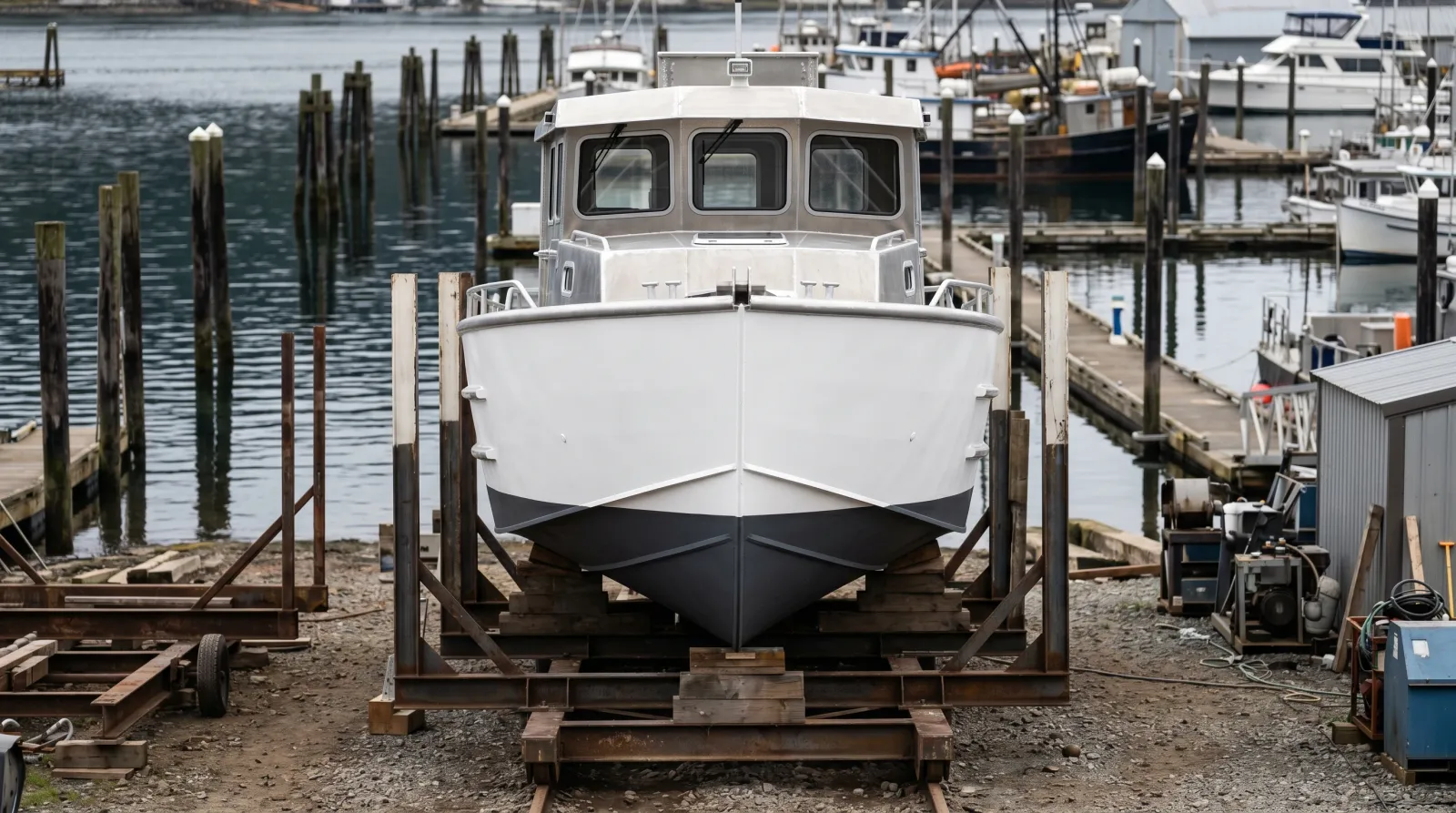
Aluminum boat paint is a multi-zone marine coating system for a substrate that fights you twice: aluminum oxidizes the instant you abrade it, and it sits low enough on the galvanic series that the wrong bottom paint will eat the hull. The asset is a welded or riveted aluminum hull — a center-console fishing boat, a jon boat, a landing craft, a workboat, a pontoon, or a trailered runabout. The environment is the harshest a coating sees: full UV, salt or brackish immersion, abrasion from beaching and trailering, and a galvanic cell waiting to form wherever dissimilar metals or copper biocide touch bare alloy.
The system is never one product. It runs in zones. The bottom (everything below the waterline) needs a sealed epoxy barrier and either a copper-free antifouling or no antifouling at all on a dry-stored boat. The topsides and transom (above the waterline) take an epoxy build coat and a UV-stable finish, which on a work boat is a single-stage acrylic or alkyd enamel and on a yacht is a sprayed two-part acrylic urethane. The deck and non-skid areas need the same barrier with an anti-slip aggregate finish. The bilge and interior take a sealed epoxy for corrosion control. Each zone has its own DFT target and its own failure mode.
Service life depends on the zone and the water. A barrier-coat-and-topside system on a trailered freshwater boat holds 8 to 12 years before it needs more than touch-up. A copper-free antifouling bottom in a warm saltwater slip is an annual-to-biennial recoat by design — ablatives are built to wear away and carry the fouling with them. The barrier epoxy underneath, if intact, lasts the life of the hull. Most premature failures trace to one of three causes: priming over re-oxidized alloy, putting copper biocide against bare aluminum, or skipping the etch step entirely.
Zoned Recommendation Matrix
An aluminum hull is not one surface, and a single paint across all of it is the most common spec mistake on alloy boats. Map the system by zone.
| Zone | Exposure | Recommended stack | Why |
|---|---|---|---|
| Bottom — wet slip (saltwater) | Continuous immersion, fouling, galvanic risk | Etch + barrier epoxy + copper-free ablative (System A or B) | Sealed barrier and copper-free biocide protect the alloy from pitting |
| Bottom — trailered / dry-stored | Intermittent immersion, no long fouling window | Etch + barrier epoxy, hard finish, no antifouling | Dry storage kills fouling; antifouling is wasted cost and ablates on the trailer |
| Topsides & transom | Full UV, splash, abrasion | Etch + epoxy build + two-part urethane (System C) or single-stage enamel | UV stability and gloss retention drive the topcoat choice |
| Deck & non-skid | UV, foot traffic, standing water | Barrier epoxy + non-skid aggregate finish | Anti-slip safety plus barrier corrosion control |
| Bilge & interior alloy | Standing water, condensation, no UV | Etch + two-coat barrier epoxy, no topcoat needed | Sealed epoxy stops crevice and condensation corrosion |
A trailered aluminum jon boat needs the topside and bilge rows and can skip antifouling outright. A wet-slipped saltwater workboat needs every row. Build the spec from the storage profile first, then the zones.
Spec Requirements
The spec block before any product name. Numbers vary by manufacturer technical data sheet; the categories are fixed.
| Spec | Value |
|---|---|
| Dry film thickness (DFT) — etch primer | 0.5–1 mil (a chemical key, not a build layer) |
| DFT — barrier epoxy | 4–10 mils; saltwater immersion wants the high end (5+ coats on Interlux InterProtect) |
| DFT — antifouling | 3–4 mils per coat, 2 coats minimum at the leading edges |
| DFT — topside finish | 2–4 mils per coat, 2–3 coats |
| Coverage @ DFT | Barrier epoxy ~125–150 sq ft/gal per coat; antifouling ~400–500 sq ft/gal per coat |
| VOC | Compliant marine finish <340 g/L; conventional yacht urethane 420–550 g/L outside CARB/SCAQMD areas |
| Standards | ASTM D3623 (antifouling panel), D4541 (adhesion), B117 (salt spray), D870 (immersion) |
| Biocide registration | EPA FIFRA registration on every antifouling sold for US waters |
| Substrate prep — solvent clean | SSPC-SP1 to remove wax, oil, mill release |
| Substrate prep — abrasion | SSPC-SP7 brush-blast with non-metallic media, or 80-grit mechanical; never steel grit |
| Prime window | Within the same shift, before oxide re-forms (hours, not days) |
| Service temp during application | 50°F to 90°F; substrate at least 5°F above dew point |
| Humidity ceiling | <85% relative humidity; immersion epoxies are moisture-sensitive during cure |
| Cure to launch | Antifouling typically 16 hours to overnight before splash; barrier epoxy 5–7 days full cure before immersion |
Three numbers govern this system. The barrier-coat DFT (whether the alloy is fully isolated from copper biocide), the prime window after abrasion (whether the etch keyed into clean metal), and the dew point at application (whether the immersion epoxy cured without water in the film). Miss any one and the coating fails its first season.
System Chemistry Compared
Aluminum boat coatings span four chemistry classes. The bottom needs immersion-grade epoxy and an appropriate biocide. The topside needs UV stability the bottom paints do not have.
| Chemistry | Pot life @ 70°F | Recoat window | Service exposure | UV stability | $/sq ft | Best for |
|---|---|---|---|---|---|---|
| Self-etch / wash primer | 4–8 hr | 30 min–8 hr | Tie coat only | 🔴 None — must be overcoated | $0.50–1.00 | Keying bare abraded alloy |
| Immersion barrier epoxy | 2–4 hr | 6–24 hr | 🟢 Continuous immersion | 🔴 Chalks bare; needs topcoat | $2–4 | Isolating the alloy below the waterline |
| Copper-free ablative antifouling | n/a (single-pack) | 16 hr–overnight | 🟢 Immersion, fouling control | ⚪ Wears by design | $3–6 | Wet-slipped alloy bottoms |
| Two-part acrylic urethane | 2–4 hr | 6–18 hr | 🟢 Above waterline, UV | 🟢 Excellent gloss retention | $4–9 | Yacht-quality topsides and transom |
Read it as a stack, not a menu. The etch keys the metal, the barrier seals it, the antifouling protects the bottom, the urethane finishes the topside. A pontoon owner who never antifouls still runs etch plus barrier plus a UV topcoat. The skipped layer is almost always the etch, and that is the layer that decides whether the rest of the stack stays attached.
Recommended Systems
Three full stacks at different price-performance points. System A and B are complete bottom systems from the two dominant US marine lines. System C is the topside finish system that runs above the waterline on any of them. Verify the current product names against the manufacturer technical data sheet before buying, since marine lines reformulate biocides on EPA cycles.
System A — Pettit Protect + Vivid Free (copper-Free Bottom)
| Layer | Product | DFT |
|---|---|---|
| Etch primer | Pettit 6455/6456 Metal Primer (self-etching) | 0.5–1 mil |
| Barrier coat | Pettit Protect 4700/4701 high-build epoxy | 4–8 mils |
| Antifouling | Pettit Vivid Free copper-free ablative (or Trinidad SR hard) | 3–4 mils × 2 coats |
| Total | 8–13 mils |
Service life: barrier holds the life of the hull; antifouling is an annual-to-biennial recoat. Vivid Free is copper-free, so it carries no galvanic risk against the alloy, which lets you run a thinner barrier than a copper bottom demands. Pettit Protect is the workhorse barrier for aluminum and steel hulls in the US fleet. This is the system for a trailered or wet-slipped aluminum fishing or workboat in fresh or brackish water. Pettit Marine product line.
System B — Interlux InterProtect + Pacifica Plus (full Barrier, saltwater)
| Layer | Product | DFT |
|---|---|---|
| Tie / barrier base | InterProtect 2000E/2001E epoxy over abraded alloy | 1 mil tie coat |
| Barrier build | InterProtect 2000E multi-coat barrier | 5–10 mils (5 coats) |
| Antifouling | Micron CSC Extra (copper) or Pacifica Plus (copper-free) | 3–4 mils × 2 coats |
| Total | 9–15 mils |
Service life: 8 to 12 years on the barrier if it stays unbreached; antifouling recoats on the slip’s fouling cycle. InterProtect builds a heavier multi-coat barrier than System A, which is what a permanently wet saltwater slip wants. If the boat runs copper antifouling, that 5-coat barrier is mandatory — it is the only thing standing between the copper biocide and the aluminum. For an aluminum hull, Pacifica Plus (copper-free) is the safer bottom even with the barrier intact. Interlux marine product line.
System C — Awlgrip Topside Finish (above the Waterline)
| Layer | Product | DFT |
|---|---|---|
| Epoxy primer | Awlgrip 545 over Alodine-treated or abraded alloy | 2–3 mils |
| Build / fairing | Awlquik or 545 high-build, sanded fair | 3–6 mils |
| Topside finish | Awlgrip Topcoat or Awlcraft 2000 acrylic urethane | 2–3 mils × 2–3 coats |
| Total | 7–12 mils |
Service life: 10 to 15 years of gloss on a sprayed Awlgrip topside, the longest in the marine finish market. This is the yacht-grade above-the-waterline system that pairs with either bottom system above. Awlgrip Topcoat is the harder, longer-lived finish but is not field-repairable without spraying; Awlcraft 2000 buffs and spot-repairs, which work boats and fleets prefer. Both are two-part isocyanate urethanes that demand supplied-air respirators and a controlled spray booth. Awlgrip marine finishes.
Systems Compared
| System | Total DFT | $/sq ft installed | Service life | Best for |
|---|---|---|---|---|
| A — Pettit Protect + Vivid Free | 8–13 mils | $6–11 | Barrier life-of-hull; antifoul annual | Trailered / brackish alloy, copper-free |
| B — Interlux InterProtect + Pacifica | 9–15 mils | $8–14 | Barrier 8–12 yr; antifoul per slip | Wet-slipped saltwater alloy |
| C — Awlgrip Topside | 7–12 mils | $12–22 | 10–15 yr gloss | Yacht-quality topsides and transom |
Pricing assumes a yard application on a 20-to-30-foot hull with prep included. Owner-applied trailer boats run lower; a full Awlgrip respray in a controlled booth runs well above the band. The bottom systems (A and B) and the topside system (C) are not alternatives — most boats run a bottom system below the waterline and a topside system above it.
Application and Contractor Path
The honest split: bottom work is owner-or-yard reachable, topside spray is not. An experienced boatyard crew, or a competent owner on a trailered hull, can solvent-clean, abrade, etch, barrier-coat, and roll-and-tip antifouling, provided the etch-to-prime window and the recoat windows are respected. The chemistry is forgiving on a brush; the prep discipline is not.
A sprayed two-part acrylic urethane topside is a different trade. Awlgrip and Awlcraft 2000 carry isocyanate hardeners that require supplied-air respirators (not cartridge masks), a controlled and ventilated spray environment, and a sprayer who has laid down the specific product before. For a yacht-quality finish, spec an Awlgrip Certified Applicator. The certified-applicator path also carries the manufacturer’s finish warranty, which a yard-floor spray does not.
Before you sign a yard or a sub:
- Confirm the abrasive. Steel grit or a shared blast pot that has run steel embeds iron in the aluminum and seeds corrosion under the new coating. The spec calls for clean aluminum oxide or garnet media on a dedicated setup.
- Confirm the prime window. Ask how long between final abrasion and first primer. Hours is the answer. A crew that sands Monday and primes Wednesday is priming oxide.
- Confirm the barrier DFT if copper antifouling is on the boat. Five coats of InterProtect is not optional with a copper bottom on aluminum. A yard that quotes two coats under copper antifouling on alloy is quoting a galvanic failure.
The manufacturer technical service lines (Pettit, Interlux, Awlgrip) will review a hull spec by phone and confirm the etch-primer and antifouling compatibility for aluminum before you buy. Use it. The compatibility chart for alloy is narrower than for fiberglass, and the wrong antifouling on bare aluminum is a haul-out and a strip, not a touch-up.
Failure Modes and How to Prevent Them
Five failures cover almost every premature breakdown on an aluminum hull.
- Galvanic pitting under copper antifouling. Cause: copper biocide in direct or near-direct contact with the alloy through a thin or breached barrier. The aluminum becomes the anode and pits under the paint. Prevention: a full 4-to-10-mil sealed epoxy barrier, or a copper-free antifouling. On an aluminum hull, copper-free is the lower-risk default.
- Delamination from priming over re-oxidized alloy. Cause: too long between abrasion and primer, so a fresh oxide layer formed and the etch never keyed into bare metal. Prevention: abrade and prime in the same shift; treat the prime window as a hard spec, not a convenience.
- Topside chalking and gloss loss. Cause: barrier epoxy or a low-grade enamel left as the finish above the waterline. Immersion epoxies have no UV package and chalk in a season. Prevention: a UV-stable topcoat (two-part urethane or marine single-stage enamel) over every above-waterline surface. See the chalking failure analysis for the same mechanism on land coatings.
- Blistering of the barrier coat. Cause: barrier epoxy applied over a wet or contaminated substrate, or launched before full cure, trapping moisture in the film. Prevention: substrate at least 5°F above dew point, humidity below 85%, and a 5-to-7-day cure before immersion.
- Antifouling shedding too fast or fouling early. Cause: copper-free ablatives wear faster in warm water and lose their hold if applied below the manufacturer’s minimum coats. Prevention: two full coats minimum, a third at the leading edges and waterline, and an annual recoat schedule built into the warm-water fleet budget.
Galvanic pitting is the failure unique to aluminum and the one that ends hulls. The other four show up on fiberglass and steel too, but on alloy the prime-window violation is the one I see most. A boat sanded one week and primed the next looks identical on launch day and lifts in sheets by the next haul-out.
Where to Buy / Spec
| Channel | Best for | Path |
|---|---|---|
| Amazon Business / marine retail (West Marine, Defender) | Owner and small-fleet stocking, trailer boats | Stock quantities, no spec support |
| Manufacturer-direct (Pettit, Interlux, Awlgrip) | Spec’d hulls, aluminum compatibility confirmation | Pettit · Interlux · Awlgrip tech lines |
| Marine distributor / boatyard account | Yard application, bulk antifouling | Contractor pricing through the yard |
| Awlgrip Certified Applicator | Sprayed topside finish with warranty | Manufacturer applicator locator |
Manufacturer-direct is the channel that matters on an aluminum hull, because the compatibility question (which etch primer, which antifouling, how many barrier coats) is the question that decides whether the system survives. The retail price difference on a can is noise next to a galvanic strip-and-recoat.
FAQ
The buyer questions are answered in the frontmatter FAQ block above: why copper antifouling pits aluminum, whether a self-etching primer is required, the SSPC prep the spec calls for, whether copper-free bottom paint works on alloy, and the boatyard-versus-certified-applicator call.