Warm Beige
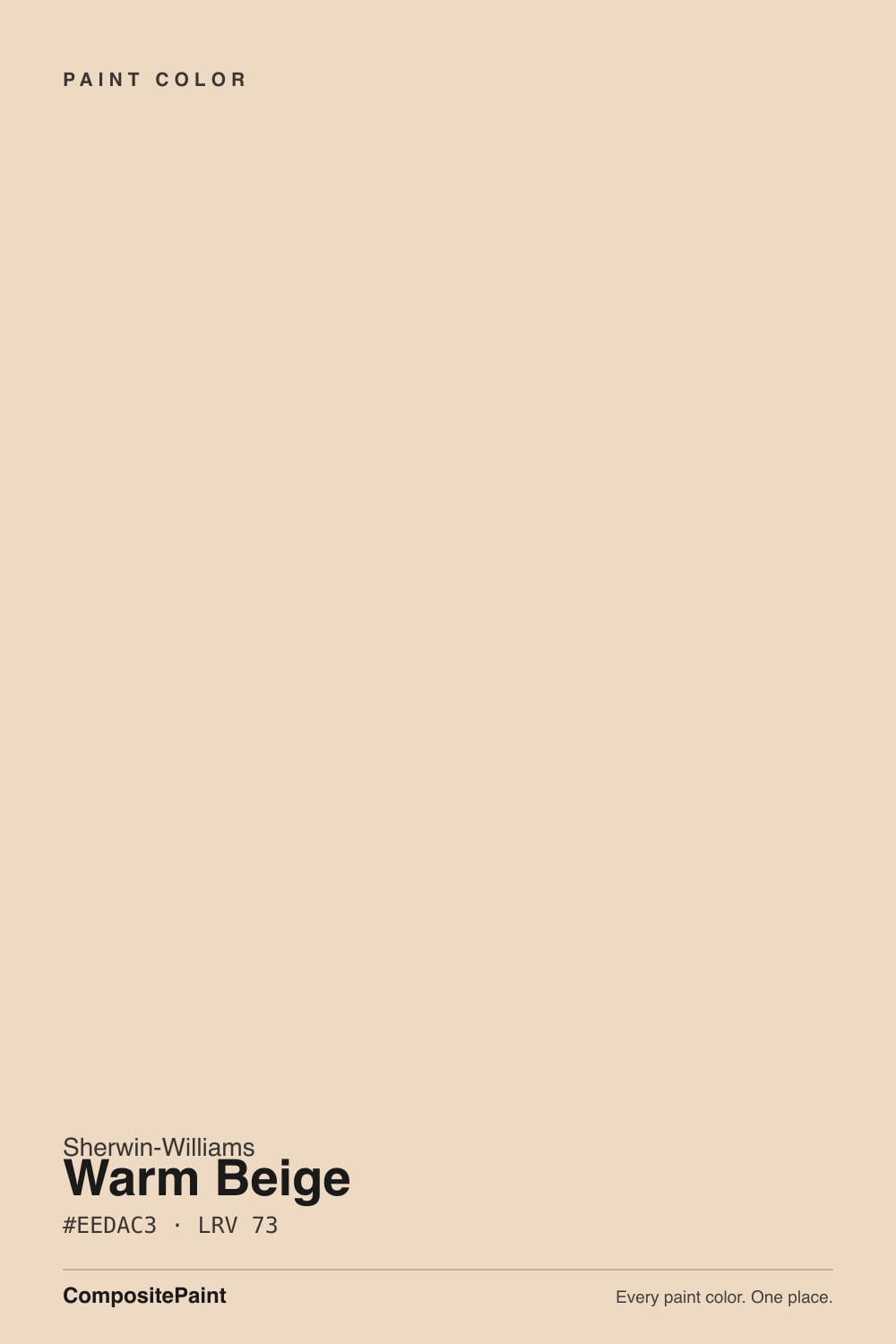
SW 35 · #EEDAC3 · LRV 73 — warm red-orange tone, light — bounces daylight without going clinical.
- 1Agreeable Gray60
- 2Balboa Mist66
- 3Warm Beige73
- 4Shoelace78
- 5Dover White83
What Color Is Warm Beige, Really?
Warm Beige SW 35 is a light cream with a clear warm lean. Its hex value is #EEDAC3 and its hue sits at 32 degrees, in the red-orange part of the wheel, with saturation around 56 percent softened by a very high lightness. An LRV of 73 places it well up in the light range, so it bounces daylight, keeps rooms open, and reads as a warm off-white rather than a mid-tone beige.
People choose it when white feels too sharp and greige feels too gray. Warm Beige has no gray in it at all, which is what gives it the settled, slightly old-fashioned comfort that a modern greige cannot produce. On large walls it acts like a soft envelope of light, and it is forgiving on older plaster and trim where a bright white would show every ripple.
The thing to check is how far the orange side travels in your light. At 56 percent saturation this has more color than most off-whites. In a south-facing room with 2700K bulbs it can read peach or apricot instead of beige, and next to cool gray floors or blue-gray tile it can look yellow and dated. Sample it large, on more than one wall.
The undertone here is warm red-orange, sitting at hue 32 degrees. That is the zone of sand, apricot, and light caramel rather than the yellow-green cast you get in a lot of builder beiges. Saturation is about 56 percent, which is high, but the lightness of 85 percent keeps the color from looking strong on a chip.
On a full wall the warmth becomes obvious. Against a stark blue-white trim, Warm Beige looks distinctly peachy. Against a cream or an antique white it settles down and reads as a plain warm neutral. Put it beside a gray-based greige and it looks yellow by comparison.
Check it against your floors first. Red oak, cherry, and terracotta amplify the orange until it can feel like too much of one thing. White oak, walnut, and pale limestone give it somewhere to sit and let the warmth read as calm instead of loud.
Best Rooms and Uses for Warm Beige
At LRV 73 this is a whole-home light neutral. It works on walls in living rooms, dining rooms, bedrooms, and hallways, and it is a good pick for open plans where you want one color to run through several rooms without feeling cold at any point in the day.
It is especially useful in rooms that lack light. North-facing spaces, basements with small windows, and interior hallways all benefit from a wall color that carries warmth on its own rather than borrowing it from a lamp.
On trim and cabinets it reads as a soft antique white, which suits traditional millwork, older homes, and painted kitchen cabinetry that should not look brand new. Outside it makes a warm body color for stucco, shingle, or clapboard, pairing naturally with stone and wood. Avoid it in rooms built around cool gray tile or blue-gray flooring, where the warmth will fight the fixed materials.
How Lighting Changes Warm Beige
With an LRV of 73 the color stays bright in almost every situation, so lighting changes its temperature rather than its depth. North-facing rooms get cool, flat daylight that tames the orange and makes Warm Beige read closer to a plain soft cream. That is often where it looks best, because the cool light does the balancing for you.
South and west light do the opposite. Strong warm sun pushes the hue toward peach, and late afternoon light in a west room can make whole walls glow apricot. East rooms are warmest in the morning and calm down by lunchtime.
Bulbs then push it further. Warm 2700K lamps add more of the same and can turn the walls golden after dark. Cooler 3500K to 4000K bulbs pull the color back toward neutral cream and keep it looking like beige rather than like skin tone. Always look at a sample at night.
Most complaints about Warm Beige are a light mismatch. Upload a photo of your actual room and see it on your walls — then ask for the same wall in north light or evening lamps before you buy a single sample.
Need It From Another Brand?
Any paint counter can custom-tint Sherwin-Williams SW 35 directly. If you would rather stay in one brand's own deck, these are the closest stock matches, measured as ΔE2000. Under 2 is a difference you will not see on the wall.
| Brand | Closest color | ΔE | LRV | |
|---|---|---|---|---|
| Behr | Steamed MilkHDC-WR15-8 · Behr | 1.2 | 71 | Color page → |
| Benjamin Moore | Mystic Beige2162-60 · Benjamin Moore | 1.8 | 73 | Color page → |
| Valspar | BubblyV090-1 · Valspar | 1.8 | 72.3 | Color page → |
| PPG / Glidden | Oatmeal CookiePPG1080-1 · PPG / Glidden | 1.6 | 72 | Color page → |
| Glidden | Oak BuffPPG1083-3 · Glidden | 1.2 | 71 | Color page → |
| Dutch Boy | Antique White011W · Dutch Boy | 3.5 | 72 | Color page → |
Similar Sherwin-Williams Colors
The nearest shades to Warm Beige within Sherwin-Williams's own range, ranked by perceptual color distance — useful when you want the same look a touch lighter, darker, or warmer.
WCAG 2.1: AA is 4.5 : 1 for normal text, 3 : 1 for large text, AAA is 7 : 1.
Warm Beige vs Similar Colors
Inside the Sherwin-Williams deck the neighbors separate mostly by how yellow they are. Navajo White SW 6126 at LRV 72 and Antique White SW 6119 at LRV 72 both sit at #E9DCC6 and #E8DCC6, which is a step toward yellow and away from the orange in Warm Beige. Napery SW 6386 at LRV 74 is brighter and more clearly yellow at #EFDDC1. Cottage Cream SW 7678 at LRV 72 is the deepest of the group in color, and Intricate Ivory SW 6350 at LRV 74 is the softest, closest to a plain warm off-white.
Across brands, C2 Brulee C2-546 at LRV 74 has a deltaE of 0.82 and is essentially the same color. Glidden Oak Buff PPG1083-3 at LRV 71, Behr Writers Parchment N280-2 at LRV 72, and Benjamin Moore Mystic Beige 2162-60 at LRV 73 sit between deltaE 1.17 and 1.82, all visually identical in normal room light. Farrow and Ball Ringwold Ground No. 208 at LRV 73 is further out at deltaE 3.15, very close but worth sampling first.
Colors That Go With Warm Beige
Trim is the first decision. A soft, warm white keeps everything in the same family and makes the walls look intentional. A bright blue-based white gives sharper contrast but also exposes the orange in the walls, so sample it before you commit a whole house of baseboard to it.
For adjacent rooms and layered neutrals, stay in the same warm band. Navajo White SW 6126 at LRV 72 is a yellower, slightly quieter version at #E9DCC6. Antique White SW 6119, also LRV 72, does the same job with a touch more depth. If you want the next room to go creamier and more golden, Cottage Cream SW 7678 at LRV 72 shifts that way, and Intricate Ivory SW 6350 at LRV 74 keeps the brightness while pulling back the color.
For materials, oak, rattan, brass, and unglazed terracotta all sit comfortably with it. Deep browns, warm blacks, and muted greens give contrast on doors, islands, and shutters without breaking the warmth.
Coordinated palette
Generated by hue-rotating #EEDAC3 in HSL space. Pair Warm Beige with one accent and one neutral — the swatches below are starting points, not final picks.
Warm Beige FAQ
Is Warm Beige warm or gray?
It is warm, with no gray in it. The undertone is red-orange at hue 32 degrees, which is the sand and apricot zone rather than the greige zone. That is why it reads cozy next to wood and brass, and why it can look yellow if you set it beside a cool gray floor or a blue-based white.
What LRV is Warm Beige?
Warm Beige has an LRV of 73. On the 0 to 100 scale that is well into the light range, so it reflects a lot of daylight and behaves like a warm off-white on a wall. It brightens dim rooms without the glare of a true white and keeps hallways and open plans feeling open.
Does Warm Beige look peach or orange on walls?
It can. With about 56 percent saturation at hue 32 degrees, this has more color than a typical off-white. In south or west light, and under 2700K bulbs, the orange side comes forward and the walls can read peach. Cool north light and 3500K to 4000K bulbs pull it back toward plain cream.
What white trim goes with Warm Beige?
A soft warm white keeps the whole room in one family and makes the walls look deliberate. A crisp blue-based white creates sharper contrast but also highlights the orange in the wall color. Sample both against the actual wall before painting an entire house of baseboard and casing.
Is Warm Beige good for cabinets or exteriors?
Yes to both. At LRV 73 it reads as an antique white on cabinetry, which suits traditional kitchens and older millwork better than a bright modern white. Outdoors it makes a warm body color for stucco, shingle, or clapboard and pairs naturally with stone, wood, and darker shutters.
Is there a Benjamin Moore or Behr match for Warm Beige?
Benjamin Moore Mystic Beige 2162-60 at LRV 73 has a deltaE of 1.82 from Warm Beige, which is visually identical in normal room light. Behr Writers Parchment N280-2 at LRV 72 sits at deltaE 1.79, and Valspar Bubbly V090-1 at LRV 72.3 is the same distance away. C2 Brulee C2-546 at LRV 74 is closest at deltaE 0.82.
Have you painted with Warm Beige?
Rate it — one tap helps the next reader decide.
Ask a Question