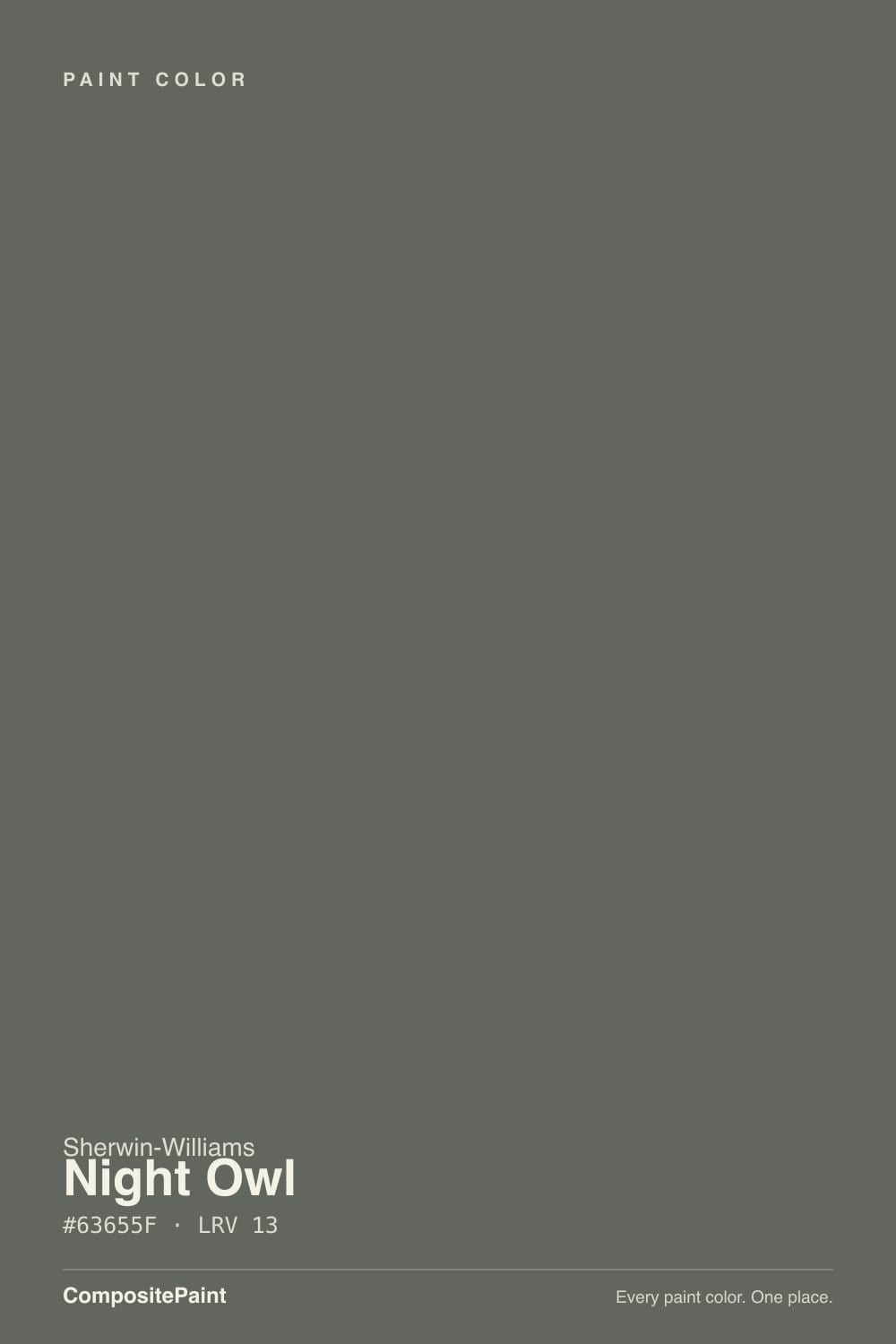
Night Owl
SW 7061 · #63655F · LRV 13 — neutral with no strong undertone, dark — high drama, needs strong daylight or warm bulbs.
- 1Urbane Bronze8
- 2Night Owl13
- 3Retreat21
- 4Stardew43
What Color Is Night Owl, Really?
Night Owl (SW 7061) is a deep charcoal gray. Its hex value is #63655F and its LRV is 13, which is very low. On a wall that means the color absorbs most of the light that reaches it and reads dark and solid from across the room. The hue measures 80 degrees, technically the green-yellow side of the wheel, but saturation is only 3 percent, so there is no strong undertone to speak of. It behaves like a straight neutral dark gray.
People pick Night Owl when they want depth without a color story. It is not a blue-black charcoal and not a brown-black one. That neutrality is the appeal: it goes dark and stays quiet, so it can sit under wood, brass, stone, or bright white without arguing with any of them. On cabinets, doors, and exterior siding it gives weight and a settled, modern look.
The catch is light. At LRV 13 there is very little reflectance to work with, so in a small north-facing room or a hallway with one window it flattens out and reads close to black, losing the small amount of character it has. Dark paint also shows lap marks and touch-ups more than a mid-tone, so plan on full even coats and pick a sheen you are happy to look at.
Night Owl is close to undertone-free. The measured hue lands at 80 degrees, on the green-yellow side of the wheel, but with saturation at 3 percent that lean is almost theoretical. On a wall you see dark gray, not olive. What the faint lean does buy you is softness, the thing that keeps the color from looking like a hard blue-black.
Company decides which side it appears to take. Next to a clearly blue-gray charcoal, Night Owl looks slightly warm and earthy. Next to an olive-leaning neighbour like Cast Iron (SW 6202) at #64645A, it swings the other way and reads cooler and cleaner. Against crisp white trim it simply reads charcoal.
Before committing, hold a sample next to whatever dark thing already lives in the room: a black fireplace surround, a stone counter, dark window frames. Those neighbours, not the chip, tell you how neutral Night Owl will look once it is up.
Best Rooms and Uses for Night Owl
Night Owl is a depth color, not a whole-house color. On walls it suits rooms you want to feel enclosed: a home office, a dining room, a den, a powder room, a bedroom with good window area. In a room with only one small window, expect it to read as a dark envelope rather than as a gray.
Cabinetry is where a neutral this dark earns its keep. It works on lower cabinets under lighter uppers, on an island, on a laundry run, and on built-in shelving, where the low LRV makes the wood and hardware around it stand forward.
Outside it holds up well as a body color on siding, as shutters, or as a front door against a light exterior. Because it has almost no undertone, it will not clash with brick, stone, or a roof color the way a blue-black or brown-black can. Trim should be a separate white; painting trim the same color removes all the definition.
How Lighting Changes Night Owl
An LRV of 13 means Night Owl gives back very little of the light it receives, so the room supplies the mood and the paint mostly absorbs. In north-facing rooms the cool, flat daylight drains what little warmth the color has and it reads near-black, dense and matte. That can be exactly right for a study or a dining room, but it will not feel airy.
South and west light do the most for it. Direct sun lifts the surface and lets you see the gray as gray rather than as a shadow, and late-afternoon western light gives it a faint warm cast. East rooms show it best in the morning and let it sink back after noon.
Bulbs matter more here than with a light color. Warm 2700K lamps keep it soft and readable at night. Cooler 4000K bulbs sharpen it and push it toward hard slate. Look at your sample after dark, since that is when a 13 LRV color spends most of its life.
Most complaints about Night Owl are a light mismatch. Upload a photo of your actual room and see it on your walls — then ask for the same wall in north light or evening lamps before you buy a single sample.
Need It From Another Brand?
Any paint counter can custom-tint Sherwin-Williams SW 7061 directly. If you would rather stay in one brand's own deck, these are the closest stock matches, measured as ΔE2000. Under 2 is a difference you will not see on the wall.
| Brand | Closest color | ΔE | LRV | |
|---|---|---|---|---|
| Behr | Black LocustPPU25-02 · Behr | 1.4 | 13 | Color page → |
| Benjamin Moore | City ShadowCSP-60 · Benjamin Moore | 2.9 | 13 | Color page → |
| Valspar | Ocean Storm4004-2B · Valspar | 1.9 | 13.3 | Color page → |
| PPG / Glidden | Plunge PoolPPG1029-7 · PPG / Glidden | 4.0 | 13 | Color page → |
| Glidden | Deepest Valley Green30GY 13/045 · Glidden | 1.2 | 13 | Color page → |
| Dutch Boy | Blackened Ore439-6DB · Dutch Boy | 4.3 | 13 | Color page → |
Similar Sherwin-Williams Colors
The nearest shades to Night Owl within Sherwin-Williams's own range, ranked by perceptual color distance — useful when you want the same look a touch lighter, darker, or warmer.
WCAG 2.1: AA is 4.5 : 1 for normal text, 3 : 1 for large text, AAA is 7 : 1.
Night Owl vs Similar Colors
Within the same brand, Grizzle Gray (SW 7068) is the closest call at #636562 and the same LRV 13. It is a hair cooler and cleaner. Braintree (SW 9595) at #65635B and Cast Iron (SW 6202) at #64645A are both LRV 12 and carry more olive-brown, so they feel earthier. Porpoise (SW 7047) at #6B645B and Limestone (SW 9599) at #6A655C are warmer again and read closer to a dark taupe.
Across brands, Obsidian Glass (HGSW 1502) from HGTV Home by Sherwin-Williams shares the exact hex and LRV, a deltaE of 0. Deepest Valley Green (30GY 13/045) from Glidden at deltaE 1.22, Black Locust (PPU25-02) from Behr at 1.35, and Tornado Wind (0584), listed by both Kompozit and Hirshfield's, at 1.37 are all visually identical in normal room light. Down Pipe (No. 26) from Farrow & Ball at deltaE 2.33 and City Shadow (CSP-60) from Benjamin Moore at 2.9 are very close but worth sampling first. Plunge Pool (PPG1029-7) at deltaE 4 and Blackened Ore (439-6DB) from Dutch Boy at 4.33 are close but visibly different side by side.
Colors That Go With Night Owl
The same-brand colors nearest to Night Owl are near-twins, not partners. Grizzle Gray (SW 7068) at #636562 and LRV 13, Roycroft Pewter (SW 2848) at #616564 and LRV 13, Braintree (SW 9595) at LRV 12, and Cast Iron (SW 6202) at LRV 12 all sit in the same narrow band. Using two of them in one room is wasted effort; pick one and build contrast elsewhere.
That contrast comes from light values. A bright or soft white on trim, ceilings, and doors gives the eye somewhere to rest, and the bigger the gap in LRV the crisper the edge looks. A mid-tone greige or warm beige on adjoining walls lets Night Owl act as the accent in an open plan.
Materials carry the rest. Warm oak and walnut, natural stone, unlacquered brass, and aged bronze all read clearly against a 13 LRV neutral. Cool chrome works too but keeps the scheme colder, which suits a modern room more than a traditional one.
Coordinated palette
Generated by hue-rotating #63655F in HSL space. Pair Night Owl with one accent and one neutral — the swatches below are starting points, not final picks.
Night Owl FAQ
Is Night Owl warm or cool?
It is neither in any strong sense. Night Owl measures 3 percent saturation at a hue of 80 degrees, so the green-yellow lean is too faint to name as an undertone. In practice it reads as a neutral dark charcoal that looks slightly warm beside a blue-gray and slightly cool beside an olive or brown.
What LRV is Night Owl?
Night Owl has an LRV of 13. Light reflectance value runs from 0 for black to 100 for pure white, so 13 is firmly in the dark band. It absorbs most of the light in a room, which gives walls weight and makes trim, wood, and metal finishes stand out sharply against it.
Does Night Owl work in a dark room?
It works if you want the room to feel dark on purpose. At LRV 13 it returns very little light, so a north-facing or single-window room will read close to black rather than gray. That suits a study, dining room, or powder room. If you need the space to feel larger or brighter, this is the wrong tool.
What white trim goes with Night Owl?
Almost any white works, because Night Owl has no undertone to clash with. A warm white keeps the contrast soft and traditional; a cleaner white makes the edge crisp and modern. The bigger point is the gap in LRV: with the wall at 13, any white in the 80s gives you a clear, defined trim line.
Is Night Owl good for exteriors and cabinets?
Yes to both. Its neutrality is the reason. On siding, shutters, or a front door it sits comfortably next to brick, stone, and most roof colors without pulling blue or brown. On cabinets it gives depth to a lower run or an island while letting wood floors and brass or bronze hardware come forward.
How is Night Owl different from Grizzle Gray?
They are very close. Grizzle Gray (SW 7068) is #636562 and Night Owl is #63655F, and both are LRV 13. Grizzle Gray is a touch cooler and cleaner, while Night Owl carries the faintest green-yellow softness. On a chip you will struggle to separate them, so sample both on the wall you actually intend to paint.
Have you painted with Night Owl?
Rate it — one tap helps the next reader decide.
Ask a Question