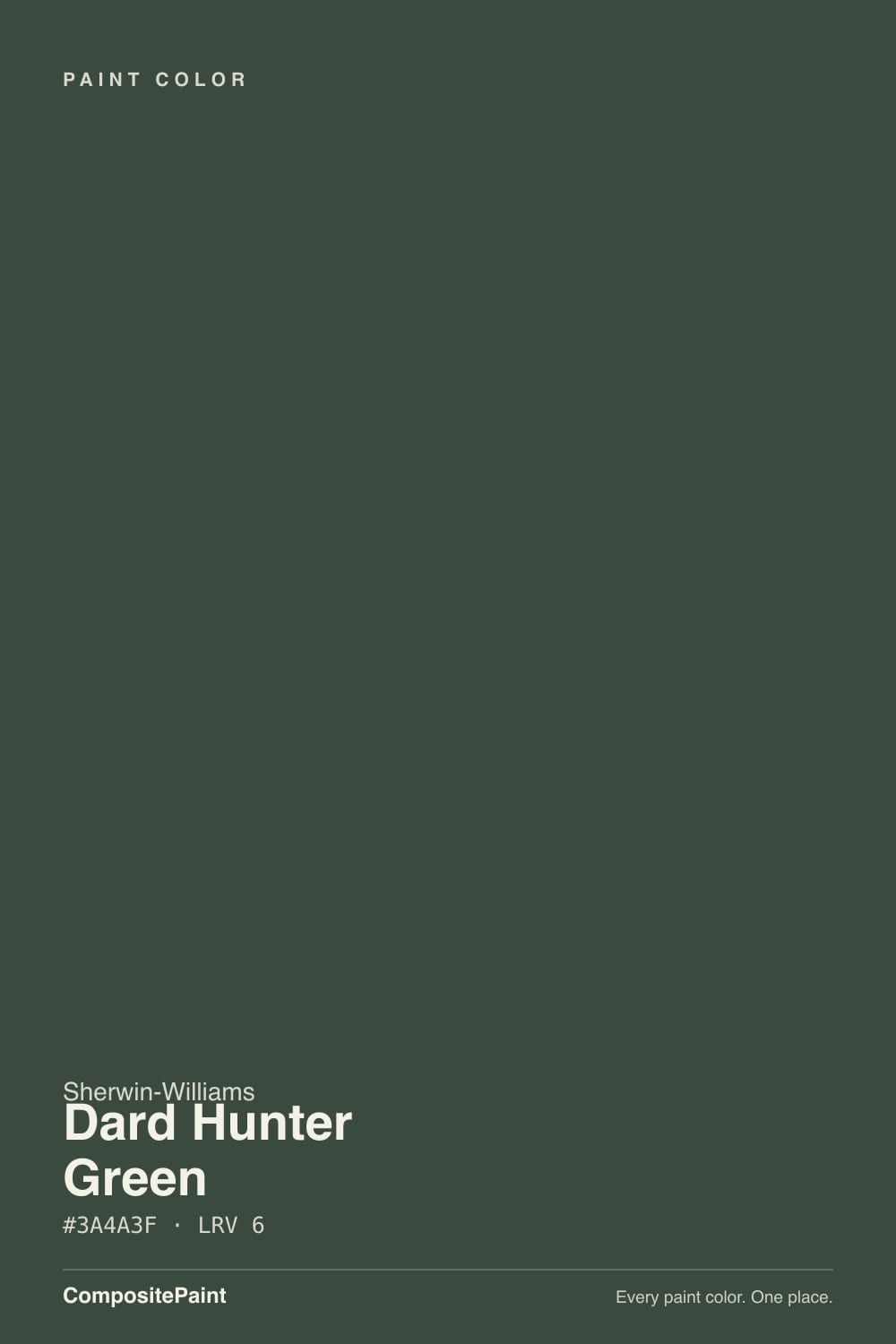
Dard Hunter Green
SW 41 · #3A4A3F · LRV 6 — cool green tone, very dark — reads black in most rooms.
- 1Black Emerald1
- 2Dard Hunter Green6
- 3Sage Green22
- 4Evergreen Fog30
What Color Is Dard Hunter Green, Really?
Dard Hunter Green (SW 41) is a very dark green with hex value #3A4A3F and an LRV of 6. Sherwin-Williams files it under the black family, and that tells you most of what you need to know. At LRV 6 it returns almost no light, so on a wall it behaves like a black. The hue sits at 139 degrees, which is squarely green, but saturation is only 12 percent, so the green is a whisper rather than a statement.
People choose it when they want black without the hardness. A true black can feel flat and severe on cabinets or a front door, while a near-black green keeps that weight and adds a little softness and age to it. In photos it usually reads as black. Standing in the room, you catch the green at the edges and in the highlights.
What to check before committing is whether your room can show the green at all. At LRV 6 the color needs direct light or a bit of sheen to reveal any hue, and in a dim north-facing space it will simply be black. If seeing green matters to you, a lighter green is the honest answer. A very dark finish also shows dust, fingerprints, and application marks more than a mid-tone, so surface prep matters here.
The undertone here is green, and it is genuinely there in the mix: in the hex #3A4A3F the green channel sits above both the red and the blue. But at 12 percent saturation and an LRV of 6, there is very little light coming back to carry that information to your eye.
The green shows in three situations. In direct sunlight, on a satin or gloss finish that throws highlights, and next to something warm. Against a walnut floor, a brass pull, or a beige wall, the green side comes forward clearly. Against a saturated green like Hunt Club (SW 6468), hex #2A4F43 at LRV 6, Dard Hunter Green flips and reads as a near-black.
If you are choosing between this and a plain black, hold both against your actual hardware and wood. That comparison, not the chip, is where the difference becomes obvious.
Best Rooms and Uses for Dard Hunter Green
This color is at its best on smaller, well-lit surfaces rather than whole rooms. Kitchen cabinets, an island under lighter perimeter cabinets, built-in bookcases, and a front door are the uses that suit it. In each case there is enough direct light, and enough hardware and wood nearby, for the green to register.
As a full wall color it works if you want an enveloping, library-like room and you are willing to light it properly. Studies, dining rooms, and powder rooms take it well, especially with the ceiling and trim carried in the same color for a deliberate, wrapped effect.
Outside it is a strong exterior accent: shutters, a front door, or window sash against a light body color. It also works as a full body color on a house with generous white trim, where the contrast does the work. In a dark, small room with one window, expect black and nothing more.
How Lighting Changes Dard Hunter Green
At LRV 6, Dard Hunter Green reflects about six percent of the light that hits it, so lighting does not change its depth, only whether you can see any color in it. North-facing rooms give cool, weak, indirect light, and there the color simply reads black. South-facing rooms with direct sun are where the green appears, usually in the lit half of a door or a run of cabinets while the shaded half stays black.
East and west rooms show the green for a couple of hours at their bright end of the day and lose it the rest of the time.
Bulbs matter more than usual. Warm 2700K light pushes it toward a dark olive or brown-black. Neutral 4000K light keeps the green-gray character intact. Sheen does as much work as the bulbs, since a satin or semi-gloss finish catches highlights that carry the hue, while a dead flat finish absorbs everything and leaves you with black.
Most complaints about Dard Hunter Green are a light mismatch. Upload a photo of your actual room and see it on your walls — then ask for the same wall in north light or evening lamps before you buy a single sample.
Need It From Another Brand?
Any paint counter can custom-tint Sherwin-Williams SW 41 directly. If you would rather stay in one brand's own deck, these are the closest stock matches, measured as ΔE2000. Under 2 is a difference you will not see on the wall.
| Brand | Closest color | ΔE | LRV | |
|---|---|---|---|---|
| Behr | Trellised IvyPPF-54 · Behr | 2.3 | 6 | Color page → |
| Benjamin Moore | TopsoilCC-692 · Benjamin Moore | 4.6 | 8 | Color page → |
| Valspar | Deepest River5009-3 · Valspar | 3.5 | 5.9 | Color page → |
| Glidden | Dark Hunter Green30GG 06/113 · Glidden | 3.4 | 6 | Color page → |
| Dutch Boy | Baked Spinach327-7DB · Dutch Boy | 0.0 | 6 | Color page → |
| Farrow & Ball | Carriage GreenNO. 94 · Farrow & Ball | 4.6 | 7 | Color page → |
Similar Sherwin-Williams Colors
The nearest shades to Dard Hunter Green within Sherwin-Williams's own range, ranked by perceptual color distance — useful when you want the same look a touch lighter, darker, or warmer.
WCAG 2.1: AA is 4.5 : 1 for normal text, 3 : 1 for large text, AAA is 7 : 1.
Dard Hunter Green vs Similar Colors
Hunt Club (SW 6468), hex #2A4F43 at the same LRV of 6, is the more obviously green of the two. Its green channel runs much further ahead of its red, so it holds a visible emerald cast where Dard Hunter Green reads black. Ripe Olive (SW 6209), hex #44483D at LRV 6, goes the other way into olive and brown, and Big Dipper (SW 9645), hex #41494B at LRV 6, drops the green entirely for a blue-gray black.
Across brands, Dutch Boy's Baked Spinach (327-7DB) at LRV 6 is an exact hex match. Backdrop's North End (BD-NE) at LRV 7 is 1.65 away, visually identical in normal room light. Behr's Trellised Ivy (PPF-54) at LRV 6 is 2.33 away and Glidden's Dark Hunter Green (30GG 06/113) at LRV 6 is 3.42 away, both very close but worth sampling first. Benjamin Moore's Topsoil (CC-692) at LRV 8 and Farrow and Ball's Carriage Green (No. 94) at LRV 7 are each 4.56 away, close but visibly different side by side.
Colors That Go With Dard Hunter Green
The most reliable scheme is simple: a light neutral on the walls, Dard Hunter Green on the cabinets or the door, and a white trim between them. A crisp white gives the sharpest, most graphic contrast. A warm white softens the edge and lets the green side of the color show more.
Wood and metal do the rest. Warm oak and walnut, rattan, and leather all sit naturally against it, and unlacquered brass or aged bronze is what makes the green readable in a way that chrome does not.
If you want a related color elsewhere in the house, its Sherwin-Williams neighbors stay in the same register. Ripe Olive (SW 6209), hex #44483D at LRV 6, is the browner, more olive version of the same depth, and Olympic Range (SW 7750), hex #424C44 at LRV 7, is a fraction lighter and slightly greener. Either can carry a second dark element without competing.
Coordinated palette
Generated by hue-rotating #3A4A3F in HSL space. Pair Dard Hunter Green with one accent and one neutral — the swatches below are starting points, not final picks.
Dard Hunter Green FAQ
Is Dard Hunter Green black or green?
Both, depending on the light. Sherwin-Williams classes it in the black family, and at LRV 6 it behaves like a black on a wall. The hue is a true green at 139 degrees, but saturation is only 12 percent, so the green shows mainly in direct sun, on a satin or gloss finish, or next to warm wood and brass.
What LRV is Dard Hunter Green?
It has an LRV of 6, on a scale running from 0 for black to 100 for pure white. That means it reflects roughly six percent of the light that reaches it, which is why it darkens a room rather than shaping it. Any surface painted in it will need its own light source if you want to see detail and hue.
Does Dard Hunter Green work in a dark room?
It will look like flat black there. At LRV 6 there is not enough reflected light in a dim or north-facing room to reveal the green undertone, so you get the depth but none of the character. If you want the color to be readable as green, use it where direct daylight or good task lighting hits it, or choose a lighter green instead.
What sheen should I use for Dard Hunter Green?
Sheen matters more here than with a mid-tone. A satin or semi-gloss finish throws highlights that let the green undertone show and makes doors and cabinets easier to wipe clean. A dead flat finish absorbs almost everything and leaves you with a plain black, and at this depth flat also shows fingerprints and touch-ups more readily.
What white trim goes with Dard Hunter Green?
A crisp white gives the strongest, most graphic contrast and is the usual choice for exteriors and for cabinets against a light wall. A warm white softens the boundary and lets the green in the color come forward. Either works, since at LRV 6 almost any white will read as high contrast against it.
Is Dard Hunter Green good for exteriors and cabinets?
Yes, those are its strongest uses. On a front door, shutters, or window sash it gives near-black weight with a softer, older feel than a true black. On kitchen cabinets or an island it does the same, and the surrounding daylight and hardware are what let the green register. Full walls work too, but only in rooms you are happy to have feel enveloping.
Have you painted with Dard Hunter Green?
Rate it — one tap helps the next reader decide.
Ask a Question