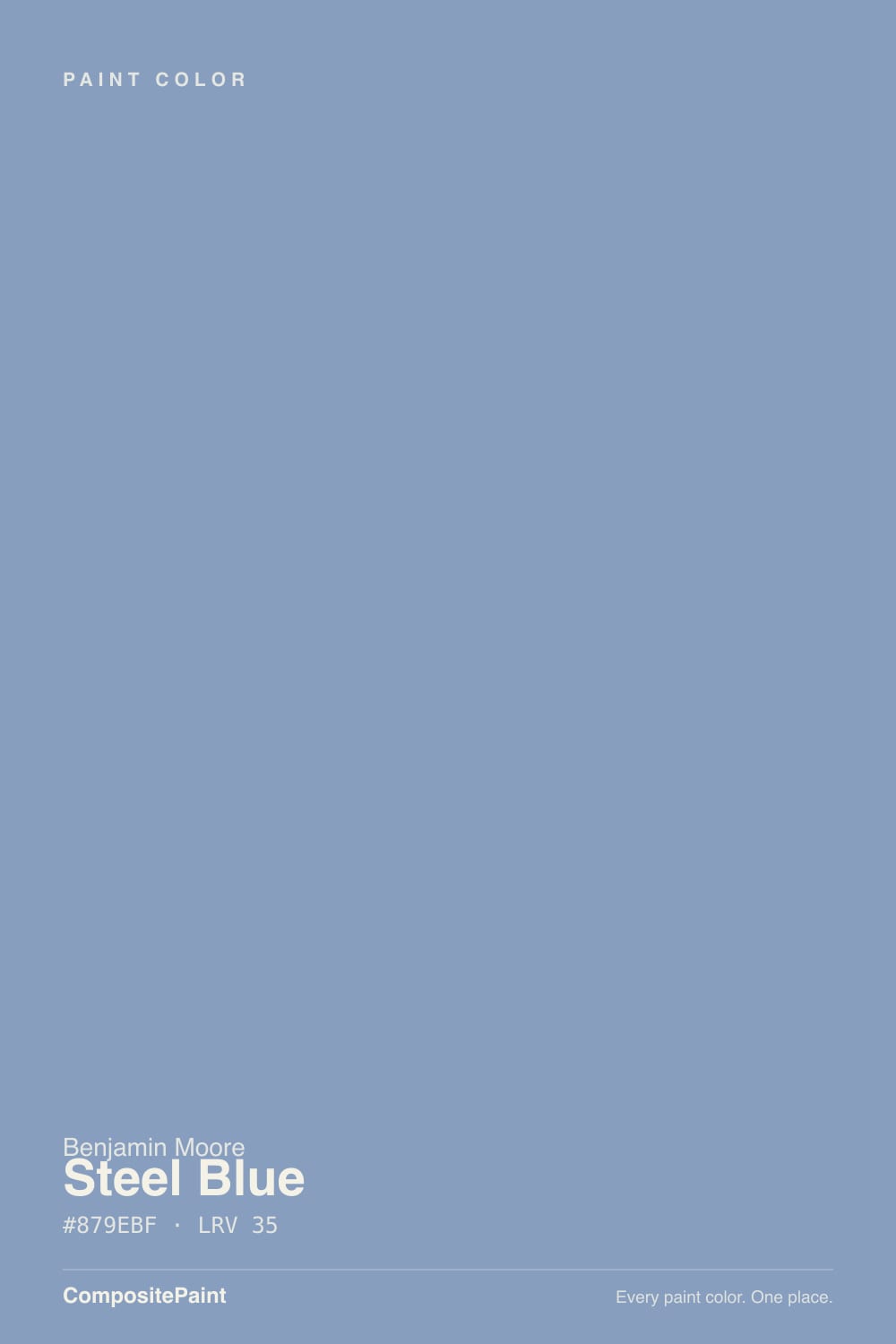
Steel Blue
823 · #879EBF · LRV 35 — cool blue tone, mid-tone — versatile but shifts visibly with light.
- 1Hale Navy8
- 2Waterloo13
- 3Steel Blue35
- 4Resolute Blue40
- 5Honolulu Blue62
What Color Is Steel Blue, Really?
Steel Blue 823 is a mid-tone blue, hex #879EBF, with an LRV of 35. That places it firmly in the middle of the scale, so it holds real color on a wall without going dark or heavy. Its hue sits at 215 degrees, which is a true blue leaning slightly toward violet, with saturation around 30 percent. That is enough color to read clearly as blue, but soft enough that it looks dusty and settled rather than bright.
People choose it when they want blue that behaves like a color and not like a statement. The muting keeps it from feeling like a nursery blue or a nautical navy, and the slight violet lean gives it a gray, weathered quality that sits well with white trim, natural wood, and brushed metal. It reads calm in a bedroom and quietly traditional on cabinetry.
The practical catch is that violet lean. At 215 degrees the color is close enough to the blue-violet border that in warm evening light or under 2700K bulbs it can shift toward periwinkle. In flat north light it can go the other way and read grayer and colder than expected. It also holds an LRV of 35, which is low enough that a small dim room will feel noticeably enclosed. Benjamin Moore sells through independent dealers, so a sample pot is easy to pick up before you decide.
Steel Blue is a cool blue with a violet lean. Its hue of 215 degrees sits just past pure blue on the way toward violet, and at 30 percent saturation there is enough color present for that lean to show under the right light. What you will not find in it is any green, so it never reads teal or aqua.
The violet side is easiest to see in comparison. Next to a true blue it looks softer and slightly purple. Next to Persian Violet 1419, hex #929BC2 at LRV 35, Steel Blue is the more clearly blue of the two. Against a warm beige or an oak floor, the coolness sharpens and the color feels crisper.
Check it against anything blue you already own. A cooler blue tile or a navy sofa can push Steel Blue toward gray-violet by comparison, which is the change that surprises people most after the walls are done.
Best Rooms and Uses for Steel Blue
Steel Blue is a mid-tone wall color that suits bedrooms, home offices, dining rooms, and powder rooms. Its calm, dusty character reads restful rather than loud, which is why it turns up so often in bedrooms and in rooms meant for quiet work. In a bright room with good daylight it can carry all four walls; in a small dark room the LRV of 35 will feel enclosed, so it works better there as an accent wall or on lower cabinetry.
On cabinets it gives a kitchen or bathroom vanity real color without going navy, and it pairs naturally with white counters, brass, and warm wood floors. Built-ins, an island, and a mudroom all take it well.
Outdoors it reads as a soft slate blue body or shutter color and sits comfortably with white trim and gray stone. Because it is a color rather than a neutral, keep trim in a separate white rather than painting trim in the same blue.
How Lighting Changes Steel Blue
At LRV 35 Steel Blue gives back a moderate amount of light. It is not a dark color, but it will not brighten a room either, and the light it sits in decides much of its character.
North-facing rooms deliver cool, indirect daylight that reinforces the blue and mutes the violet. There Steel Blue reads deeper, grayer, and more like weathered denim. South-facing rooms flood it with warm light, which softens the color and can lift the violet lean toward periwinkle in the middle of the day. East rooms look cooler and cleaner in the morning; west rooms stay flat early and warm noticeably after four, which is when the violet is most likely to appear.
Bulbs push it hard. Warm 2700K lamps are the main trigger for the periwinkle shift, while 3500K to 4000K bulbs hold the blue steady and read cooler. Because a 35 LRV goes dim at night, look at a sample under your own fixtures after dark.
Most complaints about Steel Blue are a light mismatch. Upload a photo of your actual room and see it on your walls — then ask for the same wall in north light or evening lamps before you buy a single sample.
Need It From Another Brand?
Any paint counter can custom-tint Benjamin Moore 823 directly. If you would rather stay in one brand's own deck, these are the closest stock matches, measured as ΔE2000. Under 2 is a difference you will not see on the wall.
| Brand | Closest color | ΔE | LRV | |
|---|---|---|---|---|
| Sherwin-Williams | DahliaSW 6816 · Sherwin-Williams | 4.9 | 32 | Color page → |
| Behr | Violet Shadow620F-4 · Behr | 1.0 | 32 | Color page → |
| Valspar | ViolettaV073-4 · Valspar | 2.4 | 35.8 | Color page → |
| PPG / Glidden | Alaskan BluePPG1162-4 · PPG / Glidden | 2.9 | 33 | Color page → |
| Glidden | New World Blue30BB 33/187 · Glidden | 1.2 | 33 | Color page → |
| Dutch Boy | Neptune's Folly240-4DB · Dutch Boy | 2.9 | 35 | Color page → |
Similar Benjamin Moore Colors
The nearest shades to Steel Blue within Benjamin Moore's own range, ranked by perceptual color distance — useful when you want the same look a touch lighter, darker, or warmer.
WCAG 2.1: AA is 4.5 : 1 for normal text, 3 : 1 for large text, AAA is 7 : 1.
Steel Blue vs Similar Colors
Inside Benjamin Moore, Denim Wash CC-770 at LRV 35 is the closest sibling and reads a shade more straightforwardly blue. Persian Violet 1419, hex #929BC2 at the same LRV 35, is the version that commits to the violet lean, so comparing the two shows you exactly where Steel Blue sits on that line. Pressed Violet CSP-520 at LRV 38 is lighter and better suited to a dim room.
Across brands, Behr Violet Shadow 620F-4, hex #839CBD at LRV 32, measures a delta E of 0.99 and Glidden New World Blue 30BB 33/187, hex #869BBD at LRV 33, sits at 1.2. Both are visually identical to Steel Blue in normal room light, though slightly deeper on paper.
Valspar Violetta V073-4 at 2.36, Dutch Boy Neptune's Folly 240-4DB at 2.89, and PPG Alaskan Blue PPG1162-4 at 2.9 are very close, sample first. Farrow and Ball Bothy Blue No. G11 at 3.21 and Sherwin-Williams Dahlia SW 6816 at 4.91 are close but visibly different side by side, with Dahlia clearly the more violet of the pair.
Colors That Go With Steel Blue
Trim and ceilings want a white with a large brightness gap. With walls at LRV 35, a white in the eighties or higher gives clean separation, and a slightly warm white takes the chill off a 215-degree blue better than a blue-based white, which can make the walls look colder.
Within Benjamin Moore, its close relatives work best in adjacent rooms or as a second wall. Denim Wash 838 and Denim Wash CC-770, both hex #85A0B6 at LRV 34 and 35, are the same depth with a fraction less violet. Blue Pearl 1433 and Blue Pearl CC-890, both hex #93A0BD at LRV 36 and 35, are a touch lighter and slightly more violet. Pressed Violet CSP-520, hex #8EA3C5 at LRV 38, is the airiest of the group and reads clearly more violet.
Warm woods, natural oak, rattan, brass, and aged bronze all flatter it. Cool chrome and stark blue-white lighting will make the room feel colder than intended.
Coordinated palette
Generated by hue-rotating #879EBF in HSL space. Pair Steel Blue with one accent and one neutral — the swatches below are starting points, not final picks.
Steel Blue FAQ
Is Steel Blue warm or cool?
Steel Blue is cool. Its hue sits at 215 degrees, a true blue leaning slightly toward violet, with about 30 percent saturation. There is no green or warmth in it. In warm evening light or under 2700K bulbs the violet side can surface and make it look softer, but the base character stays cool.
What LRV is Steel Blue?
Steel Blue 823 has an LRV of 35 on the 0 to 100 scale, where 0 is black and 100 is pure white. That makes it a genuine mid-tone. It reflects a moderate amount of light, so it holds clear color on a wall without reading as a dark or dramatic blue.
Does Steel Blue work in a dark room?
Use it carefully. At LRV 35 it does not return much light, so a small room with one window will feel noticeably enclosed. If you want the same character in a dim space, Pressed Violet CSP-520 at LRV 38 gives a little more back, or use Steel Blue on a single wall or on cabinetry instead of all four walls.
What white trim goes with Steel Blue?
Choose a white in the eighties or above so the trim separates clearly from walls at LRV 35. A softly warm white balances the coolness of a 215-degree blue and keeps the room from feeling chilly. A bright blue-based white will sharpen the contrast but can push the whole space cold.
Is Steel Blue good for cabinets?
Yes. Its mid depth at LRV 35 gives cabinets and islands real color without the weight of a navy, and the 30 percent saturation keeps it dusty rather than bright. It pairs well with white counters, warm wood floors, and brass or bronze hardware. Test it under your kitchen lighting first, since warm bulbs can lift the violet lean.
Why does Steel Blue sometimes look purple?
Because its hue sits at 215 degrees, close to the blue-violet border. Warm light from afternoon sun or 2700K bulbs adds red to the mix, which nudges the color toward periwinkle. Cool north light and 3500K to 4000K bulbs do the opposite and hold it as a grayed blue. Sampling under your real lighting is the only reliable check.
Have you painted with Steel Blue?
Rate it — one tap helps the next reader decide.
Ask a Question