Jade Green
2037-20 · #00874A · LRV 18 — cool green tone, dark — high drama, needs strong daylight or warm bulbs.
- 1Essex Green6
- 2Vintage Vogue12
- 3Jade Green18
- 4Evergreen Fog30
- 5Clary Sage41
What Color Is Jade Green, Really?
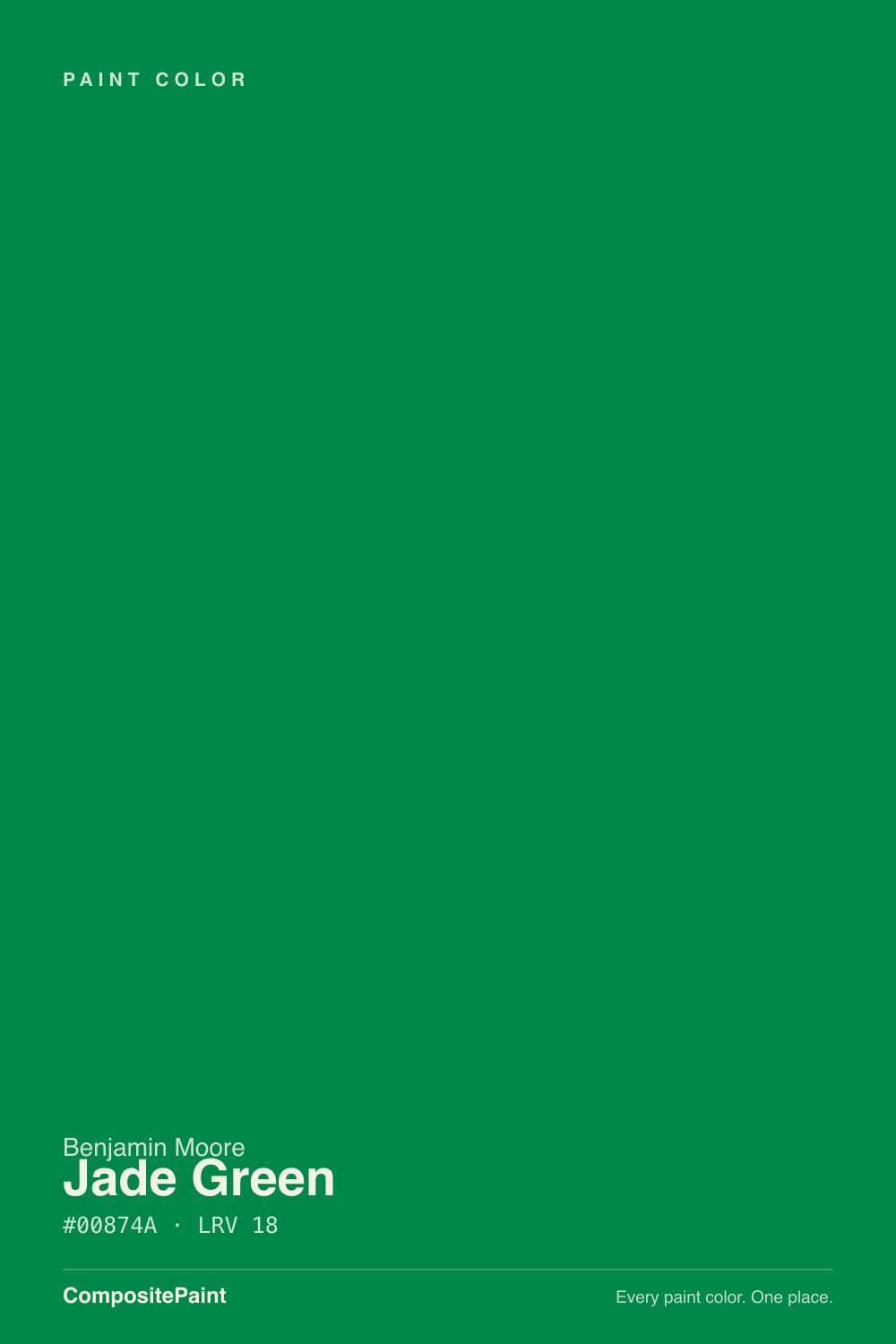
Jade Green 2037-20 is a fully saturated dark green. Its hex is #00874A and its saturation reads at 100 percent, so there is no gray in it at all. The hue sits at 153 degrees, which is green with a slight blue lean, and the LRV of 18 keeps it deep. This is not a sage or an olive. It is a clean, strong emerald-leaning green with nothing muting it.
People reach for it when they want an unmistakable color. At full saturation it looks vivid rather than earthy, so it does what a muted green cannot: it becomes the thing you notice in the room. On a front door, a bar, a powder room, or a single piece of built-in furniture it gives real punch, and the small blue lean keeps it from turning grassy or yellow.
The catch is that saturation this high is hard to live with in quantity. Across four walls the color can feel loud and can throw a green cast onto skin and white trim. It also reads more festive than most people intend when paired with red or gold accents. Strong greens tend to have thin hide, so plan on a tinted primer and extra coats. Sample it large, and look at it under your own bulbs at night.
There is nothing hiding in Jade Green. At 100 percent saturation the color is exactly what it appears to be, a pure green with a small tilt toward blue at 153 degrees on the hue wheel. That blue lean is the only subtlety worth tracking, and it is what separates this from a yellow-green like grass or lime.
Where the blue shows is next to warmer greens. Put Jade Green beside an olive or a yellow-green and it suddenly looks cool and almost jewel-like. Put it beside a teal and the situation reverses: Jade Green looks warmer and more clearly green.
Against white it looks brighter and more saturated than it did on the chip, because there is nothing to soften the edge. Against wood it settles down. If you want the color to feel less intense without changing it, surround it with warm materials rather than with more white.
Best Rooms and Uses for Jade Green
Jade Green is an accent color first. Its best uses are small and deliberate: a front door, a powder room, the inside of a cabinet or bookcase, a bar area, a mudroom bench, or a single piece of painted furniture. In those doses the saturation is an asset.
On full walls it needs a room that can absorb it. A dining room with good daylight, a library, or a den can carry it, especially with plenty of wood and warm light in the mix. Bedrooms and bathrooms are riskier, since the color reflects green onto skin and makes mirrors unflattering.
Outdoors it works well as a door or shutter color against white, cream, or stone, where the strong hue reads as traditional rather than trendy. On cabinets it is a bold choice; consider limiting it to lowers or an island so the room keeps some visual rest. With an LRV of 18, contrast against light trim will always be strong.
How Lighting Changes Jade Green
An LRV of 18 means Jade Green reflects little light, but the high saturation means the color itself stays visible even when the room is dim. That combination is unusual: many dark colors go gray in low light, while this one stays green and simply gets deeper.
In north-facing rooms the cool daylight emphasizes the blue side of the hue and the green looks a bit sharper and more jewel-toned. South-facing rooms flood it with warm light and bring out its brightness, which can be a lot across a full wall. East rooms look crisp in the morning; west rooms glow in the late afternoon.
Bulbs change the mood more than the color. Warm 2700K lamps calm the green and make it feel richer. Cooler 3500K to 4000K bulbs push it toward a harder, more electric look that some people read as clinical. Because the color bounces green light, check how it affects nearby white trim before committing.
Most complaints about Jade Green are a light mismatch. Upload a photo of your actual room and see it on your walls — then ask for the same wall in north light or evening lamps before you buy a single sample.
Need It From Another Brand?
Any paint counter can custom-tint Benjamin Moore 2037-20 directly. If you would rather stay in one brand's own deck, these are the closest stock matches, measured as ΔE2000. Under 2 is a difference you will not see on the wall.
| Brand | Closest color | ΔE | LRV | |
|---|---|---|---|---|
| Sherwin-Williams | Lucky GreenSW 6926 · Sherwin-Williams | 2.2 | 18 | Color page → |
| Behr | Paradise Of GreeneryP400-7 · Behr | 3.6 | 19 | Color page → |
| Valspar | Luscious Green6010-7 · Valspar | 3.7 | 15.8 | Color page → |
| PPG / Glidden | Blarney StonePPG1226-7 · PPG / Glidden | 4.7 | 14 | Color page → |
| Dutch Boy | Croquet Green128-7DB · Dutch Boy | 2.5 | 19 | Color page → |
| Dunn-Edwards | Later GatorDE5678 · Dunn-Edwards | 1.6 | 17 | Color page → |
Similar Benjamin Moore Colors
The nearest shades to Jade Green within Benjamin Moore's own range, ranked by perceptual color distance — useful when you want the same look a touch lighter, darker, or warmer.
WCAG 2.1: AA is 4.5 : 1 for normal text, 3 : 1 for large text, AAA is 7 : 1.
Jade Green vs Similar Colors
Within the line, Emerald Isle 2039-20 (#008158, LRV 16) is darker and pushed further toward blue, so it reads more like a true emerald. Vine Green 2034-20 (#2F7D3F, LRV 16) goes the other way, warmer and more leaf-like. Nile Green 2035-30 (#348354) and Irish Moss 2036-20 (#347E50) share the same general lightness but carry visible gray, which makes them far easier to use across a whole room than Jade Green.
Across brands, Dunn-Edwards Later Gator DE5678 (#008A51, LRV 17) at a deltaE of 1.55 is visually identical in normal room light. Sherwin-Williams Lucky Green SW 6926 (#238652, LRV 18) at 2.19 and Dutch Boy Croquet Green 128-7DB (#1D8C49, LRV 19) at 2.47 are very close, so sample before you swap. Valspar Luscious Green 6010-7 at 3.74, Behr Sparkling Emerald P430-7 at 4.64, and Farrow and Ball Danish Lawn No. 9817 at 4.99 are all close but visibly different side by side.
Colors That Go With Jade Green
White is the safest partner. A clean, slightly cool white keeps Jade Green crisp and lets its blue lean show, while a creamy warm white softens it and makes the pairing feel older and more traditional. Given the saturation, keep the rest of the room quiet.
Inside Benjamin Moore, the neighbors are useful when you want the same energy at a different weight. Emerald Isle 2039-20 at LRV 16 goes deeper and bluer for a door or cabinet base. Irish Moss 2036-20 at LRV 17 is the calmer, slightly grayed option for larger areas. Nile Green 2035-30 at LRV 18 holds the same lightness with less intensity, which makes it easier on full walls. Once Upon a Time 574 at LRV 21 lifts the same family a step lighter.
For materials, warm wood, rattan, brass, and leather all soften the green. Black hardware sharpens it. Avoid pairing it with strong reds unless a holiday look is the goal.
Coordinated palette
Generated by hue-rotating #00874A in HSL space. Pair Jade Green with one accent and one neutral — the swatches below are starting points, not final picks.
Jade Green FAQ
Is Jade Green warm or cool?
Jade Green is a cool green. Its hue sits at 153 degrees, which leans slightly toward blue rather than yellow, and its saturation is 100 percent, so nothing is muting that lean. Next to an olive or a yellow-green it looks noticeably cool; next to a teal it looks warmer by comparison.
What LRV is Jade Green?
Jade Green has an LRV of 18. On the 0 to 100 scale that is a dark color, so it reflects little light and adds weight to a room. Because its saturation is so high, though, it stays clearly green in low light instead of collapsing into gray the way many dark colors do.
Does Jade Green work in a dark room?
It holds its color better than most dark shades, since 100 percent saturation keeps the green readable even when the light is poor. What it will not do is brighten the space, because an LRV of 18 reflects very little. Expect a rich, enclosed, distinctly green room rather than a light one.
What white trim goes with Jade Green?
A clean white keeps the color crisp and lets its slight blue lean show, which suits a modern room. A creamy warm white softens the contrast and reads more traditional. Either works because the LRV gap is large, but check the trim in place first, since a saturated green bounces color onto adjacent white surfaces.
Is Jade Green good for a front door?
Yes, this is one of its best uses. At LRV 18 it reads dark and solid from the street, and the high saturation makes it register as a real color rather than a near-black. Against white, cream, or stone it looks traditional. Benjamin Moore sells through independent dealers, so ask which exterior line suits your door material.
Can you paint a whole room in Jade Green?
You can, but choose the room carefully. At full saturation the color is loud across four walls and reflects green onto skin, which makes bedrooms and bathrooms tricky. Dining rooms, libraries, and dens with good daylight and plenty of wood handle it best. If you want the same family with less intensity, Irish Moss 2036-20 at LRV 17 is the calmer option.
Have you painted with Jade Green?
Rate it — one tap helps the next reader decide.
Ask a Question