Harvest Brown
710D-4 · #B9A589 · LRV 39 — warm red-orange tone, mid-tone — versatile but shifts visibly with light.
- 1Anonymous20
- 2Felted Wool28
- 3Harvest Brown39
- 4Agreeable Gray60
- 5Pale Oak69
What Color Is Harvest Brown, Really?
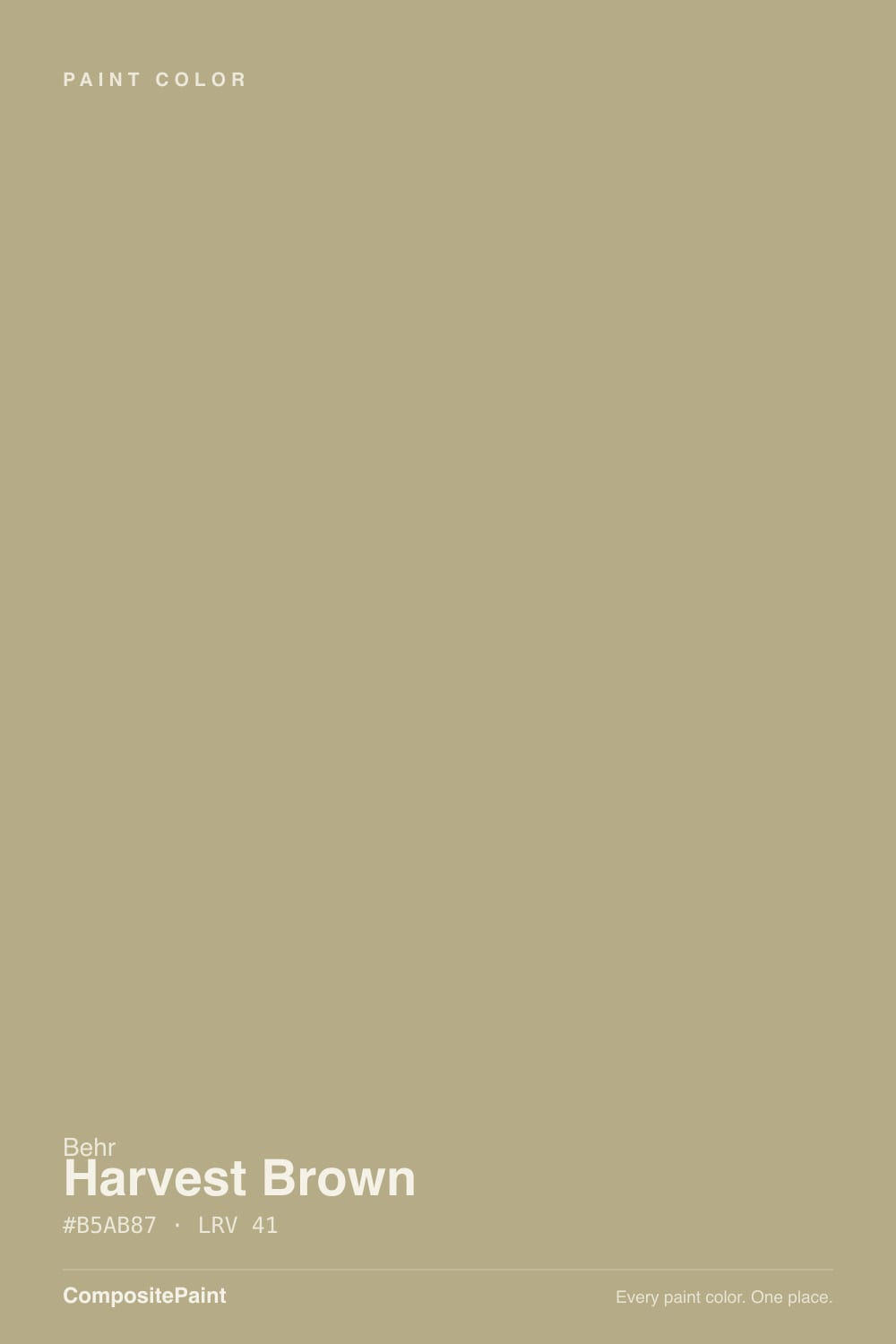
Harvest Brown (710D-4) is a warm neutral in the khaki and tan range. Its hex value is #B5AB87 and its LRV is 41, which puts it squarely in the mid-tone band. That means it reads as real color on a wall, not as a background beige, but it still keeps a room open rather than closing it in. The undertone is a warm yellow, sitting at hue 47 with about 24 percent saturation. The yellow is dulled rather than bright, which is why the color can look like soft tan in one room and dusty olive in another.
People pick it when plain beige feels flat and a real green feels like too much of a commitment. The muted yellow gives walls a sun-dried, natural look that sits comfortably with wood, leather, jute, and stone. Behr is sold at The Home Depot, so it is easy to get a quart of it and live with a sample for a few days.
The thing to check before committing is the green flip. Because the yellow is grayed down, cool north light pulls Harvest Brown toward olive, and a bright white trim next to it makes that green-yellow lean much more obvious. If you want a clean, uncomplicated tan, this one may read muddier than you expect.
The undertone is warm yellow, but it is a soft, dusty yellow rather than a golden one. Hue 47 with 24 percent saturation puts it in the same zone as dry grass and raw linen. On a small chip it usually looks like a plain tan. Spread across a full wall the yellow gains strength and a faint green cast appears, which is why Behr's own neighbors in this range carry herb names.
What sits next to it decides which side you see. Against a crisp white trim the yellow-green lean is obvious. Against a warm cream or a beige with more red in it, Harvest Brown looks cooler and greener by comparison. Next to oak, walnut, or terracotta it settles down and simply reads as a warm neutral.
Hold a sample against your trim, your floor, and any stone or tile before deciding. This color takes its character from its neighbors more than most tans do.
Best Rooms and Uses for Harvest Brown
A mid-tone at LRV 41 suits rooms where you want warmth and a bit of weight. It works well on living room and dining room walls, in a study or home office, and in bedrooms where a lighter beige would feel washed out. In hallways and stairwells it holds up better than a pale neutral because it does not show scuffs as quickly.
It is also a natural exterior color. The dusty yellow reads like stucco, adobe, and weathered wood, so it works as a body color on ranch, craftsman, and southwestern houses, with a darker trim or a deep front door for contrast.
On cabinetry it behaves like a soft olive-tan, which suits a mudroom, a laundry room, or lower kitchen cabinets under a lighter counter. Keep trim in a separate white rather than painting it the same color, since Harvest Brown is a tinted neutral and needs a clean edge to look intentional.
How Lighting Changes Harvest Brown
At LRV 41 Harvest Brown returns a moderate amount of light. It will not brighten a dim room on its own, and it will not swallow one either. In north-facing rooms the cool, flat daylight strips warmth out of it, so the grayed yellow tips toward olive and the color looks more serious and stony than the chip suggested.
South-facing rooms do the opposite. Strong warm sun pushes the yellow forward, and the color can look sandy or almost gold in the middle of the day. East rooms read warm in the morning and settle into a quieter khaki by afternoon. West rooms stay muted early and glow warm late.
Bulbs matter just as much. Warm 2700K lamps deepen the yellow and make the color feel cozy at night. Neutral 3500K to 4000K bulbs cool it off and bring the olive back. Look at a sample under your own fixtures after dark, not only in daylight.
Most complaints about Harvest Brown are a light mismatch. Upload a photo of your actual room and see it on your walls — then ask for the same wall in north light or evening lamps before you buy a single sample.
Need It From Another Brand?
Any paint counter can custom-tint Behr 710D-4 directly. If you would rather stay in one brand's own deck, these are the closest stock matches, measured as ΔE2000. Under 2 is a difference you will not see on the wall.
| Brand | Closest color | ΔE | LRV | |
|---|---|---|---|---|
| Sherwin-Williams | OuterbanksSW 7534 · Sherwin-Williams | 1.1 | 39 | Color page → |
| Benjamin Moore | Brush BeigeCW-125 · Benjamin Moore | 0.7 | 38 | Color page → |
| Valspar | Puppy LoveV131-4 · Valspar | 4.2 | 39.6 | Color page → |
| PPG / Glidden | AntelopePPG15-09 · PPG / Glidden | 0.4 | 39 | Color page → |
| Glidden | AntelopePPG15-09 · Glidden | 0.5 | 39 | Color page → |
| Dutch Boy | Towrope417-3DB · Dutch Boy | 0.8 | 39 | Color page → |
Similar Behr Colors
The nearest shades to Harvest Brown within Behr's own range, ranked by perceptual color distance — useful when you want the same look a touch lighter, darker, or warmer.
WCAG 2.1: AA is 4.5 : 1 for normal text, 3 : 1 for large text, AAA is 7 : 1.
Harvest Brown vs Similar Colors
Benjamin Moore Baby Turtle (515) at LRV 40 and hex #B4A985 is the closest cross-brand match, with a deltaE of 0.68. At that distance the two are the same color for practical purposes, so choose on availability rather than on looks. Dutch Boy Speckled Shell (323-3DB) at LRV 42 and Hirshfield's Bayberry Wax (H0110) at LRV 41 come in at deltaE 1.26 and 1.43, close enough to be visually identical in normal room light.
Step out a little and the differences start to show. Farrow and Ball Stone White (No. 11) at LRV 41 and Kompozit Travertine Path (0345) at LRV 41 both land near deltaE 2.5, so they are very close but worth sampling first.
Further out, Dunn-Edwards Sepia Tone (DET638) at LRV 39 and deltaE 3.79 leans browner and less green, while Annie Sloan Versailles at LRV 47 and deltaE 3.81 is noticeably lighter. Both are close but visibly different side by side.
Colors That Go With Harvest Brown
Inside the Behr range, the closest companions are almost the same color, so treat them as alternates rather than partners. Sanctuary (PPU9-21) at LRV 42 is a hair grayer and greener, which makes it a good choice for an adjoining room where you want continuity without an obvious seam. Tarragon Tease (PPU9-08) at LRV 41 and Kaffir Lime (PPU8-08) at LRV 41 sit in the same lane, with Makrut Lime (PPU8-08A) at LRV 41 nearly on top of it.
For trim and ceilings, a clean white or a soft off-white both work. A bright white makes the yellow-green lean pop, while a creamy white blends the two and keeps the room quiet. Pick based on how much you want the undertone to show.
For materials, oak, walnut, rattan, unlacquered brass, and aged bronze all flatter it. Black hardware or a very dark door gives the contrast this mid-tone needs to look deliberate.
Coordinated palette
Generated by hue-rotating #B9A589 in HSL space. Pair Harvest Brown with one accent and one neutral — the swatches below are starting points, not final picks.
Harvest Brown FAQ
Is Harvest Brown warm or cool?
Harvest Brown is warm. Its undertone is a soft yellow at hue 47, which puts it on the tan and khaki side rather than the gray side. The saturation is only about 24 percent, so the warmth is muted, and in cool north light the color can look more olive than golden.
What LRV is Harvest Brown?
Harvest Brown has an LRV of 41. LRV runs from 0 for black to 100 for pure white, so 41 is a true mid-tone. It reflects a moderate amount of light, meaning it gives walls visible color and depth without making a room feel dark.
Does Harvest Brown look green?
It can. The yellow undertone is grayed down, and a dulled yellow reads as olive to most eyes, especially in north light or next to a bright white trim. In warm afternoon sun the same color looks sandy and tan. Sample it on two walls with different exposures before you decide.
Does Harvest Brown work in a dark room?
It works, but it will look deeper and more olive than the chip suggests. At LRV 41 the color reflects a moderate amount of light and cannot brighten a room on its own. If the room is dim, use warm bulbs around 2700K and plenty of white on the trim and ceiling to keep it from going heavy.
What white trim goes with Harvest Brown?
Both a clean white and a soft creamy white work, and the choice changes the room. A bright white makes the yellow-green undertone stand out and gives a crisp, modern edge. A warmer off-white blends with the color and keeps everything soft and quiet.
Is Harvest Brown good for exteriors?
Yes. At LRV 41 it is dark enough to hide dust and weathering and light enough to keep a facade from looking heavy. The dusty yellow reads like stucco and weathered wood, so it suits ranch, craftsman, and southwestern homes with a darker trim or front door for contrast.
Have you painted with Harvest Brown?
Rate it — one tap helps the next reader decide.
Ask a Question