Product review · Rust-Oleum · Updated August 7, 2026
5180 Epoxy Repair MortarRust-Oleum paint review
8.6/10The right call when a load-bearing repair has to carry traffic again the same shift — and only if the crew can grind, prime, and hold temperature.
A graded-aggregate epoxy mortar that rebuilds a spalled dock edge harder than the slab around it and takes light service in 6 to 12 hours. The strength is not the constraint — pot life, slab temperature, and the 5401 primer are.

Robert Vega · Commercial Coatings Editor · Updated August 7, 2026
Robert spent twelve years in facility engineering specifying coatings for school districts, light industrial sites, and municipal water assets before moving to editorial. He still consults on tank-lining specs and writes the pieces that have to survive a procurement meeting. About the testing process →
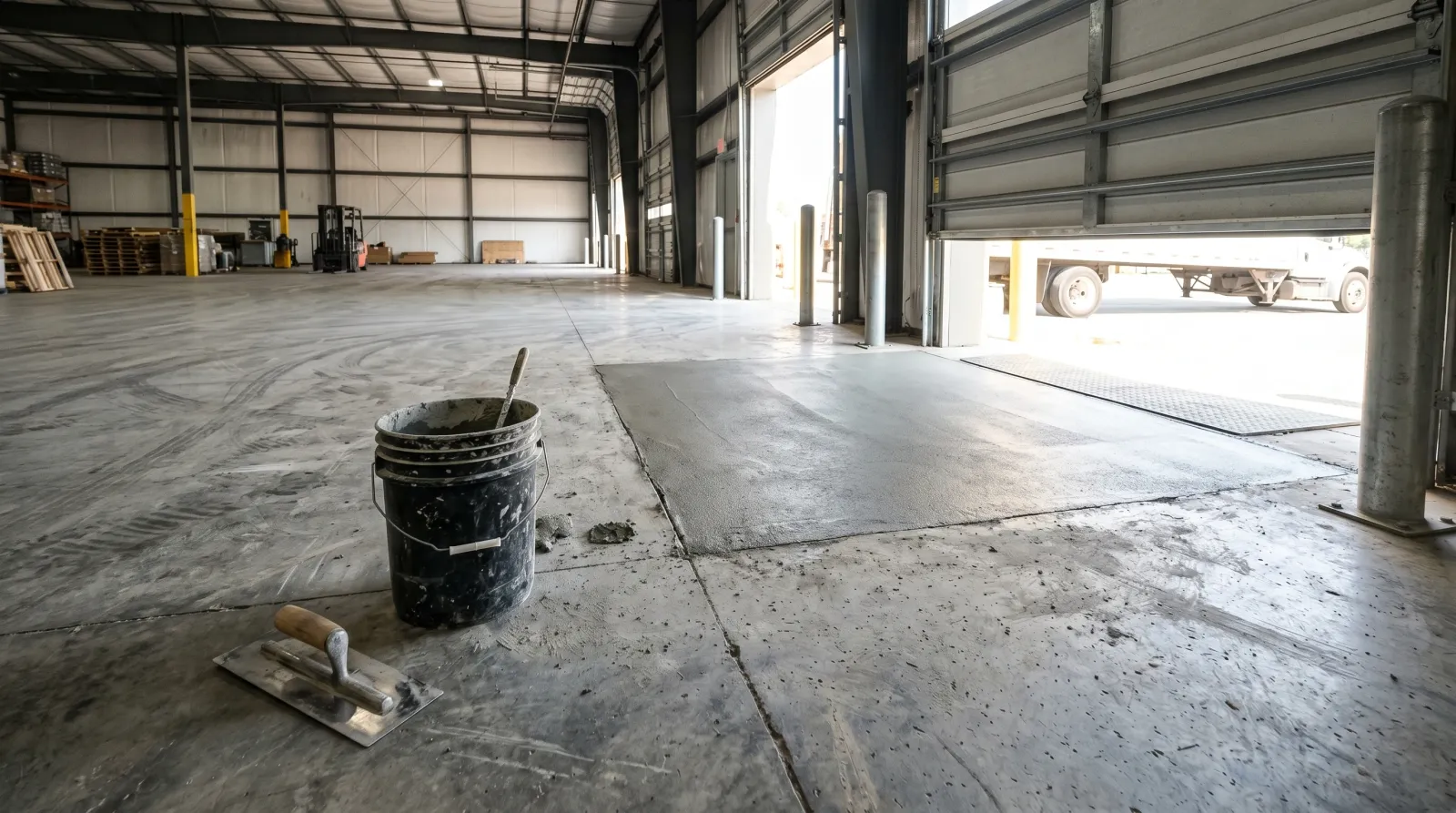
Rust-Oleum 5180 Epoxy Repair Mortar
VOC0 g/L
Cure to light service6–12 hours at 68°F
Read this first
The Fast Verdict
Specify it for load-bearing concrete that has to be back under traffic the same shift. Compressive strength near 55 MN/m² exceeds the 25 to 35 MPa slab it repairs, the patch does not shrink at the bond line, and light service returns in 6 to 12 hours at 68°F for roughly $45 to $70 a 5-kg pack. It is the wrong specification for hairline cracks, for voids deeper than 2 inches in a single lift, or for a crew that cannot grind the substrate, prime with the 5401, and hold the slab above 50°F through cure.
Best for
Spalled loading-dock and bay edges · Broken steps and stair nosings · Eroded interior slab in plants and warehouses · Repairs that must carry traffic the same shift · Occupied food, school, and hospital spaces at 0 g/L
Skip if
Hairline driveway cracks · Voids deeper than 2 inches in one lift · A slab you cannot grind and prime · Unheated bays below 50°F · Resurfacing a whole floor
What it's good at
- Compressive strength near 55 MN/m², above the 25–35 MPa slab it repairs
- One-shift turnaround: touch dry in 3–6 hours, light service in 6–12
- Holding the bond line without shrinking, so the patch does not become a trip edge
- Feathering flush at the perimeter while building to 50 mm in the void
- 0 g/L VOC for occupied food plants, schools, and hospitals that cannot be vented
- Troweling and screeding cleanly with graded aggregate carrying the compressive load
What it's not good at
- Large batches — pot life punishes anything you cannot place in 20 to 30 minutes
- Cold work; below 50°F the cure stalls and the published strengths stop applying
- Substrates that were not ground, dried, and primed with the 5401
- Single-lift voids deeper than 2 inches, which belong to the 5190
- Homeowner sourcing — metric packs through industrial distribution, not a Saturday store run
- Resurfacing: it is a repair mortar, not a leveller and not a coating
Numbers, not adjectives
Spec Sheet
- Type
- Two-component (base + hardener) epoxy mortar with graded aggregate
- Surfaces
- Aged concrete and stone floors, steps, bay edges, plinths, interior and exterior
- Application depth
- Feather edge to 50 mm (about 2 inches) per lift; full mechanical strength from 5 mm
- Compressive strength
- About 55 MN/m² (MPa) per the published data sheet
- Flexural strength
- About 56 MN/m² (MPa)
- Touch dry
- 3–6 hours at 68°F
- Cure to light service
- 6–12 hours at 68°F
- VOC
- 0 g/L
- Primer
- 5401 Impregnation Primer, flashed 30–60 minutes before troweling
- Application temperature
- 50–95°F (10–35°C); cure stalls in the cold
- Sizes
- 2.5 kg, 5 kg, and 25 kg all-in-1 packs (base, hardener, graded aggregate)
- Price
- Roughly $45–70 per 5-kg pack through industrial distributors
Application Settings That Work
- Primer
- 5401 Impregnation Primer on sound, dry, aged slab, flashed 30 to 60 minutes before the mortar goes in. It wets the substrate and pulls bond strength up, and it is the single step that separates a patch that holds from one that delaminates. Grind or scarify first to remove laitance, old coatings, and curing compound; the slab should be at least 28 days old.
Cure to Service, and What Cold Does to It
Touch dry is 3 to 6 hours and cure to light service is 6 to 12 hours, both at 68°F. That schedule is the reason to specify this material at all: a Friday-evening repair on a warehouse bay edge carries forklift traffic Saturday morning, and a facility that cannot surrender a dock for three days gets its asset back in one shift. Strength keeps developing for several days after the patch first carries traffic, so the service point and the fully cured point are not the same milestone. The temperature window is 50 to 95°F, measured on the slab and not the air above it. Below 50°F the cure stalls and the published strength figures stop applying — a January dock repair in an unheated bay does not reach light service in 12 hours regardless of what the sheet says. Plan spot heat on the slab and on the material, and hold the bay in the window until the patch has carried its first traffic.
Mid-project panic
When It Goes Wrong, and How to Fix It
The batch went hard in the mixing tub
Why it happens. Pot life is short once base and hardener are combined, and a 25-kg pack is a lot of material to place. A crew that mixes the full pack and then works across the whole bay will be chiselling a kicked bucket out of the tub before the last zone is filled.
The fix. Mix to the zone, not to the pack. Break the work into areas a crew can trowel in 20 to 30 minutes and combine only that much base, hardener, and aggregate at a time. The 2.5-kg and 5-kg packs exist for small, discrete repairs.
The patch lifted at the edge under load
Why it happens. Almost always prep or primer. If the substrate was not ground or scarified to a sound profile, or the 5401 Impregnation Primer was skipped, the bond fails at the interface rather than at the surface, and you cannot see it until traffic finds it. Laitance, old coatings, oil-soaked concrete, and green slab under 28 days all produce the same result.
The fix. Grind or scarify to a clean, open, sound profile, confirm the slab is at least four weeks old and dry, and wet it with the 5401, flashed 30 to 60 minutes before troweling. Mechanical prep and the primer are not steps you can value-engineer out.
The repair never reached strength in a winter bay
Why it happens. The 50 to 95°F application and cure window is real. Below 50°F the reaction stalls, and the compressive and flexural figures on the data sheet stop describing what is in the floor.
The fix. Warm the slab and the material before placing, then hold the bay in the window through cure. Do not trust the 6-to-12-hour service time on an unheated slab in January; schedule the repair for a heated shift or bring in spot heat and extend the closure.
A deep void cracked or performed badly
Why it happens. The 5180 is specified from feather edge to 50 mm per lift. Dumping a 4-inch void in one pass exceeds what the material is formulated to do at depth.
The fix. Build it in lifts, or specify the 5190 Deep Fill Repair Mortar, which is formulated for the thicker pour. Feather the 5180 over the top of a 5190 fill if the surface needs a finer finish.
Side by side
5180 vs Cementitious Patch vs the Consumer EpoxyShield Kit
These three get confused at the counter because all three are sold as concrete repair. They are specified for different loads, different schedules, and different channels.
| Rust-Oleum 5180 | Polymer-modified cement patch | EpoxyShield patch kit | |
|---|---|---|---|
| What it is | Two-component epoxy mortar with graded aggregate | Cementitious repair mortar with polymer modification | Consumer two-part epoxy patch kit |
| Where it belongs | Industrial and commercial floors, dock edges, steps, plinths | Light-traffic, non-aggressive repairs on a tight budget | Driveway and garage cracks, smaller voids |
| Strength and shrink | About 55 MPa compressive, non-shrink at the bond line when primed | Lower compressive strength, and it shrinks as it cures | Sized for residential loads, not a graded-aggregate floor rebuild |
| Return to service | Light service in 6–12 hours at 68°F | Longer cure to traffic | Per the kit label; not specified for dock-edge traffic |
| Depth per lift | Feather edge to 50 mm; 5190 above that | Per the bag instructions | Small voids only |
| Channel and packaging | Industrial coatings distributor, 2.5 / 5 / 25 kg metric packs | Building supply, by the bag | Home center shelf |
| Cost | About $45–70 per 5-kg pack | A fraction of the epoxy pack | Home-center consumer pricing |
What it is
Rust-Oleum 5180Two-component epoxy mortar with graded aggregate
Polymer-modified cement patchCementitious repair mortar with polymer modification
EpoxyShield patch kitConsumer two-part epoxy patch kit
Where it belongs
Rust-Oleum 5180Industrial and commercial floors, dock edges, steps, plinths
Polymer-modified cement patchLight-traffic, non-aggressive repairs on a tight budget
EpoxyShield patch kitDriveway and garage cracks, smaller voids
Strength and shrink
Rust-Oleum 5180About 55 MPa compressive, non-shrink at the bond line when primed
Polymer-modified cement patchLower compressive strength, and it shrinks as it cures
EpoxyShield patch kitSized for residential loads, not a graded-aggregate floor rebuild
Return to service
Rust-Oleum 5180Light service in 6–12 hours at 68°F
Polymer-modified cement patchLonger cure to traffic
EpoxyShield patch kitPer the kit label; not specified for dock-edge traffic
Depth per lift
Rust-Oleum 5180Feather edge to 50 mm; 5190 above that
Polymer-modified cement patchPer the bag instructions
EpoxyShield patch kitSmall voids only
Channel and packaging
Rust-Oleum 5180Industrial coatings distributor, 2.5 / 5 / 25 kg metric packs
Polymer-modified cement patchBuilding supply, by the bag
EpoxyShield patch kitHome center shelf
Cost
Rust-Oleum 5180About $45–70 per 5-kg pack
Polymer-modified cement patchA fraction of the epoxy pack
EpoxyShield patch kitHome-center consumer pricing
Where the load is foot traffic and there is time to cure, a polymer-modified cement patch saves real money and is the correct specification. Where the repair is a homeowner's driveway crack, the EpoxyShield kit is sized and priced for it. The 5180 is for the case in between those and a full resurface: localized, load-bearing damage on a floor that has to be back under wheels the same shift, with a crew that can grind, prime with the 5401, and hold the slab in temperature. Buy the mortar and the primer together, or the bond line is where the money goes.
If not this one
Honest Alternatives
PM
Polymer-modified cement patch (Quikrete, Sika)A fraction of the epoxy pack
Bonds well enough for light-traffic, non-aggressive repairs at a much lower material cost. The trade is shrinkage, a longer cure to traffic, and lower compressive strength. Correct where the load is foot traffic and the schedule allows a real cure.
RO
Rust-Oleum 5190 Deep Fill Repair MortarIndustrial distribution, same family
Formulated for the deep pour. When a void runs past the 50 mm single-lift limit of the 5180, the 5190 fills it in fewer lifts without the exotherm and cracking risk of stacking thick epoxy. Specify it for deep gouges and structural voids, then feather the 5180 over the top if the surface needs it.
RO
Rust-Oleum 6700 System 100% Solids EpoxyConcrete Saver system pricing
Not a mortar. When the problem is a worn surface across a whole bay rather than localized damage, this is the continuous wear coat. Repair with the 5180 first, let the mortar carry its own cure, then coat the bay for chemical and abrasion resistance.
Questions people actually ask
5180 Epoxy Repair Mortar Questions, Answered
Is the Rust-Oleum 5180 epoxy mortar worth it?
For load-bearing concrete that has to carry traffic again the same shift, yes. Compressive strength near 55 MN/m² beats the 25 to 35 MPa slab it repairs, the patch does not shrink at the bond line, and light service returns in 6 to 12 hours at 68°F for roughly $45 to $70 a 5-kg pack. It is not worth it for hairline cracks, for voids deeper than 2 inches in one lift, or for a crew that cannot grind, prime with the 5401, and hold the slab above 50°F.
Does the 5180 mortar need a primer first?
Yes on most concrete. Rust-Oleum calls for the 5401 Impregnation Primer on sound, dry, aged slab, flashed off for 30 to 60 minutes before you trowel the mortar in. The primer wets the substrate and pulls bond strength up. On a tight, non-porous repair you can sometimes skip it, but the spec assumes you prime.
How deep can one lift go?
Feather edge up to 50 mm, about 2 inches, in a single pass, with full mechanical strength reached at 5 mm and above. For voids deeper than 2 inches, build it in lifts or switch to the 5190 Deep Fill Repair Mortar, which is formulated for the thicker pour. Do not place a 4-inch void in one shot.
How long before forklifts can run over it?
Touch dry runs 3 to 6 hours and the patch takes light service in 6 to 12 hours at 68°F. Cold slows that down hard. Below 50°F the cure stalls, so an overnight dock repair in winter needs the bay warmed. Full chemical and mechanical cure keeps developing for several days after it carries traffic.
Is this the same as the EpoxyShield patch kit at the home center?
No. The consumer EpoxyShield Concrete Patch and Repair Kit is a smaller two-part epoxy aimed at driveway and garage cracks. The 5180 is the industrial Concrete Saver mortar: graded aggregate, higher fill depth, and strength data published in MPa. Different product, different shelf, different job.
Is the 5180 worth it over a bag of repair cement?
For high-traffic edges that take impact and need to return to service the same day, yes. The epoxy mortar's near-55 MPa compressive strength, non-shrink bond, and 6-to-12-hour service time outrun cementitious patch on every metric that matters at a dock edge. For low-load foot-traffic repairs with time to cure, a polymer-modified cement saves real money.
Why does my patch keep failing at the edge?
Almost always prep or primer. If the slab was not ground to a sound profile, or the 5401 was skipped, the bond fails at the interface where you cannot see it. The other common cause is cold: below 50°F the cure stalls and the patch never reaches strength.
Can I coat over the repair?
Yes, but not while it is green. Where a bay needs a continuous wear surface, the mortar repairs go in first, carry their own cure, and then a Concrete Saver epoxy floor system tops the whole floor. The mortar rebuilds damage; the coating handles the surface.
Keep exploring
Rust-Oleum brand guideBest garage floor coatingsFixing efflorescence on a concrete floorFilm thickness and mil readings explained
We may earn a commission when you buy through the retailer link above. It never changes the score or the verdict.
Ask a Question