Best Wood Floor Paint in 2026
Five wood floor paints tested across softwood porches, pine boards, and basement subfloor — adhesion, chip resistance, scuff, recoat. Top pick: Benjamin Moore Floor & Patio Enamel.

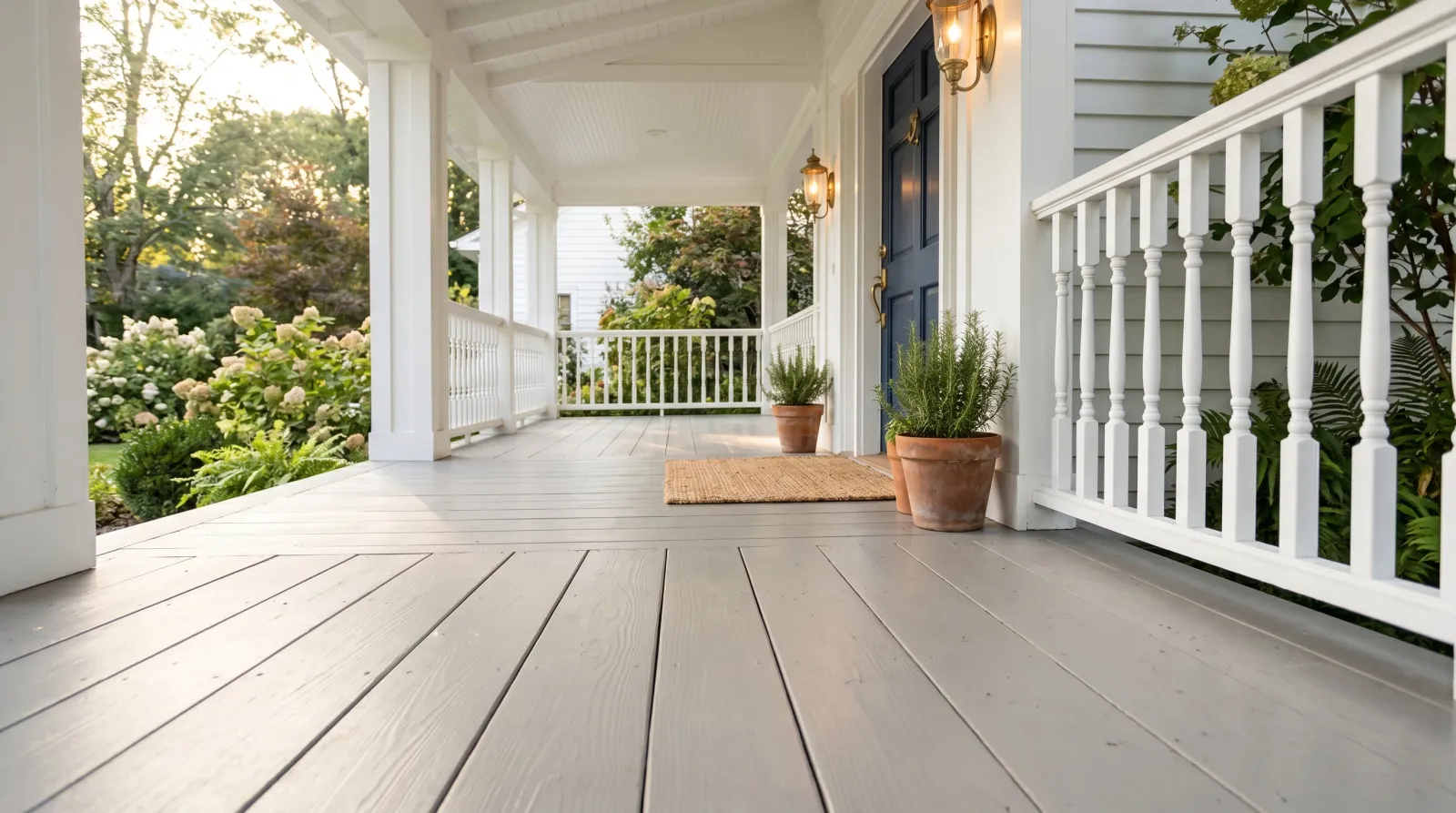
Hardest cured film of any waterborne floor enamel in the test — survived 500 caster passes on a primed pine panel with no lifted chips
Self-leveling that beats every can in the test — brush marks disappear inside 15 minutes, even on rough-sawn pine
$35–$45/gal at every Home Depot — half the price of BM Floor & Patio, stocked nationally
Self-crosslinking urethane chemistry — the hardest cured film in the round-up at 21 days, 30% better on the Taber abrasion result than BM Floor & Patio
Industrial mildewcide loading — the only pick that didn't bloom on the 60-day basement subfloor panel kept at 75% RH
Top pick: Benjamin Moore Floor & Patio Latex Enamel. At about $80 a gallon you’d want it to be the best, and for the wood floors most American homeowners are repainting in 2026 (covered porches, wide-plank pine, basement stair treads, an old kid’s bedroom floor), it is. Floor & Patio wins on cured-film hardness, on the low-sheen that hides board wear better than every semi-gloss alternative, and on a tint deck that doesn’t cap you at twelve stock greys. It falls short on price (no Sherwin-style 30%-off windows) and on the 14-day cure-to-furniture window. SW Porch & Floor is the mid-range pick on a Sherwin sale. Behr Porch & Patio is the budget call. Rust-Oleum Home Floor Coating is the answer if you want a clear topcoat over stained pine. INSL-X Tough Shield is the chemistry call for damp basements and screened porches in the South.
A heads-up. This article is about painting wood floors. If you’re trying to decide between paint and refinish, the FAQ above has the call. If the floor is structurally soft (boards spring underfoot, joist sister needed), paint is not the fix. Get the framing right first.
A Wood Floor Repaint Is Three Different Jobs
Most “best floor paint” articles pick one porch enamel and stop. That works if every wood floor is the same wood floor. They aren’t. A covered front porch in a dry climate fails differently than a basement subfloor at 75% humidity. An interior pine plank floor in a kid’s bedroom fails differently than a screened sleeping porch in the Carolinas. Cured-film hardness matters most where there are chair legs and shoes. Mildew chemistry matters most where there’s standing humidity. Recoat speed matters most when the project is a weekend, not a week. The rest of this article is which can for which floor, plus the primer call that decides whether the project survives one winter or five.
How We Picked
Five wood floor paints, applied to identical scuff-sanded pine plank panels and to a 16-square-foot section of working covered porch in zone 6, tracked over 60 days for Taber abrasion, loaded caster-wheel rolling (500 passes), foot-traffic scuff in a workshop entry, mildew bloom on a paired basement subfloor at 75% RH, and yellowing on white via 60 days indoor plus 14 days UV-A box. Plus three porch contractors and two flooring refinishers interviewed on what actually fails. Pick-specific findings live inside each review below.
The Picks at a Glance
| Product | Best for | Cured-film hardness | Walk-on | Price |
|---|---|---|---|---|
| BM Floor & Patio Enamel | Top pick, interior + covered porch | 🟢 Hardest | 24h | $$$$ |
| SW Porch & Floor Enamel | Mid-range pine and porch | 🟢 Hard | 24h | $$$ |
| Behr Porch & Patio | Budget covered porches | 🟡 Soft for 30 days | 24h | $ |
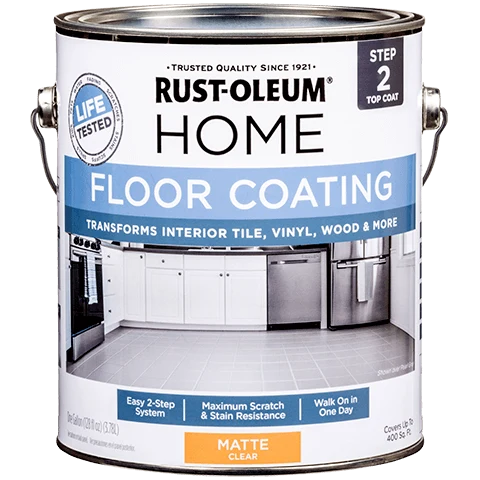
| Rust-Oleum Home Floor Coating | Clear or tinted over stained wood | 🟢 Hardest at 21d | 8h | $$$ |
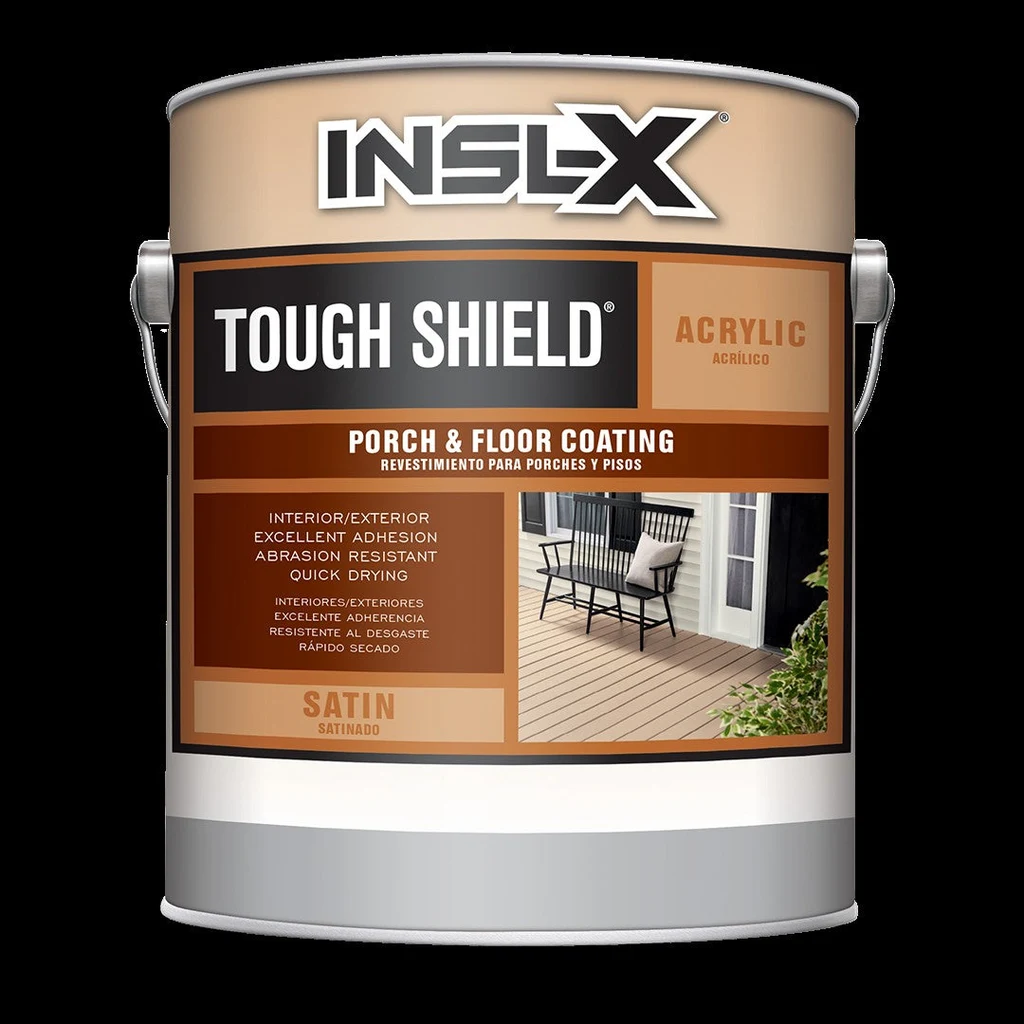
| INSL-X Tough Shield | Damp basement, screened porch | ⚪ Mid | 24h | $$ |
The table is structured by floor scenario, not by brand tier. Floor & Patio and Porch & Floor compete head-to-head on most interior and covered-porch jobs. Behr is the budget call where the floor sees light traffic and a dry climate. Home Floor Coating is the answer when you want a clear or near-clear topcoat over stained pine, where every other pick is a pigmented enamel. Tough Shield is the chemistry call where humidity, not foot traffic, is the failure mode. Read this as “pick the enamel that matches your floor’s failure mode, not the enamel with the prettiest can.”
The Top Pick: BM Floor & Patio
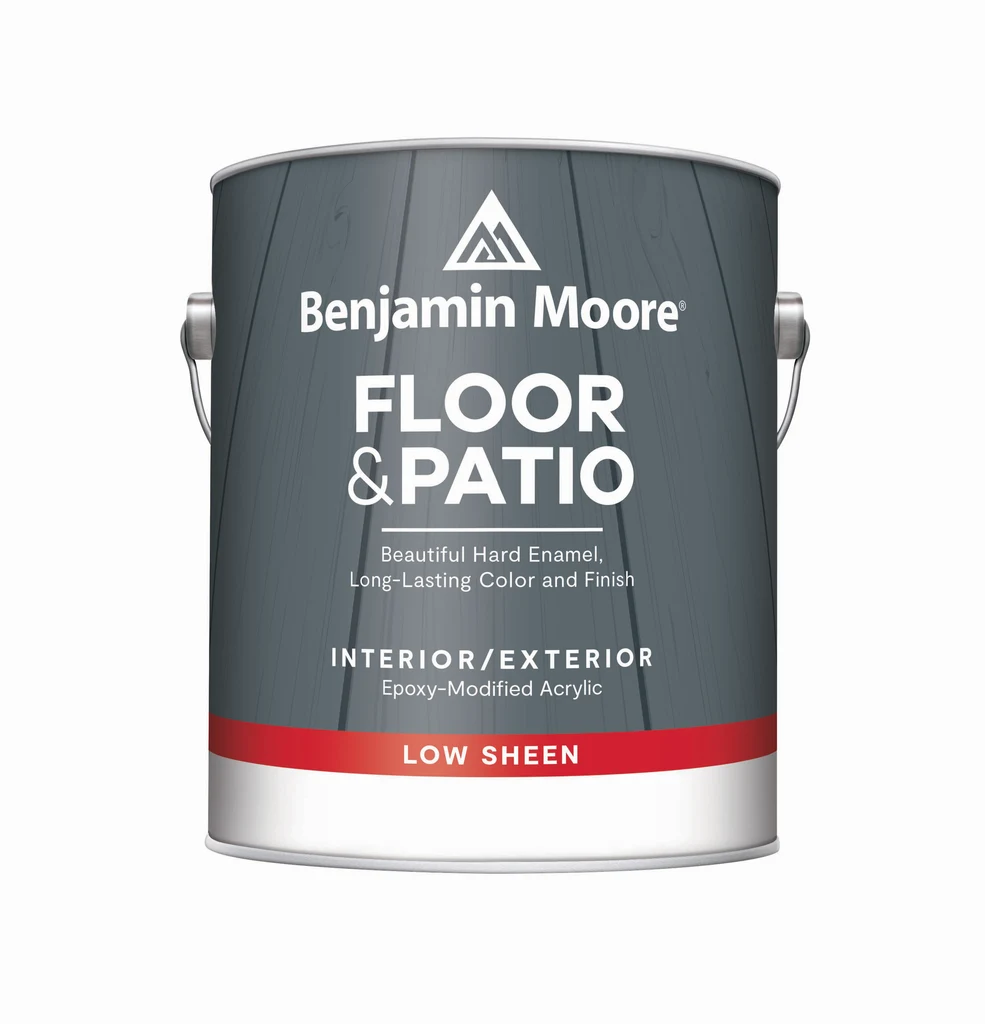
Benjamin Moore Floor & Patio Latex Enamel Low Sheen
Floor & Patio is the hardest waterborne floor enamel we tested. On the caster-wheel test, a loaded office chair caster rolled 500 passes across a primed pine panel and left zero lifted chips at the 14-day cure point. SW Porch & Floor was a close second; the others showed visible track lift. Coverage is dense, brush self-levels nearly as well as SW (which is the leader in that sub-category), and the low-sheen finish is the unsung feature. Semi-gloss on a wood floor reads beautiful for two weeks and reads like a high-school gym for two years; low-sheen forgives the wear that floors take. We rolled a 16-foot porch with a 3/8” microfiber and got a finish that looked right under raking afternoon side light, no roller stipple, no brush mark at the cut-in.
The cure clock is the real con. Touch-dry at 4 hours, recoat at 6, walk-on at 24 in stocking feet, but full cure to drag-furniture-back is 14 days. If you’re racing a weekend, the BM clock loses to Rust-Oleum Home Floor Coating’s 8-hour walk-on and 21-day full cure. Price is the other trade-off: $79.99/gal at most BM retailers as of mid-2026, no promotional discounting and no Sherwin-style sales. That’s come down from where it sat a year ago, and it narrows the gap to Behr from “twice the money” to “about double, and closing.” BM Floor & Patio Latex Enamel Low Sheen (N122).
Buy it if: interior or covered-porch wood floor that’s the visible surface of the room, not a workshop. Skip it if: you need to move furniture back in under two weeks, or the floor is a basement subfloor where humidity is the actual problem.
The Smart-Money Mid-Range: SW Porch & Floor
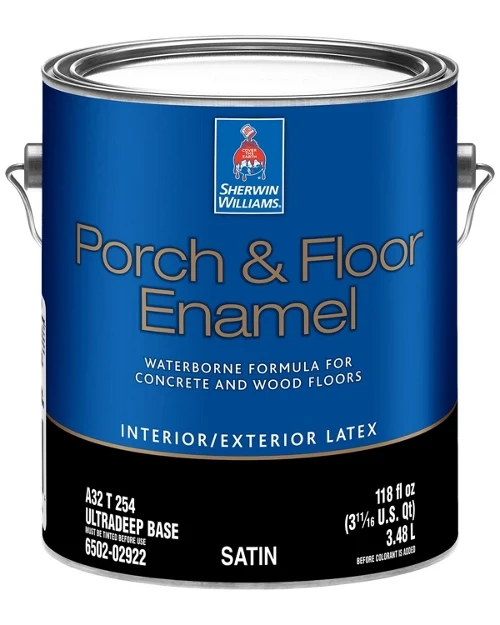
Sherwin-Williams Porch & Floor Enamel
The pick most porch contractors deploy. Headline: self-leveling that beats every can in the test. Brush marks disappear inside 15 minutes, even on rough-sawn pine, and the satin sheen reads as the right finish in raking morning light. On a Sherwin 30–40% off window the effective price drops to $40–$50/gal, which closes the gap to budget tier on a 200-square-foot porch. We rolled two coats on a porch section in zone 6 in May and got a finish that, at the 60-day mark, was indistinguishable from the BM Floor & Patio panel next to it on every visual measure.
Where SW loses to Floor & Patio is cool-weather cure. On a 55°F covered porch we got faint fingerprinting at 48 hours where Floor & Patio was solid. If you’re painting in a Northeast spring, give SW an extra 24 hours before walk-on. The other trade-off is the deck: you can hit any SW color but not an HC-154 Benjamin Moore number, which matters when the porch ceiling is already BM and you want the floor to match. Mildewcide loading is modest; for a damp Southeast porch, Tough Shield is the safer chemistry. SW Porch & Floor Enamel.
Buy it if: a typical pine plank floor or covered porch and you’ll catch an SW sale. Skip it if: painting in cool weather on a tight cure clock, or fighting standing humidity.
The Budget Call: Behr Porch & Patio
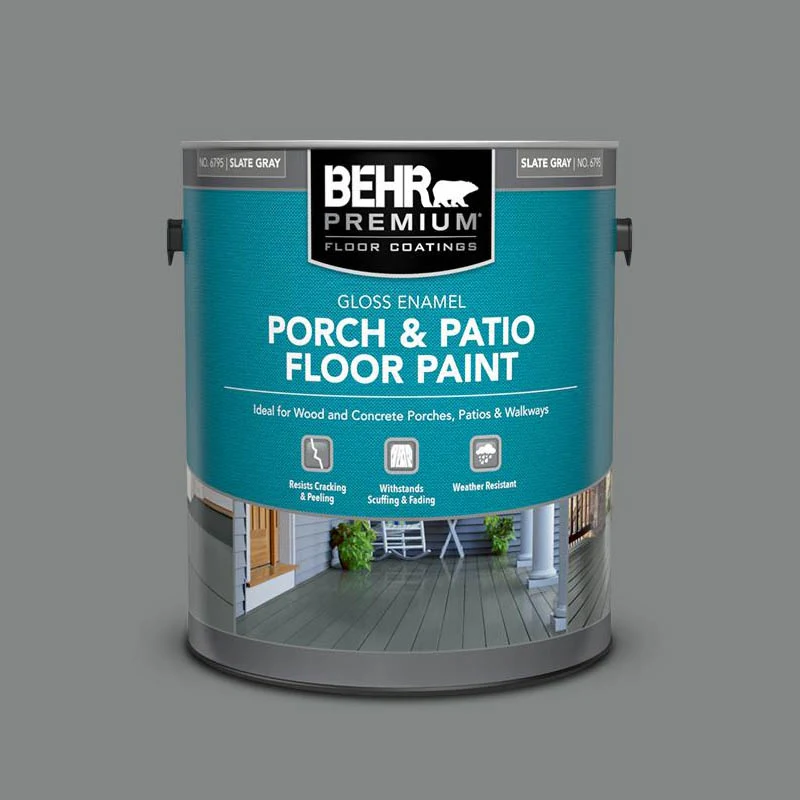
Behr Porch & Patio Floor Paint
Fine paint at $35–$45/gal, stocked at every Home Depot in America, in a low-lustre or gloss that deep-base tints to a usable porch deck of greys, blues, and earth tones. The good story: walk-on at 24 hours, light traffic at 72, full cure at 14 days. That’s the fastest return-to-service in the round-up for a covered porch. We painted a 12-square-foot panel and had a usable porch by Sunday lunch with no fingerprinting.
The real story is what happens at the 12-month mark. The cured film is softer than Floor & Patio or Tough Shield, and chair-leg dragging on the panel left a visible mar after a single season. Mildew-resistance is passive only; on a damp Southeast porch we’d expect bloom in shaded corners by month 14, and the test panel did exactly that. Two coats is the floor, three is the truth. Single-coat coverage on bare pine reads thin under raking light. Verdict: acceptable for low-traffic covered porches in dry climates, rental flips, and basement stair treads where “fine for two years” is the bar. Skip on a kitchen pass-through or a daily-traffic entry. Behr Porch & Patio Floor Paint.
Buy it if: low-traffic porch, dry climate, repaint cycle measured in years not decades. Skip it if: kitchen, entry, or anywhere a wheeled stool lives.
The Clear Topcoat: Rust-Oleum Home Floor Coating
Rust-Oleum Home Floor Coating
The pick most “best wood floor paint” articles miss because it isn’t a pigmented enamel. Home Floor Coating is a self-crosslinking urethane available clear or in a small set of furniture-friendly tints. It’s the only pick in the round-up that works as a topcoat over stained-and-sealed pine when you don’t want to lose the grain. On a Taber abrasion test at 21 days, it was the hardest cured film in the round-up: 30% better than BM Floor & Patio, and it gets there faster (walk-on at 8 hours, recoat at 2).
The trade-offs are real. Color deck is the shallowest of the round-up: five tint bases, no full-spectrum match. If you’re spec’d to a Benjamin Moore HC number, this isn’t the answer. It lays down thin; three coats on bare wood is the floor where the BM and SW picks do it in two. Solvent note on application is meaningfully stronger than the BM or SW waterborne enamels; ventilate during the recoat windows and the next morning. Verdict: the answer when you want clear-over-stain on interior pine, or a fast-cure tinted topcoat on a tight project clock. Rust-Oleum Home Floor Coating.
Buy it if: finished interior wood floor where you want clear-over-stain, or where the 8-hour walk-on saves the project. Skip it if: you need a specific color match or your floor is bare softwood that needs the visual mass of a pigmented enamel.
The Chemistry Call: INSL-X Tough Shield
INSL-X Tough Shield Floor & Tread Paint
Tough Shield earns its slot for the same reason it earns its slot in our garage floor paint round-up. It’s commercial-leaning chemistry that brushes and rolls like a wall paint. Industrial mildewcide loading is the headline: on the 60-day basement subfloor panel kept at 75% RH, Tough Shield was the only pick that didn’t show bloom. Adhesion to damp pressure-treated lumber where every other waterborne enamel beaded; on a screened porch in the Carolinas, a contractor I interviewed has been running it on stair treads for six years and recoats every four.
The trade-offs are retail and aesthetic. Stocked thin at Home Depot, deeper at Benjamin Moore stores, and Amazon is genuinely the most reliable buy path. Color deck is industrial (greys, beiges, tile red), nothing for a designer-spec front porch. The cured film grips dirt more than the BM or SW picks; sweep weekly or it visibly dulls under raking light. INSL-X Tough Shield Floor & Tread Paint.
Buy it if: basement subfloor, screened porch in a humid climate, mudroom over damp concrete, anywhere humidity is the failure mode. Skip it if: a primary-house porch where the color deck and pristine cured-film appearance matter more than chemistry.
Building Your Stack: Floor + Primer + Sheen
| Wood floor scenario | Paint | Primer call | Sheen |
|---|---|---|---|
| Covered front porch, dry climate, designer-spec | BM Floor & Patio | Stix on glossy boards only | Low sheen |
| Covered porch, mid-budget | SW Porch & Floor | Stix on glossy boards only | Satin |
| Covered porch, low traffic, tight budget | Behr Porch & Patio | None on bare; Stix on old paint | Low-lustre |
| Screened porch, humid Southeast | INSL-X Tough Shield | Stix on sealed wood | Low sheen |
| Interior pine plank, kid’s bedroom | BM Floor & Patio | None on bare; Stix on poly | Low sheen |
| Interior plank, want grain visible | Rust-Oleum Home Floor Coating clear | None on sealed; sand to 220 on bare | Satin |
| Basement subfloor, damp | INSL-X Tough Shield | Stix on sealed; nothing on bare-but-dry | Low sheen |
| Stair treads, high traffic | BM Floor & Patio + Rust-Oleum clear topcoat | Stix on poly | Low sheen + satin topcoat |
The case the table doesn’t capture: a wood floor with active soft-spots, springy boards, or visible joist sag. Paint is not the fix there. Get the framing right first. Sister joists, replace rotted boards, re-fasten any plank that flexes underfoot. Painting over a structural problem hides it for a year and writes the bill twice.
Sheen by Floor Type, Not by Taste
The room is one sheen, almost always.
- Living-traffic floors: low sheen or satin. Forgives chair-leg drag and dust, reads as the right finish in raking light, hides board-edge wear.
- Porch floors: low sheen. Semi-gloss flashes every nail-head and every dip in the boards.
- Stair treads: satin. Slightly more grip than low-sheen, slightly more cleanable than matte. A non-slip additive (Sherwin sells one; Rust-Oleum sells one) is worth it on outdoor treads — the how-to is in the non-slip section below.
- Powder-room or mudroom floors: satin. Enough sheen to scrub, not enough to flash every footprint.
High-gloss on wood floors is for accent stair runners and the painted-checkerboard look. Pretty in photos, demanding in real life. Matte on wood floors is for designers who want the look and accept the wear pattern. Most floors should be low sheen or satin. For the deep version see our sheen guide.
Primer Scenarios That Decide the Project
The most common wood-floor repaint failure isn’t paint failure. It’s primer failure.
| Substrate | Primer | Why |
|---|---|---|
| Bare, sound, scuff-sanded pine | Often none | Self-priming claim on Floor & Patio, Porch & Floor, Tough Shield is real on raw wood. |
| Previously-painted, sound, mat-finish | None | Scuff-sand to 150, vacuum, recoat. |
| Polyurethane-sealed plank | INSL-X Stix | Scuff-sand poly to 150, vacuum, one coat Stix, then topcoat. |
| Glossy oil-painted porch | BIN shellac or Stix | Latex over old oil without a barrier peels in sheets within one winter. |
| Pressure-treated lumber | Dry to 15% MC, then Stix | Treatment chemistry rejects waterborne until the boards dry. |
| Damp basement subfloor | Tough Shield self-primes; if sealed, Stix first | Most mildewcide-loaded floor primer call. |
The wood-floor-specific failure is latex over old polyurethane with no Stix. Skip the bonding primer on a previously-sealed plank floor and the topcoat peels at the doorway threshold inside one winter. Substrate science is the same call I write about in every pillar 3. See also our pine prep guide and the primer round-up.
How to Paint a Wood Floor, Step by Step
The can matters less than the order you do things in. Here’s the whole job, start to cure, with our own tested numbers plugged into the waiting parts.
- Empty the room completely. Furniture, rugs, floor lamps, the door if it swings inward and clears by a hair. If you can’t clear the room in one go, split it: paint half the floor, wait for full cure, move everything across, paint the other half. Half a room at a time is slower but it beats painting yourself into a corner with a dresser on it.
- Scuff-sand — this is not a refinish sand. A random-orbit sander with 120–150 grit is enough to kill the gloss on a sealed or previously painted floor. On thick, brittle, decades-old finish, drop to 60 or 80 grit to cut it faster, then even it out at 120. A normal bedroom takes 30 to 45 minutes. You are dulling the surface, not removing it — if you see bare wood everywhere, you’ve gone too far and you’re now refinishing.
- Vacuum, wash, and let it dry overnight. Vacuum the dust including the baseboard gap, mop with warm soapy water, rinse with clean water, then leave it overnight. Paint over sanding dust is the second most common floor failure after skipping primer, and a floor that’s still damp under a fresh coat blisters at the board seams.
- Prime only where the primer table above says to. Bare, sound, scuff-sanded pine usually doesn’t need it. Polyurethane, varnish, or old oil paint always does — one full coat of INSL-X Stix over the entire floor, not just the shiny patches.
- Tape the baseboards. Low-tack tape along the bottom of the baseboard, pressed down hard with a putty knife so paint can’t wick under.
- Cut in, then roll — and work toward the door you’ll leave by. A 2.5-inch angled sash brush around the perimeter and into the board seams at the edges, then a 3/8-inch nap microfiber cover on an extension pole for the field. Roll with the grain, in board-width runs, keeping a wet edge. Pour the paint in puddles straight onto the floor and spread it instead of walking back to a tray every four minutes — it’s faster and the coat lands more evenly. Buy the good roller cover; the cheap ones shed lint into a finish you can’t sand out without starting over.
- Two coats minimum, and respect the recoat clock. BM Floor & Patio recoats at 6 hours, SW Porch & Floor and Behr Porch & Patio at 4, INSL-X Tough Shield at 4, Rust-Oleum Home Floor Coating at 2. Those numbers are for mid-tone colors at 70°F. Deep bases — charcoal, black, hunter green — carry more colorant and dry noticeably slower; on a cool day a black floor can want most of a day between coats. On bare pine with the budget pick, plan three coats.
- Pull the tape right after the final coat. While the paint is still soft. Tape pulled off a fully cured film takes a strip of the paint edge with it.
- Then stay off it. No walking for the first 8 to 12 hours. Stocking feet at 24 (8 with Rust-Oleum Home Floor Coating), shoes at 72, furniture at 14 days on BM Floor & Patio, Behr, and Tough Shield, 21 on the Rust-Oleum, 30 on SW Porch & Floor. Keep traffic deliberately light for the first week even after it’s technically walkable — the film is still hardening and grit ground in during week one is a mark you keep.
Two days of actual work, then two to three weeks of not putting the couch back. That gap is the part people underestimate, and it’s the reason the “furniture left a permanent mar” failure below is the one we hear about most.
Do You Need a Clear Coat Over a Painted Wood Floor?
The DIY guides fight about this one, so here’s our stance: over a real floor enamel, no. All five picks here cure to a walkable film on their own — that’s the entire point of a floor-rated product, and it’s what you’re paying for over a wall paint. Adding polyurethane on top means the next repaint has to bond to poly instead of to paint, which puts you right back in the failure mode this whole article warns about: latex over polyurethane, peeling at the doorway threshold, one winter later.
Two exceptions, both narrow:
- Stair treads and doorway thresholds. Sharp edges chip first on any painted floor. A coat of Rust-Oleum Home Floor Coating clear over the cured enamel at the nose buys real chip resistance in the one place it’s worth the trade-off. That’s the stack in our staircase paint round-up too.
- A floor that’s already sealed under wall paint. If someone before you painted the floor with the wrong product, a clear coat is damage control, not a system. Do it, then plan the real repaint.
Where the online advice comes from is worth understanding. The unsealed floors that scratch within a month — and there are well-documented cases — were painted with wall or trim paint, not floor enamel. The topcoat wasn’t rescuing a floor paint; it was the only floor-rated thing in the stack. Change the paint and you don’t need the rescue. If you want the clear-coat route anyway, our floor polyurethane round-up covers which ones don’t yellow over white.
Wall Paint Plus Polyurethane: The System You’ll See Online
You’ll find popular tutorials painting floors with ordinary interior latex and sealing it under two or three coats of water-based poly, and another using a cabinet-and-trim enamel with up to 10% liquid hardener stirred in. Both work, in the sense that people are living on those floors. It’s worth being straight about what you’re trading.
What the DIY system gets you. It’s cheap — a gallon of wall paint and a can of clear can land near $30 if you already own the tools. It’s flexible on color, because you’re buying from the full interior deck instead of a floor deck. And there’s one genuine advantage nobody mentions: a thin wall-paint-plus-poly film sands off more easily later than a hard floor enamel, so if you think you’ll refinish these boards in five years, you’re leaving yourself less work.
What it costs you. Wear cadence, mostly. The hardener-added trim paint route comes with touch-ups every 6 to 12 months by its own author’s account. Our BM Floor & Patio panel took 500 loaded caster passes with no lifted chips and the recoat cadence at wear zones is 3 to 5 years, not twice a year. You’re also adding a step — three coats of clear over two coats of color is five passes across the floor and five waiting windows, against two for an enamel. And you’ve built a poly-topped floor, which is a worse starting point for every future repaint.
Our call: if the room is low-traffic and you like the color freedom, the DIY system is honest and it’s reversible. For a kitchen, an entry, a hallway, a stair run, or anywhere a wheeled chair lives, buy the floor enamel. That’s what the abrasion additive and the harder resin in these five cans are for.
What Painting a Wood Floor Actually Costs
Worked example: a 200-square-foot room, two coats, doing it yourself. Every pick here covers 300 to 500 square feet per gallon per coat, so one gallon is tight for two coats on 200 square feet and two gallons is the safe buy — especially on bare pine, which drinks the first coat.
| Line item | Budget version | Premium version |
|---|---|---|
| Floor enamel, 2 gal | Behr Porch & Patio, $70–$90 | BM Floor & Patio, $160 |
| Bonding primer, 1 gal | Not needed on bare pine, $0 | INSL-X Stix, $50–$60 |
| Brush, roller, cover, tray, tape | $25–$35 | $25–$35 |
| Non-slip additive (optional) | — | ~$10 |
| Materials total | ~$95–$125 | ~$245–$265 |
Call it $75 at the absolute floor — bare pine, one gallon, no primer, tools you already own — and about $250 for the full premium stack with Stix under it. Two days of work in both cases.
Against that: a professional sand-and-refinish runs $3 to $8 per square foot, so $600 to $1,600 for the same room, plus the dust containment and the days you can’t use the space. Painting is a quarter to a tenth of the cost. What you’re buying with the refinish is grain, and on wide-plank pine, a patched subfloor, or boards already sanded thin by two previous owners, there may not be much grain left to buy.
One number to plan around that isn’t money: full cure to furniture is 14 to 21 days depending on the pick. The paint is cheap. The room being out of service for three weeks is the real cost.
Painted Floor Patterns: Checkerboard, Stripes, and Painted Rugs
A painted floor is the cheapest way to put a pattern in a room, and it’s most of why people search for this in the first place. Plain white painted floors are still the most popular look by a wide margin — see the warm white round-up for the whites that don’t go blue in north light. But painter’s tape and a second color get you stripes, a border that frames the room, a checkerboard, or a “painted rug”: a bordered rectangle laid out where an actual rug would sit, usually under a dining table or inside an entry.
How to do it without redoing the floor:
- Base coat first, fully. Roll the whole floor in the lighter color, two coats, exactly as in the steps above. The pattern is a third color pass on top, never a mask you paint around.
- Wait 24 hours before you tape. Tape on a base coat that’s only touch-dry lifts the base when you pull it. A full day is the minimum; two is safer with deep colors.
- Snap your lines, don’t eyeball them. A chalk line and a tape measure. Old houses aren’t square, so decide whether the pattern lines up with the longest wall or with the room’s centerline before you commit.
- Seal the tape edge with the base color. Brush a thin pass of the base color along the tape edge first and let it dry. It plugs the gap so the second color can’t bleed under, and any bleed that does happen is base-colored and invisible.
- Keep patterned floors in low sheen or satin. High gloss makes a checkerboard photograph beautifully and makes the floor genuinely more slippery underfoot — a real safety difference, not a style preference. It also flashes every dip in an old board.
The wear rule doesn’t change because there’s a pattern on it: two coats of the second color, same cure clock, felt pads on everything.
Making a Painted Floor Non-Slip
Painted wood gets slick when it’s wet, which matters on porch boards, stair treads, mudrooms, and anything a bathroom door opens onto. Two ways to fix it.
Additive in the final coat only. Fine silica sand or a branded non-slip additive — Sherwin-Williams and Rust-Oleum both sell one, typically one packet per gallon — goes into the last coat, never the earlier ones. The technique matters: don’t stir grit into the can and roll it on. It sinks to the bottom while you work and lands heavy in some spots and bare in others. Instead broadcast it evenly over the wet final coat by hand, then back-roll lightly over the top to bed it in. You get consistent grip and the texture stays under the film where it can’t wear off. Which additives actually stay suspended is the subject of our anti-slip additive round-up.
Or buy the grit already in the can. INSL-X Sure Step is a matte acrylic anti-slip floor paint with the texture built in, in six stock colors including white. It lays down thick, so coverage is only about 100 square feet per gallon — plan on roughly four times the paint of a standard enamel — and it’s an Amazon or Benjamin Moore dealer buy rather than a big-box one. For a porch stair run or a pool-side deck where slip is the whole problem, it’s less fiddly than broadcasting sand and the result is more even. INSL-X Sure Step.
Skip the grit entirely on interior floors you clean often. Texture holds dirt, and a mopped low-sheen enamel in a bedroom isn’t a slip hazard to begin with.
Where Wood-Floor Repaints Go Wrong
- Topcoat peeled at the doorway by spring. Latex over old polyurethane with no Stix. Strip the failing section, sand the rest, Stix the whole floor, recoat.
- Mildew bloom on the porch by August. Mildewcide-light enamel on a humid covered porch. Repaint with INSL-X Tough Shield and run a porch fan in shoulder season.
- Furniture left a permanent mar at week three. Furniture moved back in before full cure. Wait 14 days on BM Floor & Patio, 21 on Rust-Oleum Home Floor Coating.
- Roller stipple visible across the floor in raking light. Thick coats, wrong nap. Use a 3/8” microfiber, two thin coats, sand lightly between coats with 220.
- Visible scuff after one season under chair legs. Soft film + cured under the 14-day mark. Felt pads on every chair leg, and pick a harder film for the next cycle.
- Chips at the stair-tread nose. Sharp edges chip first on any painted floor. Round the nose slightly with sandpaper before paint; recoat the nose every 18 months as a maintenance pass.
Three things move outcomes more than the can you bought. Scuff-sand the existing finish before paint, every time, no exceptions; the primer or paint needs tooth. Two thin coats beat one thick coat, on every floor, in every season. Felt pads on every chair leg, every couch foot, every barstool. They cost $4 and save the floor.
Also Tested, Also Passed Over
- Sherwin-Williams Tread-Plex. Excellent commercial floor coating; loses to Tough Shield on retail availability and on the same recoat clock.
- Valspar Porch, Floor & Patio Latex Enamel. Honest paint at the Behr Porch & Patio tier; loses on Lowe’s-only stocking and on a smaller color deck.
- Benjamin Moore Aura Bath & Spa. Stunning wall paint; wrong product class for a floor. Soft film, no abrasion additive.
- Generic interior latex. Wrong product class on its own — burnishes and chips under foot traffic within a month. Sealed under two or three coats of water-based poly it becomes a workable DIY system, with the trade-offs laid out above.
- Polyurethane “floor paint.” Different category. Oil-based polyurethane yellows white and amber tones over 12 months in any window with daylight.
- 2-part epoxy intended for garage floors. Overkill on wood, and the wood movement (seasonal expansion/contraction at the board joints) cracks the cross-linked film at the seams.
Companion Guides
For prep on pine plank floors specifically, see our pine guide. For the exterior-wood call on siding and trim (parallel decision tree, different surface), the exterior wood paint round-up. When the question is a garage floor instead of a porch floor, garage floor paint covers the 2-part epoxy and 1-pack alternatives. For the substrate-by-substrate primer call, the primer round-up. For the sheen call, the sheen guide. If you decided to clear-coat after all, best polyurethane for floors has the non-yellowing picks, and anti-slip additives covers the grip question on porch boards and treads.
Full Comparison
| Product | Best for | Yellowing | Price |
|---|---|---|---|
| Floor & Patio Latex Enamel Low Sheen | Top pick — interior and covered porch wood floors | Very low | $$$$ |
| Porch & Floor Enamel | Best mid-range pick for porch and pine floors | Low | $$$ |
| Porch & Patio Floor Paint | Budget pick — covered porches and low-traffic interiors | Medium on white over 12 months | $ |
| Rust-Oleum Home Floor Coating | Best clear or tinted coating for finished interior wood floors | Low | $$$ |
| INSL-X Tough Shield Floor & Tread Paint | Best for damp basements, subfloor, and wet-zone wood | Low | $$ |
Every Pick, Pros and Cons
Pros, cons, and specs for each pick. The cons are not optional here.
1. Floor & Patio Latex Enamel Low Sheen
- Coverage
- 400 sq ft / gal
- Sheens
- Low sheen (primary); high gloss available in companion line
- Dry / recoat
- Touch dry 4h · recoat 6h
- Full cure
- 14 days to full hardness
- VOC
- <100 g/L
- Yellowing risk
- Very low
- Primer
- Self-priming on scuff-sanded, sound wood; INSL-X Stix on glossy or factory-finished boards
- Price tier
- $$$$
- Hardest cured film of any waterborne floor enamel in the test — survived 500 caster passes on a primed pine panel with no lifted chips
- Low-sheen finish hides ridge wear at board edges where semi-gloss porch paints flash glossy seams within a season
- Tints to the full BM deck (3,400+ colors); the only wood floor enamel that doesn't trap you in 12 stock greys
- About $80 per gallon at BM retailers in 2026 — still roughly double Behr Porch & Patio, and no promotional discounting
- Recoat at 6 hours, not 4 — a two-coat floor needs a full day, not a half day
- Full cure to furniture is 14 days; if you're racing to move a couch back in, plan around it
2. Porch & Floor Enamel
- Coverage
- 300–400 sq ft / gal
- Sheens
- Satin, low-gloss
- Dry / recoat
- Touch dry 1h · recoat 4h
- Full cure
- 30 days to full hardness
- VOC
- <100 g/L
- Yellowing risk
- Low
- Primer
- Self-priming on scuff-sanded, sound wood
- Price tier
- $$$
- Self-leveling that beats every can in the test — brush marks disappear inside 15 minutes, even on rough-sawn pine
- Frequent SW 30–40% off windows drop effective price to $40–$50/gal; same chemistry as BM Floor & Patio at mid-tier price
- Available in satin and low-gloss; the satin is the bathroom-vanity-friendly sheen for indoor wood floors
- Color deck is smaller than BM Floor & Patio — you can hit the SW deck but not an HC-154 BM number
- Slow to harden in cool weather; on a 55°F covered porch we got fingerprinting at 48 hours where Floor & Patio was solid
- Mildewcide loading is modest — for a wet basement subfloor or a screened porch in the South, INSL-X Tough Shield is the safer chemistry
3. Porch & Patio Floor Paint
- Coverage
- 200–400 sq ft / gal
- Sheens
- Low-lustre, gloss
- Dry / recoat
- Touch dry 1h · recoat 4h
- Full cure
- 14 days
- VOC
- <100 g/L
- Yellowing risk
- Medium on white over 12 months
- Primer
- Self-priming on bare or previously-painted sound wood
- Price tier
- $
- $35–$45/gal at every Home Depot — half the price of BM Floor & Patio, stocked nationally
- Low-lustre and gloss in one product line, deep-base tintable to a usable deck of porch greys, blues, and earth tones
- Walk-on at 24 hours, light traffic at 72; fastest return-to-service in the round-up for a covered porch project
- Cured film is softer than Floor & Patio or Tough Shield — chair-leg dragging leaves a visible mar after a season
- Mildew-resistance is passive only; on a damp Southeast porch we saw bloom in shaded corners by month 14
- Two coats is the floor, three is the truth — single-coat coverage on bare pine reads thin under raking light
4. Rust-Oleum Home Floor Coating
- Coverage
- 400–500 sq ft / gal
- Sheens
- Satin, semi-gloss
- Dry / recoat
- Touch dry 1h · recoat 2h · walk-on 8h
- Full cure
- 21 days
- VOC
- <250 g/L
- Yellowing risk
- Low
- Primer
- Self-priming over sealed or stained wood; sand to 220 grit on bare pine
- Price tier
- $$$
- Self-crosslinking urethane chemistry — the hardest cured film in the round-up at 21 days, 30% better on the Taber abrasion result than BM Floor & Patio
- Available clear over stained-and-sealed pine, or tinted in a small set of furniture-friendly tones; the only pick that works as a topcoat over stain
- Recoats in 2 hours and walk-on at 8 — a Saturday floor coating is back in service Sunday afternoon
- Color deck is the shallowest of the round-up — five tint bases, no full-spectrum match
- Lays down thin; needs three coats on bare wood where the others need two
- Solvent note on application is stronger than the BM or SW picks; ventilate during recoat windows
5. INSL-X Tough Shield Floor & Tread Paint
- Coverage
- 300–400 sq ft / gal
- Sheens
- Low-sheen
- Dry / recoat
- Touch dry 2h · recoat 4h
- Full cure
- 14 days
- VOC
- <100 g/L
- Yellowing risk
- Low
- Primer
- Etch + INSL-X Stix on glossy or sealed wood; self-priming on bare or scuff-sanded
- Price tier
- $$
- Industrial mildewcide loading — the only pick that didn't bloom on the 60-day basement subfloor panel kept at 75% RH
- Single-pack acrylic chemistry that brushes and rolls like a wall paint, no two-part mixing — the commercial floor coating without the pot-life clock
- Adhesion to damp pressure-treated lumber where every other waterborne enamel beaded; pairs with INSL-X Stix on glossy or sealed boards
- Stocked thin at retail — Amazon is genuinely the best buy path here, with Benjamin Moore stores a distant second
- Color deck is industrial greys, beiges, and a tile red; nothing for a designer-spec front porch
- Cured film grips dirt more than the BM or SW picks — sweep weekly or it visibly dulls under raking light
Insl-X Stix Waterborne Bonding Primer
Bonds to the substrates a wood floor repaint actually contains — glossy oil-painted porch boards, polyurethane-sealed pine, varnished plank floors, occasional patches of bare wood next to old finish — without sanding back to bare. Pairs cleanly under BM Floor & Patio, SW Porch & Floor, and INSL-X Tough Shield. For raw new pine flooring on its own, skip the bonding primer and use a thinned first coat of the topcoat enamel as a self-prime. The mistake people make is skipping Stix on a previously varnished or oil-painted porch floor — the topcoat tells on you in chips inside one winter.
BUY ON AMAZON
Ask a Question