Best Spackle and Patching Compounds
Five spackles and patching compounds tested on 80 nail holes, eight screw pops, a hairline crack, and an exterior trim gouge. Top pick: DAP DryDex.

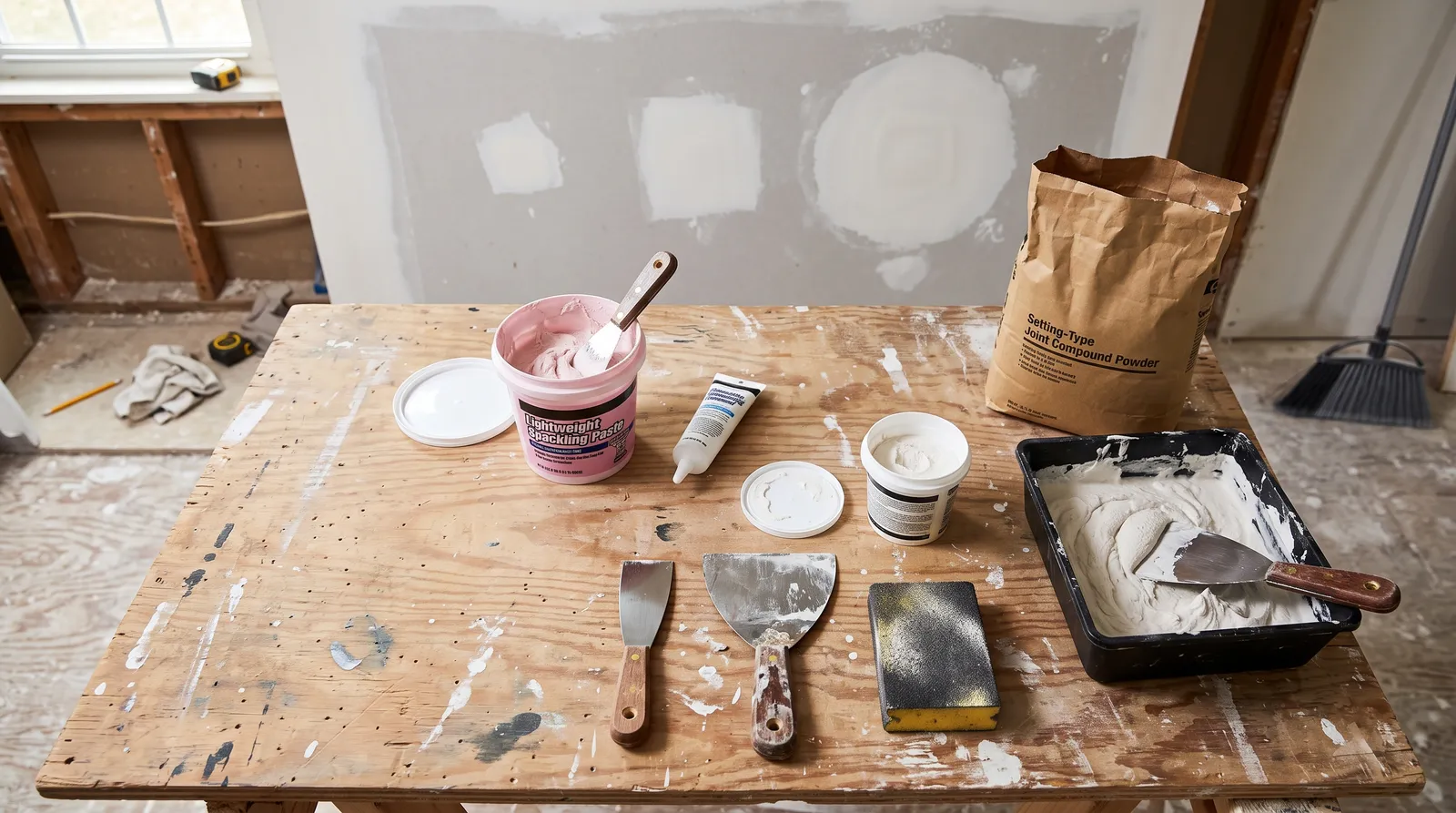
Goes on pink, dries white. On 80 holes across two rooms I sanded in the order I filled and never hit a wet one, which is worth more than it sounds
Primer is mixed into the fill, so a sanded patch takes one coat of wall paint without a flash spot under raking light
Cures by chemical reaction at 20 minutes, so humidity and fill depth stop mattering; nothing else in this round-up can say that
The no-shrink claim holds at the depths it is sold for. My 3/8-inch test holes came back flat the next morning with one fill
Rated for exterior service and rain-ready once cured at 24 hours, which no interior spackle in this round-up survives
Disclosure: Some links below are affiliate links. We earn a commission if you buy through them, at no extra cost to you. Picks are based on the criteria in “How I Picked”. No brand pays for placement.
Top pick: DAP DryDex. Eight to ten dollars for a 16-ounce tub, sold in every hardware store in the country, and the pink-to-white dry indicator turns a wall of 80 nail holes into a job you can sand in the order you filled it. DryDex wins on speed, availability, and sanding feel. It falls short on depth, dishing at 1/2 inch and needing a second pass. For screw pops, cracks, and real holes, USG Sheetrock Easy Sand 20 is the smarter pick because it sets chemically instead of drying. 3M Patch Plus Primer skips the spot-prime step. Red Devil Onetime holds a crack closed through a winter. DAP Weatherproof Patching Compound is the only one here that belongs outside.
Spackle Is a Depth Rating Wearing a Brand Name
Every tub on the shelf says “patches holes and cracks.” What separates them is how deep a hole they fill before the fill dishes at the center, and whether the repair moves with the wall or fights it.
Three failure depths, three chemistries.
Under 3/8 inch. Nail holes, anchor holes, drywall scuffs, the ding from a doorknob. Lightweight vinyl spackle owns this. It weighs almost nothing, sands in half an hour, and comes flush in one pass. DAP DryDex, 3M Patch Plus Primer, Red Devil Onetime all live here.
3/8 inch to a fist. Screw pops, gouges, the crater left when a heavy anchor pulls through. Air-dry spackle shrinks as the water leaves, so the fill sinks and reopens the rim. Setting-type joint compound cures by chemical reaction instead, which is why USG Easy Sand 20 is in this round-up and why it is the pick most “best spackle” lists skip entirely.
Anything outdoors. Different problem. UV, freeze-thaw, and standing water tear apart an interior vinyl fill inside one season. DAP Weatherproof Patching Compound is the exterior answer.
The mistake I see most: someone buys one tub of lightweight spackle and uses it for all three. The nail holes look great. The screw pop reopens by Thanksgiving. The soffit fill crumbles by April.
How I Picked
Five products, four surfaces, one 1962 ranch mid-renovation. Eighty nail and anchor holes left by a gallery wall, a kitchen wall with eight screw pops that had already been filled once and reopened, a plaster-over-drywall hallway with two winter cracks, and a fiber-cement trim board with a 1/2-inch gouge. Every fill struck flush with a 1.5-inch flexible knife, left for the label dry time, sanded, then half of each panel spot-primed with Zinsser Bulls Eye 1-2-3 and the whole wall rolled with two coats of the same Behr Premium Plus eggshell. Depth measured with a straightedge and feeler gauge at 12 hours and 7 days to catch dishing. Tracked 14 months through one heating season. Pick-specific findings sit in each review below.
The Five Picks Side by Side
| Product | Best for | One-pass depth | Ready to sand | Price |
|---|---|---|---|---|
| DAP DryDex | Nail holes, punch lists | 🟡 To 3/8 in. | 30–45 min | $ |
| 3M Patch Plus Primer | Paint-the-same-hour repairs | 🟡 To 3/8 in. | 30 min | $$ |
| USG Easy Sand 20 | Screw pops, cracks, patches | 🟢 1/2 in. and deeper | 20 min set | $ |
| Red Devil Onetime | Crack-prone walls | 🟢 To 1/2 in. | ~60 min | $$ |
| DAP Weatherproof | Exterior trim and siding | 🟢 To 1/2 in. | 2–4 h | $$ |
Read that table as five different jobs, not a ranked ladder. Only the first two compete head to head.
DAP DryDex, Top Pick
The dry indicator sounds like packaging gimmickry until you are 40 holes into a wall. DryDex goes on a soft coral pink and turns white as the water leaves. I filled the gallery wall left to right, went back for coffee, and by the time I came up the ladder the first column had gone white while the last one was still pink. I sanded in that order. Not one wet patch, not one gummed-up sponge, no guessing.
The sanding feel is the other reason it wins. At 35 minutes, a 220-grit sponge takes the proud edge off in two passes and leaves a rim that feathers into the wall instead of crumbling out of the hole. Cheaper store-brand lightweights tend to tear at the edge if you catch them early. DryDex tolerates being sanded a little too soon, which is what most people actually do.
Depth is where it gives up. A 1/2-inch anchor hole read flush when I struck it and measured 0.4 mm low on the feeler gauge the next morning, a visible dish under a work light held at the wall. Second pass fixed it. On the screw-pop wall, DryDex reopened at the rim on three of eight fills by month four, which is exactly the failure the setting compound exists to prevent.
Two housekeeping notes. Press a square of plastic wrap onto the surface before the lid goes on or the tub skins over in three weeks. And the pink tint can ghost through one thin coat of a cheap flat white, so either spot-prime or plan on two coats. Under eggshell and up, it disappears.
Buy it if: nail holes, anchor holes, dings, and any wall you are prepping to repaint. Skip it if: the hole is deeper than a stacked pair of quarters or the crack has come back before.
3M Patch Plus Primer, Best for Same-Hour Repairs
The pitch is primer mixed into the fill, and it does what it says. I patched two identical anchor holes a foot apart, one with DryDex and one with the 3M, sanded both, primed neither, and rolled a single coat of eggshell over the pair. At 4 p.m. with the sun coming through the window at a low angle, the DryDex patch read as a dull coin. The 3M patch did not. That is the whole product in one sentence, and it saves a real step when you are patching a rental wall an hour before the paint goes on.
Format decides the rest. The squeeze tube makes a single hole an eight-second job with nothing to open or wash, which is genuinely faster than a tub for one to ten fills. Past that it turns into a chore, and you feel every dollar of the roughly 3x per-ounce premium over tub spackle.
Two tubes have seized on me at the nozzle after sitting in a hot garage with the cap cocked. Cap discipline matters more with this one than with anything else in the round-up.
Buy it if: a handful of holes, a flat topcoat, no appetite for spot-priming. Skip it if: the punch list runs past ten holes.
USG Sheetrock Easy Sand 20, Best for Anything That Has to Hold
This is not spackle and that is the point. Easy Sand 20 is a setting-type joint compound. It cures through a chemical reaction the way plaster does, which means humidity, room temperature, and fill depth stop mattering. It sets hard at 20 minutes whether the hole is a quarter inch or an inch deep, and it does not shrink while it does it.
The screw-pop wall made the case. Eight pops on a kitchen wall, all previously filled with lightweight spackle by the last owner, all reopened. I backed each pop out, drove a new screw an inch away, and filled with Easy Sand 20 in two thin coats. Fourteen months and one heating season later, the straightedge still sits flat on all eight and nothing has telegraphed through the eggshell. The DryDex fills two rooms away have already dished at three holes.
The costs are real. You mix it, which means a mud pan, a margin trowel, and small batches, because 20 minutes is 20 minutes from water to firm-in-the-pan. USG sells 45, 90, and 210-minute versions of the same chemistry if that clock feels tight, and the 45 is the friendlier starting point for a first-timer. Sanding is harder work than spackle: 120-grit to knock down, 150 to finish, and a dust mask you actually wear. Skip the drywall sanding respirator advice at your own lungs’ expense.
Prime it. Cured setting compound is thirsty enough that it flashes under most flats and plenty of eggshells. A quick pass of Zinsser Bulls Eye 1-2-3 over the patch closes that.
Buy it if: screw pops, recurring cracks, drywall patches, any hole past 3/8 inch. Skip it if: you have four nail holes and no interest in mixing powder for them.
Red Devil Onetime, Best One-Pass Fill
Onetime sits between the lightweights and the setting compound. It is a vinyl paste with a more flexible cured film than DryDex, and the no-shrink claim survives contact with a feeler gauge. My 3/8-inch test holes measured flush at 12 hours and flush again at 7 days with a single fill. DryDex needed two passes at the same depth.
The hallway cracks are the better story. Two hairline cracks in the same plaster-over-drywall wall, six feet apart, one filled with DryDex and one with Onetime, both sanded and painted the same afternoon. By February the DryDex line had hairlined back open along about two inches. The Onetime fill was still closed. It flexes enough to ride out seasonal movement that a rigid fill cracks through.
Where it loses is surface hardness. The cured fill stays soft for about an hour after sanding, and a thumb press still leaves a dent. Filling a baseboard ding behind a kitchen door with Onetime is a bad trade, because the next boot scuff opens it again. It also drags on the knife more than DryDex; wipe firmly and once, not three times.
Buy it if: the wall has a history of hairline cracks, or you want one fill and no return trip. Skip it if: the repair is in a high-traffic zone, or you are pricing a 60-hole punch list.
DAP Weatherproof Patching Compound, Best for Outside
Sold as Platinum Patch on most shelves, labeled Weatherproof Patching Compound by DAP. It is the only pick here rated for exterior service, and it earns the slot by being the alternative to nothing. Interior spackle outdoors fails on a predictable schedule: fine through summer, hairlined by the first freeze, crumbling out of the hole by the next spring.
I filled a 1/2-inch gouge in a fiber-cement trim board on the shaded north side of the house, primed, and topcoated with the existing exterior acrylic. Through a wet spring the fill stayed put, stayed clean of the black algae speckle that colonizes everything on that elevation, and showed no crack at the rim at 14 months. It bonds to fiber cement, PVC trim, vinyl siding, composite, metal, brick, and wood, which is a wide enough net that one tub handles an entire exterior punch list.
Dry time is the tax. Two to four hours before sanding at moderate temperature, longer when it is cold or damp, so a same-day fill-sand-prime-paint sequence needs an early start. And keep it in perspective: this is a filler, not a structural repair. Soft, rotted wood in a door jamb wants a two-part epoxy filler and a chisel, not a tub of patching compound. Start with the exterior wood prep guide if the substrate is questionable.
Buy it if: exterior trim, siding, soffit, or any patch that will see rain. Skip it if: the wood is soft to a screwdriver probe.
Match the Repair to the Tub
| The repair | Reach for | Why |
|---|---|---|
| Picture-hook nail hole | DAP DryDex | One pass, sands in half an hour, indicator tells you when |
| 80-hole gallery wall | DAP DryDex | Tub format plus the dry indicator wins on volume |
| One anchor hole, painting today | 3M Patch Plus Primer | Primer in the fill kills the flash spot |
| Drywall screw pop | USG Easy Sand 20 | Chemical set; anything air-dry reopens by winter |
| Hairline crack, first attempt | Red Devil Onetime | Flexible fill rides out seasonal movement |
| Hairline crack that came back | USG Easy Sand 20 with tape | The tape carries the movement, the compound bridges it |
| Fist-sized drywall hole | USG Easy Sand 20 with mesh | Two skim coats, no shrink, flat under raking light |
| Brad-nail hole in painted trim | DAP DryDex | Fine at this depth; a dense vinyl paste is better if you own one |
| Gouge in exterior trim board | DAP Weatherproof | Only pick rated for UV and freeze-thaw |
| Soft, rotted exterior wood | Two-part epoxy filler | Past patching compound; see the wood filler picks |
For the tool side of these repairs, knives, sponges, and sanders, see the wall filler and spackle guide.
What It Costs, and Where It Costs Less
Prices as of July 2026, and the gap between shelf and cart is bigger in this category than in almost any other paint aisle, because you are shipping water and gypsum.
A 16 oz tub of DryDex runs about $8 to $10 in store. Amazon lists roughly the same, sometimes better in a two-pack. The 8 oz 3M Patch Plus Primer tube sits near $8 either way. Red Devil Onetime in a pint lands around $9 to $11. Those three ship fine and buying online is a wash.
USG Easy Sand 20 is the one to buy in person. An 18-lb bag is about $16 to $19 at Home Depot or Lowe’s. The same bag on Amazon regularly runs double once shipping is baked into the price, because it is 18 pounds of powder. Amazon does carry the smaller 3-lb boxes at a fair price, and if you are patching four screw pops that box is all you need. I have kept the Amazon link on the size that actually ships well and I would drive to the store for the big bag.
DAP Weatherproof at 32 oz runs $14 to $17 in store. Buy it when you buy the exterior paint, not separately.
One more piece of honest math: the cheapest house-brand lightweight tub at $4 fills a picture-hook hole exactly as well as the $9 one. You are paying up for a feature, the indicator or the primer or the flex. If none of those solve a problem you actually have, save the money.
Sand Wide, Prime Narrow
Three habits separate a patch you cannot find from a patch that shows up the first sunny afternoon.
Sand past the hole, not just the hole. Feather at least an inch of wall beyond every fill. A perfectly smooth patch with a hard edge still reads under raking light, because the eye catches the shadow line, not the color.
Dust the wall before you prime. A damp microfiber cloth, top to bottom. Sanding dust left on the wall turns the first coat of primer into a gritty film that telegraphs through two coats of finish.
Prime the fill, not the room. Setting-type compound always gets primer. Lightweight spackle gets it under thin flats and skips it under satin and semi-gloss. A quart of Zinsser Bulls Eye 1-2-3 and a 2-inch brush handles a whole house of spot repairs. If the ceiling patch is covering a stain rather than a hole, that is a different primer conversation and a shellac product; see the ceiling water stain fix.
Paint the repair out in a square, not a circle. Cut a rectangle of topcoat around the patch corner to corner and the flash line hides in the geometry instead of ringing the hole.
Six Ways a Patch Gives Itself Away
- A dull coin appears under one coat of flat. Porosity, not a bad fill. Spot-prime and recoat.
- The rim reopens in a fine circle. The spackle shrank. Refill at half depth, let it dry fully, top off, or move to setting compound.
- The screw pop is back by January. Air-dry filler on a moving fastener. Back out the screw, drive a new one an inch away, fill with Easy Sand 20.
- The crack returns in exactly the same line. No tape. Open to a V, embed tape, skim with setting compound.
- The patch feels proud under a hand. Sanded the fill and not the edge. Feather wider with 220.
- The exterior fill crumbles in spring. Interior spackle used outside. Dig it out, refill with the weatherproof compound, prime, topcoat.
The pattern behind five of those six: someone bought the tub that fits their idea of the job instead of the depth of the hole.
Also Tested, Passed Over
- DAP Fast ‘N Final. Genuinely good lightweight spackle, no-shrink claim, sands beautifully. Lost the crack slot to Onetime on movement tolerance and lost the punch-list slot to DryDex on the indicator. If it is what your store stocks, buy it without regret.
- Pre-mixed all-purpose joint compound (the big blue-lid tub). Shrinks badly on small holes and wants overnight to dry. It is a new-drywall product, not a repair product.
- Store-brand lightweight spackle. Fills a nail hole fine. Saves two dollars. Buys you no features.
- Two-part epoxy wood filler. Different category. The right call for a rotted jamb or window sill, over-engineered for a wall.
- Spray-can texture patch. Useful on orange peel and knockdown ceilings, useless as a filler. It goes on after the compound, not instead of it.
If you buy one thing off this page, make it a 16 oz tub of DAP DryDex, and if you buy two, make the second one an 18-lb bag of USG Easy Sand 20. Between them they cover every hole in a normal house for under $30, and the second one is the reason your patches are still flat next winter.
Full Comparison
| Product | Best for | Yellowing | Price |
|---|---|---|---|
| DAP DryDex Dry Time Indicator Spackling | Top pick — nail holes, dings, and the move-out punch list | n/a | $ |
| 3M Patch Plus Primer Lightweight Spackling | Best for patches you want to paint the same hour | n/a | $$ |
| USG Sheetrock Easy Sand 20 Setting-Type Joint Compound | Best for screw pops, cracks, and holes bigger than a quarter | n/a | $ |
| Red Devil Onetime Lightweight Spackling | Best single-pass fill on walls that crack every winter | n/a | $$ |
| DAP Weatherproof Patching Compound | Best for exterior trim, siding, and anything that gets rained on | n/a | $$ |
Every Pick, Pros and Cons
Pros, cons, and specs for each pick. The cons are not optional here.
1. DAP DryDex Dry Time Indicator Spackling
- Coverage
- Holes and dings up to about 3/8 inch deep in one pass
- Sheens
- n/a (substrate filler)
- Dry / recoat
- Pink to white in 30–45 min at nail-hole depth; 2 h-plus at 1/2 inch
- Full cure
- 24 h
- VOC
- Low, water cleanup
- Yellowing risk
- n/a
- Primer
- Spot-prime under thin flats; not needed under satin or semi-gloss
- Price tier
- $
- Goes on pink, dries white. On 80 holes across two rooms I sanded in the order I filled and never hit a wet one, which is worth more than it sounds
- Sands at 30 to 45 minutes on nail-hole depth with a 220-grit sponge, no crumbling at the rim
- Sold in 5.5 oz, 8 oz, 16 oz, 32 oz and 1-gallon sizes at every Home Depot, Lowe's, Ace, and on Amazon; the 16 oz tub is the homeowner size
- Shrinks where it counts. A 1/2-inch anchor hole dished at the center overnight and needed a second pass
- Open tubs skin over in about three weeks unless you press plastic wrap onto the surface before the lid goes on
- The pink tint can ghost under one thin coat of cheap flat white; spot-prime or use a second coat of wall paint
2. 3M Patch Plus Primer Lightweight Spackling
- Coverage
- Nail holes, anchor holes, and hairline cracks up to about 3/8 inch
- Sheens
- n/a
- Dry / recoat
- Sandable in about 30 min at nail-hole depth
- Full cure
- 1–2 h
- VOC
- Low, water cleanup
- Yellowing risk
- n/a
- Primer
- Built in; paintable without a separate spot-prime under most topcoats
- Price tier
- $$
- Primer is mixed into the fill, so a sanded patch takes one coat of wall paint without a flash spot under raking light
- Squeeze-tube version turns a single anchor hole into an eight-second job with nothing to open, stir, or wash
- Wipes to a clean edge on smooth drywall with less feathering work than any other pick here
- Roughly three times the cost per ounce of tub spackle; you are paying for the tube and the primer
- Wrong tool past ten holes. Squeezing a tube for a whole gallery wall is a forearm workout
- Nozzles seize if the tube sits in a hot garage with the cap half on
3. USG Sheetrock Easy Sand 20 Setting-Type Joint Compound
- Coverage
- 1 lb of mixed powder covers roughly 30 sq ft of skim or about 40 screw pops
- Sheens
- n/a
- Dry / recoat
- Sets in 20 min; 45, 90, and 210 min versions use the same chemistry
- Full cure
- Set time is cure time; topcoat once the surface is dry to the touch
- VOC
- None; gypsum powder plus water
- Yellowing risk
- n/a
- Primer
- PVA drywall primer or Zinsser Bulls Eye 1-2-3 before paint, always
- Price tier
- $
- Cures by chemical reaction at 20 minutes, so humidity and fill depth stop mattering; nothing else in this round-up can say that
- Effectively zero shrinkage on the first pass. My eight test screw pops closed in two coats and were still flat 14 months later
- Powder format means you mix what you need. An 18-lb bag outlasts six tubs of spackle and costs about the same as two
- You mix it. Mud pan, margin trowel, small batches, and a real learning curve if tubs are all you have used
- Sands hard once set. Bring 120-grit and patience, not the 220 sponge you would use on DryDex
- Needs a drywall primer before topcoat or the cured compound drinks paint and flashes dull
4. Red Devil Onetime Lightweight Spackling
- Coverage
- Holes and cracks to about 1/2 inch, claimed no-shrink
- Sheens
- n/a
- Dry / recoat
- About 1 h at nail-hole depth; longer on deep fills
- Full cure
- 2–4 h
- VOC
- Low, water cleanup
- Yellowing risk
- n/a
- Primer
- Spot-prime under thin flats only
- Price tier
- $$
- The no-shrink claim holds at the depths it is sold for. My 3/8-inch test holes came back flat the next morning with one fill
- Cured fill stays slightly flexible, which is why a hairline crack I filled with Onetime stayed closed through a heating season while the DryDex fill two feet away reopened
- Bright white, so it disappears under flat ceiling paint with no spot-prime
- Sticky on the knife. Wipe too early and it tears out of the hole instead of leveling
- Stays soft for about an hour after sanding; a thumb press still dents it, so it is the wrong fill for a baseboard that takes boot traffic
- No contractor-size bucket, and the per-ounce price sits well above DryDex on a long punch list
5. DAP Weatherproof Patching Compound
- Coverage
- Exterior fills to about 1/2 inch per pass; deeper in layers
- Sheens
- n/a
- Dry / recoat
- 2–4 h before sanding, depending on temperature, humidity, and depth
- Full cure
- 24 h; rain-ready at full cure
- VOC
- Low, water cleanup
- Yellowing risk
- n/a
- Primer
- Prime before topcoat on exterior; spot-prime indoors under flats
- Price tier
- $$
- Rated for exterior service and rain-ready once cured at 24 hours, which no interior spackle in this round-up survives
- Bonds to fiber cement, PVC trim, vinyl siding, composite, metal, brick, and wood, so one tub covers the whole exterior punch list
- Mold, mildew, and algae resistant in the cured film; a shaded north-side fill stayed clean through a wet spring
- Dry time runs 2 to 4 hours before sanding, and cold or damp weather stretches that further
- Sold in 16 oz and 32 oz only. For a rotted door jamb you want an epoxy wood filler, not a tub of patching compound
- Costs about twice what DryDex does per ounce, which stings if you use it indoors out of habit
Zinsser Bulls Eye 1-2-3 Water-Base Primer
A patch that reads through the topcoat almost never failed as a fill; it failed as a porosity mismatch. Cured spackle and setting-type joint compound both drink paint faster than the aged wall around them, so the patch dries duller and the eye finds it under raking light. Zinsser Bulls Eye 1-2-3 seals that porosity in one coat, sticks to gypsum, cured compound, and glossy old trim paint without sanding, and dries fast enough to topcoat in an hour. A quart primes hundreds of spot repairs and lives in the kit for years. Setting-type compound (USG Easy Sand) is not optional here, it flashes under almost every flat and most eggshells. Lightweight spackles are situational: skip the primer under satin and semi-gloss, use it under any thin flat white.
BUY ON AMAZON
Ask a Question