Best Paver Sealers
Five paver sealers judged on color lift, joint-sand hold, oil and salt resistance, and reseal cycle. Top pick: DOMINATOR LG+ Low Gloss Paver Sealer.

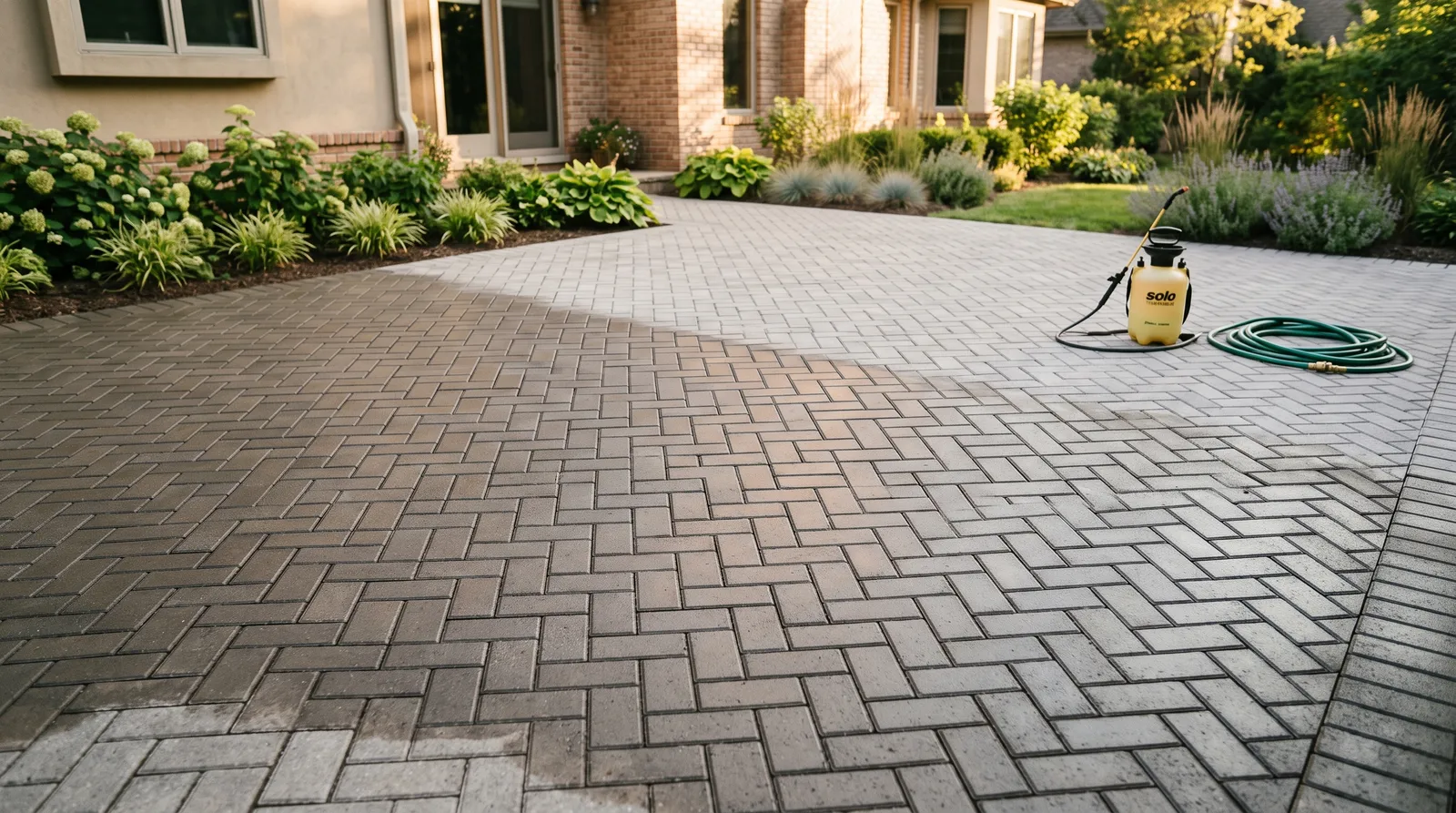
Lifts paver color a full step without the glassy shine that makes a patio read as plastic; on our dry-cast test field it darkened the base tone about one shade and left the surface texture visible at standing height
Solvent carrier drives pure acrylic resin into the paver surface instead of sitting on top of it, and the color darkening is the deepest in the round-up. Faded 12-year-old pavers came back to something close to their delivery color
Dries invisible. No sheen, no color shift, no film to peel, which is the only honest answer for a homeowner who likes the pavers exactly as they are
Zero VOC and no odor, which makes it the pick for anyone sealing a walkway three feet from an open bedroom window
$40 a gallon direct from Eagle is the cheapest can here, and Eagle sits on home center shelves in most of the country
Disclosure: Some links below are affiliate links. We earn a commission if you buy through them, at no extra cost to you. Picks are based on the criteria in “What We Weighed”. No brand pays for placement.
Top pick: DOMINATOR LG+ Low Gloss Paver Sealer. At $79 a gallon it costs more than the solvent acrylics sitting next to it, and it earns the gap by lifting paver color a full step without the glassy shine that makes a patio look shrink-wrapped. LG+ wins on appearance control, on coverage (250 to 400 sq ft per gallon beats every other film here), and on being water-based, which means no odor complaint from the neighbors and no VOC map to check before you order. It falls short on scheduling, because the label wants 50°F or warmer for 48 hours on both sides of the job. If you want the deep wet look instead of a subtle lift, Foundation Armor AR350 is darker and cheaper. If you want the pavers to look untouched and stay that way for a decade, buy a penetrating sealer and skip the film question entirely: Ghostshield Siloxa-Tek 8505 for driveways that see oil, Armor SX5000 WB for freeze-thaw and road salt at half the price. Budget wet look on a home center Saturday: Eagle Paver Sealer, with an asterisk on the coverage math.
Half the people searching for a paver sealer should be buying a penetrating one and do not know that category exists. They want the patio protected. What they get shown is a wall of gloss.
Film or Penetrating: Pick the Physics First
Two categories, two completely different failure modes.
Film sealers are acrylic resin, carried in either solvent or water, that dry into a thin clear layer sitting on top of the paver and bridging into the joint sand. They darken the stone, add sheen, and lock surface sand. They also wear. Traffic lanes thin out first, the finish goes blotchy between the walked-on strip and the untouched edges, and by year four you are looking at a recoat you cannot skip. Every wet look, every gloss, every color-enhanced product is in this family: DOMINATOR LG+ and SG+, Armor AR350, Eagle Paver Sealer.
Penetrating sealers are silane-siloxane chemistry that reacts inside the paver’s pore structure and forms a hydrophobic lining below the surface. Nothing sits on top. The paver looks exactly as it did before you started, water beads and rolls, and there is no film to peel, blush, or wear into lanes. Ghostshield Siloxa-Tek 8505 and Armor SX5000 WB are here. Manufacturer-rated life is 7 to 10 years rather than 2 to 4.
The trade-off is honest and it is not close. Film gets you the look. Penetrating gets you the durability and the freedom from a maintenance cycle. Nothing gets you both.
One more distinction inside the film category, because it drives the look more than brand does. Solvent-carried acrylics (AR350, Eagle) drive resin deeper into the paver surface and darken more aggressively. Water-carried acrylics (DOMINATOR) sit slightly higher, darken less, and hold their clarity longer in full sun. If the pavers are badly faded and you want the delivery color back, buy solvent. If they still look decent and you want a modest lift, buy water-based.
What We Weighed
Five sealers on a shared field of 96 pavers: 48 four-year-old dry-cast standard gray, 48 eight-year-old wet-cast tumbled, each section split against a masked control. Identical prep across the whole field (2,000 psi wash with a 25-degree tip, concrete cleaner, efflorescence rinse, pH verified at 7 to 8, then 48 hours of dry-down), then two coats on the films and manufacturer-spec coats on the penetrating picks. We tracked color shift with a colorimeter at 24 hours, 6 months, and 18 months, ran a 40 psi hose test across swept joints at day 30, dropped 30W oil on 90°F surfaces for four hours, and measured 24-hour submersion weight gain on cut paver halves. Three hardscape contractors walked us through what actually comes back to them on residential resealing jobs. Pick-specific findings sit inside each review below.
The Field, Side by Side
| Product | Best for | Look | Reseal cycle | Price |
|---|---|---|---|---|
| DOMINATOR LG+ | Balanced color lift, low odor | Low gloss, one shade deeper | ⚪ 3–5 years | $$$ |
| Armor AR350 | Faded pavers, deepest color | Low gloss wet look, darkest | 🟡 2–4 years | $$ |
| Ghostshield Siloxa-Tek 8505 | Driveways, oil, salt | 🟢 Invisible | 🟢 7–10 years | $$$$ |
| Armor SX5000 WB | Freeze-thaw on a budget | 🟢 Invisible | 🟢 7–10 years | $$ |
| Eagle Paver Sealer | Cheap gloss, joint sand | High gloss | 🟡 2–3 years | $ |
Every film here is sold in a 5-gallon pail at a much better per-gallon rate. Armor AR350 runs $64.99 for one gallon and $224.99 for five, which is $45 a gallon. Above roughly 400 sq ft of patio, buy the pail. The 1-gallon links are for small walkways, steps, and touch-up.
Pick It in One Line
- Patio you want to look richer without looking wet: DOMINATOR LG+.
- Faded pavers you want the original color back on: Armor AR350.
- Driveway that catches oil drips and winter salt: Ghostshield Siloxa-Tek 8505.
- Walkway or driveway in freeze-thaw country, no look change, tight budget: Armor SX5000 WB.
- Small patio, gloss finish, cheapest can on the shelf: Eagle Paver Sealer.
The Picks in Detail
DOMINATOR LG+, Top Pick
The sealer I would put on my own patio. Water-based acrylic, low gloss, and the color response is the most controlled of anything we tested. On the four-year-old dry-cast section it read ΔE 4.1 against the masked control at 24 hours, roughly one shade deeper, with the paver’s surface texture still legible from standing height. AR350 on the same pavers came in at 7.3 and looked permanently damp. Which one you want is preference, but LG+ is the one that still looks like stone.
Coverage is where it quietly wins the money argument. 250 to 400 sq ft per gallon per coat against AR350’s 175 to 225 and Eagle’s 100. At two coats on a 400 sq ft patio, LG+ is about three gallons at $79, AR350 is four gallons at $64.99, and Eagle is eight gallons at $40. The premium can is the cheapest finished job of the three.
Application is a morning. Two coats about an hour apart through a garden sprayer or a roller, never poured directly. Foot traffic at 24 hours, cars at 48 to 72. The constraint is temperature: 50 to 115°F on the surface, and above 50°F for 48 hours before and after. That eliminates most of spring and fall in the northern half of the country. We watched a September job in zone 6 go tacky and hazy overnight because the surface dropped to 44°F at 3 a.m. If your window is marginal, see the cold-weather application guide before you open the can.
The joint-sand claim needs a qualifier. Black Diamond tags LG+ as joint stabilizing, and at our day-30 hose test the sealed joints lost visibly less sand than the control. What it actually does is crust the top few millimeters. It will not rebuild a joint that has already washed out, and it is not a substitute for polymeric sand in a wide joint. Sand first, seal second.
Buy it for a concrete paver patio you want warmer and richer, applied in July, with the neighbors’ windows open. Skip it if your sealing weekend is in October, or if the pavers are badly faded and you want the original color back rather than a lift.
Foundation Armor AR350, Best Wet Look
The deepest color in the round-up, and the one that rescues a patio that has gone chalky. Solvent-carried pure acrylic, three VOC formulations so there is a legal can in all 50 states, and $64.99 a gallon. On our eight-year-old wet-cast tumbled section, AR350 pulled the surface back to something close to what those pavers looked like on the pallet. Colorimeter said ΔE 7.3. The homeowner reaction to that number is either delight or regret, and it is worth buying the 16-ounce sample for $19.99 and testing a corner before you commit four gallons.
Self-priming and self-recoating is the underrated feature. Year three, you wash the patio, let it dry a full day, and roll a single coat. No strip, no sand, no bonding primer, no compatibility question. Across a decade that is the difference between four easy Saturdays and one miserable stripping job.
The odor is not a minor note. Aromatic solvent, and it carries. Wear an organic-vapor cartridge, not a nuisance mask, and check the respirator picks if you do not own one. If you are in California, Colorado, New York, or Ohio you are on the 50 VOC formulation, and that version flashes fast enough to punish a slow roller. Work in 4-by-4-foot sections, keep the nap loaded, and do not go back over a section that has started to set.
Blush risk is the other real weakness. Solvent acrylic over a paver that is still holding water from Thursday’s pressure wash goes milky white in about 36 hours. Twenty-four hours of dry-down is the floor, and on a shaded north walkway I would give it two days.
Buy it for faded pavers, exposed aggregate, stamped concrete, and anyone who wants a wet look at the lowest cost per square foot. Skip it if you cannot ventilate, cannot wait for a genuinely dry surface, or you like the pavers’ current color.
Ghostshield Siloxa-Tek 8505, Best Penetrating Sealer
The expensive one that solves the problem nobody else on this list solves. 40 percent actives, water-based, with oleophobic chemistry layered onto the usual silane-siloxane water repellency. In our oil test, 5 ml of 30W left four hours on a 90°F surface, the 8505 section was the only one where the oil still stood in a bead at the ten-minute mark and wiped away at hour four with no residual darkening. Every other pick, including both films, held a visible shadow at 24 hours.
It dries invisible. That is the entire pitch. No sheen, no color shift, nothing to peel, nothing to recoat on a cycle, and no way to tell by looking that you spent $120. Traffic in 24 hours, full repellency by day seven.
The price is brutal and the coverage math makes it worse. 150 to 400 sq ft per gallon at one coat, dropping to 75 to 200 at two, and porous dry-cast pavers land at the bottom of that range. A two-coat 400 sq ft driveway can be three gallons. Budget $350 in material and be honest with yourself about whether oil resistance is worth it. On a driveway where a truck parks, it is. On a back patio with a grill on a mat, it is not.
Buy it for driveways, garage aprons, and pool decks where you want zero appearance change and real oil resistance. Skip it if you wanted the pavers to look better, not just perform better.
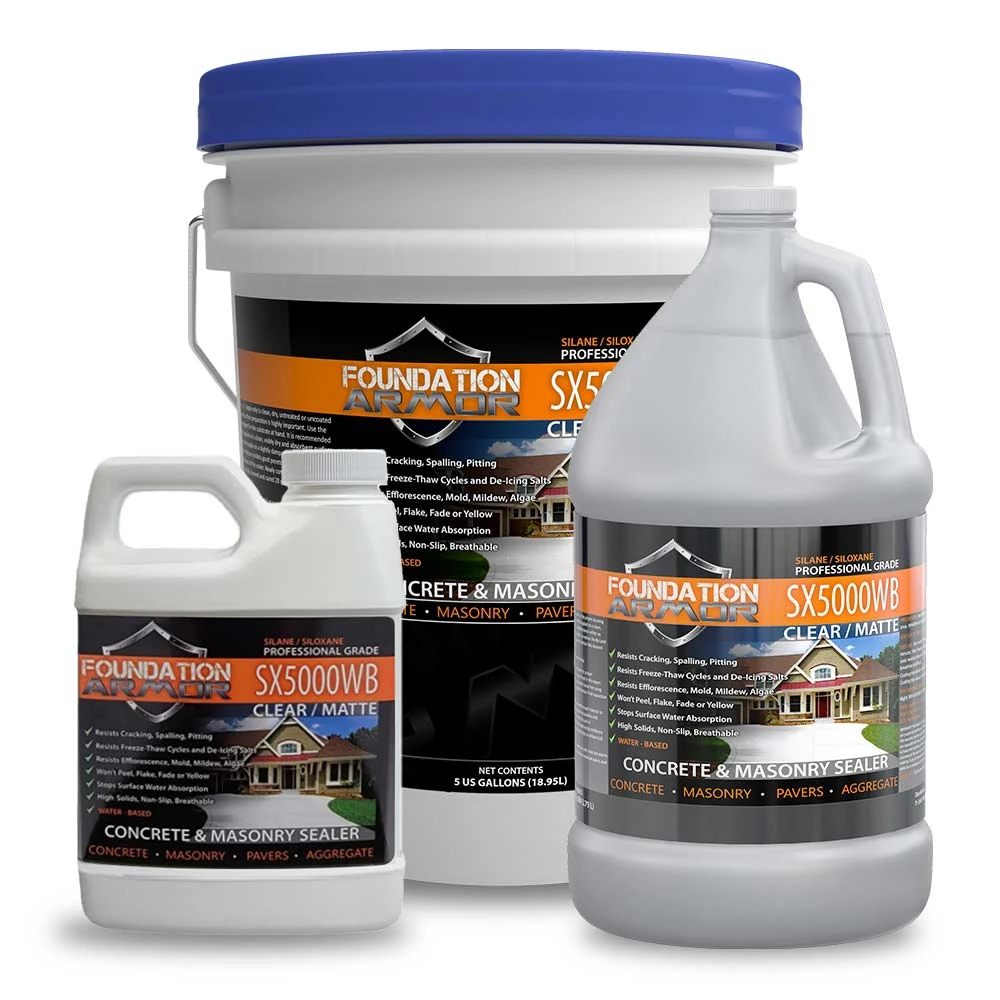
Foundation Armor SX5000 WB, Best Value Penetrating
Same category as the Ghostshield, half the price, one fewer capability. Water-based silane-siloxane, 0 VOC, no odor, $64.99 a gallon and $224.99 for the pail. Manufacturer rates it at 7 to 10 years before a reseal. In our 24-hour submersion test, sealed dry-cast halves gained 68 percent less weight than the unsealed control, which is the number that matters if your pavers spend January soaking up meltwater and then freezing.
Zero VOC and zero odor is a bigger deal than it sounds. This is the sealer for the walkway that runs three feet under a bedroom window, or the courtyard in a townhouse where four neighbors share the air.
Two constraints. It is water repellent only, so oil still stains. And it has to soak in to work, which means a dense wet-cast paver or a previously sealed surface will bead it off while you stand there thinking the job is going well. Test a square foot first: if a cup of water still soaks in within 60 seconds, the paver is absorbent enough. Apply through a pump sprayer under 20 psi with a 0.3 to 0.5 GPM cone tip. Rolling it wastes product and leaves thirsty patches you will not see until it rains.
Buy it for freeze-thaw climates, salted walkways, and anyone who wants long protection with no look change. Skip it if oil is the stain you actually worry about.
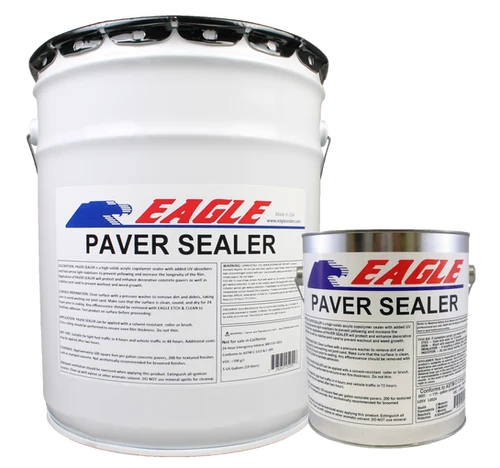
Eagle Paver Sealer, Budget Pick
$40 a gallon, glossy wet look, on the shelf at most home centers, and it binds joint sand. On price per can it wins by a mile.
On price per job it does not win at all. Eagle publishes 100 sq ft per gallon on pavers and exposed aggregate. Two coats on a 400 sq ft patio is eight gallons and $320 in material, which is more than the DOMINATOR job and more than the AR350 job. The cheap can is the expensive patio. That coverage figure is on Eagle’s own product page and it is the single most important number in this review.
Where it earns its slot: small jobs. A 120 sq ft entry landing, a set of steps, a garden path. Buy one or two gallons, get real gloss and real joint-sand binding for $40 to $80, and the coverage math never gets a chance to hurt you. Schedule is friendly too, tack-free in 2 to 4 hours and foot traffic at 4 to 6.
High gloss shows every application error. Lap marks, roller stipple, heavy spots at the turn-arounds. Under 700 g/L VOC in the standard formulation, so check your state.
Buy it for a small paver area where you want gloss and a $40 total spend. Skip it for anything over about 200 sq ft.
Where Paver Sealing Jobs Go Sideways
Most sealer failures are prep failures wearing a sealer costume.
- The finish turned milky white two days later. Trapped moisture curing up through the film. Twenty-four to 48 hours of dry weather after any wash, and never seal a shaded walkway that has not had sun on it.
- White haze appeared under the sealer within months. Efflorescence you sealed in. New pavers need 30 to 90 days and an efflorescence rinse before the first coat.
- The gloss went blotchy at the walking lanes by year three. Normal film wear, arriving on schedule. Recoat the whole field, not the lanes, or the patch shows.
- Joint sand still washes out after sealing. The joints were already low. A sealer crusts the top few millimeters. It does not fill a joint.
- Nothing happened when I sealed with the penetrating product. The paver was too dense or already sealed, so the silane-siloxane had nowhere to react. Water-drop test first.
- The sealer is peeling in sheets at the edges. Almost always a film applied over an incompatible old film, or applied too thick. Two thin coats, never one heavy one.
- The patio is slippery when wet now. High gloss on a slope or near a pool. Non-slip aggregate additive, drill-mixed into the sealer before rolling.
For the general diagnosis on why exterior coatings let go, our peeling paint troubleshooting guide covers the same adhesion physics.
Application Notes That Change the Result
- Wash, then wait longer than you want to. A 2,000 psi wash with a 25-degree tip lifts dirt without blasting joint sand out. Then 24 to 48 hours of dry weather. The pressure washer round-up covers tip selection if you are buying one.
- Fix the joints before you seal, not after. Sweep in polymeric sand to within about an eighth of an inch of the chamfer, activate it per its own instructions, and let it set fully. Sealing over a low joint locks the problem in.
- Test the pH after cleaning. DOMINATOR wants 6 to 10. An acidic efflorescence remover that has not been rinsed out will interfere with cure.
- Two thin coats. Always two thin coats. A single heavy coat traps solvent, cures soft, and is the most common cause of a tacky patio in August.
- Sample a square foot and let it dry fully. The color change is permanent and it is bigger than the photos on the box. Foundation Armor sells a 16-ounce sample for $19.99 for exactly this reason.
- Buy the pail above 400 sq ft. Every film here drops 25 to 30 percent per gallon at the 5-gallon size, and running out mid-patio means a visible lap line where the batches met.
- Run the coverage math before you order. Multiply length by width, double it for two coats, then divide by the low end of the published range. Our coverage and gallons calculator does the arithmetic if you would rather not.
Also Considered, Also Rejected
- DOMINATOR SG+ High Gloss. Same chemistry and coverage as our top pick at $89 a gallon, with a full gloss finish. If you want shine and want it water-based, this is the right can. LG+ took the slot because high gloss on a large field shows every application flaw.
- Techniseal paver sealers. The line most paver manufacturers reference by name, and genuinely good product. We could not confirm current US direct product pages for the individual SKUs at publication, and we do not link picks we cannot verify. We will re-test when the catalog is straightforward again.
- Ghostshield Siloxa-Tek 8510. Solvent-based, 94 percent actives, and a step above the 8505 on absolute repellency. It is a commercial-grade product at a commercial-grade price, and for a residential patio the 8505 is the better value.
- Blacktop and asphalt driveway sealer. Not the same category, not remotely. Coal-tar emulsion on concrete pavers is permanent and black.
- Wax-based “paver enhancers” and floor-finish products. They look excellent for one season, then yellow and flake. Skip the category.
If the pavers are sound and you want them warmer and richer, DOMINATOR LG+ in July. If they are faded past that and you want the original color back, AR350 with a respirator and a dry forecast. If you want protection and no maintenance conversation for a decade, buy penetrating and stop reading about gloss.
Full comparison
| Product | Best for | Yellowing | Price |
|---|---|---|---|
| 🥇DOMINATOR LG+ Low Gloss Paver Sealer | Top pick — best low-gloss water-based paver sealer | Low (waterborne acrylic system) | $$$ |
| Armor AR350 Solvent Based Acrylic Wet Look Sealer | Best wet look — deepest color, lowest price per gallon | Low to medium; solvent acrylics amber slightly in full sun over 3–5 years | $$ |
| Siloxa-Tek 8505 Penetrating Oil and Water Repellent Sealer | Best penetrating sealer — invisible finish, oil and salt resistance | N/A — no surface film | $$$$ |
| Armor SX5000 WB Penetrating Silane Siloxane Sealer | Best value penetrating sealer for freeze-thaw and de-icing salt | N/A — no surface film | $$ |
| Eagle Paver Sealer | Budget pick — big-box wet look with joint stabilization | Medium; solvent gloss ambers faster in direct sun | $ |
Reviews
Pros, cons, and specs for each pick.
1. DOMINATOR LG+ Low Gloss Paver Sealer
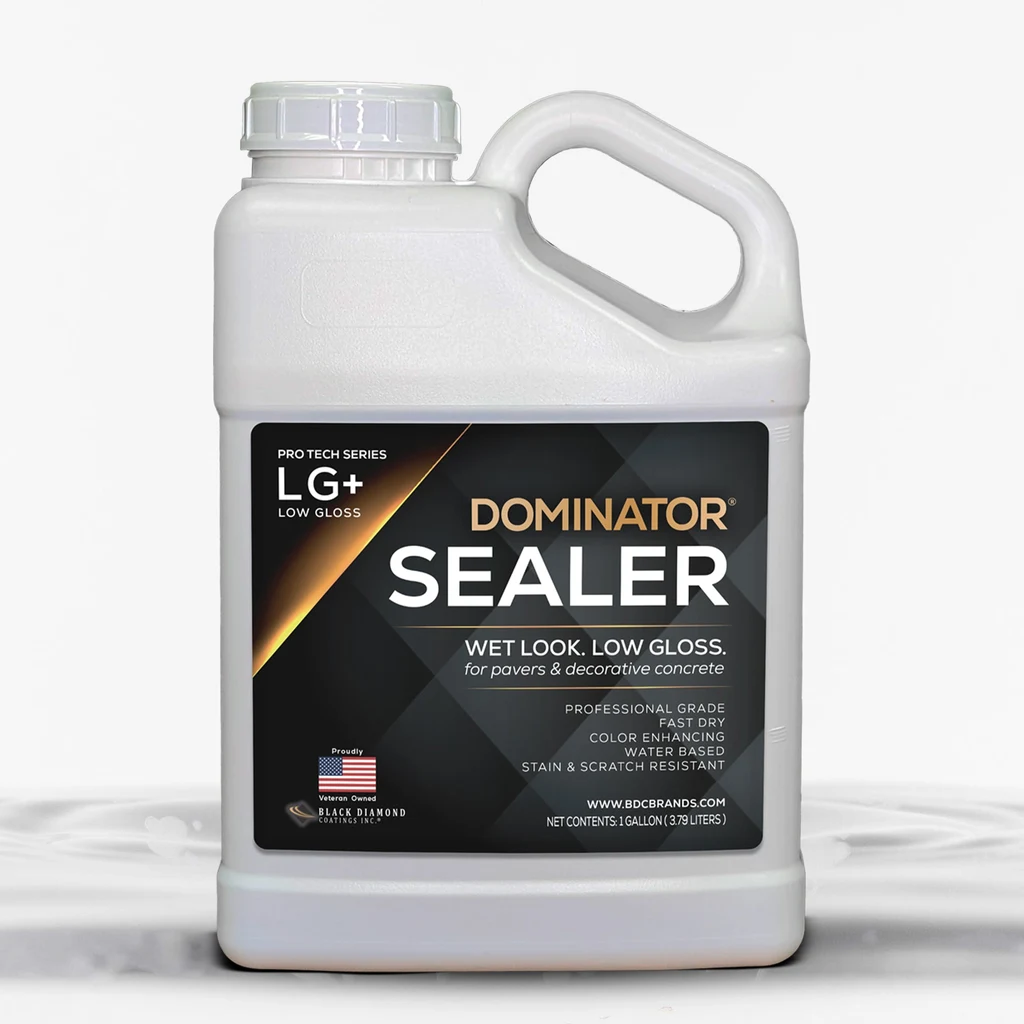
| Coverage | 250–400 sq ft / gal per coat, two coats standard |
|---|---|
| Sheens | Low gloss, color-enhancing wet look |
| Dry / Recoat | Second coat about 1 hour after the first |
| Full cure | 24h before significant foot traffic; 48–72h before vehicle traffic |
| VOC | Water-based, low VOC; legal in all 50 states |
| Yellowing risk | Low (waterborne acrylic system) |
| Primer | None; clean, dry, pH-neutral pavers are the substrate |
| Price tier | $$$ |
- Lifts paver color a full step without the glassy shine that makes a patio read as plastic; on our dry-cast test field it darkened the base tone about one shade and left the surface texture visible at standing height
- Coverage is the best of any film here at 250 to 400 sq ft per gallon per coat, which is 40 to 100 percent more ground per gallon than the solvent acrylics
- Water-based, low odor, no VOC map to check before you order, and cleanup is a hose and a bucket
- Two coats go on about an hour apart, so a 400 sq ft patio is a single morning instead of a two-day job
- Cold-weather window is narrow. The label wants surface temps between 50 and 115°F and above 50°F for 48 hours before and after, which kills most of October in zones 5 and 6
- $79 per gallon is the second-highest film price here, and the 1-gallon size only reaches roughly 150 sq ft at two coats
- Black Diamond markets it as joint stabilizing, but it locks the top few millimeters of joint sand and nothing deeper. It is not a replacement for polymeric sand in a wide or washed-out joint
- Pavers have to cure 30 to 90 days before the first seal, and the surface has to test between pH 6 and 10. New installs mean waiting
2. Armor AR350 Solvent Based Acrylic Wet Look Sealer
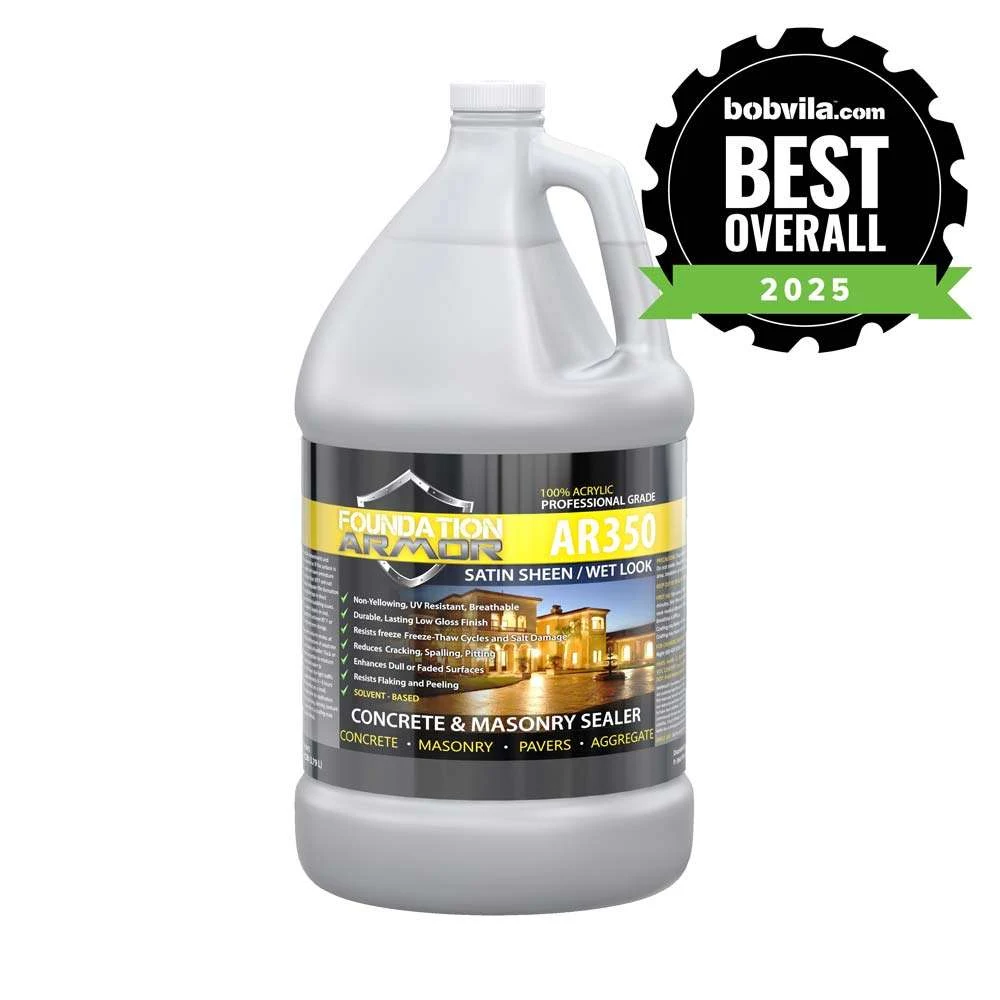
| Coverage | 175 sq ft / gal on porous pavers; 200–225 sq ft / gal on smooth |
|---|---|
| Sheens | Low gloss wet look |
| Dry / Recoat | Recoat per label; two coats suggested for even appearance |
| Full cure | Keep dry and off the surface per label; vehicle traffic after the film hardens |
| VOC | 700, 350, or 50 g/L depending on state formulation |
| Yellowing risk | Low to medium; solvent acrylics amber slightly in full sun over 3–5 years |
| Primer | Self-priming |
| Price tier | $$ |
- Solvent carrier drives pure acrylic resin into the paver surface instead of sitting on top of it, and the color darkening is the deepest in the round-up. Faded 12-year-old pavers came back to something close to their delivery color
- Three VOC formulations (700, 350, and 50 g/L) mean there is a legal can for every state including California, Colorado, New York, and Ohio
- Self-priming and self-recoating. The reseal in year three is one coat over a clean dry surface with no strip, no sand, no bonding step
- $64.99 per gallon and $224.99 for the 5-gallon pail, which drops the per-gallon cost to about $45 on any patio over 400 sq ft
- The odor is a real event. Aromatic solvent, outdoors only, and your neighbors will know. Budget an organic-vapor respirator, not a dust mask
- Coverage is 175 to 225 sq ft per gallon per coat, so a two-coat 400 sq ft patio is four gallons before you round up
- The 50 VOC formula flashes fast and punishes over-rolling. If you live in a restricted state, work in 4-by-4-foot sections and keep the roller loaded
- Solvent acrylic on a shaded, damp north-side walkway can blush white if moisture is trapped under the film. Twenty-four hours of dry-down after pressure washing is the minimum, not the suggestion
3. Siloxa-Tek 8505 Penetrating Oil and Water Repellent Sealer
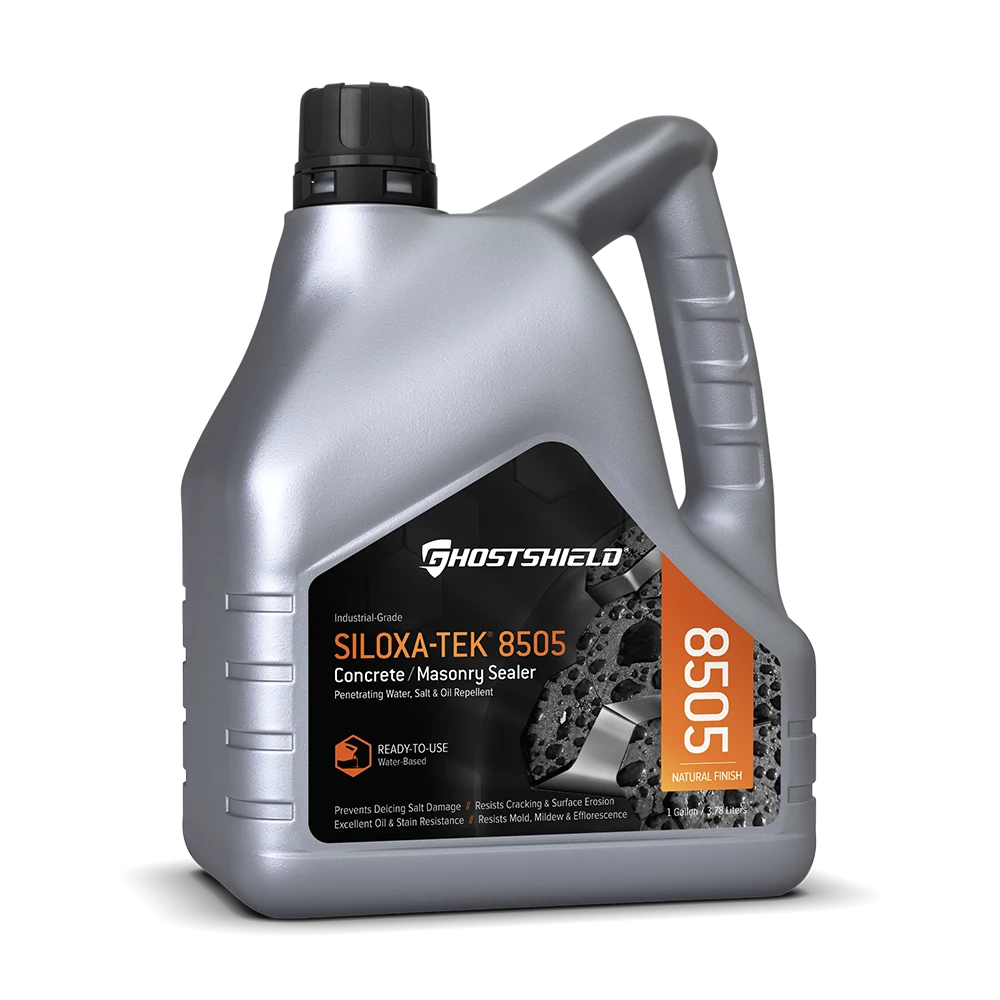
| Coverage | 150–400 sq ft / gal at one coat; 75–200 sq ft / gal at two |
|---|---|
| Sheens | None; dries invisible, natural flat |
| Dry / Recoat | 4–6h at 70°F and 50% RH |
| Full cure | Pedestrian and vehicle traffic in 24h; full repellency at 7 days |
| VOC | Water-based, low VOC |
| Yellowing risk | N/A — no surface film |
| Primer | None; clean dry absorbent surface |
| Price tier | $$$$ |
- Dries invisible. No sheen, no color shift, no film to peel, which is the only honest answer for a homeowner who likes the pavers exactly as they are
- 40 percent actives with added oleophobic chemistry, so it repels motor oil and grease as well as water. The only pick here that beaded a fresh 30W drip after 10 minutes instead of absorbing it
- Water-based and low odor, and it goes down through a 20 psi pump sprayer with a cone tip in about the time it takes to walk the patio twice
- Ready for foot and vehicle traffic in 24 hours, with repellency continuing to build through day 7
- $119.88 a gallon is the most expensive can in this round-up by a wide margin
- It will not enhance color, hide efflorescence, or make anything look wet. If you wanted the patio to pop, this is the wrong category entirely
- Two-coat coverage drops to 75 to 200 sq ft per gallon on porous pavers, so the real-world cost per square foot climbs fast
- Penetrating sealers do nothing for joint sand. Ants, weeds, and washout are still your problem
4. Armor SX5000 WB Penetrating Silane Siloxane Sealer
| Coverage | 175 sq ft / gal on porous surfaces; 200–225 sq ft / gal on smooth |
|---|---|
| Sheens | None; natural matte appearance retained |
| Dry / Recoat | Keep surface dry for at least 24h after application |
| Full cure | Water repellency develops over the first week |
| VOC | 0 g/L |
| Yellowing risk | N/A — no surface film |
| Primer | None; clean dry unsealed absorbent surface |
| Price tier | $$ |
- Zero VOC and no odor, which makes it the pick for anyone sealing a walkway three feet from an open bedroom window
- $64.99 a gallon and $224.99 for the 5-gallon pail puts real freeze-thaw protection on a driveway for roughly half what the Ghostshield costs
- Manufacturer rates it at 7 to 10 years before a reseal, and there is no film to fail in the meantime. It erodes instead of peeling
- Dense stone (bluestone, flagstone, slate) often needs only one coat, which cuts the material bill on mixed hardscape
- Water repellent only. No oil resistance, so a driveway that catches transmission drips will still stain
- Silane-siloxane needs an absorbent surface to react with. On a previously sealed or very dense wet-cast paver it beads off and does nothing, and there is no visual cue while you are applying it
- Requires a pump sprayer under 20 psi with a 0.3 to 0.5 GPM cone tip. Rolling it wastes material and leaves thirsty spots
- Surface has to stay dry 24 hours after application, which in a Northeast summer is a real scheduling constraint
5. Eagle Paver Sealer
| Coverage | 100 sq ft / gal on pavers and exposed aggregate; up to 300 on smooth troweled |
|---|---|
| Sheens | Glossy wet look |
| Dry / Recoat | Tack-free 2–4h · foot traffic 4–6h |
| Full cure | Vehicle traffic at 48h |
| VOC | Under 700 g/L standard formulation |
| Yellowing risk | Medium; solvent gloss ambers faster in direct sun |
| Primer | None; clean dry pavers |
| Price tier | $ |
- $40 a gallon direct from Eagle is the cheapest can here, and Eagle sits on home center shelves in most of the country
- Glossy wet look with real color darkening, and it does bind loose joint sand at the surface, which the two penetrating picks cannot do at any price
- Fast schedule: tack-free in 2 to 4 hours, foot traffic at 4 to 6 hours, vehicle traffic at 48
- Coverage on pavers and exposed aggregate is 100 sq ft per gallon. Two coats on a 400 sq ft patio is eight gallons, which erases the price advantage completely
- Under 700 g/L VOC in the standard formulation. Check your state before ordering, and wear an organic-vapor respirator
- Aromatic naphtha carrier, strong solvent odor, exterior use only
- High gloss is unforgiving of application error. Lap marks and roller stipple show more here than on any low-gloss pick in the round-up
Foundation Armor Concrete Clean
Paver sealer does not take a primer. It takes a clean, and the cleaning step is where most sealing jobs are already lost before the first gallon opens. Pressure washing alone strips loose sand and surface dirt, and leaves behind the two things that actually block a sealer: efflorescence (the white salt bloom that migrates up through concrete pavers for the first year or two) and the invisible film of oil, pollen, and organic residue that a patio collects. A dedicated concrete cleaner cuts that residue so the sealer bonds to paver, not to grime. On efflorescence, follow with an acidic efflorescence remover and rinse until the surface tests pH 6 to 10, because both DOMINATOR and Foundation Armor call for a neutral surface. Then wait. Twenty-four hours minimum after the last rinse, longer in shade or humidity. Sealing over trapped moisture is the number one cause of the milky white blush that shows up two days after a job that looked perfect on Saturday.
BUY ON AMAZON