Best Paint for Metal
Six metal paints tested on rusted steel, galvanized, and mill-finish aluminum panels over 12 months outdoors. Top pick: Rust-Oleum Stops Rust Protective Enamel.

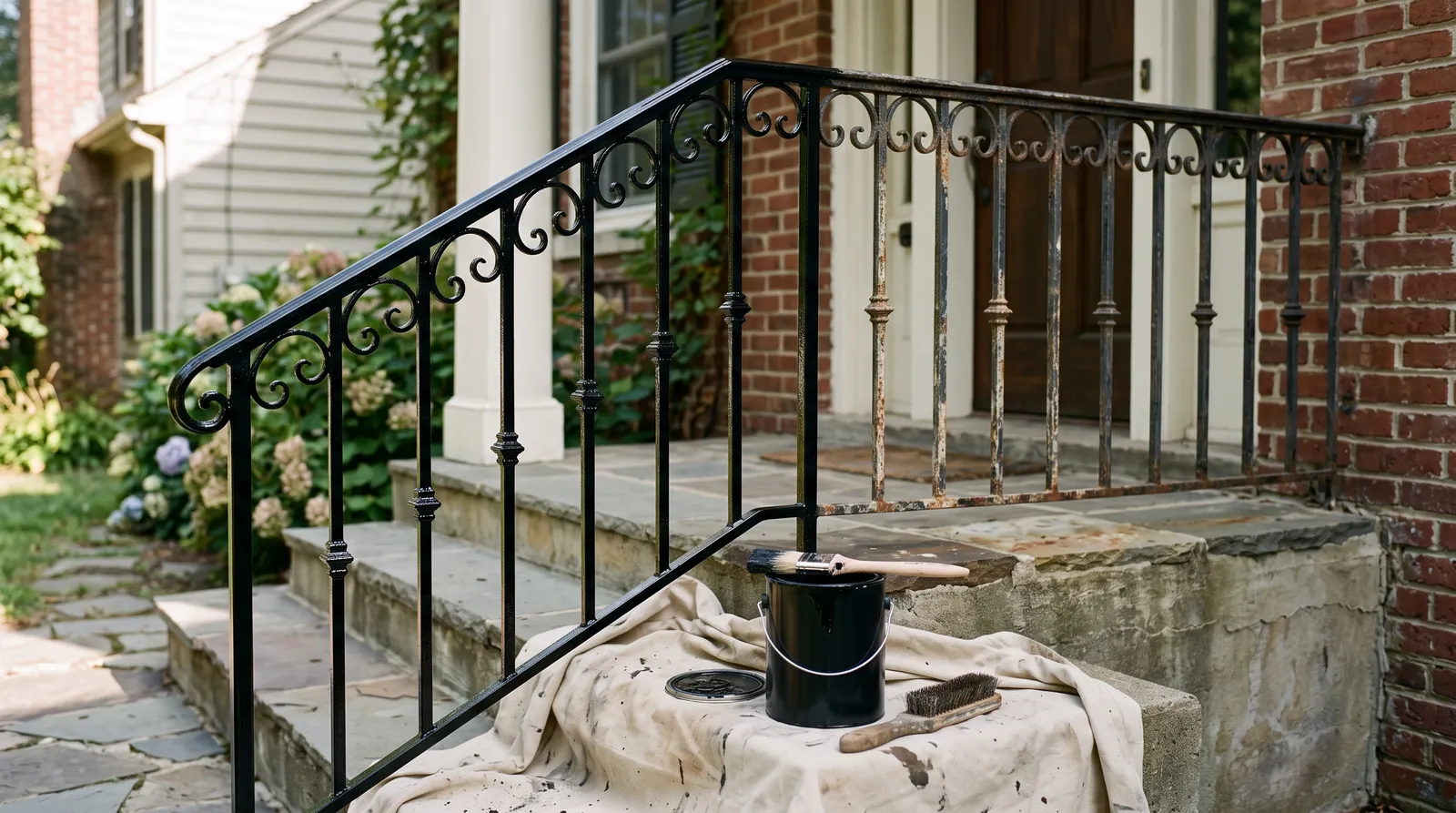
Best rust hold-out per dollar in the group: after 12 months on an outdoor rack, creep back from our X-scribe measured under 1 mm where two cheaper enamels had crept 3 mm and lifted
The dimpled metallic pattern breaks up reflection, so pitting, hammer dings, and old weld scars stop reading from 3 feet away
Genuinely one product: primer, undercoat, and topcoat in a single can, which cuts a two-weekend gate job to one
Bonds to scuffed galvanized and mill-finish aluminum with no primer, the two metals that peel every ordinary enamel off in a season
Rated to 1200°F, which covers a charcoal kettle, a wood stove body, a fire pit ring, and a header wrap that every ordinary enamel scorches off
Converts loose surface oxide into a stable flat-black film, which is the only honest answer for a fence post or a trailer frame you cannot get back to bare steel
Disclosure: Some links below are affiliate links. We earn a commission if you buy through them, at no extra cost to you. Picks are based on the criteria in “How we picked”. No brand pays for placement.
Top pick: Rust-Oleum Stops Rust Protective Enamel, the brush-on quart. At $14 to $18 a quart it covers a porch railing, a gate, and two patio chairs, and after twelve months on an outdoor rack it was the only pick under $20 that hadn’t crept back from the scribe line. Stops Rust wins on rust hold-out, on color range, and on being sold in every hardware store in the country. It falls short on speed, since an oil alkyd wants overnight before anyone leans on it, and on white, which ambers inside two years. If you need to hide pitting rather than show it, buy the Hammered version of the same line. If the piece has balusters or mesh, skip the brush entirely and spray Krylon Fusion All-In-One.
The metal decides the can, not the color chip. Steel, galvanized, and aluminum fail in three different ways, and a paint that holds beautifully on a wrought-iron railing will peel off a galvanized fence post in one wet season. Identify the metal first. Everything after that is easy.
What Metal Am I Actually Painting?
Four substrates cover almost every home job, and each one has one right answer.
| The metal | What it needs | Why |
|---|---|---|
| Rusted steel or iron (railings, gates, patio sets) | Rusty Metal Primer, then oil enamel | Primer soaks into pitting and locks residual oxide; topcoat alone bridges it and lifts |
| Bare, clean steel (new stock, welded fabrication) | Clean Metal Primer, then oil enamel | Nothing to convert, so you want maximum adhesion and a smooth base |
| Galvanized (fence posts, ductwork, shed panels) | Self-etching primer or a bonding acrylic | Fresh zinc reacts with alkyd binders and the paint releases in sheets |
| Aluminum (screen doors, furniture frames, gutters) | Self-etching primer, then anything | The oxide skin re-forms in hours and rejects a plain topcoat |
| Anything above 200°F (grills, stoves, exhaust) | High-heat silicone coating only | Ordinary enamel scorches, chalks, and smokes off in one burn cycle |
That table is most of the article. Galvanized is where I see the most expensive mistakes. Somebody paints a new galvanized fence with a quart of good oil enamel, it looks sharp for eight months, and then it comes off the posts in strips the size of a hand. The paint was fine. The zinc turned the binder to soap.
For the full prep ladder on old rusted steel, work through our rusted metal prep guide before you buy anything.
How We Picked
Six coatings applied to matched steel, hot-dip galvanized, and mill-finish aluminum panels at 72°F and 50% RH, with the steel deliberately wire-brushed for a timed five minutes instead of sanded to white metal, because that’s the prep people actually do. Cured 30 days, X-scribed to bare metal, then mounted on a south-facing rack in coastal Mid-Atlantic weather for twelve months and checked at 3, 6, and 12 months for creep, blistering, and gloss loss. Sister panels ran ASTM D3359 cross-hatch and ASTM D3363 pencil hardness at 30 days. Four trade interviews, three fabricators and one fence contractor, filled in the galvanized failure patterns. Pick-specific findings live in each review below.
The Six Picks Side by Side
| Product | Best for | Rust creep at 12 mo | Handle time | Price |
|---|---|---|---|---|
| Rust-Oleum Stops Rust Enamel | Top pick: railings, gates, rusted steel | 🟢 Under 1 mm | 5–9h | $$ |
| Rust-Oleum Hammered | Pitted, scarred, ugly metal | 🟢 Under 1 mm | 5–9h | $$ |
| Hammerite Direct to Rust | One-can jobs, no separate primer | 🟢 1 mm | Overnight | $$$ |
| Krylon Fusion All-In-One | Balusters, mesh, galvanized, aluminum | 🟡 2–3 mm | 1h | $ |
| Rust-Oleum High Heat | Grills, stoves, fire pits | ⚪ N/A (heat, not weather) | 1–2h | $ |
| Rust-Oleum Rust Reformer | Base coat on unremovable rust | 🟢 Under 1 mm topcoated | 24h to topcoat | $ |
Two of these are not finishes and I want that clear before anyone buys. Rust Reformer is a base coat and fails within a year on its own. High Heat is a heat coating, not a weather coating, so it belongs on a grill and nowhere near a mailbox post.
The Picks in Detail
Rust-Oleum Stops Rust Protective Enamel, Top Pick
This is the can that has been on American hardware store shelves since before most of us were born, and it is still the right default. Oil alkyd, quart or gallon, dozens of colors in four sheens, and a matching aerosol so touch-ups in year four actually match.
The twelve-month rack test is what earns it the top spot. We scored an X through to bare steel on every panel and left them south-facing through a full winter. Stops Rust over Rusty Metal Primer showed under a millimeter of creep back from the cut, no blistering along the score, and gloss still holding at about 80 percent of day-one. The Fusion panel next to it had crept two to three millimeters and dulled noticeably. On the hardness check at 30 days, Stops Rust came in at 2H where the aerosols sat at HB to F, and that gap is why a patio chair leg dragged across a painted steel table leaves a scuff on one and a gouge on the other.
The dry schedule is the frustrating part, and it catches people every single time. Touch dry at two to four hours reads like the piece is ready. It isn’t. Handle time is five to nine hours, full hardness is a week, and the recoat window is the real trap: go back within two hours or wait forty-eight. We painted a test panel at hour six and got a wrinkled, lifted first coat that had to be stripped. Read the can, set a timer, and go do something else.
One honest note on where to buy it. A quart of Stops Rust is usually a couple of dollars cheaper at your local Home Depot or Ace than shipped, and you can carry it home in one hand. The Amazon link matters when you want a specific color the store doesn’t stock, or the gallon, which nobody enjoys hunting for on a Saturday.
Whites amber. Not a defect, just alkyd chemistry doing what alkyd chemistry does, and it’s worse on an interior radiator in a heated house than on an outdoor gate. If you want a white metal finish that stays white, that’s a waterborne DTM job and a different article.
Buy it if you have rusted steel, iron, or sound previously painted metal and a weekend rather than an afternoon. Skip this if the piece is galvanized, aluminum, or you need to use it tonight.
Rust-Oleum Stops Rust Hammered, Best over Pitted Metal
Same chemistry as the top pick, different job. The hammered pattern is a dimpled metallic texture that scatters light instead of reflecting it evenly, and scattered light is how you hide a surface you can’t fix. Old wrought iron with sixty years of pitting, a mailbox post with hammer dents, a fabricated stair stringer with visible weld grind. Smooth gloss enamel on any of those is a magnifying glass. Hammered makes them read as texture.
It also builds thicker than the smooth enamel. On our panels a single heavy coat of Hammered measured close to two coats of gloss Stops Rust in dry film, which is half the reason it hides and most of the reason it drags under a cheap brush. Use a decent synthetic-blend sash brush, load it heavier than feels right, lay it off in one direction, and stop fussing with it.
Two real limits. The color deck is nine metallic-leaning shades, so a flat modern black or a clean white doesn’t exist in this line. And touch-up is visible forever, because the pattern lands differently on the second pass. Plan to coat a whole element rather than patch a section.
Buy it if the metal is scarred and you want the scars gone. Skip this if you need a specific color or you expect to touch it up later.
Hammerite Direct to Rust, Best One-Can Job
The pitch is honest: primer, undercoat, and topcoat in one can, brushed straight onto rusted metal. On our five-minute wire-brushed steel panel it wet into the residual oxide better than anything else we brushed, and at twelve months the scribe creep matched Stops Rust over a separate primer. That’s a genuinely good result for a product that eliminates a whole step and a whole day.
The catch is buying it. US distribution runs through Amazon and some independent hardware stores, and stock gaps are common enough that I wouldn’t plan a Saturday around finding it locally. Per quart it also costs more than Stops Rust plus its primer, which is a strange place to land for a product whose whole argument is simplicity.
It skins over fast and rain-resists early, then takes its time getting hard. Painted Friday, still marking under a thumb Sunday.
Buy it if the project is a gate or a fence panel, you have one weekend, and you’d rather pay for a step than perform it.
Krylon Fusion All-In-One, Best for Shapes a Brush Can’t Reach
Aerosol changes the geometry problem. A porch railing with thirty balusters has four sides per baluster and a brush reaches two of them properly, and the unpainted side is where the rust starts. Fusion sprays that in twenty minutes.
What makes it a metal pick rather than a general spray paint is the bonding chemistry. On scuffed hot-dip galvanized, Fusion came back 5B on the cross-hatch test with no primer at all, which is the best unprimed result on zinc in this group by a wide margin. On mill-finish aluminum it landed 4B. The oil enamels on the same unprimed panels peeled off with the tape in ribbons. If you have galvanized fence posts, a metal shed, or an aluminum screen door and you don’t want to buy a separate etching primer, this is the answer.
Where it falls short is film hardness and coverage. Pencil hardness at 30 days came in a full grade under Stops Rust, so it dents and scuffs more readily on anything that gets handled. And 25 square feet per can means a 40-foot railing is five cans and roughly $40, at which point a $16 quart and a brush looks smarter. Fusion is for awkward geometry and difficult metals, not for large flat surfaces.
For the head-to-head against the other big aerosol, see our Rust-Oleum 2X vs Krylon Fusion comparison.
Buy it if the piece has balusters, mesh, or zinc. Skip this if it’s a big flat panel; you’re buying air.
Rust-Oleum Specialty High Heat, Best for Grills and Stoves
Different physics, different can. Anything running over about 200°F destroys ordinary enamel, and a charcoal kettle lid hits 500°F on a good day. This is a silicone-modified coating rated to 1200°F that cures by heat rather than by time.
Our panels went through twenty cycles to 500°F on a propane burner after the specified heat cure. No blistering, no chalking, no smell after cycle three. The panel that skipped the heat cure wiped partly off with a shop rag, which is the failure mode I hear about constantly and it’s always the same cause. Do the cure: an hour at 250°F, then two hours at 400°F or higher. On a grill that means running it empty before you cook on it.
Flat only, four or five colors, and it isn’t a rust preventive. Don’t put it on a mailbox because you liked the flat black.
Rust-Oleum Rust Reformer, Best Base Coat on Unremovable Rust
Here for the trailer frame, the fence post at the ground line, the underside of a wrought-iron chair where a wire wheel doesn’t fit. It reacts with iron oxide and converts it to a stable flat-black film you can topcoat in 24 hours.
On our worst panel, the one left outdoors ninety days and then only wire-brushed for five minutes, Rust Reformer plus two coats of Stops Rust matched the properly primed panel at twelve months. That’s a real result and it’s the whole reason this product is on the list.
It is not a finish, and the manufacturer doesn’t claim it is. Uncoated outdoors it chalks and fails inside a year. It also needs actual rust to react with; on clean steel it’s just a weak flat-black film. Chemistry explained properly in our rust converter explainer.
Brush, Roll, or Spray
Shape decides this, not chemistry.
Brush anything flat and reachable. A 2-inch angled sash brush with a synthetic-blend filament handles oil enamel cleanly and gets into the inside corner of an angle iron. Roll large flat metal, a steel door or a shed side, with a 1/4-inch nap mohair or foam roller and tip it off with a brush before it skins.
Spray anything with repeated vertical elements. Balusters, grilles, mesh, chain link, radiator fins, wire shelving. Aerosol for small pieces, and a real sprayer for a whole fence run, since oil enamel thins per the TDS and shoots fine through an HVLP or an airless with the right tip. See our paint sprayer round-up for the machine end of that.
One rule that saves jobs: on a railing, spray or brush the underside and the back of every picket first, then do the faces. The side you can see is the side that gets two coats regardless of your plan.
How to Choose
- Rusted iron railing, gate, or patio set: Rusty Metal Primer, then Stops Rust Protective Enamel in gloss. Two coats.
- Metal so pitted it looks beyond saving: Stops Rust Hammered, one heavy coat, no primer needed on tight rust.
- One free weekend and a fence panel: Hammerite Direct to Rust, if you can find it in stock.
- Galvanized posts, an aluminum door, or thirty balusters: Krylon Fusion All-In-One, no primer, three light passes.
- Grill, wood stove, fire pit, exhaust: Rust-Oleum High Heat, and run the heat cure before you cook.
- Rust you can’t reach or remove: Rust Reformer first, then any brush-on pick above within a few days.
Prep Is Most of This Job
- Degrease before you sand, not after. Sanding grinds oil and wax into the metal. Wipe with a degreaser, rinse, dry, then abrade. Reverse that order and you’ve made the contamination invisible instead of gone.
- Loose comes off, tight stays. A wire brush, a scraper, and five honest minutes. If a flake lifts with a fingernail it goes. If it doesn’t move, prime over it. Our test panels prove that tight rust under the right primer is fine.
- Scuff sound old paint to 180 or 220-grit. Enough to kill the gloss, not enough to go to bare metal. Our sandpaper guide covers grit selection.
- Two thin coats beat one thick coat, always. Thick oil enamel skins on the surface and stays soft underneath for weeks, and then it prints when you set something on it.
- Wipe the surface with a tack cloth or a solvent-damp rag right before you paint. Metal picks up dust from the air faster than wood does.
- Wear a respirator with oil enamel, and open the garage door. Solvent vapor from a quart of alkyd in a closed space is not something to tough out. Our respirator round-up has the cartridge ratings.
- Watch the dew point outdoors. Painting metal in the late afternoon when the surface is about to drop below dew point traps moisture under the film, and that’s a blister in April.
For step-by-step on furniture specifically, our garden furniture repaint guide walks the whole sequence.
What I Left Out and Why
- Waterborne DTM acrylics. The commercial ones are genuinely good and the low VOC is a real advantage in a garage. Consumer-shelf versions still lose to oil alkyd on twelve-month rust creep at the same price, so they didn’t earn a slot yet. This will change.
- Rust-Oleum Professional High Performance Enamel in gallons. Excellent paint, and the right call for a whole fence or a big fabrication job. It’s a gallon-scale product for a gallon-scale problem, and most readers here have a railing.
- Appliance epoxy. Different category. It’s for the outside of a refrigerator or a washer, cures to a hard white enamel, and has no business outdoors.
- Automotive-grade 2K urethanes. Better than everything above on paper and in practice, and they need a spray gun, isocyanate-rated respiratory protection, and a booth. Wrong audience.
- Anything sold as a “rust-proof” one-coat miracle in a two-pack on a marketplace listing. The category is full of relabeled generic alkyd with no TDS and no warranty. Stick with cans that publish data.
- Cold galvanizing compound. Real product, real use case, but it’s a zinc-rich repair coating for damaged galvanizing rather than a finish paint. Pair it with a topcoat if you use it.
If your railing is rusted steel and you can give it a weekend, buy the quart of Stops Rust and the quart of Rusty Metal Primer, and stop shopping. If it’s galvanized, put the enamel back on the shelf.
Full Comparison
| Product | Best for | Yellowing | Price |
|---|---|---|---|
| Stops Rust Protective Enamel | Top pick — best all-around brush-on metal paint | Medium on whites and pastels (oil alkyd) | $$ |
| Stops Rust Hammered Metal Finish | Best over pitted, already-rusted metal | Low (heavily pigmented metallic) | $$ |
| Hammerite Direct to Rust Metal Paint | Best one-can job — no separate primer at all | Low to medium | $$$ |
| Fusion All-In-One Spray Paint | Best for railings, grilles, and shapes a brush cannot reach | Low | $ |
| Specialty High Heat Spray Paint | Best for grills, wood stoves, and exhaust | N/A (flat black and metallics) | $ |
| Rust Reformer | Best first coat on rust you cannot sand off | N/A | $ |
Every Pick, Pros and Cons
Pros, cons, and specs for each pick. The cons are not optional here.
1. Stops Rust Protective Enamel

- Coverage
- 100–120 sq ft / quart (roughly 400–450 sq ft / gal)
- Sheens
- Gloss, semi-gloss, satin, flat
- Dry / recoat
- Touch 2–4h · handle 5–9h · recoat within 2h or after 48h
- Full cure
- 7 days to full hardness
- VOC
- 340–400 g/L on standard SKUs; check the can for restricted states
- Yellowing risk
- Medium on whites and pastels (oil alkyd)
- Primer
- None on sound painted metal; Rusty Metal Primer on pitted rust, Clean Metal Primer on bare steel
- Price tier
- $$
- Best rust hold-out per dollar in the group: after 12 months on an outdoor rack, creep back from our X-scribe measured under 1 mm where two cheaper enamels had crept 3 mm and lifted
- Oil alkyd film cures hard enough to take a dragged patio chair leg without printing, and it stays glossy through a winter of freeze-thaw
- Broadest color and sheen range of any metal paint on a US shelf, in quarts and gallons, plus a matching aerosol for touch-ups three years later
- Slow. Handle time is 5 to 9 hours and full hardness is a week, so a railing you paint Saturday is not a railing anyone leans on Sunday
- Recoat window is a trap: back into it within 2 hours or wait 48, and painting at hour 6 wrinkles the first coat
- White and light colors amber over 18 to 24 months, worse in a heated garage than outdoors; alkyd chemistry, not a defect
- Mineral spirits cleanup, real solvent smell, and a VOC level that keeps some SKUs off the shelf in California and OTC states
2. Stops Rust Hammered Metal Finish

- Coverage
- 100–110 sq ft / quart
- Sheens
- Hammered (low-gloss dimpled metallic)
- Dry / recoat
- Touch 2–4h · handle 5–9h · recoat within 1h or after 48h
- Full cure
- 7 days
- VOC
- Roughly 400 g/L; restricted-state availability varies
- Yellowing risk
- Low (heavily pigmented metallic)
- Primer
- None on sound or lightly rusted metal; Rusty Metal Primer on deep pitting
- Price tier
- $$
- The dimpled metallic pattern breaks up reflection, so pitting, hammer dings, and old weld scars stop reading from 3 feet away
- Goes directly over lightly rusted metal with no primer per the label, and our scribe panel matched smooth Stops Rust at 12 months
- Thicker build than the smooth enamel, which is why it hides; one heavy coat often does what two coats of gloss cannot
- Nine colors, all metallic-leaning. If you want a flat modern black or a true white, this line does not have it
- Touch-up never disappears. The hammered pattern lands differently on a second pass, so a repaired section shows in raking light
- Brushes thick and drags; a cheap chip brush leaves ropes in it
3. Hammerite Direct to Rust Metal Paint

- Coverage
- 90–110 sq ft / quart
- Sheens
- Smooth gloss and hammered
- Dry / recoat
- Touch 1–2h · recoat 4h · handle overnight
- Full cure
- 7 days
- VOC
- High-solids alkyd; check the SKU for your state
- Yellowing risk
- Low to medium
- Primer
- None; the product is the primer
- Price tier
- $$$
- Genuinely one product: primer, undercoat, and topcoat in a single can, which cuts a two-weekend gate job to one
- Wets into residual oxide better than any other pick we brushed, so a wire-brushed-but-not-clean surface still gets a bonded film
- Smooth and hammered versions in the same line, so a gate and its matching posts can differ in finish without differing in chemistry
- US distribution is patchy. It shows up on Amazon and at some independents, rarely on a big-box shelf, and stock gaps are common
- Costs more per quart than Stops Rust for a similar film, and you are partly paying for import logistics
- Rain-resistant fast but slow to full hardness, so an outdoor railing painted Friday still marks under a palm on Sunday
4. Fusion All-In-One Spray Paint
- Coverage
- About 25 sq ft per 12 oz can
- Sheens
- Gloss, satin, matte, flat, metallic, hammered, textured
- Dry / recoat
- Touch 25 min · handle 1h · recoat any time
- Full cure
- 7 days
- VOC
- Aerosol; compliant cans sold in CA and OTC states
- Yellowing risk
- Low
- Primer
- None on clean scuffed metal; Rusty Metal Primer under it on pitted steel
- Price tier
- $
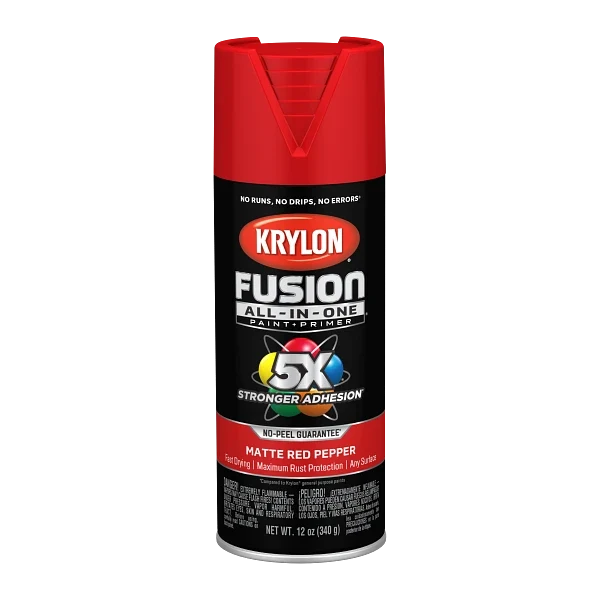
- Bonds to scuffed galvanized and mill-finish aluminum with no primer, the two metals that peel every ordinary enamel off in a season
- Handle time about 1 hour, so a folding chair sprayed before lunch is back on the patio by dinner
- Sheen range nothing else matches: gloss, satin, matte, metallic, hammered, and textured across a wide color deck
- Aerosol coverage is roughly 25 sq ft a can, so a full railing run is four or five cans and the math stops being cheap
- Softer film than an oil alkyd. On our pencil-hardness check it came in a full grade below Stops Rust at 30 days
- Overspray travels further than people expect on any breeze; mask twice as wide as feels necessary
5. Specialty High Heat Spray Paint
- Coverage
- 10–15 sq ft per 12 oz can
- Sheens
- Flat
- Dry / recoat
- Touch 30 min · handle 1–2h · recoat within 1h or after 48h
- Full cure
- Heat cure required: 1 hour at 250°F, then 2 hours at 400°F+
- VOC
- Aerosol; low-VOC SKUs available in restricted states
- Yellowing risk
- N/A (flat black and metallics)
- Primer
- None; high-heat primer only on bare cast iron
- Price tier
- $
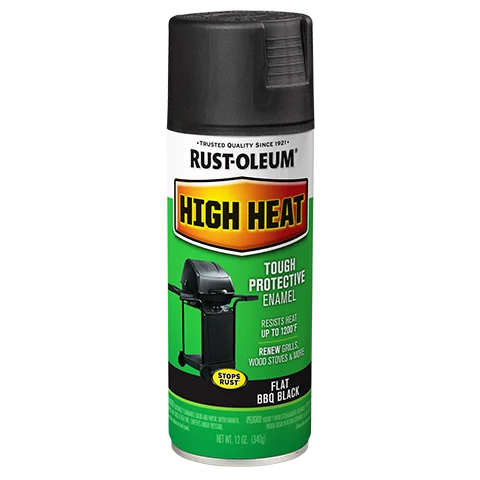
- Rated to 1200°F, which covers a charcoal kettle, a wood stove body, a fire pit ring, and a header wrap that every ordinary enamel scorches off
- Silicone-modified resin cures by heat rather than time, so the first burn cycle is what locks the film down
- Cheap enough to redo a grill every couple of seasons without thinking about it
- Four or five colors, flat only. Black, silver, white, almond. There is no glossy high-heat finish worth buying
- Not a rust-preventive coating outdoors; on an unheated part it chalks and lets moisture through faster than Stops Rust
- The heat-cure step is mandatory and people skip it, then wonder why the paint wipes off the grill lid with a rag
6. Rust Reformer
- Coverage
- 10–12 sq ft per 10.25 oz aerosol; about 100 sq ft per quart
- Sheens
- Flat black
- Dry / recoat
- Touch 20–40 min · topcoat after 24h
- Full cure
- 24h before topcoat; cure completes under the topcoat
- VOC
- Water-based quart is low-VOC; aerosol varies by state
- Yellowing risk
- N/A
- Primer
- This is the primer step; always topcoat it
- Price tier
- $
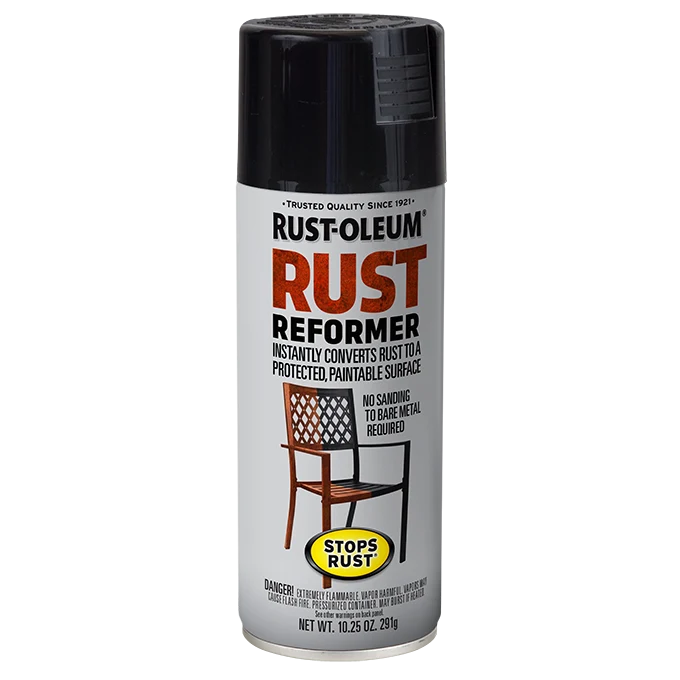
- Converts loose surface oxide into a stable flat-black film, which is the only honest answer for a fence post or a trailer frame you cannot get back to bare steel
- Goes on over rust with a brush or a can and is topcoatable in 24 hours by any of the picks above
- Under $12 for enough to treat a whole gate, and it turns a scary-looking job into a normal painting job
- Not a finish. Leave it uncoated outdoors and it chalks and fails inside a year
- Needs actual rust to work. On clean steel it sits there as a weak flat-black film with nothing to bond into
- Loose scale still has to come off first. It converts oxide, it does not glue flakes down
Rust-Oleum Stops Rust Rusty Metal Primer
The step that decides whether a wire-brushed railing looks right for two years or ten. Rusty Metal Primer is a high-solids alkyd built for metal you could not get all the way clean. It soaks into the remaining pitting and locks the residual oxide instead of bridging over it, which is exactly where a direct topcoat fails. One quart primes a standard porch railing run with enough left for a gate. Two coats, 48 hours, then any brush-on pick above. Two things it is not for: bare shop-new steel takes Clean Metal Primer instead, and galvanized or aluminum needs a self-etching primer, because an alkyd on fresh zinc saponifies and slides off in sheets.
BUY ON AMAZON
Ask a Question