Best Paint Conditioners and Additives
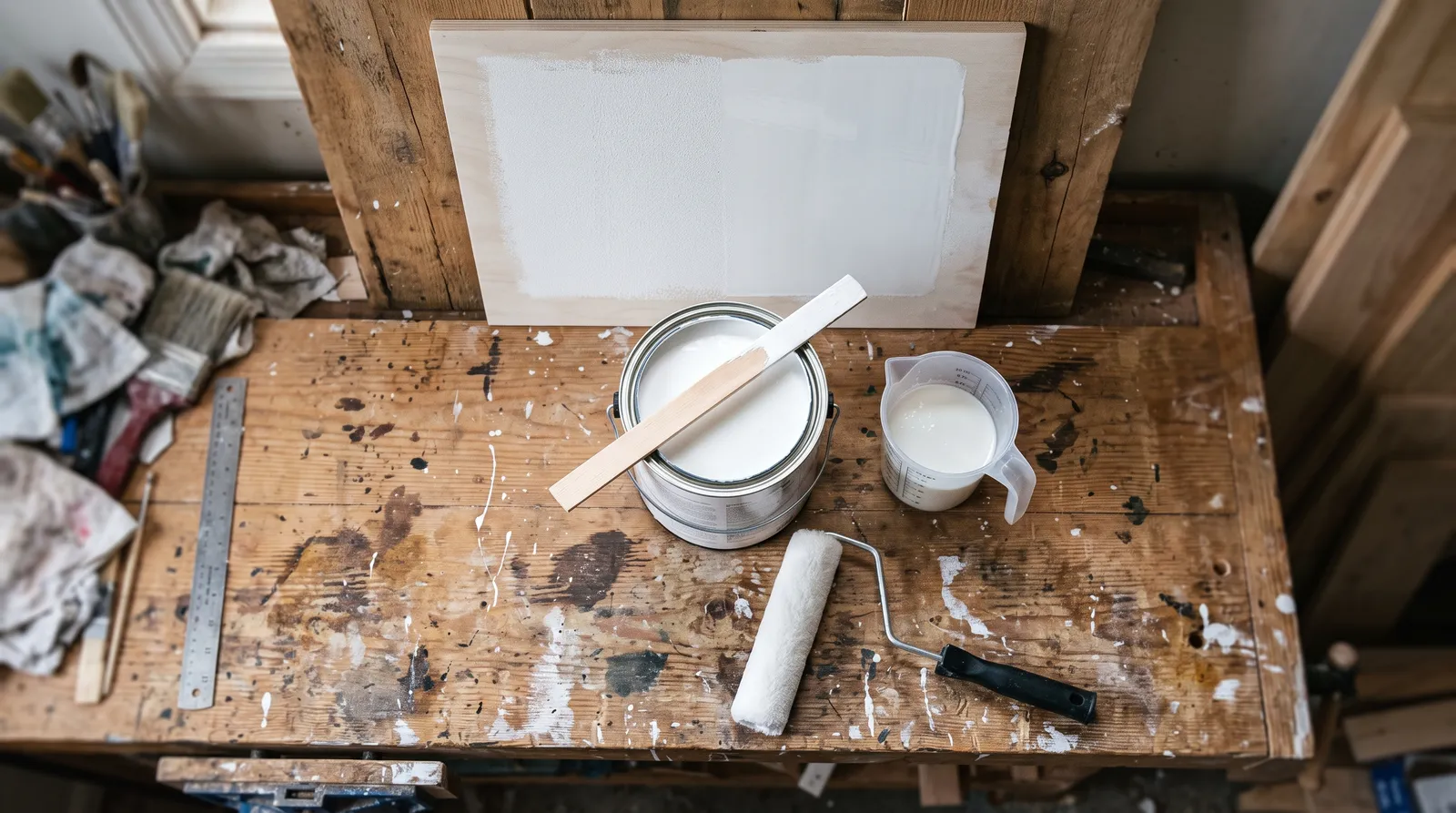
Six paint conditioners and additives dosed into the same three base paints and drawn down on glass. Top pick: Flood Floetrol for latex flow and brush marks.

Cheapest fix in the category at roughly $2 to $4 per treated gallon from the gallon jug; on our drawdown cards an 8-ounce dose closed roller stipple on flat wall paint that the same paint neat left visibly textured
The only pick here that improves penetration on chalky, weathered, or previously oiled substrate, which is why exterior painters keep it on the truck for old alkyd siding
100 percent acrylic waterborne chemistry that matches the resin family in BM Advance, Scuff-X, and Command, so open time goes up without the sheen sliding down
One pint disperses into a gallon of porch enamel or deck stain and stays suspended through a full roller pan, which the sand-from-the-hardware-store method never does
A 6-ounce bag into a gallon of ceiling flat put a fine sand tooth on our patched drywall panel that hid three feathered-out repairs a flat white had been highlighting
One 3.5-ounce packet solidifies up to two thirds of a gallon of latex in 15 to 20 minutes, which is the difference between curbside disposal and a Saturday at the county hazmat window
Disclosure: Some links below are affiliate links. We earn a commission if you buy through them, at no extra cost to you. Picks are based on the criteria in “How we picked”. No brand pays for placement.
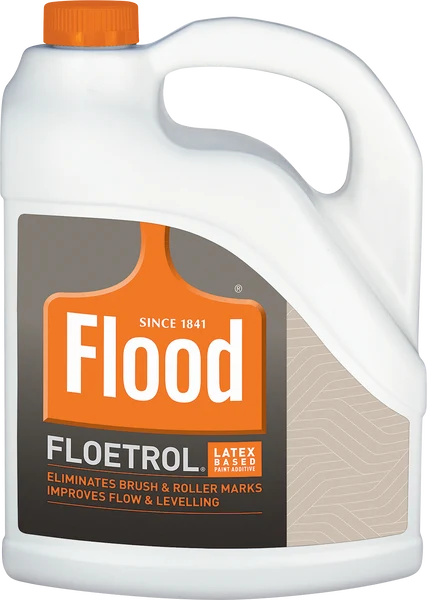
Top pick: Flood Floetrol. A gallon jug runs $32 to $40 and treats about sixteen gallons of wall paint at the label dose, which makes it the cheapest available fix for roller stipple and brush drag in latex. Floetrol wins on price per treated gallon, on sprayer behavior, and on being stocked in every paint aisle in the country. It falls short on oil-based paint, where it does nothing at all, and on hot-weather exteriors, where it buys minutes rather than hours. For alkyd enamel, varnish, and weathered or rusted metal, the answer is its sibling Flood Penetrol. For a waterborne cabinet enamel you already paid $80 a gallon for, Benjamin Moore Paint Extender 518 holds the sheen where a general-purpose conditioner drags it down. Three specialty jobs (grip on stair treads, texture on bad drywall, and hardening the half-can in the garage) all belong to Homax.
Most people buy an additive to solve a problem a better brush would have solved. That’s the honest framing of this whole category. A conditioner buys you time and flow; it does not buy you hide, adhesion, durability, or a coat you skipped. If your leveling problem comes from a $6 polyester brush, a 1/4-inch nap on textured drywall, or a box fan pointed at the wall you’re cutting in, no bottle on this page fixes it.
What an Additive Changes and What It Doesn’t
Paint dries in two stages. The water or solvent leaves first, then the resin particles coalesce into a continuous film. Everything a conditioner does happens in the gap between those two events.
A flow conditioner slows the first stage. The paint stays mobile a few minutes longer, so brush ridges and roller orange-peel have time to sag back into each other before the surface skins. That’s it. That’s the mechanism.
What it does not do: raise hide, improve adhesion, add scrub resistance, block a stain, or make a thin coat behave like a thick one. Additives that claim otherwise are selling the base paint’s job back to you in a smaller bottle.
There’s a second family here that isn’t about flow at all. Grit, aggregate, and hardener are physical additives. They put something into the can that stays in the film (or in the case of hardener, that turns the leftovers into a solid you can throw away). Different mechanism, different aisle logic, and worth understanding separately before you buy.
How We Picked
Six additives dosed into three base paints (an acrylic wall flat, BM Advance satin, and an oil porch enamel) at label rate and at double label rate, drawn down on black-and-white opacity cards with a 3-mil applicator and rolled on primed drywall with a 3/8-inch microfiber cover. We measured wet-edge minutes by lapping stripes at 60-second intervals until a lap line held, read 60-degree gloss on 7-day panels, checked hide by contrast ratio, and ran viscosity through a Ford #4 cup before confirming atomization on an airless with a 515 tip. Grit and texture additives were judged on suspension through a 45-minute roller-pan cycle instead. Three repaint contractors told us what they actually carry; pick-specific findings live in each review below.
The Six Picks at a Glance
| Product | Best for | Carrier | Cost per treated gallon |
|---|---|---|---|
| Flood Floetrol | Latex flow, brush marks, spraying | Waterborne | 🟢 $2–$4 |
| Flood Penetrol | Oil enamel, varnish, weathered metal | Solvent | ⚪ $4–$7 |
| BM Paint Extender 518 | Premium waterborne trim and cabinets | Waterborne | ⚪ $5–$7 |
| Homax Tread Tex | Grip on steps, decks, ramps | Inert aggregate | 🟡 $12–$16 |
| Homax Paint Texture Sand | Hiding drywall repairs and flaws | Inert aggregate | 🟡 $8–$10 |
| Homax Paint Hardener | Throwing out leftover latex | Powder | 🟡 $5 per 2/3 gal |
Homax takes three of six slots because PPG bought the specialty-additive aisle and nobody has taken it back. Those three products do three unrelated jobs, and in each one the alternative is a workaround (play sand stirred into porch paint, a rented hopper gun, a trip to the county hazmat window) rather than a competing product.
Which Bottle Solves Which Problem
- Roller stipple on a wall you can see in raking light: Floetrol, 4 to 8 oz per gallon.
- Spraying thick self-priming wall paint through an airless: Floetrol, up to 16 oz per gallon.
- Brush marks in oil enamel on a handrail or a steel door: Penetrol, 4 oz per gallon.
- Bare or lightly rusted metal that needs sealing before paint: Penetrol, applied neat.
- BM Advance or Scuff-X on cabinet doors in a warm shop: Extender 518, 4 oz per gallon.
- Painted concrete steps that go slick in the rain: Tread Tex, 1 pint per gallon.
- A ceiling covered in feathered-out patches you can still see: Homax Sand Texture, 6 oz per gallon.
- Three half-cans of latex and a garage you want back: Homax Paint Hardener.
The Picks in Detail
Flood Floetrol, Top Pick
The default answer, and it’s been the default answer since Flood introduced the chemistry decades before PPG bought the brand. Waterborne conditioner for latex, acrylic, waterborne alkyd, primer, and textured coating. Quart or gallon. Every paint aisle in America.
On our drawdowns the effect showed up exactly where you’d expect and nowhere else. Neat acrylic wall flat rolled with a 3/8-inch microfiber left visible stipple under raking light at full dry. The same paint at 8 ounces of Floetrol per gallon leveled to a surface that read smooth from two feet and nearly smooth at arm’s length. Wet-edge time went from about four minutes to about seven at 78 degrees. Seven minutes is not a long time. It is, however, the difference between lapping a 10-foot cut-in successfully and not.
The sprayer case is the stronger one. A thick self-priming wall paint pushed through a 515 tip on an airless atomized cleanly at 8 to 12 ounces of Floetrol per gallon, and the film build held. Cut the same viscosity with water and you get the atomization but a thinner dry film, which is how a “two-coat” job quietly becomes a one-and-a-half-coat job. If you spray, this bottle pays for itself. See the paint sprayer round-up for the tips and machines this pairs with.
Where it fails is the double-dose panel. At 16 ounces per gallon on a brush-and-roll job, gloss dropped about 4 units on our eggshell and the contrast ratio slipped enough that a deep base needed a third coat. People do this constantly, then blame the additive.
Buy the quart on Amazon and the gallon at the store. Heavy liquid ships badly, and the in-store gallon is usually $8 to $12 cheaper than the shipped one.
Buy it if you brush, roll, or spray waterborne paint and you can see your own tool marks. Skip it if the can in front of you is oil-based, or if you were about to pour in a whole quart.
Flood Penetrol, Best for Oil-Based Paint and Metal
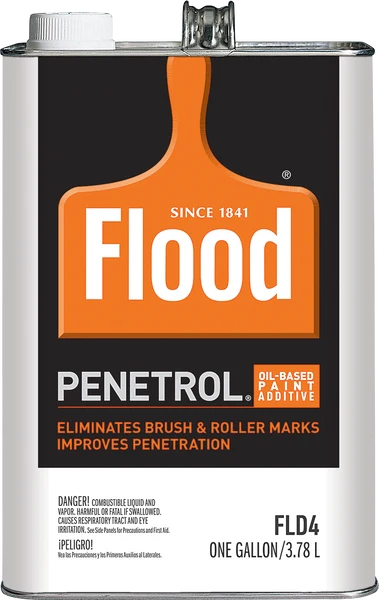
The other half of the pair, and the one people grab by mistake. Penetrol is solvent-borne, built for alkyd and oil paint, varnish, spar urethane, and oil-based primer and stain.
Two things it does that nothing else here does. First, it penetrates. On chalky, weathered, previously-oiled siding it carries binder down into the degraded surface layer instead of bridging over it, which is why exterior crews still keep a quart in the truck for 1970s alkyd trim. Second, it works neat. Wiped straight onto bare or lightly rusted steel it seals and inhibits, and on our test railing a Penetrol wipe followed by an oil enamel showed no bleed-through at 90 days where the enamel alone showed rust ghosting at the weld seams. For the full prep sequence on that substrate, our rusted metal guide covers what has to happen before either product touches the steel.
Brushing behavior is the everyday reason to own it. Oil enamel on a handrail at 4 ounces per gallon lost the brush drag entirely; the film flowed out over about 20 minutes into a surface with no visible ridges.
The cost is dry time. Oil is already slow, and Penetrol makes it slower. Our enamel panel at 8 ounces per gallon was still fingerprinting at 14 hours in 60 percent humidity, and every one of those hours is a chance for a dust nib. Plan the job so the piece dries somewhere clean, and check the drying and recoat times chart before you commit to a two-coat weekend.
High VOC, mineral-spirits odor, restricted availability in some states. Skip it if everything in your garage is waterborne.
Benjamin Moore Paint Extender 518, Best for Waterborne Trim and Cabinets
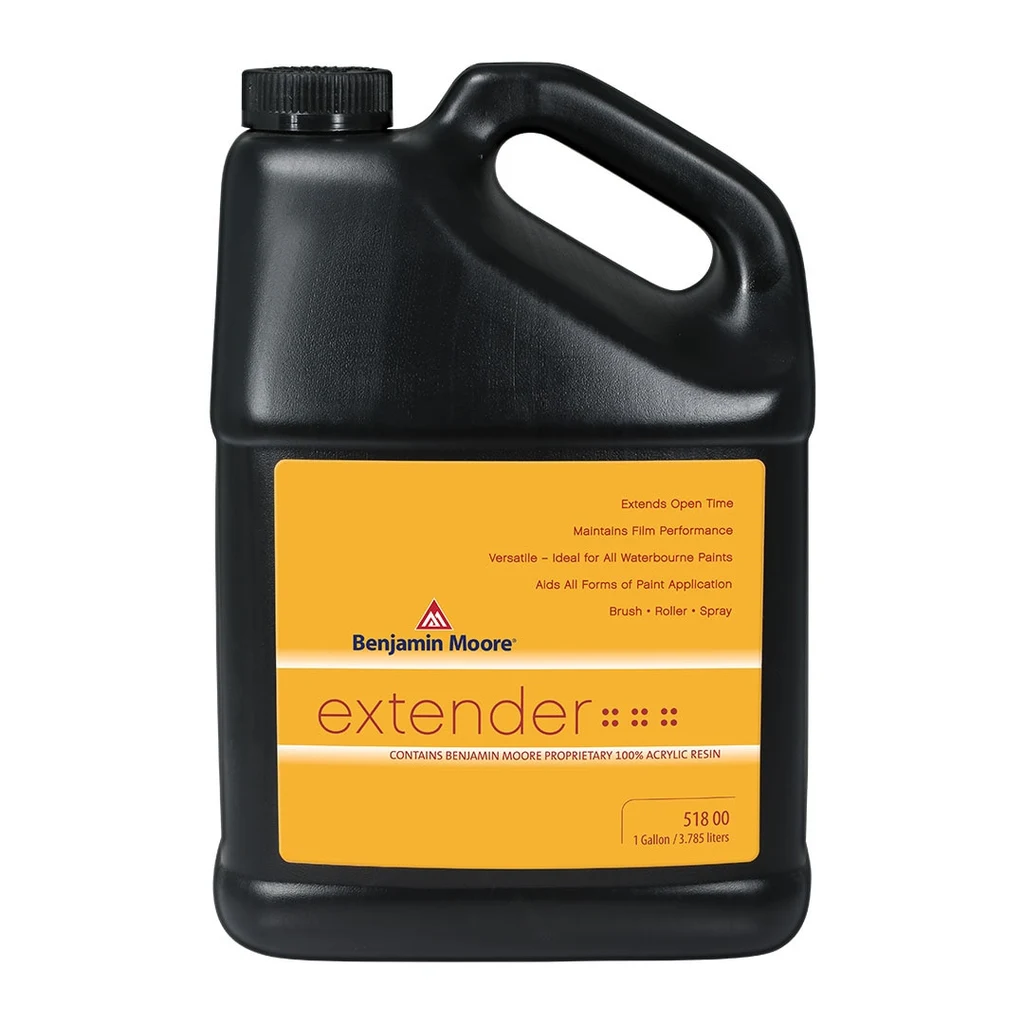
The specialist. BM’s 518 is a 100 percent acrylic waterborne extender built around the resins in Advance, Scuff-X, and Command, and the resin match is the entire argument for paying $50 a gallon instead of $35.
Here’s what that buys. Waterborne alkyd cabinet enamel is a high-solids, fast-tacking coating; the whole reason it looks like oil is that it flows hard and then sets hard. Add a general-purpose conditioner and you get the open time, but you also get a sheen drop, because you’ve diluted a carefully balanced resin package with a different one. On our Advance satin drawdowns, 4 ounces of 518 per gallon held the 60-degree gloss reading within 1 unit of neat. The same dose of Floetrol pulled it down about 3.
Practical result on a real door: at 78 degrees, neat Advance started tacking around the middle of a 30-inch cabinet face, which is where lap lines are born. At 4 ounces of 518 the wet edge held across the whole face and into the stile. That’s the job. If you’re spraying or brushing cabinets, read the full kitchen cabinet project guide and the best cabinet paint round-up alongside this.
Under 50 g/L VOC, which matters if you’re working to a low-VOC spec in a nursery or a closed kitchen.
The trade is distribution and price. Benjamin Moore dealers plus a thin third-party Amazon shelf. Call ahead. And on ordinary wall paint it is not worth the premium; Floetrol does that job at a third of the cost per treated gallon.
Buy it if you’re spraying or brushing BM waterborne enamel on trim, doors, or cabinets. Skip it if you’re painting walls.
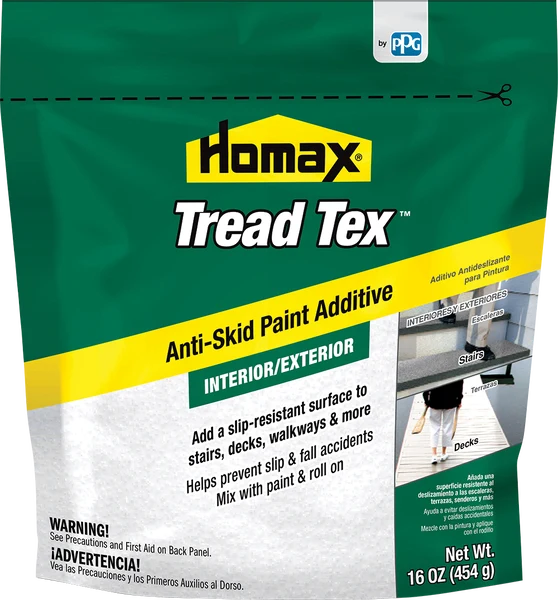
Homax Tread Tex, Best Anti-Skid Additive
A pint of graded aggregate that goes into a gallon of porch enamel, floor paint, or deck stain and makes the finished surface grip. Interior or exterior, latex or oil, paint or stain. No chemistry restriction, which is unusual on this page.
The alternative most people try is play sand from the hardware store. It doesn’t work, and the reason is suspension. Sand sinks to the bottom of the pan in about two minutes, so the first cut is gritty and the last cut is glass. Tread Tex stayed dispersed through a 45-minute roller-pan cycle with a stir every ten minutes or so, and the finished tread had grip across the whole board instead of in patches.
Grit size is well judged. Painted stair treads still look like painted stairs. Bare feet on a pool deck are fine.
Two honest warnings. It settles, and if you walk away from the pan you’ll notice. And texture holds dirt, so exterior concrete steps with Tread Tex want a deck brush rather than a hose. There is no undo either; getting rid of the grip later means stripping the coating.
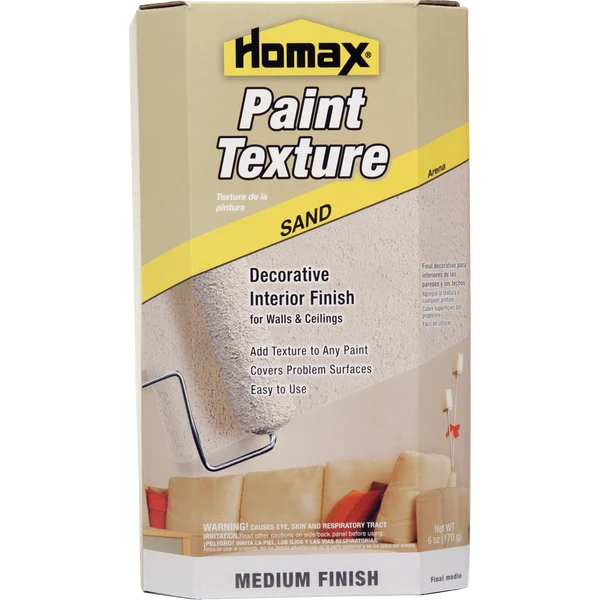
Homax Interior Paint Texture Sand, Best Texture Additive
A 6-ounce bag into a gallon of paint. Fine aggregate, rolls on with an ordinary cover, texture and color in one pass.
We rolled it into a ceiling flat over a drywall panel with three feathered-out patches that a flat white had been happily advertising. The sand tooth killed all three. Not disguised, gone, because the eye stops reading the plane as flat and starts reading it as texture. For an older house with a ceiling full of history, this is a $9 bag against a full skim coat.
Two things to accept going in. Washability drops hard, so keep it off hallway walls and out of mudrooms. And a future drywall repair means re-texturing the whole plane, since a sand tooth does not patch invisibly. If the flaws are localized rather than everywhere, fix them properly first with the products in our wall filler and spackle round-up and skip the texture.
Mix it slow. Dumped in dry it clumps; stirred in gradually with a five-minute soak before you roll, it disperses clean.
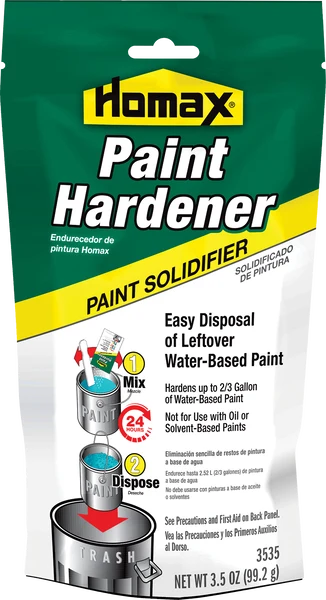
Homax Paint Hardener, Best for the Half-Can in the Garage
Not a conditioner. A disposal product, shelved with the additives, and the highest problem-solved-per-dollar item on this page.
One 3.5-ounce packet solidifies up to two thirds of a gallon of latex paint in 15 to 20 minutes. It works on roller-bucket wash water too, which is the part people miss; the cleanup stream from a whole interior repaint goes into one can and comes out as a solid. About $5 a packet.
Latex and acrylic only. Oil paint, oil stain, and solvent still go to household hazardous waste, and no powder changes that.
The one place it goes wrong is dosing by eyeball. A packet against a nearly full gallon gives you pudding rather than a solid, and pudding is not curbside-legal anywhere. Estimate high, use two packets if you’re unsure, and check your municipality’s rules on lid-off disposal before the truck comes.
Dosing Is the Whole Skill
Every failure story in this category is a dosing story.
The label numbers are ceilings, not targets. Floetrol says up to 8 ounces per gallon for brush and roll, up to 16 for spraying. Start at 4. Add more only if the first test panel still shows tool marks. Penetrol at 4 ounces per gallon is plenty for brushing oil enamel; 8 is for weathered substrate where penetration is the goal. Extender 518 at 4 ounces is where the sheen holds.
The failure mode past those numbers is consistent across all three. Gloss drops. Hide drops. Film build drops. Scrub resistance drops, and that one doesn’t show up until month eight when somebody wipes a scuff off the hallway and takes the paint with it.
Mix a test board. Every time.
Where Additive Jobs Go Wrong
- Poured Floetrol into oil paint. Wrong chemistry. The emulsion never comes together and the film stays soft. Start over.
- Used a full quart on a gallon. That’s a 25 percent dilution. Sheen, hide, and washability all take the hit. Label dose exists for a reason.
- Expected an additive to fix a hot wall. At 92 degrees with wind, seven extra minutes of open time doesn’t save the lap. Move to the shaded elevation and follow the sun around the house.
- Blamed the conditioner for brush marks that came from the brush. A stiff polyester brush in a high-solids enamel leaves ridges no additive levels out. Fix the tool. Our brush mark fix guide walks the diagnosis.
- Stirred in the texture additive dry and fast. Clumps show up in the roller cover, not in the bucket, which means you find them on the ceiling.
- Stopped stirring the anti-skid pan. Grit settles in minutes. Stir every ten, or the last third of the job is slick.
- Under-dosed the hardener. Pudding, not solids. Two packets is cheaper than a trip to hazmat.
Application Notes
- Add the additive to the paint, not the other way around. Pour, then box the paint between two buckets so the mix is uniform across every gallon on the job.
- Dose per gallon, not per bucket. A 5-gallon box gets five doses, measured, not a splash.
- Test on a board in the room’s light. Sheen shift and hide loss show up under the actual lamps, not in the garage.
- Give the mix five minutes. Aggregate additives especially need a soak before the first roll.
- Don’t stack additives. Conditioner plus texture plus a colorant load is three changes to one film; pick the one you actually need.
- Keep the base paint’s recoat window. A conditioner extends open time, not the manufacturer’s cure schedule.
Also Considered, Also Rejected
- XIM Latex X-tender. A real competitor to Floetrol with a loyal following among sprayers. Distribution has thinned out at retail since the Rust-Oleum acquisition, and we don’t rank a product readers can’t reliably buy this week.
- Standalone paint mildewcide additives. Hand-dosing a biocide is a real exposure risk with a narrow label window, and modern exterior and bath paints ship with a better-balanced package than anything you can stir in. Buy the right paint.
- Japan drier. Speeds oil-paint dry, and it’s the fastest way to get a brittle, alligatored film if you go past a few drops per quart. Too much rope for a homeowner.
- Water as a conditioner. Free, and it does lower viscosity. It also lowers film build, hide, and scrub resistance in exact proportion. The reason Floetrol exists is that water is the wrong tool for this.
- Latex paint “cell activators” sold for pour art. Repackaged flow additives at a craft-aisle markup. Buy the Floetrol quart.
If you brush or roll waterborne paint and you can see your own tool marks, buy a quart of Floetrol and start at 4 ounces per gallon. If the can is oil-based, buy Penetrol instead and plan for a slower dry. Everything else on this page solves a narrower problem, and you’ll know when you have it.
Full Comparison
| Product | Best for | Yellowing | Price |
|---|---|---|---|
| FLOOD FLOETROL Latex-Based Paint Additive | Top pick — best latex and acrylic flow conditioner | None (waterborne, no oil) | $ |
| FLOOD PENETROL Oil-Based Paint Additive | Best for oil-based paint, varnish, and bare or rusted metal | Oil chemistry; expect the same ambering as the alkyd it goes into | $$ |
| Benjamin Moore Paint Extender 518 | Best for premium waterborne trim and cabinet enamel | None (waterborne acrylic) | $$$ |
| HOMAX TREAD TEX Interior/Exterior Anti-Skid Paint Additive | Best anti-skid additive for steps, decks, and ramps | None | $ |
| HOMAX Interior Paint Texture - Sand | Best texture additive for hiding wall and ceiling flaws | None | $ |
| HOMAX Paint Hardener | Best for disposing of leftover latex paint | N/A | $ |
Every Pick, Pros and Cons
Pros, cons, and specs for each pick. The cons are not optional here.
1. FLOOD FLOETROL Latex-Based Paint Additive
- Coverage
- Treats up to 16 gal of paint per gallon jug at the 8 oz brush/roll dose
- Sheens
- No sheen of its own; slight sheen drop at high dose
- Dry / recoat
- Extends wet edge; does not change the paint's stated recoat window
- Full cure
- Follows the base paint
- VOC
- Waterborne, low VOC; well under the architectural coatings cap
- Yellowing risk
- None (waterborne, no oil)
- Primer
- N/A — mixes into finish paint, primer, or textured coating
- Price tier
- $
- Cheapest fix in the category at roughly $2 to $4 per treated gallon from the gallon jug; on our drawdown cards an 8-ounce dose closed roller stipple on flat wall paint that the same paint neat left visibly textured
- Behaves in a sprayer. It lowers viscosity enough to atomize a thick self-priming wall paint through a 515 tip without the water-thinning penalty of a thinner film build
- Stocked at Home Depot, Lowe's, Ace, Sherwin, and Amazon in quart and gallon. No hunting, no special order, no waiting
- Rust-inhibiting on metal primer and a genuine fix for faded fiberglass, which is a second and third job most buyers never find out about
- Does nothing in oil-based paint, alkyd enamel, or varnish. Wrong chemistry entirely, and people pour it in anyway
- Overdosing past the 8-ounce label limit thins the film, drops the sheen a half step, and on deep bases visibly weakens hide
- Open time gain is minutes, not hours. On a 92-degree south wall with wind you still get a lap line if you stop for lunch
- The gallon jug is usually cheaper at the store than shipped; Amazon is the better buy on the quart
2. FLOOD PENETROL Oil-Based Paint Additive
- Coverage
- Treats roughly 4 gal of oil paint per quart at the 8 oz dose; less when used neat on metal
- Sheens
- Slightly raises gloss on oil enamel at low dose
- Dry / recoat
- Lengthens open time; adds several hours to recoat on oil systems
- Full cure
- Follows the base coating; expect a longer cure on humid days
- VOC
- Solvent-borne, high VOC. Check state restrictions before ordering
- Yellowing risk
- Oil chemistry; expect the same ambering as the alkyd it goes into
- Primer
- N/A — mixes into oil paint, stain, varnish, or primer
- Price tier
- $$
- The only pick here that improves penetration on chalky, weathered, or previously oiled substrate, which is why exterior painters keep it on the truck for old alkyd siding
- Brushes out oil enamel on handrails and doors with a leveling quality no waterborne conditioner reproduces; the brush drag disappears at about 4 oz per gallon
- Works neat as a rust-inhibiting sealer on bare or lightly rusted metal, and restores gloss to sun-faded fiberglass doors and boat hulls
- Extends working time on varnish and spar urethane, where a 15-minute open window is the difference between a flat film and a row of brush ridges
- Solvent-borne with a real mineral spirits load. High VOC, needs ventilation, and availability is tighter in California and the OTC states
- It slows dry. On a humid day an oil enamel already sitting at 8-hour recoat can push past 16, and dust nibs land in every one of those hours
- Roughly $18 to $22 a quart, which is 40 to 60 percent more than Floetrol for a job most homeowners only hit once a year
- Overdose and the film stays soft. Past about 8 oz per gallon you are diluting the resin, not conditioning it
3. Benjamin Moore Paint Extender 518
- Coverage
- Treats roughly 8 gal at the 4 oz dose per gallon jug
- Sheens
- Designed to hold the base sheen at label dose
- Dry / recoat
- Extends wet edge and open time; recoat window follows the base paint
- Full cure
- Follows the base paint (Advance is a 7-day handle, 30-day cure)
- VOC
- Under 50 g/L
- Yellowing risk
- None (waterborne acrylic)
- Primer
- N/A — mixes into waterborne finish paint or primer
- Price tier
- $$$
- 100 percent acrylic waterborne chemistry that matches the resin family in BM Advance, Scuff-X, and Command, so open time goes up without the sheen sliding down
- Under 50 g/L VOC, which keeps a low-VOC cabinet or nursery spec intact when a general-purpose conditioner would not
- On our Advance satin drawdowns a 4-ounce dose held a wet edge across a full 30-inch cabinet door face at 78 degrees, where neat Advance started tacking at the halfway point
- Thins for spraying and extends for brushing out of the same jug, so one product covers both cabinet workflows
- Benjamin Moore dealers and a thin Amazon third-party shelf. No Home Depot, no Lowe's, and stock goes in and out
- About $20 a quart and $50 a gallon. You are paying premium-brand money for a job Floetrol does 80 percent as well on ordinary wall paint
- Formulated around BM waterborne resins. It works in other acrylics, but the resin match that justifies the price stops applying
4. HOMAX TREAD TEX Interior/Exterior Anti-Skid Paint Additive
- Coverage
- 1 pint treats 1 gal of paint or stain
- Sheens
- Knocks gloss down toward satin by adding surface texture
- Dry / recoat
- No change to the base coating
- Full cure
- Follows the base coating
- VOC
- Negligible; inert aggregate
- Yellowing risk
- None
- Primer
- N/A — mixes into the topcoat
- Price tier
- $
- One pint disperses into a gallon of porch enamel or deck stain and stays suspended through a full roller pan, which the sand-from-the-hardware-store method never does
- Grit is fine enough that painted stair treads still read as painted stairs, not as skateboard tape
- Works in latex and oil, interior and exterior, in stain as well as paint. The one additive here with no chemistry restriction
- It settles. Stop stirring for ten minutes and the last third of the pan comes out slick while the first two thirds came out gritty
- Adding grit to a horizontal surface adds dirt-holding texture. Painted concrete steps with Tread Tex need a scrub brush, not a hose
- You cannot un-grit a floor. Removing it later means stripping the coating, not sanding the texture off
5. HOMAX Interior Paint Texture - Sand
- Coverage
- 6 oz bag treats 1 gal of paint
- Sheens
- Reads flat regardless of the base paint's sheen
- Dry / recoat
- No change to the base paint
- Full cure
- Follows the base paint
- VOC
- Negligible; inert aggregate
- Yellowing risk
- None
- Primer
- N/A — mixes into the finish paint
- Price tier
- $
- A 6-ounce bag into a gallon of ceiling flat put a fine sand tooth on our patched drywall panel that hid three feathered-out repairs a flat white had been highlighting
- Texture and paint go on in one pass with an ordinary roller. No hopper gun, no compressor, no second dry cycle
- Around $8 to $10 a bag, which makes a whole hallway ceiling cheaper to texture than to skim-coat and sand
- Sand tooth is close to impossible to patch invisibly later; a future drywall repair means re-texturing the whole plane, not the patch
- Cuts washability hard. Wrong choice for a mudroom, a kid's hallway, or anywhere fingers land
- Mixing is fussy. Dump it in dry and you get clumps, so it wants a slow stir and a five-minute soak before you roll
6. HOMAX Paint Hardener
- Coverage
- 1 packet hardens up to 2/3 gal of latex paint or wash water
- Sheens
- N/A
- Dry / recoat
- Solidifies in 15 to 20 minutes
- Full cure
- N/A
- VOC
- Non-toxic powder
- Yellowing risk
- N/A
- Primer
- N/A
- Price tier
- $
- One 3.5-ounce packet solidifies up to two thirds of a gallon of latex in 15 to 20 minutes, which is the difference between curbside disposal and a Saturday at the county hazmat window
- Works on wash water and roller-bucket sludge, not only on paint, so the whole cleanup stream goes in one can
- Costs about $5 a packet. Cheapest problem-solved-per-dollar on this page
- Latex and acrylic only. Oil paint, stain, and solvent still go to household hazardous waste, no exceptions
- Dose is measured against how much paint is left, and most people guess. Under-dose and you get pudding, not a solid
- Check your local rules before you toss the can. Some municipalities want the lid off and the solids visible at the curb
Ask a Question