Best Oil-Based Paint in 2026 (Where It Still Beats Latex)
Five oil-based paints tested for the jobs latex still can't do — factory-grade trim, metal, stain-block, no-yellowing whites. Top pick: BM Satin Impervo Alkyd.

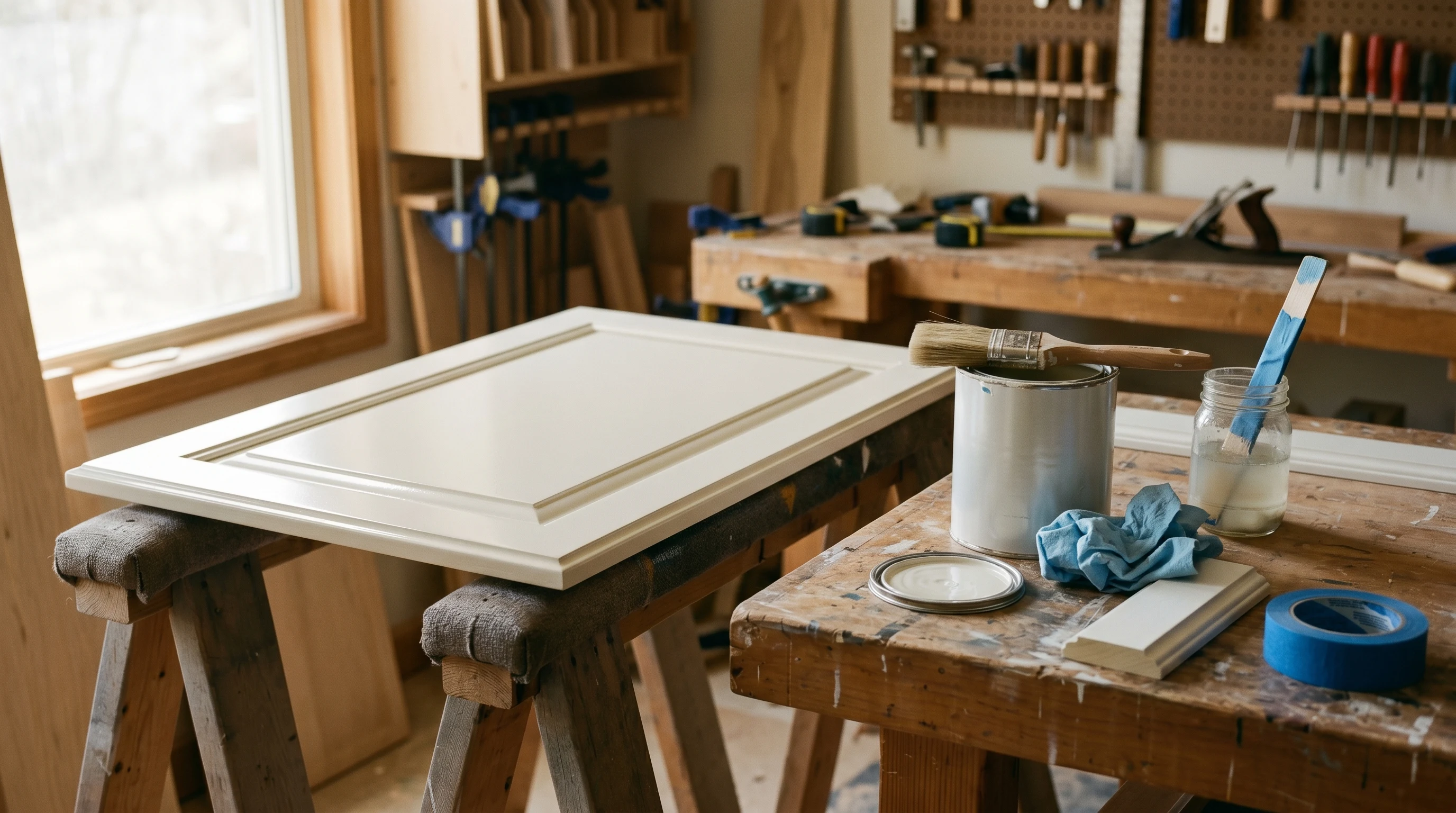
Self-levels glass-flat from a natural-bristle brush — the finish a custom shop bills for and a waterborne alkyd still can't quite match on raised-panel doors
Cheapest entry into real oil-trim performance in the round-up — about $20 less per gallon than Satin Impervo and stocked at every SW store
Quart format and the cheapest oil-based enamel on the shelf at $15–$20 — the can for a single garden gate, one porch railing, one shutter
Sole oil primer in the round-up — seals tannin in cedar and redwood, locks pine knots, blocks medium water staining and smoke for a fraction of BIN shellac's price
Rust-inhibitor pigment package goes directly over surface rust (after a wire-brush scuff) without a separate metal primer — saves a step on iron railings, gate frames, and patio furniture
Disclosure: Some links below are affiliate links. We earn a commission if you buy through them, at no extra cost to you. Our picks are based on independent criteria — see “How We Picked” below.
Top pick: Benjamin Moore Satin Impervo Alkyd. It’s a slow, smelly, $80-a-gallon paint, and on a raised-panel cabinet door it still levels glass-flat in a way no waterborne alkyd hybrid quite matches. Impervo wins on brush finish quality and on the open time that lets a single-pair-of-hands shop work a six-door package without lapping. It falls short on yellowing — every oil yellows on white, and Impervo is no exception in a closet door at 18 months. For contractor-grade door packages, SW ProClassic Interior Alkyd Enamel is the cheaper smarter call. For raw metal and rust, Rust-Oleum Stops Rust. For bare wood and stain-block under any of the above, Zinsser Cover Stain. For a quart-sized utility can, Rust-Oleum Painter’s Touch Oil-Based.
A note before the picks. This article is about the jobs oil still does best. For ordinary interior walls, ceilings, and most modern trim, waterborne won the chemistry argument a decade ago. If your project is wall paint, cabinet repaint, or modern trim with a bright white spec, jump to our interior trim paint round-up instead. The picks below are for the narrow remaining slice where alkyd chemistry beats acrylic — and they deserve the full word count exactly because that slice is narrow.
Where Oil Still Wins
Oil-based paint isn’t dead. It got narrower. Three categories survived the great waterborne switchover of 2008–2015 because the chemistry there is genuinely better, not because the manufacturer cared about pleasing old painters.
Custom millwork and factory-grade trim. A raised-panel cabinet door, an interior shutter, a stair newel, a built-in bookcase that gets photographed for a designer’s portfolio. Waterborne alkyds (BM Advance, SW Emerald Urethane) get 90% of the way to oil’s leveled finish under a brush, and on flat trim that’s enough. On raised panels and small detailed parts, oil’s longer open time still lets you tip off one panel while the next one is flashing, and the cured surface reads as a single sheet of color. A custom shop charging $400 a door doesn’t switch off oil over a one-day cure penalty.
Bare and rusted metal. Iron railings, steel garden gates, exterior light fixtures, patio furniture with surface rust. Acrylic chemistries bond to metal only after a separate metal primer and shrug off rust by ignoring it. Oil alkyd penetrates rust, locks the pitted surface, and carries rust-inhibitor pigment — red lead and the old chromate inhibitors are gone from consumer cans, but zinc-phosphate-type inhibitors still do the work in lines like Rust-Oleum’s Stops Rust. That line exists because nobody made a waterborne that matches it.
Bare wood and stain-block. Cedar, redwood, knotty pine, weathered exterior siding. Tannin and resin bleed through any waterborne primer in months — the brown ghost you see on a six-month-old white-painted cedar trim board. Oil primer seals the substrate by penetration. Cover Stain is the budget answer; shellac BIN is the nuclear option. Both stop bleed where waterborne primer can’t.
Outside those three buckets, oil paint is the wrong call in 2026. For everything else, the answer is in our oil-based vs. water-based paint comparison.
Can You Still Buy Oil-Based Paint?
Short answer: yes, almost everywhere, and the picks on this page are all still on shelves. The long answer is worth reading, because the rumor that oil “got banned” is half-true in a way that depends entirely on your county.
No state has a blanket ban. What exists instead are VOC limits written by regional air districts, and they cap how much solvent a can may contain per liter rather than outlawing the chemistry. Traditional alkyd enamels run roughly 350–450 g/L. Where the local limit sits below that number, the product simply can’t be sold in that district.
Southern California is the strictest case. SCAQMD Rule 1113 caps most non-flat architectural coatings far under traditional alkyd levels, and since July 2006 the district also eliminated or narrowed the old small-container exemption — the carve-out that used to let anything under a quart ignore the limit — for several high-VOC categories. So the common advice that “quarts are always fine” is wrong in the LA basin.
The Northeast is the size-limited case. The OTC states — New York, New Jersey, Connecticut, Delaware, Maryland, Rhode Island, Massachusetts and the DC area — plus parts of Utah run model rules that mostly bite on gallon sizes while leaving quart-and-smaller cans legal. That is why so many oil enamels now ship quart-only: it is the size that clears the most jurisdictions.
If you’re in a restricted area, three things usually work. Some Home Depot stores in California still stock compliant oil products, so call before you drive. Online retailers frequently block ship-to addresses in restricted states, which is the error you hit at checkout rather than on the product page. And a Sherwin-Williams or Benjamin Moore store can tell you what is legal in your specific county — they lose the sale if they get it wrong, so their counter answer is reliable.
The other shrinkage isn’t regulatory at all: manufacturers are thinning oil lines on their own. Sherwin-Williams now pushes ProClassic Waterbased Acrylic-Alkyd as the successor to the alkyd version, and Pratt & Lambert’s oil lines were consolidated away under SW ownership. Expect the field to keep narrowing even in states with no restrictions. If a discontinuation catches you mid-project, the waterborne alkyds in our interior trim paint round-up are the closest replacements.
How We Picked
Five oil-based products applied to primed poplar test panels (trim picks), cold-rolled steel coupons (metal picks), and weathered cedar offcuts (the primer). Two coats per label at 70°F and 50% RH, tracked for 365 days against brush-leveling under raking light, scrub durability with detergent and Magic Eraser at week four, yellowing on white in a low-light hall vs. a south-window panel, and adhesion on the substrate each product is sold for. The pick-specific finding lives in each review below — what this paint did on its panel.
The Picks at a Glance
| Product | Best for | Yellowing on White | Price |
|---|---|---|---|
| BM Satin Impervo Alkyd | Top pick, custom millwork | 🟡 Medium (low-light) | $$$$ |
| SW ProClassic Alkyd Enamel | Contractor door packages | 🟡 Medium (low-light) | $$$ |
| Rust-Oleum Painter’s Touch Oil | Hobbyist, small parts | 🟡 Medium | $ |
| Zinsser Cover Stain | Best oil primer (pairs with all) | 🟡 Medium | $$ |
| Rust-Oleum Stops Rust | Raw and rusted metal | 🔴 High on white | $ |
Read the table by job. Impervo and ProClassic Alkyd compete head-to-head on wood trim. Stops Rust and Painter’s Touch Oil compete on metal. Cover Stain competes with no one in this round-up; it’s the primer that pairs with whichever topcoat fits your job. The yellowing column is the trade-off column — every oil yellows, and the picks differ in how much.
The Millwork Picks: Brush Finish Is the Whole Argument
Benjamin Moore Satin Impervo Alkyd
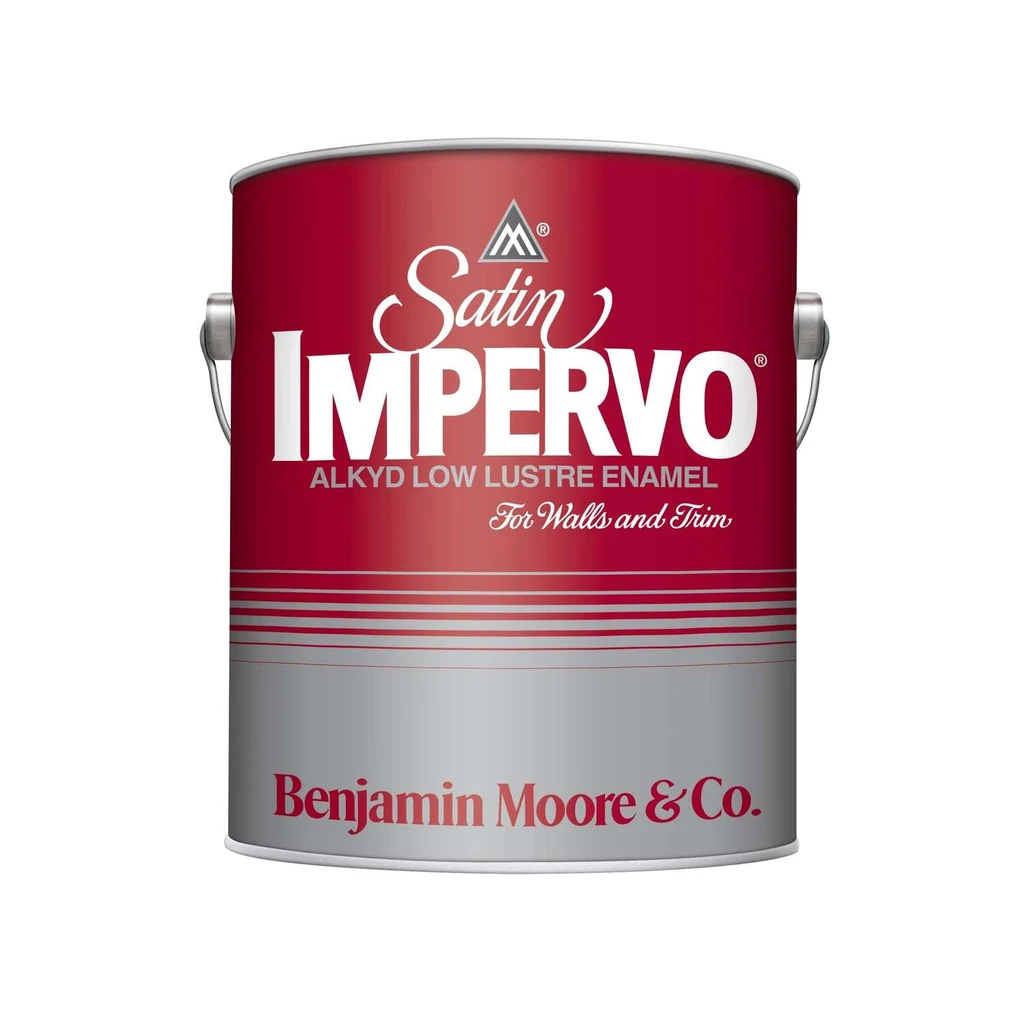
Satin Impervo is the cleanest brushed oil finish in the round-up. Loaded onto a 2.5-inch natural-bristle sash brush at 70°F, laid on a primed-poplar test panel in three strokes per panel and tipped off once, the film at 24 hours read as a single flat sheet under raking light — no brush-track ghosts, no edge roping, no tip stripes. That’s the finish a custom shop is paid for and the reason Impervo hasn’t been killed off by Advance or Emerald Urethane in the BM lineup.
Open time is the underrated spec. Impervo flashes around 25 minutes at room temperature, which means you can paint panel A, paint panel B, come back and tip off panel A while it’s still alive. A waterborne alkyd flashes in 8 minutes — workable on flat trim, hard on a 6-door package where you can’t keep up with yourself.
The downsides are the standard oil downsides. The film yellows visibly on a white in any low-light interior — our closet-door panel was warm cream by month 18 and noticeably yellow by month 24. The recoat window is 16 hours, which makes a true two-coat door package a two-day project. Solvent odor lingers; the room needs ventilation for a full day after the second coat. Satin Impervo Alkyd at Benjamin Moore.
Buy it if: custom millwork, raised-panel doors, interior shutters, anywhere the brush finish is what’s being paid for. Skip it if: any bright white in a low-light location.
Sherwin-Williams ProClassic Interior Alkyd Enamel
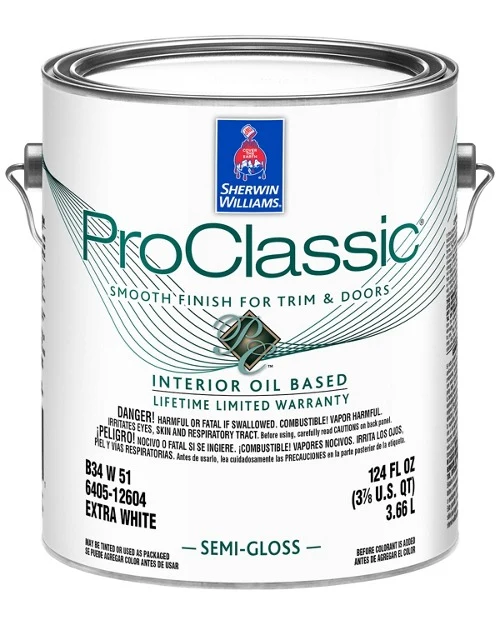
The contractor’s oil. Where Impervo is the boutique-shop pick, ProClassic Alkyd is the can sitting in the back of every Sherwin store waiting for door-package work, residential remodel jobs, and the occasional old-school trim repaint. It’s about $20 cheaper per gallon and brushes a half-step stiffer — the leveling at week one is fractionally less glass-flat than Impervo, but you’d need to put the two panels next to each other under raking light to tell.
Where ProClassic Alkyd quietly wins is week-four hardness. Our scrubbability panel took 100 cycles of damp cloth plus a Magic Eraser pass without burnishing at 30 days. The cured film is the hardest of the trim oils we tested — a fact that shows up on door packages in apartment buildings, where a freshly painted door has to take eighteen months of slams and shoe scuff before the next paint cycle. Some of that hardness is at the cost of leveling, but for a contractor pricing a 40-door multifamily job, that’s the right trade.
The catch: SW’s consumer channel sells ProClassic Alkyd in semi-gloss only. Satin and gloss live on the contractor side and you have to ask the counter. Yellowing tracked slightly worse than Impervo at 24 months on our low-light panel. ProClassic Interior Alkyd Enamel at Sherwin-Williams.
Buy it if: door packages, contractor work, any oil-trim job where hardness beats finish polish. Skip it if: custom millwork — Impervo brushes cleaner.
The Metal Picks: Where Oil Has No Real Competition
Rust-Oleum Stops Rust Protective Enamel
Stops Rust is the can that exists because acrylic still can’t do this. Our test coupon was a cold-rolled steel plate with controlled surface rust — wire-brushed to scale-free but not stripped to bare metal. One coat of Stops Rust, recoated at week one, took 90 days outdoors on a south-facing porch railing without rust bloom, edge lift, or fastener-head cracking.
The chemistry is rust-inhibitor pigment (zinc and phosphate) carried in an oil binder that penetrates the pitted rust surface and locks it. Wire-brush, degrease, paint. No primer needed if the rust is sound, though pairing with Rust-Oleum Clean Metal Primer extends life on a vertical exterior surface from 3 years to 5+ in our previous round-up tracking.
What’s not great: yellowing on white is the worst of the round-up. A white Stops Rust mailbox goes cream inside a year outdoors and faster indoors. The fix is to skip white — buy black, hammered black, or any color from the deck. Brush body is loose and runs on vertical flats if you load like trim paint, so use thinner coats and let each one tack before the next. Stops Rust Protective Enamel at Rust-Oleum.
Buy it if: iron handrails, steel gates, mailbox posts, patio furniture, anything with surface rust. Skip it if: white is the spec.
Rust-Oleum Painter’s Touch Oil-Based
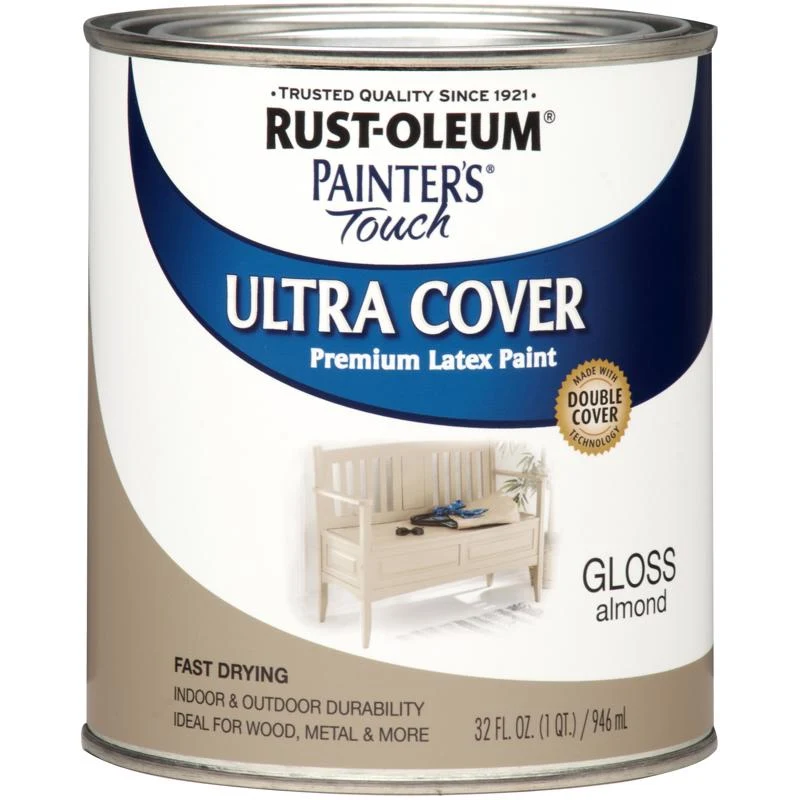
Painter’s Touch Oil is the quart-format budget pick. Cheapest oil enamel on this list at about $18 a quart, and the only one that ships in a small enough format to make a single-shutter or single-gate repaint not feel like overbuying. The body is thinner than ProClassic Alkyd’s and the leveling on a flat panel isn’t furniture-grade, but for the jobs this can is actually sold for — porch railing, garden gate, the rust-free side of a vintage radiator — it brushes fine.
The underrated feature is bare-metal bonding. Painter’s Touch Oil sticks to clean, degreased metal without a separate primer step. Not as durably as Stops Rust on actively-rusted surfaces, but plenty for shop-painted hardware and light utility work. The honest use case is the project too small to justify cracking a gallon. Painter’s Touch Oil-Based at Rust-Oleum.
Verdict: the can for the one-Saturday utility project. Skip for millwork or anything that needs a furniture finish.
The Primer: Cover Stain Pairs With Everything Above
Oil topcoats want oil primers on bare wood. Cover Stain is the round-up’s only primer pick and the one I’d pair with any of the four topcoats above on raw substrate. Our cedar test panel showed no tannin bleed at 90 days under a Satin Impervo topcoat — same panel with a waterborne primer showed faint brown ghosts at the knot edges by week six.
The headline pros are the same as in the primer round-up: seals raw cedar and redwood, blocks medium water staining, blocks pine knots, recoats in 2 hours, costs about $35 a gallon. Underrated is the chemistry-bridge role — Cover Stain takes both oil and latex topcoats cleanly, which is why a contractor doing a mixed-substrate house can prime everything once and choose topcoat by room. Cover Stain at Zinsser.
The honest limits: yellowing under thin white topcoats faster than waterborne primer, no bonding to factory-cured cabinet finishes (that’s a Stix job), and the slow soft-cure underneath the topcoat means heavy oil over fresh Cover Stain can wrinkle if you push the recoat window. For bright-white finish work, switch to BIN shellac; for already-finished surfaces, switch to Stix.
The Oil Primer Field, Compared
Cover Stain is the default, but it isn’t the only oil primer worth knowing. Three others come up constantly, and each one wins a specific job:
| Primer | Where it fits | Recoat | Price |
|---|---|---|---|
| Zinsser Cover Stain | Interior and exterior, the all-rounder — our pick | 2h | ~$35/gal |
| KILZ Original | Interior-only oil, strong odor and stain blocker, easy Home Depot stock | 1h | ~$25–30/gal |
| SW Exterior Oil-Based Wood Primer | Exterior bare and weathered wood specialist; tannin and knot block | 24h | $$ |
| Zinsser BIN (shellac, not oil) | Whitest and fastest — the pick when yellowing under bright white matters | 45 min | $$$ |
The Sherwin-Williams exterior primer is the one people misread. Its 24-hour recoat looks like a downside next to Cover Stain’s two hours, but the slow schedule is deliberate — the primer keeps penetrating weathered wood fibers the whole time, which is where its adhesion comes from. On a chalky, sun-baked cedar or fir siding board, that trade is worth losing a day for. SW Exterior Oil-Based Wood Primer.
KILZ Original is the fastest cheap answer for an interior stain-block problem, and Home Depot stocks it deep. It’s interior-only, though, and in our tracking Cover Stain ranged wider across substrates and took both oil and waterborne topcoats more predictably. KILZ Original at Home Depot.
BIN is shellac rather than oil, so it belongs in the comparison only because it beats every oil primer on one axis: it dries whitest and never ghosts yellow under a thin bright-white topcoat. It also grabs glossy and problem surfaces oil primer slides off. The costs are price, alcohol cleanup, and a film too brittle for full exterior exposure. The full field is in the primer round-up.
How to Choose
- Pick Satin Impervo Alkyd if: the project is custom millwork, raised-panel doors, or any interior trim where brush finish quality is the deliverable, the room has decent lighting, and the white isn’t pure-arctic spec.
- Pick ProClassic Alkyd if: the project is a contractor door package, multifamily trim refresh, or any oil-trim job where cure hardness matters more than the last 10% of finish polish.
- Pick Stops Rust if: the substrate is metal with any surface rust, and the color isn’t white. Pair with Clean Metal Primer on a vertical exterior surface.
- Pick Painter’s Touch Oil if: the project is small, the substrate is clean metal or small wood parts, and a gallon is overkill.
- Pick Cover Stain if: the substrate is bare wood, cedar, redwood, or weathered exterior siding. It’s the primer that pairs with any oil topcoat above and most waterborne topcoats too.
Where Latex Beats Oil (and You Should Switch)
The list is short but worth naming.
- Modern white interior trim. Yellowing is the deal-breaker. Use BM Advance or SW Emerald Urethane from the interior trim paint round-up.
- Bathroom or kitchen walls. Wrong chemistry for humid rooms. Use the picks from the bathroom paint round-up instead.
- Speed-priority work. Oil’s 16-hour recoat doesn’t fit a one-day repaint. Waterborne alkyd recoats in 4 hours.
- Low-VOC jurisdictions. Air-district rules, not a federal ban. The Northeast OTC states mostly limit gallons and leave quarts alone; Southern California’s SCAQMD limits small containers too. Check local rules before you order.
- Cabinet refinish. BM Advance and SW Emerald Urethane brush nearly as flat with one-third the smell and a vastly better white. See the kitchen cabinet paint round-up.
If your project is on this list, close the tab and use a waterborne alkyd hybrid. The picks above stay on the page for the three categories where waterborne hasn’t closed the chemistry gap.
Should You Use Oil-Based Paint on Walls?
You can. You shouldn’t, and the reasons are specific rather than ideological.
Oil on walls used to be normal. Pre-1990s kitchens and bathrooms were routinely done in oil semi-gloss because it was the only thing that took a scrub brush without giving up. That argument is gone: modern washable acrylics — the scuff-resistant matte and eggshell lines — match that durability on a wall, and they do it without oil’s three wall-specific problems.
Yellowing scales with area. A yellow shift on a baseboard is a detail. The same shift across 400 square feet of light-colored wall is the room’s color changing. You notice it because the ceiling and the trim didn’t move with it.
The film is brittle where the substrate isn’t. Drywall and framing move seasonally. A cured oil film is harder and less elastic than acrylic, so it telegraphs and cracks along seams and corners where acrylic flexes and rides it out.
There’s a repaint tax forever after. Every future waterborne coat on those walls needs sanding plus a bonding primer, or it peels in sheets. You’re not choosing a paint for this repaint — you’re choosing extra prep for every repaint after it.
Add the schedule problem: an 8–16 hour recoat turns a single bedroom into a two-day job, in a room you can’t sleep in while it off-gasses. The one place you’ll still legitimately meet oil walls is an old plaster home where nobody ever switched. Test before you repaint those.
How to Tell If Your Existing Paint Is Oil or Latex
Two minutes, one cotton ball, no guessing.
- Pick a hidden spot — inside a door jamb, behind a hinge leaf, low on a baseboard behind furniture. Wipe it clean of dust and any wax or polish.
- Soak a cotton ball or a rag corner in denatured alcohol (acetone also works, and nail-polish remover with acetone will do in a pinch).
- Rub the spot firmly for 10–20 seconds.
- Read the cotton. If paint color transfers and the surface goes soft or gummy, it’s latex or acrylic. If the cotton stays clean and the film stays hard, it’s oil.
If it comes back oil and you want a waterborne topcoat, the sequence is sand to dull, prime with Insl-X Stix (or Zinsser BIN if you also need stain-block), then topcoat. Skipping the primer is the single most common cause of trim that peels off in sheets a few months later — the peeling paint repair guide covers the failure and the fix.
One caveat: on a house that’s been repainted five times, different rooms — and sometimes different pieces of trim in the same room — give different answers. Test each area you plan to paint, not one spot for the whole house.
Application Tips
Three things move outcomes more than the can you bought.
- Natural bristle, not synthetic. Synthetic brushes drag and tip-stripe in oil; natural bristle (China bristle or badger blend) carries the paint and releases it on the tip-off. Buy a $25 brush; it lasts decades if you clean it in mineral spirits.
- Load heavy, tip off light. Oil is supposed to sit on the surface and self-level under its own weight. Load the brush past the ferrule, lay the paint on in three strokes, tip off once with a near-empty brush. Don’t go back to fix anything after minute eight.
- Cleanup is mineral spirits, not water. Brush kept in a sealed jar of mineral spirits stays alive between coats. Don’t try to wash oil out with soap and water at the end of the day; the binder will set on the bristle.
For the full prep sequence on cabinet doors, see the kitchen cabinet paint round-up; on metal, the exterior wood paint round-up covers the analogous prep for iron rails and gates.
Safety: Rags, Ventilation, and Odor
Oily rags start fires. This is the one to take seriously. A rag wet with oil paint, linseed oil, or mineral spirits keeps oxidizing after you drop it, and oxidation gives off heat. Wadded in a pile or a trash bag, that heat can’t escape, the reaction accelerates, and the pile can reach ignition on its own with nothing else involved. It is a documented cause of garage and shop fires, and it happens hours after the painter has gone home.
Two safe ways to end the day. Lay the rags out flat outdoors — on a driveway, over a rail, weighted so they don’t blow away — until they dry stiff, then bin them. Or drop them in a metal can with a sealing lid, filled with water so they stay submerged. What you never do is leave them bunched in a bag indoors, in a shop bin, or in the back of a van.
Ventilate longer than you think. Cross-ventilate during the work and for a full day after the last coat, and plan on the odor taking days rather than hours to fully clear in a closed room. Keep kids, pets, and anyone with asthma or chemical sensitivity out until it does — a bedroom painted in oil on Friday isn’t a bedroom again on Saturday. Wear a respirator with organic-vapor cartridges, not a dust mask; a dust mask does nothing against solvent vapor.
Storage, Cleanup, and Disposal
Oil paint is the one category where “what do I do with the leftover” has a wrong answer that can get you fined.
Storage first, because it’s usually the right answer. A sealed oil can stores 10–15 years if it doesn’t freeze. Wipe the rim before you hammer the lid, store it upright somewhere that stays above freezing, and label the lid with the room and the date. Touch-ups two years out are far easier than color-matching a discontinued alkyd, and it’s the cheapest solution to the disposal problem: don’t have the problem.
Never treat it like latex. Latex you can dry out with hardener or kitty litter and put in the trash in most places. Oil-based paint is household hazardous waste in every US state. It does not go in the trash, it does not go down a drain or into a storm sewer, and the dry-and-bin trick is not legal for it.
The two legal routes. A Household Hazardous Waste facility or a municipal collection event will take it, usually free for residents — search your county’s name plus “household hazardous waste.” Or use a PaintCare drop-off site, which is the more convenient option where it exists: PaintCare runs in about a dozen states including California, Colorado, New York, Oregon, Washington, Minnesota, Vermont, Connecticut, Rhode Island, Maine and DC, with Illinois and Maryland rolling out, and it partners with Sherwin-Williams stores plus some Home Depot and Lowe’s locations. The PaintCare site locator finds the nearest one.
The mineral spirits trick worth knowing. Dirty thinner from brush cleanup isn’t waste yet. Pour it into a sealed glass jar and leave it overnight — the pigment settles into a sludge at the bottom and the solvent above goes clear. Decant the clear spirits into a labeled jar and use it again for the next cleanup. Only the sludge at the bottom goes to HHW. Do this three or four times per project and one can of thinner covers the whole job.
Also Tested, Also Passed Over
- Pratt & Lambert Aquanamel. Excellent old waterborne alkyd; effectively discontinued in 2024 as the brand consolidated under SW.
- California Paints Fres-Coat Oil. Regional pick; fine performance, narrow US availability.
- Insl-X Cabinet Coat. Waterborne, not oil. Top pick in the interior trim paint round-up — wrong category for this page.
- Generic store-brand oil enamel. Soft cure, heavy yellowing, no rust inhibition. The bottom shelf is the bottom shelf for a reason.
- KILZ Original Oil-Based Primer. A respectable interior stain-blocker and the cheapest oil primer on the Home Depot shelf; Cover Stain ranges wider across substrates and goes outside, which is why it holds the pick. Both are in the primer comparison above.
Full Comparison
| Product | Best for | Yellowing | Price |
|---|---|---|---|
| Satin Impervo Alkyd Low Lustre Enamel | Top pick — custom-shop trim and millwork | Medium (low-light) · Low (well-lit) | $$$$ |
| ProClassic Interior Alkyd Enamel | Best contractor-grade oil trim enamel | Medium (low-light) | $$$ |
| Painter's Touch Oil-Based | Best budget oil for hobbyist and small repair | Medium on white | $ |
| Cover Stain Oil-Base Primer-Sealer & Stain Killer | Best oil primer (the stain-block that pairs with every pick above) | Medium (oil-base) | $$ |
| Stops Rust Protective Enamel | Best oil for raw and rusty metal | Medium-high on white | $ |
Every Pick, Pros and Cons
Pros, cons, and specs for each pick. The cons are not optional here.
1. Satin Impervo Alkyd Low Lustre Enamel
- Coverage
- 400–450 sq ft / gal
- Sheens
- Satin (low lustre); high gloss available in Impervo line as Insl-X 309
- Dry / recoat
- Touch dry 8h · recoat 16h
- Full cure
- 30 days (service), 6 months (full hardness)
- VOC
- <340 g/L (check local restrictions)
- Yellowing risk
- Medium (low-light) · Low (well-lit)
- Primer
- Use Stix or BIN over latex; use oil primer (Cover Stain) on bare wood
- Price tier
- $$$$
- Self-levels glass-flat from a natural-bristle brush — the finish a custom shop bills for and a waterborne alkyd still can't quite match on raised-panel doors
- Open time of 25–30 minutes lets you tip off one panel while the next one flashes, which is the whole reason millworkers haven't switched
- Cures hard enough to take a Magic Eraser at week three without burnishing, then continues hardening for another six months in service
- Yellows visibly on a white in any low-light location inside 18 months — closet doors and interior shutters drift to warm cream
- Slow. Touch-dry 8 hours, recoat 16, and don't expect a true second coat the same day no matter how impatient you are
- Mineral-spirits cleanup, real solvent odor, can't be used in California or other low-VOC states without checking local rules
2. ProClassic Interior Alkyd Enamel
- Coverage
- 350–400 sq ft / gal
- Sheens
- Semi-gloss (consumer); gloss and satin via contractor channel
- Dry / recoat
- Touch dry 4h · recoat 16h
- Full cure
- 30 days
- VOC
- <340 g/L
- Yellowing risk
- Medium (low-light)
- Primer
- Stix over latex; Cover Stain on bare wood; BIN on knots and tannin
- Price tier
- $$$
- Cheapest entry into real oil-trim performance in the round-up — about $20 less per gallon than Satin Impervo and stocked at every SW store
- Hardest semi-gloss film of the oil picks at week 4, which is why it shows up on door packages in apartment buildings where doors get slammed
- Tints to the full SW deck (Satin Impervo is locked to BM's), so a millworker matching a developer-spec trim color has the wider deck
- Brushes a half-step stiffer than Satin Impervo; tip-off marks if you go back over a tacky stroke at minute ten
- Same low-light yellowing as Satin Impervo, slightly more pronounced on bright whites at the 24-month mark in our panel
- Available in semi-gloss only on the consumer side; the gloss and satin sheens are commercial-channel SKUs
3. Painter's Touch Oil-Based
- Coverage
- 60–120 sq ft / quart
- Sheens
- Gloss, semi-gloss, satin, flat
- Dry / recoat
- Touch dry 2–4h · recoat 24h or after 48h
- Full cure
- 5–9 days
- VOC
- <450 g/L
- Yellowing risk
- Medium on white
- Primer
- Self-priming on clean metal; use Cover Stain on bare wood
- Price tier
- $
- Quart format and the cheapest oil-based enamel on the shelf at $15–$20 — the can for a single garden gate, one porch railing, one shutter
- Bonds straight to bare metal without a separate primer when the metal is sound and degreased; no other oil pick in the round-up does that
- Cures hard enough to live outside without an exterior topcoat for 2–3 seasons on horizontal surfaces, longer on vertical
- Body is thin compared to ProClassic or Impervo; on millwork it sags off a vertical panel if you load the brush like a trim paint
- Color deck is the Rust-Oleum aerosol-line palette translated to liquid — fine for utility, limited for spec work
- Self-leveling is fine on small parts and rough metal; for furniture-grade smoothness on flat panels, this is the wrong pick
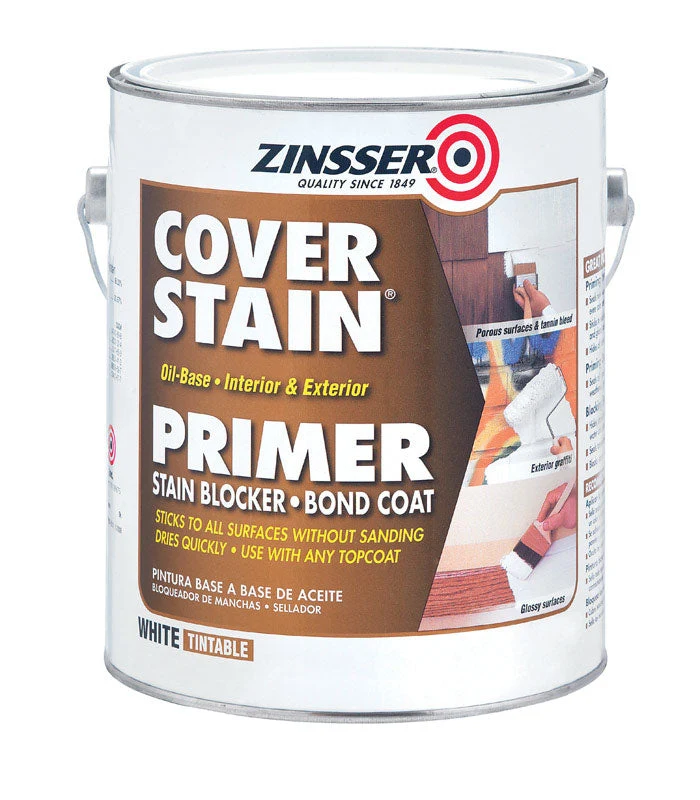
4. Cover Stain Oil-Base Primer-Sealer & Stain Killer
- Coverage
- 350–400 sq ft / gal
- Sheens
- Flat (primer)
- Dry / recoat
- Touch dry 35 min · recoat 2h
- Full cure
- 7 days under topcoat
- VOC
- <350 g/L
- Yellowing risk
- Medium (oil-base)
- Primer
- Standalone; topcoat with oil or latex
- Price tier
- $$
- Sole oil primer in the round-up — seals tannin in cedar and redwood, locks pine knots, blocks medium water staining and smoke for a fraction of BIN shellac's price
- Recoats in 2 hours where Satin Impervo recoats in 16, so you can prime in the morning and topcoat the same day
- Rated for inside and outside use under both oil and waterborne topcoats — the only chemistry-bridge primer on this list
- Slow soft-cure underneath: a heavy oil topcoat over fresh Cover Stain can wrinkle if you push the recoat window early
- Yellows under thin white topcoats faster than a waterborne primer would — for the brightest whites, BIN shellac is the cleaner pick
- Will not bond to glossy factory cabinet finishes the way Stix does — wrong primer for melamine, thermofoil, or cured oil enamel
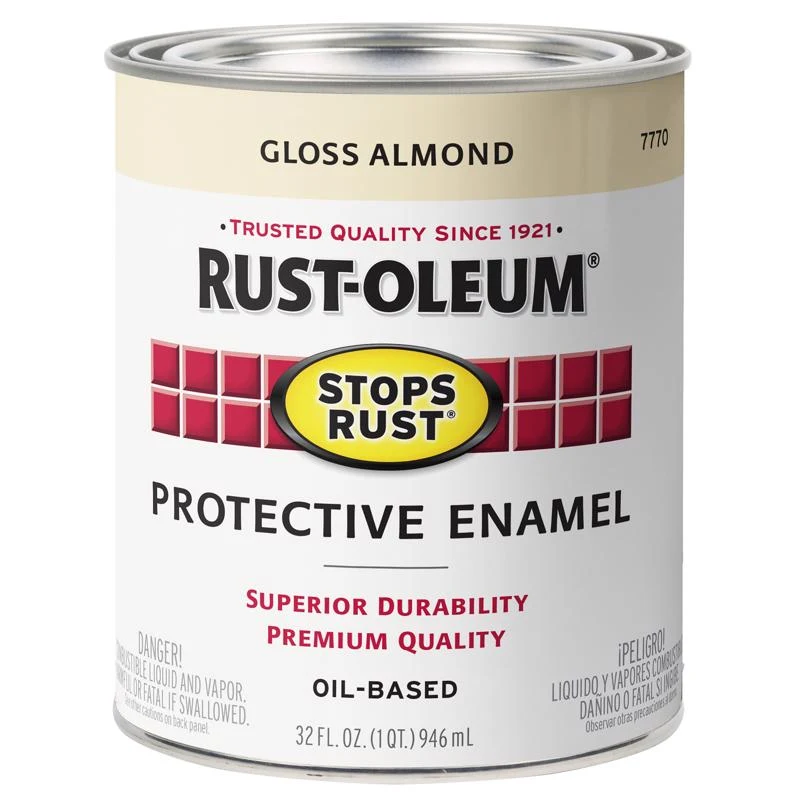
5. Stops Rust Protective Enamel
- Coverage
- 60–110 sq ft / quart
- Sheens
- Gloss, semi-gloss, satin, flat, hammered
- Dry / recoat
- Touch dry 2–4h · recoat 1h or after 48h
- Full cure
- 7 days
- VOC
- <450 g/L
- Yellowing risk
- Medium-high on white
- Primer
- Self-priming on rust; pair Rust-Oleum Clean Metal Primer for max life
- Price tier
- $
- Rust-inhibitor pigment package goes directly over surface rust (after a wire-brush scuff) without a separate metal primer — saves a step on iron railings, gate frames, and patio furniture
- Sets up tough enough to take light foot scuff on porch railings within a week and stays flexible enough not to crack at fastener heads
- Three-season exterior service on a vertical metal surface (handrails, mailboxes, fence posts) with one primer-plus-topcoat cycle; longer with the matching primer underneath
- Yellows fast on white — only buy Stops Rust in a color or in flat black; the white version goes cream inside 12 months even outdoors
- Brush body is loose and runs on vertical flats if you load like trim paint; thin coats only, and let each one tack before the next
- Not for interior use beyond utility shop work; the cure odor lingers 18+ hours in a closed room and the film is harder than it is pretty
Zinsser Cover Stain Oil-Base Primer-Sealer
Oil topcoats want oil primers under them on bare wood. Cover Stain pairs cleanly under all four oil topcoats above on raw cedar, raw pine, weathered exterior siding, and most interior trim. On glossy factory finishes (already-painted cabinet doors, factory-cured enamel), switch to Insl-X Stix; Cover Stain doesn't bond to release-coated surfaces. On bright white finish work where any yellow ghost is a problem, switch to Zinsser BIN shellac — shellac primes whiter than oil. Cover Stain is the default; the others are the exception.
BUY ON AMAZON
Ask a Question