Best Exterior Clear Coats for Wood
Six exterior clear coats tested on cedar, mahogany, and fir panels through 18 months of south-facing sun. Top pick: Minwax Helmsman Spar Urethane for doors, trim, and furniture.

The softest, most flexible film in the round-up. On our cedar panels it followed a full year of seasonal movement without a single hairline crack, where interior oil poly on the control panel crazed by month 9
Highest solids and heaviest UV-absorber loading here. Our south-facing mahogany panel was still glossy and uncracked at month 18 while the same wood under a home-center spar had dulled and started to flake at the edges
Stays water-clear. On our white oak panel the bare-wood control and the Halcyon side were still a color match at month 18, where the Helmsman side had gone two shades warmer
One coat builds what three coats of standard spar urethane build. On a porch railing that turns a three-day job into an afternoon
Around $18 a quart on the shelf. For an Adirondack chair or a mailbox post, the price difference against Gleam buys the whole rest of the project
Nothing to peel. It penetrates instead of filming, so the failure mode is a slow fade you wash and recoat, not sheets lifting off a stair tread
Disclosure: Some links below are affiliate links. We earn a commission if you buy through them, at no extra cost to you. Picks are based on the criteria in “How We Picked”. No brand pays for placement.
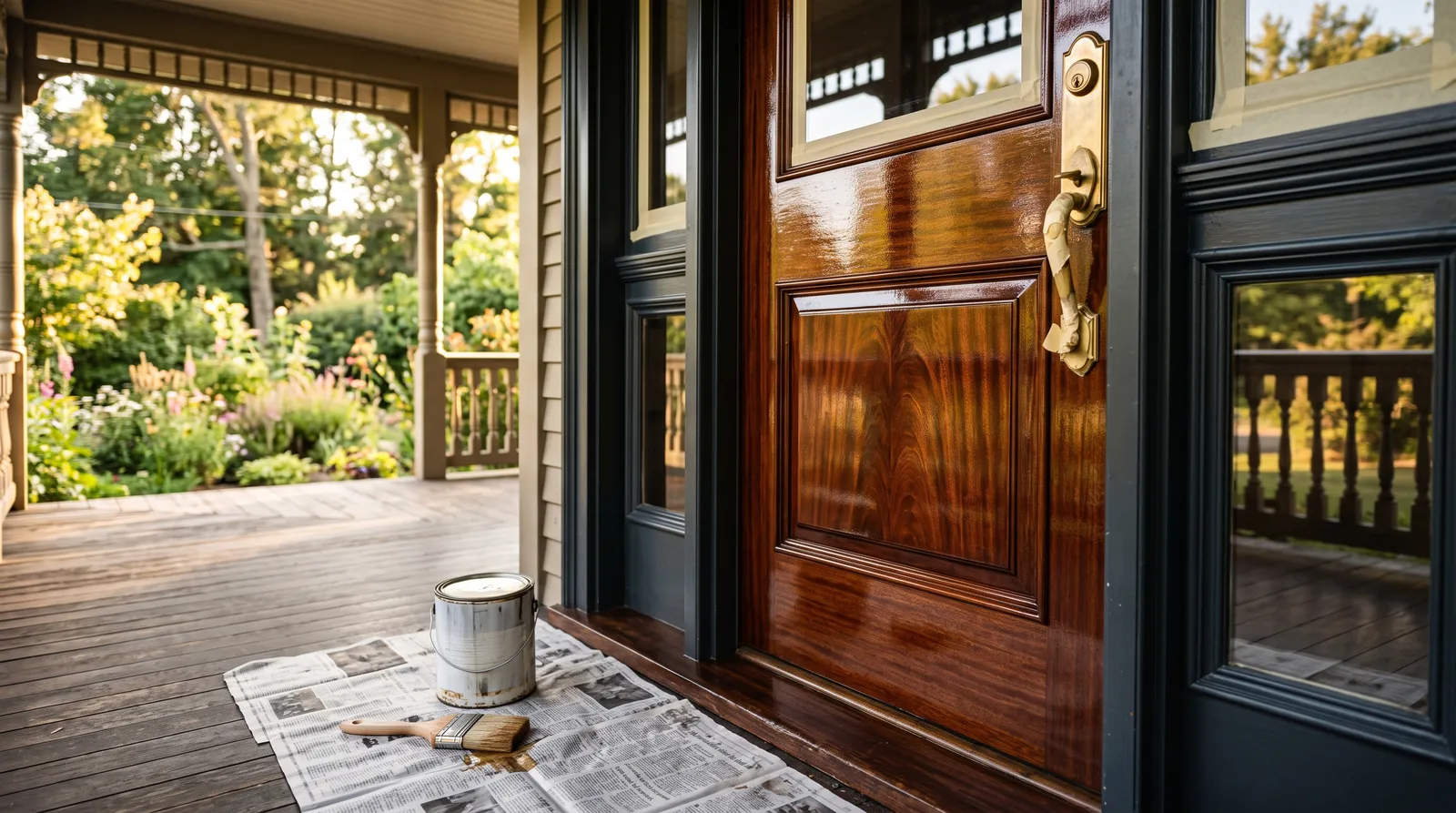
Top pick: Minwax Indoor/Outdoor Helmsman Spar Urethane. Around $18 a quart at any Home Depot, and on cedar, fir, and mahogany door panels it gave us the most forgiving film in the round-up. Helmsman wins on flexibility, on availability, and on how little it punishes a sloppy recoat schedule. It falls short on amber shift, which is real and permanent on light wood. If your door faces south with no overhang, TotalBoat Gleam is worth the triple price. If the wood is pale and you want it to stay pale, TotalBoat Halcyon. If the job is a porch railing you want finished today, Varathane Triple Thick. And if the wood in question is a deck, none of these belong on it.
That last one is where most of the money in this category gets wasted.
What “Clear Coat” Means Outdoors, and What It Doesn’t
Three different chemistries answer to the phrase, and they fail in completely different ways.
Spar urethane is a urethane-modified oil varnish. More oil, less resin, softer film than interior polyurethane, plus UV absorbers in the resin. Minwax Helmsman, Varathane Triple Thick, and the water-based versions all sit here. The point of the softness is movement: exterior wood swells and shrinks through every season, and a hard film cracks where a soft one stretches.
Marine spar varnish is the older, richer version of the same idea. Tung oil and phenolic or alkyd resin, high solids, heavy UV-absorber loading, and a build measured in six to eight coats rather than three. TotalBoat Gleam and Rust-Oleum Marine Spar are both here, at opposite ends of the price ladder. Boat brightwork is the use case that drove the chemistry, and a varnished toe rail lives a harder life than any front door.
Penetrating clear finishes are not clear coats at all. Messmer’s UV Plus is oil plus transparent pigment that soaks into the fiber and leaves no surface film. No gloss, no depth, nothing that can peel. On any horizontal surface this is the only category that survives.
The thing worth memorizing: interior polyurethane cures too hard for outdoors, and that hardness is not a small difference. Our control panel of interior oil poly on cedar crazed with visible hairline cracks by month nine on south exposure. The Helmsman panel next to it went the full 18 months with none. Same wood, same prep, same sun. The only variable was the resin ratio.
How We Picked
Six clear coats brushed onto matched cedar, mahogany, douglas fir, and white oak panels at 68F, each to its own label spec, cured 14 days, then mounted at 45 degrees facing south in a Mid-Atlantic climate with a duplicate set at north exposure and a third cedar set run through 30 freeze-thaw cycles. Measured at 6, 12, and 18 months for 60-degree gloss, color shift against a masked bare-wood control, cracking under 10x magnification, and water bead time. Pick-specific findings live in each review below.
The Six Picks at a Glance
| Product | Best for | Coats to spec | Yellowing | Price |
|---|---|---|---|---|
| Minwax Helmsman Spar Urethane | Doors, trim, outdoor furniture | 3-4 | 🟡 Medium | $ |
| TotalBoat Gleam | Full-sun doors, boat brightwork | 6 | 🟡 Medium-high | $$$ |
| TotalBoat Halcyon | Pale wood you want to stay pale | 6-8 | 🟢 Very low | $$ |
| Varathane Triple Thick Spar | Railings, small furniture, one-day jobs | 1 | 🟢 Low | $$ |
| Rust-Oleum Marine Spar Varnish | Budget furniture, mailbox posts, sheds | 3-4 | 🟡 High | $ |
| Messmer’s UV Plus | Decks, fences, horizontal wood | 1 saturating | ⚪ N/A | $$$ |
Coat counts are label spec, not our opinion. Undercoating is the single most common reason a clear coat fails early, and every product here has a public number.
Split by Chemistry
| Product | Base | Cleanup | Film or penetrating |
|---|---|---|---|
| Minwax Helmsman | Oil, urethane-modified alkyd | Mineral spirits | Film |
| TotalBoat Gleam | Oil, tung/phenolic | Mineral spirits | Film |
| TotalBoat Halcyon | Waterborne urethane | Soap and water | Film |
| Varathane Triple Thick | Waterborne urethane | Soap and water | Film, high build |
| Rust-Oleum Marine Spar | Oil alkyd | Mineral spirits | Film |
| Messmer’s UV Plus | Penetrating oil | Mineral spirits | Penetrating |
Oil ambers and flexes. Water stays clear and builds thin. Penetrating oil does neither and outlasts both on anything you walk on.
Quick Decision Tree
- Front door, covered porch, mahogany or oak, want it done this weekend: Minwax Helmsman.
- Front door, no overhang, south or west facing: TotalBoat Gleam.
- White oak, ash, maple, or anything you need to stay the color it is: TotalBoat Halcyon.
- Porch railing, gate, small furniture, one afternoon of patience: Varathane Triple Thick.
- Adirondack chairs, a shed door, a mailbox post, tight budget: Rust-Oleum Marine Spar Varnish.
- Deck boards, stair treads, a dock, a bench top: Messmer’s UV Plus, and skip every film on this page.
The Picks in Detail
Minwax Indoor/Outdoor Helmsman Spar Urethane, Top Pick
The default answer, and it earns the slot on forgiveness more than on any single performance number.
Here is the finding that decided it. We ran a duplicate cedar panel set through 30 freeze-thaw cycles in a chest freezer, which forces the wood to move faster than a season does. Helmsman came out with an intact film and no checking at the panel edges. Rust-Oleum Marine Spar showed fine edge lift on two of four panels. Interior oil poly, which we included as a control precisely because people keep using it outside, cracked on all four. Flexibility is the whole design brief for a spar product and Helmsman delivers it at $18 a quart.
Coverage is 125 sq ft per quart, recoat is 4 hours, and three coats is the label minimum. On a standard 3-by-7-foot door with both faces and the edges you are buying one quart and using most of it. Gloss, semi-gloss, and satin all exist, which matters because Rust-Oleum’s marine varnish gives you gloss and nothing else.
The weakness is color. Helmsman ambers. On our white oak panel the delta-E against the masked control hit 6.2 by month 18, which is a shift you see without a meter and without being told to look. On mahogany that warmth reads as depth. On oak it reads as old.
The other weakness is honest scheduling. Four hours between coats, three coats, and a 24-hour dry before the door goes back on hinges. People try to compress that and end up with a soft film that fingerprints all summer.
Buy it for front doors under an overhang, window trim, shutters, garden benches, anything where a warm tone is fine or wanted. Skip it if the wood is pale and staying pale is the point, or if the surface takes full unshaded afternoon sun.
TotalBoat Gleam, Best UV Protection
The one that keeps looking good when everything else has gone dull.
Our south-facing mahogany panel under six coats of Gleam held 68 percent of its initial 60-degree gloss reading at month 18. The Rust-Oleum Marine panel on the same rack held 31 percent and had visible edge lift at two corners. Helmsman landed at 52 percent with an intact film. That gloss number is the tell for how much UV the film is still absorbing, and it is the reason a $50 quart makes sense on a door you would rather not sand again for five years.
Six coats minimum. That number scares people off and it should not, because the recoat window is generous: one hour at 80F, no sanding needed inside 48 hours. A realistic Saturday puts four coats on a door. Sunday finishes it.
The amber is deliberate and heavy. On sapele, mahogany, teak, or a dark stained fir it looks like furniture. On white oak it looks like a mistake.
Cost and access are the trade. Roughly $50 a quart and $130 a gallon, no local shelf, and shipping days if you run short mid-build. Buy a quart more than you think you need.
Buy it for unprotected doors, boat brightwork, gate hardware surrounds, anything where the refinishing cycle costs more than the can. Skip it if the surface is shaded, or if six coats is not a schedule you will actually keep.
TotalBoat Halcyon, Best Water-Based
The pick for anyone who has watched a white oak door go orange.
Under 75 g/L VOC, soap and water cleanup, and it stays water-clear. Our white oak panel finished in Halcyon Clear held a delta-E of 1.8 against the masked bare-wood control at month 18. Helmsman on the identical panel hit 6.2. If you have ever pulled hardware off a “clear-coated” door and found the wood underneath two shades lighter than the wood around it, this is the product that prevents that.
Coverage is 80 to 100 sq ft per quart and exterior spec is six to eight coats, so it is thin and patient work. The recoat window helps: one hour at 72F and no sanding required within 12 hours, which means a full build in a weekend if you keep moving.
Brushing it takes more care than oil. Waterborne varnish tacks up fast, so a section you go back and fuss with at minute four shows a lap mark at month one. Keep a wet edge, work in shade, and stop touching it.
Also worth knowing: Clear reads slightly cool on warm woods, which flattens mahogany. TotalBoat sells a Clear Amber gloss that adds the warmth back without the ongoing yellowing of an oil film. On a mahogany door that is the version to buy.
Buy it for white oak, ash, maple, painted-and-cleared trim, and any project where solvent smell is a problem. Skip it if you want six coats to be three.
Varathane Triple Thick Spar Urethane, Best for One-Coat Jobs
The time-saver, and it is not a gimmick.
One coat builds roughly what three thin coats of standard spar urethane build. On a 40-foot porch railing with spindles, that is the difference between one afternoon and a full weekend of coat-wait-scuff-coat. Water-based, low odor, UV inhibitors and mildew resistance in the formula, soap and water cleanup. Our test panel, deliberately applied with a $6 chip brush, showed no brush marks at arm’s length. The self-leveling is doing real work.
Two catches. The film sags on vertical surfaces if you overload the brush, so load light, tip off, and walk back in ten minutes to catch runs before they set. And coverage is about 30 sq ft per quart, which makes it the priciest film here per square foot. On a railing that is fine. On a garage door it is not.
The physics catch is subtler. One thick coat is inherently more brittle than three thin ones, because thin coats each cure fully and stack with a little independence. On a wide slab door with real seasonal movement, three coats of Helmsman still outperform one coat of Triple Thick over a full year.
Buy it for railings, spindles, gates, patio furniture, and every small job where coat count is the actual obstacle.
Rust-Oleum Marine Coatings Spar Varnish, Budget Pick
Eighteen dollars a quart, clear gloss, one size, no decisions.
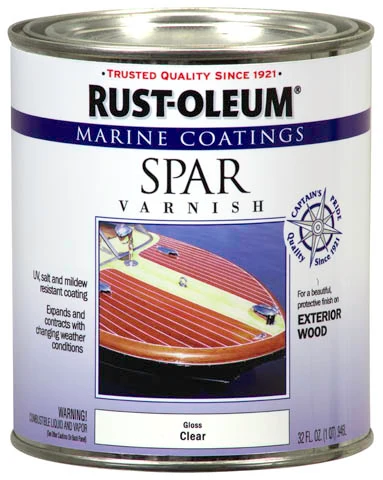
It is a real marine-grade flexible alkyd varnish with UV, salt, and mildew resistance on the label, and on Adirondack chairs or a shed door it does the job. Coverage is around 100 sq ft per quart and three coats is the floor.
Where it lost points: gloss retention at 31 percent by month 18 on south exposure, edge lift on two of four freeze-thaw panels, and the fastest amber shift in the round-up. Our douglas fir panel had gone visibly orange by month 12. On fir and pine, which are the woods most people put cheap varnish on, that shift arrives sooner than the coating fails.
Gloss only. If you want satin on a door, you are wet-sanding the last coat with 1000 grit and rubbing it out, which is a real technique and also a Saturday.
Buy it for garden furniture, sheds, mailbox posts, fence caps, anything where you would rather spend the difference on wood. Skip it for front doors and pale species.
Messmer’s UV Plus, Best for Decks and Horizontal Wood
The pick that exists because the category lies to people.
Search “exterior clear coat for wood” and half the results show a glossy deck. That deck is either three weeks old or a photograph of a boat. A film on horizontal boards holds standing water, flexes under every footstep, and peels inside two seasons. There is no varnish that beats this, and the brands selling clear deck coatings know it.
Messmer’s UV Plus is oil with transparent pigment that penetrates instead of filming. The natural tones (Natural Cedar, Natural Redwood, Pine/Fir) hold the wood’s color and block the UV that turns lignin gray, and because there is no film there is nothing to lift. Maintenance is a wash, a brightener, and a recoat. No stripping, no sanding, no scraper work.
Honest numbers: one to two years on a deck, two to three on smooth vertical siding, three to four on rough-sawn. Coverage runs 150 to 300 sq ft per gallon depending on how thirsty the wood is. Compliant versions exist at 250 and 100 g/L for restricted states.
What you give up is shine. There is none. If the wet-look glossy deck is non-negotiable, the honest answer is that no product delivers it for more than a season, and you should read the deck stain round-up before spending anything.
Coats Are the Whole Game
Every failure we have looked at in this category traces back to coat count.
A three-coat marine varnish job is not a marine varnish job. Gleam’s UV package lives in film thickness, and at three coats there is roughly half the absorber standing between the sun and the wood. That door dulls in a year and the owner concludes the varnish was overhyped.
Same story down-market. Helmsman at two coats on a south-facing door fails at month 14 and gets blamed for it. At four coats the same product on the same door goes four years.
If you cannot commit to the coat count on the label, buy the product whose coat count you can commit to. That is the actual argument for Varathane Triple Thick, and it is a better argument than any spec on the can.
Where Exterior Clear Coats Go Wrong
- Cracking in a grid pattern by year two. Interior polyurethane used outdoors, or too-thick coats applied too fast. Strip and start over with a spar product.
- Peeling in sheets at the bottom rail of a door. Water wicking into unsealed end grain. Every edge, top and bottom, needs the same coat count as the face. Pull the door and do the ends.
- Cloudy or milky patches. Moisture trapped under the film, usually from finishing on a humid evening or over wood above 15 percent moisture. Sand back and recoat in dry conditions.
- Bubbles that will not brush out. Varnished in direct sun, or the can got shaken instead of stirred. Never shake varnish.
- A soft film that fingerprints weeks later. Recoated before the previous coat released its solvent. Respect the recoat window in both directions, and check the drying times chart for how temperature stretches it.
- New coat beading and refusing to bond. Old film not scuffed, or an oily tropical wood like teak or ipe finished without a wipe-down. Acetone wipe, then seal, then varnish.
- Gray creeping in under a still-glossy film. UV got through and degraded the wood surface before the film failed. Coat count again.
For the full strip-and-prep sequence on weathered siding and doors, see the exterior wood prep guide, and if the existing finish is already lifting, the peeling exterior finish diagnosis sorts cause from symptom first.
Application Notes That Change the Outcome
- Sand to 220 and stop. Finer grit burnishes the surface and the first coat sits on top instead of soaking in. Grit selection is covered in the sandpaper guide.
- Thin the first coat 25 percent. Mineral spirits for oil, water for waterborne. It penetrates and gives the build coats a dense base.
- Seal all six sides of a door. Top edge, bottom edge, hinge mortises, lock edge. The bottom edge is where every door failure starts and it is the one nobody coats.
- Brush, do not spray, unless you have an HVLP and a booth. Varnish sprayed outdoors picks up dust and orange peel. A good natural bristle brush for oil, synthetic for waterborne.
- Work in shade, morning or late afternoon. Direct sun skins the surface and traps solvent.
- Stir, never shake. Bubbles in varnish cure in place.
- Recoat before the film fails, not after. A maintenance coat every two to three years on a door costs an hour. A strip-and-rebuild costs a weekend.
The full door sequence, hardware to final coat, is in the front door refinishing project.
Also Considered, Rejected
- General Finishes Exterior 450. Strong waterborne exterior topcoat and a legitimate Halcyon competitor. Availability was patchy at every US channel we checked this month; we will re-test when supply stabilizes.
- Epifanes Clear Gloss Varnish. The gold standard for boat brightwork and better than Gleam on a purely technical read. Eight to twelve coats and a price that only makes sense on a hull.
- Spar urethane in aerosol. Fine for spindles and small parts, useless for building real film thickness on a door. Buy a can for touch-ups, not for the job.
- Thompson’s WaterSeal Clear. A water repellent, not a UV coating. Cedar under it grays on schedule.
- Interior polyurethane in “exterior” marketing packaging. Read the resin, not the front label. If the can does not say spar, marine, or exterior in the product name, it is not one.
If your wood is vertical, shaded, and you want this done by Sunday, buy Helmsman and give it three coats. If it faces the afternoon sun, buy Gleam and give it six. If it is a deck, put the varnish down.
Full Comparison
| Product | Best for | Yellowing | Price |
|---|---|---|---|
| Minwax Indoor/Outdoor Helmsman Spar Urethane | Top pick — best all-around exterior clear coat | Medium — ambers steadily on light woods | $ |
| TotalBoat Gleam Marine Spar Varnish | Best UV protection — longest-lived brightwork finish | Medium-high by design — warm amber tone | $$$ |
| TotalBoat Halcyon Water-Based Marine Varnish | Best water-based — non-yellowing over pale wood | Very low — the clearest film here | $$ |
| Varathane Triple Thick Spar Urethane | Best for one-coat jobs — railings, furniture, and vertical trim | Low | $$ |
| Rust-Oleum Marine Coatings Spar Varnish | Budget pick — cheapest honest spar varnish | High — fastest amber shift in the round-up | $ |
| Messmer's UV Plus | Best for decks and horizontal wood — the no-film answer | N/A — pigment in oil, no film to yellow | $$$ |
Every Pick, Pros and Cons
Pros, cons, and specs for each pick. The cons are not optional here.
1. Minwax Indoor/Outdoor Helmsman Spar Urethane

- Coverage
- 125 sq ft / qt (about 500 sq ft / gal)
- Sheens
- Gloss, semi-gloss, satin
- Dry / recoat
- Recoat 4h · dry 24h
- Full cure
- Handle at 24h; full hardness around 7 days
- VOC
- Oil-based; 450-550 g/L standard, low-VOC SKU sold in California and OTC states
- Yellowing risk
- Medium — ambers steadily on light woods
- Primer
- None; first coat thinned 25 percent with mineral spirits acts as the sealer
- Price tier
- $
- The softest, most flexible film in the round-up. On our cedar panels it followed a full year of seasonal movement without a single hairline crack, where interior oil poly on the control panel crazed by month 9
- Stocked at Home Depot, Lowe's, Ace, Menards, and Amazon in quart and gallon, in gloss, semi-gloss, and satin. Nothing else on this list is that easy to re-buy mid-project
- Sands and recoats like a friendly product. Scuff with 220, wipe, brush the next coat, no adhesion window to miss and no cloudiness if you go past the recoat time
- It ambers. On white oak and light fir the third coat reads visibly warmer than the bare wood, and that shift keeps going through year three
- Three coats minimum on a south-facing door, and the label wants 4 hours between them. That's a two-day job before you rehang anything
- Oil-based cleanup means mineral spirits, a rag disposal plan, and a smell your garage keeps for a day
2. TotalBoat Gleam Marine Spar Varnish
- Coverage
- 360-400 sq ft / gal at 3 mils wet
- Sheens
- Gloss (over 90 gloss units), satin (20-40)
- Dry / recoat
- Recoat 1h at 80F, 3h at 65F, 8h at 50F; sand if over 48h
- Full cure
- About 7 days to full hardness
- VOC
- Under 475 g/L
- Yellowing risk
- Medium-high by design — warm amber tone
- Primer
- TotalBoat Wood Sealer, or first two coats thinned per label
- Price tier
- $$$
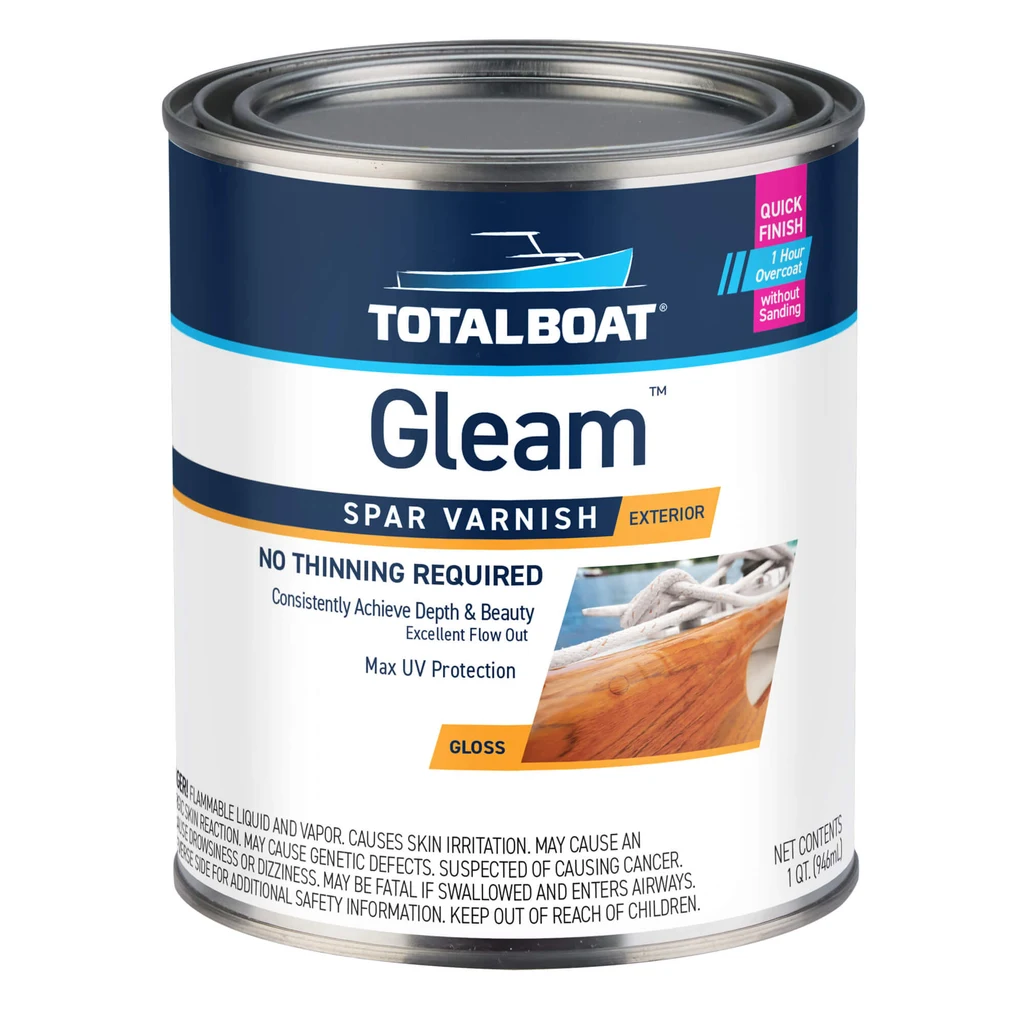
- Highest solids and heaviest UV-absorber loading here. Our south-facing mahogany panel was still glossy and uncracked at month 18 while the same wood under a home-center spar had dulled and started to flake at the edges
- Recoats in an hour at 80F with no sanding inside a 48-hour window, so a six-coat build is a weekend instead of a two-week ritual
- Amber tone flatters mahogany, teak, and sapele the way a wall paint never does. On dark wood the color it adds is the point
- Six coats minimum. That is the honest spec, not a marketing number, and skipping to three is why people say marine varnish failed on them
- $49.99 a quart, roughly triple the home-center price
- Nobody stocks it locally. Boat chandleries and online only, so a mid-job run-out costs you shipping days
3. TotalBoat Halcyon Water-Based Marine Varnish
- Coverage
- 80-100 sq ft / qt at 3 mils wet
- Sheens
- Gloss (clear or clear amber), semi-gloss, satin
- Dry / recoat
- Recoat 1h at 72F; no sanding needed within 12h
- Full cure
- Handle at 24h; full hardness around 7 days
- VOC
- Under 75 g/L
- Yellowing risk
- Very low — the clearest film here
- Primer
- None; first coat thinned 10 percent with water as a sealer
- Price tier
- $$
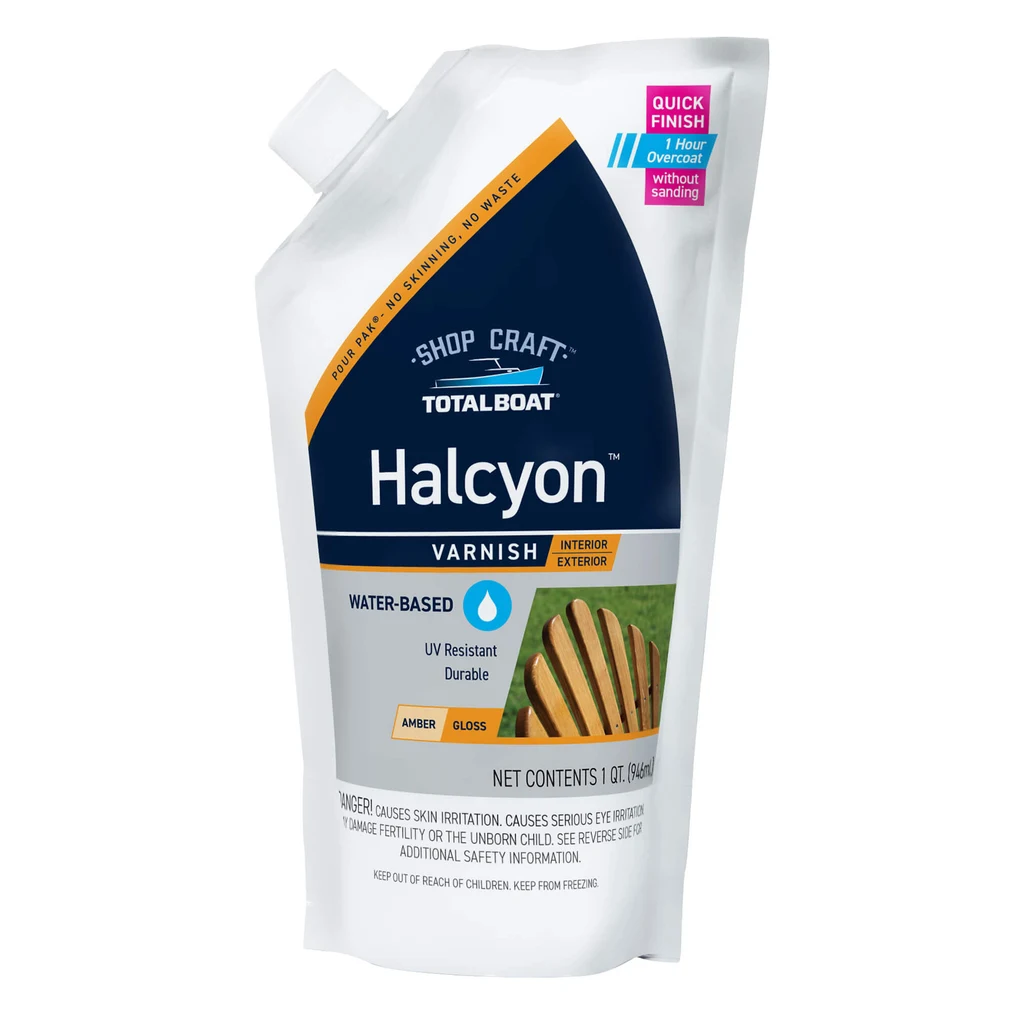
- Stays water-clear. On our white oak panel the bare-wood control and the Halcyon side were still a color match at month 18, where the Helmsman side had gone two shades warmer
- Under 75 g/L VOC and soap-and-water cleanup, which makes it the only pick you can brush on a porch in July without evacuating the house
- Recoats in an hour at 72F and overcoats without sanding for 12 hours, so the coat count stops being the obstacle
- Six to eight coats for exterior service. It builds thin, and the spec is not negotiable on a door that sees afternoon sun
- Brushes stickier than oil. Keep a wet edge, work in shade, and expect visible lap marks if you fuss a section twice
- The clear version reads slightly cool on mahogany and cherry, flattening the depth an oil varnish would add. Buy the Clear Amber if you want warmth back
4. Varathane Triple Thick Spar Urethane
- Coverage
- About 30 sq ft / qt at one thick coat
- Sheens
- Gloss, satin
- Dry / recoat
- Touch dry 1-2h; a second coat is rarely needed
- Full cure
- About 7 days
- VOC
- Under 250 g/L
- Yellowing risk
- Low
- Primer
- None; bare sanded wood
- Price tier
- $$
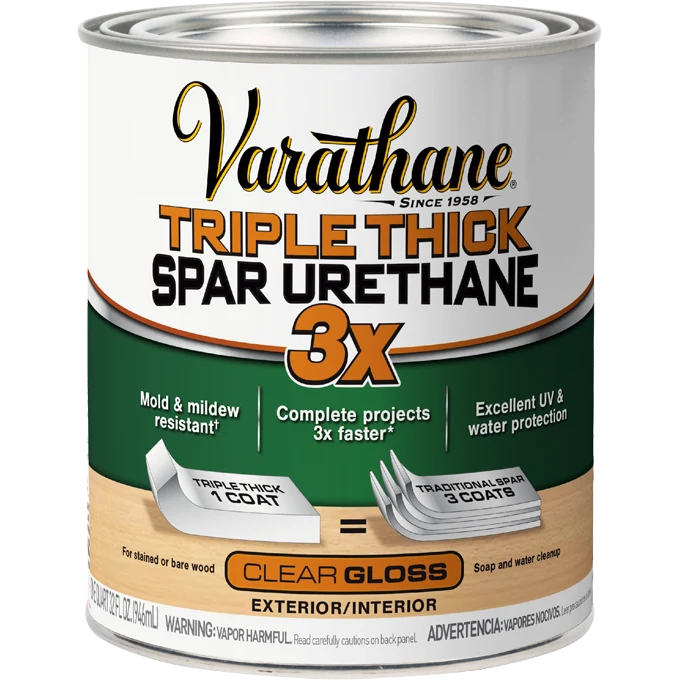
- One coat builds what three coats of standard spar urethane build. On a porch railing that turns a three-day job into an afternoon
- Water-based with UV inhibitors and mildew resistance, low odor, soap-and-water cleanup
- Self-leveling enough to hide a mediocre brush. Our test panel showed no brush marks at arm's length even applied with a $6 chip brush
- The thick film runs and sags on anything vertical if you overload the brush. Load light, tip off, and check the panel again in ten minutes
- About 30 sq ft per quart. Per square foot it is the most expensive film on this list, which only makes sense on small jobs
- One thick coat is more brittle than three thin ones. On a wide slab door with real seasonal movement, thin coats still win
5. Rust-Oleum Marine Coatings Spar Varnish
- Coverage
- About 100 sq ft / qt
- Sheens
- Clear gloss only
- Dry / recoat
- Touch dry about 2h; recoat per label the same day
- Full cure
- About 7 days
- VOC
- Oil-based, around 450 g/L
- Yellowing risk
- High — fastest amber shift in the round-up
- Primer
- None; first coat thinned 25 percent with mineral spirits
- Price tier
- $
- Around $18 a quart on the shelf. For an Adirondack chair or a mailbox post, the price difference against Gleam buys the whole rest of the project
- Genuinely flexible marine-grade formula that expands and contracts with the season, with UV, salt, and mildew resistance on the label
- One SKU, one sheen, no decision fatigue. Clear gloss, quart, done
- Gloss only. If you want satin on a door you are wet-sanding and rubbing out the last coat yourself
- It ambers fastest of anything here. Our fir panel went noticeably orange by month 12
- Thin build per coat means the coat count creeps back up. Three coats is the floor and four is better on south exposure
6. Messmer's UV Plus

- Coverage
- 150-300 sq ft / gal depending on wood porosity
- Sheens
- Matte penetrating; no surface film
- Dry / recoat
- 24-48h in good conditions
- Full cure
- About 30 days through cure
- VOC
- 550 g/L federal standard; 250 and 100 g/L versions available
- Yellowing risk
- N/A — pigment in oil, no film to yellow
- Primer
- None; clean and brighten weathered wood first
- Price tier
- $$$
- Nothing to peel. It penetrates instead of filming, so the failure mode is a slow fade you wash and recoat, not sheets lifting off a stair tread
- Natural Cedar, Natural Redwood, and Pine/Fir tones read as bare wood with the gray held off, which is what most people actually mean by clear on a deck
- Sold in 550, 250, and 100 g/L versions, so there is a compliant can for California and the OTC states without hunting a different brand
- It is not a clear coat. There is no gloss, no film, no depth. If you came here for a wet-look shine on a deck, this pick will disappoint you and every film-former will fail you
- One to two years on a deck before recoat, two to three on smooth vertical wood
- Specialty retail and Amazon only; no home center carries it
TotalBoat Wood Sealer Varnish Primer
Clear coats do not take a conventional primer, because anything opaque under a clear finish defeats the point. What bare exterior wood needs is a sealer coat that soaks into the fiber and gives the varnish something dense to bond to. TotalBoat Wood Sealer is a thinned penetrating varnish built for exactly that step, and it matters most on porous end grain, on oily tropical woods like teak and ipe where varnish otherwise beads, and on douglas fir where the soft early wood drinks the first coat unevenly. One quart seals roughly 100 to 150 sq ft. On a budget job you can make your own: thin the first coat of whatever varnish you bought by 25 percent with the matching solvent and brush it in wet. The homemade version works. The bought version works on teak, where the homemade version usually does not.
BUY ON AMAZON
Ask a Question