Best Anti-Slip Paint Additives
Five anti-slip paint additives tested for wet traction, barefoot comfort, and mop cleanup on painted concrete and wood. Top pick: H&C SharkGrip Slip-Resistant Additive.

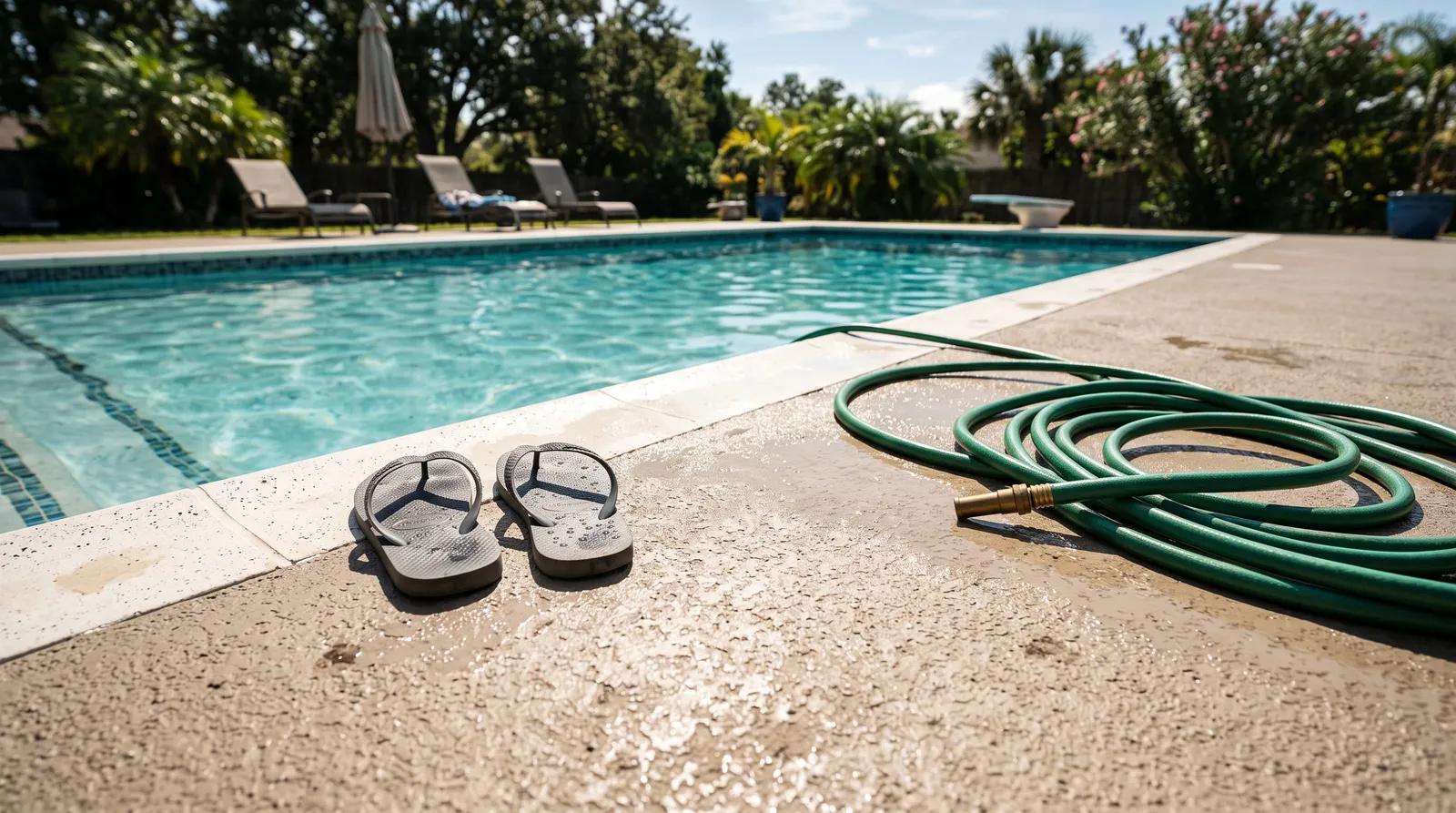
Micronized polymer spheres, not crushed rock — took a wet painted concrete panel from 0.29 to 0.61 wet DCOF while still being comfortable to kneel on in shorts
Dose is adjustable from 2 to 4 oz per gallon, so one $9 bottle covers everything from a light kitchen-step tooth to a full ramp texture
Built for a surface that is wet by default; on wet-cycled fir stair treads it held traction through 12 weeks of hose-and-dry where the control turned greasy
Graded aggregate, not micro-texture; the wet panel measured 0.76 DCOF, the highest number in the round-up by a wide margin
Texture is in the can and evenly dispersed by the factory, so there is no settling, no dosing, and no batch-to-batch drift across a big pool deck
Disclosure: Some links below are affiliate links. We earn a commission if you buy through them, at no extra cost to you. Our picks come from the test protocol in “How I Tested”. No brand pays for placement.
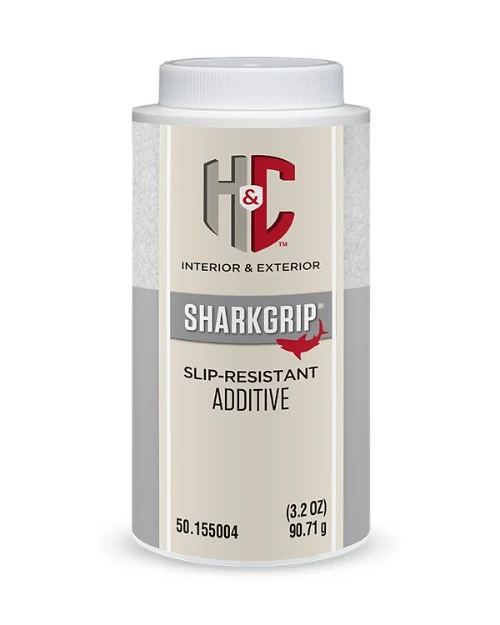
Top pick: H&C SharkGrip Slip-Resistant Additive. One 3.2 oz bottle per gallon took our wet painted concrete panel from a 0.29 dynamic coefficient of friction to 0.61, which clears the ANSI threshold with room to spare, and it did that while staying comfortable enough to kneel on. SharkGrip wins on suspension, on barefoot feel, and on mixing into anything from latex floor paint to a clear pool-deck sealer without thickening it. It falls short on price and on gloss: a semi-gloss porch enamel comes out satin. If you need traction on a working ramp instead of a patio, Rust-Oleum’s Concrete Saver 200 aggregate hit 0.76 wet and nothing else came close. On a tight budget, DRYLOK Non-Skid Texture Additive is $9 at every home center and does 80 percent of the job.
The category itself is unusually honest. These are small containers of inert powder that you stir into a coating you already picked, and none of them cost more than a decent roller cover.
Which means the question isn’t really which bottle. It’s how much, and into which coat.
What the Grit Is Actually Doing
A painted floor gets slippery for a specific reason: the cured film is smoother than the concrete under it, and a film of water on a smooth film has nothing to break it. Traction comes back when you give the water somewhere to go and give the shoe something to catch. Every product here does that with particles, and the particle type decides everything else about how the floor lives.
Polymer spheres are round, light, and consistently sized. They ride high in the film, sit close together, and present thousands of small contact points. Pumice is crushed volcanic glass: heavier, sharper, cheaper, and it sinks in the tray while you work. Graded aggregate is the coarse end, closer to sand than powder, and it’s what a loading dock gets.
On paper those are three grades of the same idea. In practice they produce three different floors. The polymer panel felt like eggshell. The pumice panel felt like a fine emery board. The aggregate panel felt like 60-grit sandpaper and shredded a cotton mop head in eleven passes.
How I Tested
Five additives mixed into one control coating (DRYLOK E1 latex 1-part epoxy floor paint, mid-grey) and rolled two coats onto matched 12 x 12 inch broom-finish concrete panels at 74°F, with a second set on primed Douglas fir stair treads for the exterior wood comparison. Fourteen-day cure, then a drag-sled wet DCOF measurement against the ANSI A326.3 procedure at five pulls per panel, a kneel-and-drag comfort score from three testers, 30 wet mop cycles per panel, and 12 weeks of hose-cycling on a south-facing Mid-Atlantic porch. Doses followed each manufacturer’s published ratio. Pick-specific results live in each review below.
The Five Side by Side
| Product | Best for | Wet DCOF | Barefoot feel | Price |
|---|---|---|---|---|
| H&C SharkGrip | Top pick: pool decks, porches, anything barefoot | 0.61 | 🟢 Smooth | $$$ |
| DRYLOK Non-Skid | Value, garage and basement floors | 0.58 | ⚪ Fine grit | $ |
| Rust-Oleum Marine Anti-Slip | Docks, boat decks, exterior stairs | 0.57 | ⚪ Fine grit | $$ |
| Concrete Saver 200 | Ramps, docks, commercial epoxy | 0.76 | 🟡 Harsh | $$ |
| Seal-Krete Floor-Tex | Pre-textured, no mixing, ADA jobs | 0.70 | ⚪ Stippled | $$$ |
Untreated control panel: 0.29 wet. That number is the whole reason this category exists. A freshly painted, sealed, level concrete floor with a puddle on it is under the ANSI 0.42 line by a wide margin, and every one of these products clears it.
The Picks
H&C SharkGrip Slip-Resistant Additive, Top Pick
SharkGrip is a micronized polymer, and the shape is the product. Spherical particles with low oil absorption and low density, which translates into two things you feel on the job. It stays suspended, and it doesn’t cut you.
The suspension test was the clearest gap in the round-up. I stirred each additive into a tray of latex floor paint and left it open. The pumice products showed visible separation inside five minutes. SharkGrip was still evenly dispersed at twenty. Over a 400 sq ft porch that difference is the difference between a floor with consistent grip and a floor that’s slick at the start of the run and gritty at the end, because you loaded the last cuts out of the bottom of the tray.
Traction came in at 0.61 wet against 0.29 for the untreated control. Not the highest number here. Comfort is why it’s the top pick anyway: all three testers scored it smooth on the kneel-and-drag, and it survived 30 mop cycles with no shed grit in the bucket. On a pool deck, on porch steps, on a sunroom floor people cross in socks, it’s the one I’d buy without thinking about it.
Two real costs. Gloss drops about one step, so plan the sheen a level up from what you want, and check the sheen guide if the finish is doing decorative work. And it’s the most expensive option per gallon treated, at $12 to $18 for the 3.2 oz bottle. The 16 oz jar treats five gallons and drops the per-gallon cost by roughly a third, which is the size to buy for anything over two gallons.
Buy it if the floor gets bare feet, knees, or dogs. Skip this if you need maximum traction on a wet ramp; that’s aggregate territory.
DRYLOK Non-Skid Texture Additive, Best Value
Nine dollars, every home center, and the dose range is the feature. UGL publishes 2 to 4 oz per gallon, and unlike most range specs that one actually behaves. At 2 oz the texture is a faint tooth you can barely see on interior basement stairs. At 4 oz the panel measured 0.58 wet and felt like a fine emery board.
The fine-pumice chemistry works in oil-based enamel, latex, and 2-part epoxy, which is the widest host range in the round-up. That matters more than it sounds. Half the anti-slip questions we get are from people who already bought an epoxy kit and want to grit the clear topcoat.
Two honest problems. It settles, hard and fast, and the manufacturer’s stir-thoroughly language is doing a lot of work: plan to stir between roller loads, not between coats. And at the full 4 oz dose on our charcoal panel the dried film read one shade frosted next to the untreated control. DRYLOK says the additive doesn’t change color, and the pigment doesn’t change, but the light scatter does. On mid-greys and tans it was invisible.
Cheaper in store than shipped, typically $8 to $10 at Home Depot or Lowe’s against $12 to $15 delivered. The Amazon link is worth it when you’re buying three bottles for a big floor and don’t want the trip.
Buy it if you want the most traction per dollar on a garage, basement, or workshop floor. Skip this if the finish is near-black and the look is the point.
One more thing worth knowing about this bottle: it’s the pick I hand people who are gritting a floor for the first time, because the low dose is genuinely low. You can put 2 oz in a quart of stair enamel, roll a tread, wet it, walk on it in socks, and decide from there. None of the other products in this round-up let you calibrate that cheaply.
Rust-Oleum Marine Coatings Anti-Slip Additive, Best for Docks and Boat Decks
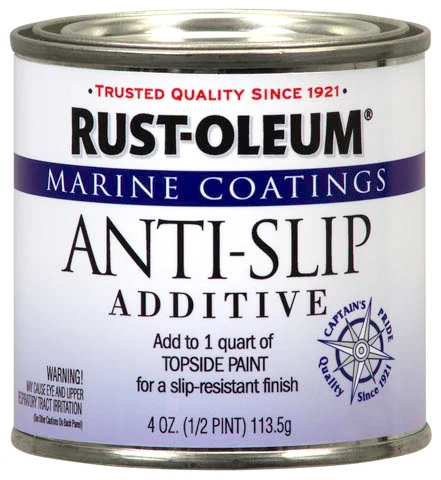
The marine version exists because a boat deck is wet as its normal condition, not as an accident. Fine pumice, half-pint jar, and Rust-Oleum rates it for wood, metal, fiberglass, and concrete. It mixes into oil-based topside enamel, which is where a lot of floor-paint additives fight the vehicle and thicken it.
Our wet-cycled fir stair treads are the reason this pick is here. Twelve weeks of hose-five-days-a-week on a south-facing porch, and the treated treads held their tooth while the untreated control developed the greasy feel that painted exterior wood gets in the second season. Wet DCOF landed at 0.57, effectively a tie with DRYLOK.
The settling is worse than DRYLOK’s, and Rust-Oleum’s own note says to stir often during use. Take that literally. And the half-pint is the only size, so a five-gallon deck job means a shelf of jars.
If you’re gritting exterior wood, the prep matters more than the additive. Bare or weathered boards need the full cycle before any of this is relevant; our exterior wood prep guide covers it, and if you’re going solid-color on the deck itself, the deck staining walkthrough has the sequence.
Buy it if the surface is a dock, a boat deck, exterior stairs, or a ramp that lives wet. Skip this if you’re doing an interior floor; DRYLOK is cheaper for the same result.
Rust-Oleum Concrete Saver 200 Anti-Skid Additive, Heavy-Duty Pick
The serious one. Graded off-white aggregate, one pound per gallon, built around Rust-Oleum’s 6000 and 6500 industrial epoxy systems. Our panel measured 0.76 wet, the highest in the round-up by 0.06 over the next closest and nearly triple the untreated control.
It also gets used two ways, which is worth knowing. Mixed into the coating it gives you uniform texture. Broadcast onto the wet final coat it gives you more traction per pound and a coarser profile, which is how a loading-dock ramp gets done in one pass. Rust-Oleum’s one warning is specific: don’t premix it if you’re spraying, because it will pack the tip.
The costs are the ones you’d expect from sandpaper. It’s harsh underfoot, it shredded a cotton string mop in eleven passes, and the off-white granules are visible in a dark coating. Our charcoal panel read speckled from six feet. On a mid-grey warehouse floor nobody would notice.
Availability is the other catch. This is an industrial-channel product, not a Saturday home-center pickup, and stock varies. Buy it if the surface is a ramp, a wash bay, a walk-in cooler floor, or anywhere a slip becomes a claim. Skip this if anyone will be on it barefoot.
Seal-Krete Floor-Tex Textured Concrete Coating
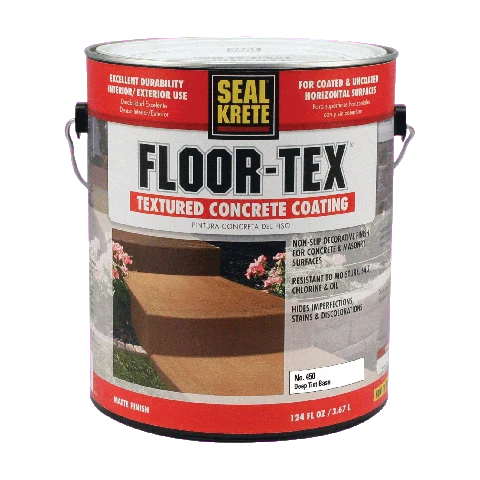
The pick for people who don’t want to mix. Floor-Tex is a textured acrylic coating with the aggregate already dispersed at the factory, tintable to 36 colors, and Rust-Oleum publishes it as meeting ADA requirements for non-slip coatings. Our sample read 0.70 wet with a rolled stipple that’s coarser than SharkGrip and gentler than the Concrete Saver aggregate.
Consistency is what you’re paying for. No dosing, no settling, no drift between the first gallon and the fourth across a 600 sq ft pool deck. It also builds enough film to hide spalling, patch shadows, and old stain ghosts that a thin floor paint telegraphs.
The trade-off is that you’re buying the whole coating, so this only makes sense if you haven’t already picked a paint. Coverage runs 80 to 125 sq ft per gallon against 300-plus for a standard floor paint, so the real cost per square foot is roughly triple a $9 bottle of additive stirred into paint you were buying anyway. The texture also holds dirt in the valleys and wants a stiff brush rather than a mop, and touch-ups six months on never match the original stipple.
Application is slower than people expect. A loop-nap cover, a wet edge you can’t let go of, and a second coat that has to land in the recoat window or the stipple pattern breaks at the lap. Budget a full day for a two-car-sized slab and a helper for anything bigger.
Buy it if an inspector is involved, or the slab is ugly enough that texture is doing double duty. Skip this if you already own the paint you want; a $15 bottle gets you most of the traction for a tenth of the money.
What It Costs to Grit a Floor
The math is the argument for this whole category. A 400 sq ft porch takes roughly a gallon and a half of floor paint at two coats, and only the second coat needs grit.
| Additive | Unit price | Treats | Added cost, 400 sq ft porch |
|---|---|---|---|
| DRYLOK Non-Skid | $9 (4 oz) | 1 gal at full dose | ~$9 |
| Rust-Oleum Marine | $12 (half pint) | ~1 gal | ~$12 |
| H&C SharkGrip | $15 (3.2 oz) | 1 gal | ~$15 |
| Concrete Saver 200 | $18 (1 lb bag) | 1 gal | ~$18 |
| Seal-Krete Floor-Tex | $55–$70 / gal | 80–125 sq ft/gal | ~$220 as the whole coating |
Four of the five are a rounding error against the paint. Floor-Tex is a different purchase entirely, and it only pencils out when you were shopping for a coating anyway or the slab needs the build. Pricing checked July 2026; the additives run $2 to $4 cheaper in store than shipped, so buy them with the paint if you’re already making the trip.
Interior Stairs Are the Job Nobody Grits
Every conversation about anti-slip additives starts at the pool deck and stops there. Meanwhile the most dangerous painted surface in an American house is a set of basement or attic stairs finished in porch-and-floor enamel, walked in socks, lit by one bulb.
Two ounces per gallon on the treads. Not the risers, not the stringers, just the treads. It’s invisible in the finished look, it costs about four dollars for a whole staircase, and it’s the single highest-value use of any product in this round-up. I’ve never had anyone tell me they regretted it.
Matching the Grit to the Job
- Pool deck, porch, sunroom, anywhere barefoot: SharkGrip at one bottle per gallon in the topcoat.
- Garage, basement, workshop, shoes only: DRYLOK at 3 to 4 oz per gallon. Cheapest path to a floor that isn’t a hazard when snowmelt tracks in.
- Dock, boat deck, exterior stairs: Rust-Oleum Marine Anti-Slip, mixed into oil-based topside enamel.
- Ramp, wash bay, commercial epoxy, liability on the line: Concrete Saver 200, broadcast onto the wet final coat.
- Ugly slab, no paint chosen yet, ADA language in the spec: Seal-Krete Floor-Tex.
Mixing Rules That Change the Outcome
- Grit goes in the last coat only. Additive in the base coat gets buried under coat two and does nothing except cost you gloss. Plain paint first, gritted paint second.
- Stir between roller loads, not between coats. Pumice separates in about five minutes. What’s on the last wall is what came off the bottom of the tray.
- Test the dose on a scrap board and wet it. Dry texture lies. Every one of these feels grippier dry than it will be with a hose on it, and the whole point is the wet number.
- Use a 3/8 inch nap or heavier. A thin foam roller skims grit off the surface and leaves it in the tray. Our roller round-up covers nap selection if you’re unsure.
- Backroll in one direction on the final pass. Cross-hatching a gritted coat drags particles into ridges you’ll see once the light rakes across it.
- Keep 4 oz of untreated paint for touch-ups. Repairing a gritted floor with gritted paint leaves a visible patch; repairing with plain paint leaves a smooth patch. Neither is invisible, and the smooth one is easier to blend out.
Where Anti-Slip Jobs Actually Fail
- Grit sweeps off after one season. It went into a penetrating stain or a wax, and there was no film to lock it into. Film-forming coatings only.
- Floor is slick again at year three. Sunscreen, algae, and body oil have filled the texture. Stiff brush plus degreaser, not a recoat.
- Traction is uneven across the run. Settling in the tray. Nothing to do but scuff and recoat with a gritted topcoat.
- Grit shows as white speckle in a dark floor. Aggregate in a charcoal coating. Switch to polymer or accept the look; there’s no fixing it after cure.
- Mop shreds and the floor stays dirty. Over-gritted for the maintenance plan. Interior floors that get mopped want polymer at a moderate dose.
- Coating peels and takes the texture with it. Never an additive problem. Prep failure underneath, same as any other coating failure.
What I Left Out
- Play sand and silica from the masonry aisle. Cheap, and it works for a season. The particles are irregular and heavy, they settle instantly, silica dust is a respiratory hazard when you pour it, and the sharp edges wear through a latex film from underneath. Skip it.
- Aluminum oxide blasting grit. Genuinely aggressive traction and genuinely awful to live with. It’s also conductive and abrasive enough to chew equipment wheels.
- INSL-X Sure Step. A pre-gritted acrylic anti-slip coating, competitive with Floor-Tex on pool decks, but it’s a coating rather than an additive and distribution runs through Benjamin Moore dealers rather than the big boxes.
- Peel-and-stick anti-slip tape. Fine on individual stair nosings, wrong for a whole floor. It lifts at the edges as soon as water gets under it.
- Adding grit to a 2-part epoxy color coat. Do the clear topcoat instead; if you’re picking the epoxy first, our EpoxyShield vs RockSolid comparison sorts the kit choice, and the concrete sealer picks cover clear-topcoat options.
One bottle of SharkGrip in the topcoat of a porch you already planned to paint is a $15 upgrade that roughly doubles wet traction. There is no version of this where skipping it was the smart call.
Full comparison
| Product | Best for | Yellowing | Price |
|---|---|---|---|
| 🥇H&C SharkGrip Slip-Resistant Additive | Top pick — best all-around, best barefoot feel | None — inert white polymer, no binder of its own | $$$ |
| DRYLOK Non-Skid Texture Additive | Best value and easiest to find | None | $ |
| Rust-Oleum Marine Coatings Anti-Slip Additive | Best for docks, boat decks, and exterior wood stairs | None | $$ |
| Rust-Oleum Concrete Saver 200 Anti-Skid Floor Coating Additive | Best heavy-duty traction for epoxy and ramps | None | $$ |
| Seal-Krete Floor-Tex Textured Concrete Coating | Best if you'd rather not mix anything | Low | $$$ |
Reviews
Pros, cons, and specs for each pick.
1. H&C SharkGrip Slip-Resistant Additive
| Coverage | 3.2 oz bottle treats 1 gal; 16 oz treats 5 gal |
|---|---|
| Sheens | Reduces gloss roughly one step; no color change |
| Dry / Recoat | Unchanged from the host coating |
| Full cure | Unchanged from the host coating |
| VOC | None added (dry powder) |
| Yellowing risk | None — inert white polymer, no binder of its own |
| Primer | N/A; mixes into the finish coat |
| Price tier | $$$ |
- Micronized polymer spheres, not crushed rock — took a wet painted concrete panel from 0.29 to 0.61 wet DCOF while still being comfortable to kneel on in shorts
- Low density keeps it suspended; it was the only additive in the test still evenly dispersed after 20 minutes of sitting in an open tray
- Stirs into latex, oil-based, stains, and clear sealers without thickening them, so a clear pool-deck sealer stays clear
- Knocks gloss down noticeably; a semi-gloss porch paint reads satin after one bottle per gallon, and you can't undo that
- Sherwin-Williams stores and Amazon only, so there's no Saturday-morning home center rescue if you run a bottle short
- At $12–$18 per 3.2 oz bottle it's the priciest per gallon treated in this round-up
2. DRYLOK Non-Skid Texture Additive
| Coverage | 2–4 oz per gal (4 oz bottle = 1 gal at full dose) |
|---|---|
| Sheens | Matte texture; slight gloss reduction |
| Dry / Recoat | Unchanged per the manufacturer |
| Full cure | Unchanged from the host coating |
| VOC | None added (dry powder) |
| Yellowing risk | None |
| Primer | N/A; mixes into the finish coat |
| Price tier | $ |
- Dose is adjustable from 2 to 4 oz per gallon, so one $9 bottle covers everything from a light kitchen-step tooth to a full ramp texture
- Fine pumice works in oil, latex, and 2-part epoxy floor paint, which is the widest host-coating range of any pick here
- Stocked at Home Depot, Lowe's, Ace, and Amazon; typically $8–$10 in store against $12–$15 shipped
- Pumice is denser than water-thin latex and drops to the bottom of the tray inside five minutes; you will stir between every roller load
- At the full 4 oz dose on a charcoal floor paint the dried film read one shade frosted next to the untreated control
- Rougher underfoot than SharkGrip; fine for shoes, borderline for a barefoot pool deck
3. Rust-Oleum Marine Coatings Anti-Slip Additive
| Coverage | Half pint treats roughly 1 gal, dose to taste |
|---|---|
| Sheens | Clear fine pumice; no color shift, mild gloss reduction |
| Dry / Recoat | Unchanged from the host coating |
| Full cure | Unchanged from the host coating |
| VOC | None added (dry powder) |
| Yellowing risk | None |
| Primer | N/A; pair with Marine Coatings Topside Paint or any oil/latex enamel |
| Price tier | $$ |
- Built for a surface that is wet by default; on wet-cycled fir stair treads it held traction through 12 weeks of hose-and-dry where the control turned greasy
- Rated for wood, metal, fiberglass, and concrete, and it mixes into oil-based topside enamel that most floor-paint additives fight
- Half-pint jar is the right unit for a job that's two quarts of paint, not two gallons
- Half pint is the only size sold, so a 5-gallon deck job means buying a shelf of jars
- Settles harder than any other pumice here; Rust-Oleum's own instruction is to stir during use, and they mean during
- Sold through marine and hardware channels, not the paint aisle, which trips people up when they go looking for it
4. Rust-Oleum Concrete Saver 200 Anti-Skid Floor Coating Additive

| Coverage | 1 lb bag per gal of coating |
|---|---|
| Sheens | Heavy texture, strong gloss reduction |
| Dry / Recoat | Unchanged from the host coating |
| Full cure | Unchanged from the host coating |
| VOC | None added (dry aggregate) |
| Yellowing risk | None |
| Primer | N/A; designed for Concrete Saver 6000 / 6500 epoxy |
| Price tier | $$ |
- Graded aggregate, not micro-texture; the wet panel measured 0.76 DCOF, the highest number in the round-up by a wide margin
- Works mixed into the coating or broadcast onto the wet final coat, which is how you get a loading-dock ramp legal in one pass
- 1 lb bag per gallon is pre-portioned, so nobody on the crew is eyeballing scoops
- Off-white granules are visible in a dark coating; on charcoal epoxy the finish reads speckled from six feet away
- Too aggressive for bare feet and hard on a string mop, which snags and shreds on it
- Sold through the industrial channel and formulated around Rust-Oleum's 6000 and 6500 epoxy systems; availability at consumer retail is spotty
5. Seal-Krete Floor-Tex Textured Concrete Coating
| Coverage | 80–125 sq ft / gal depending on texture depth |
|---|---|
| Sheens | Textured matte |
| Dry / Recoat | Touch 1–2h · recoat 4h at 70°F |
| Full cure | 7 days before heavy traffic |
| VOC | <100 g/L |
| Yellowing risk | Low |
| Primer | Seal-Krete Quick Prep or a bonding primer on sealed or previously coated slabs |
| Price tier | $$$ |
- Texture is in the can and evenly dispersed by the factory, so there is no settling, no dosing, and no batch-to-batch drift across a big pool deck
- Tintable to 36 colors and thick enough to hide spalling, patch lines, and old stain shadows that a thin floor paint telegraphs
- Rust-Oleum publishes it as meeting ADA requirements for non-slip coatings, which matters if an inspector is involved
- You're buying the whole coating, not a $9 upgrade to the paint you already chose
- The texture holds dirt in the valleys; a pool deck needs a stiff brush, not a mop
- Rolls heavy and slow with a loop-nap cover, and touch-ups six months later never quite match the original stipple