Best Wire Brushes and Wheels for Rust Removal
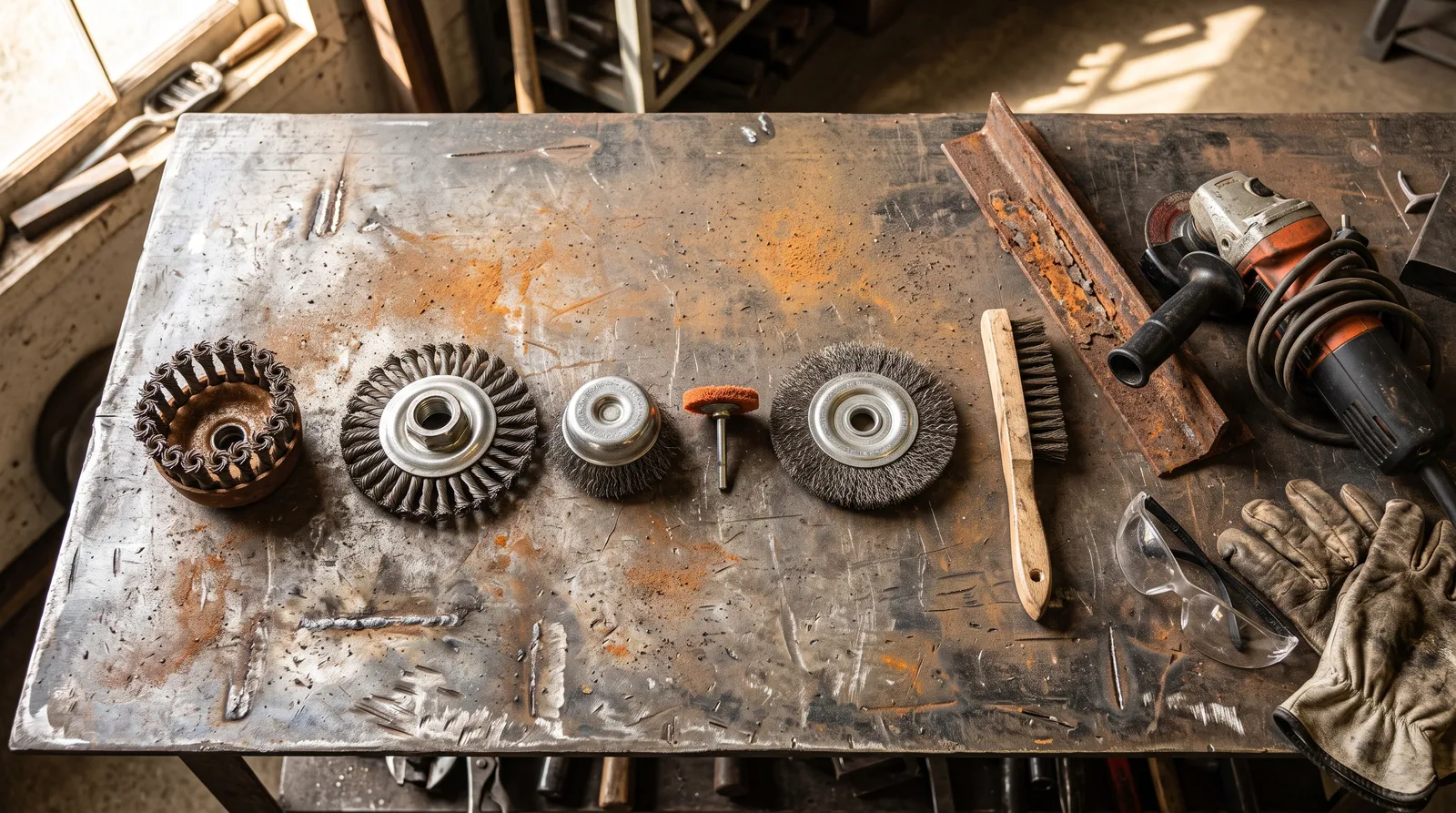
Six wire brushes and wheels tested on rusted railing, a trailer frame, and pitted patio furniture. Top pick: Forney 72753 knotted cup brush, plus where each one falls short.

Disclosure: Some links below are affiliate links. We earn a commission if you buy through them, at no extra cost to you.
Top pick: the Forney 72753 knotted wire cup brush, 4-inch face, .020 carbon knots, 5/8 in.-11 arbor, about $24 on any angle grinder you already own. It wins on the only thing that matters against heavy rust, which is bite. Twisted knots chisel flaking scale off structural steel instead of buffing it shiny. It falls short on control. That same bite scores thin sheet, and it throws wire hard enough that a face shield stops being optional. On thin panels the DEWALT DW4910 crimped cup is the gentler call. On edges, seams, and angle iron, the Forney 72812 knotted wheel reaches where a cup rides on its rim. For drill work with zero gouging, the Dico Nyalox nylon abrasive wheel. For loose hardware, a 6-inch Forney 72752 bench wheel cleans a bolt in two seconds. And a $6 Forney 70505 hand brush earns its place as the last step before primer.
The brush is not really the decision. The fill is.
Why These Six Made the Cut
I bought all six through normal retail channels and ran them against three rust conditions over three weeks.
A 34-foot porch railing on the Rhode Island coast, orange bloom at every weld and black enamel flaking off the top rail in sheets. A 16-foot utility trailer frame with heavy mill scale and pack rust down in the channel, which is the hardest case a homeowner is likely to meet. Five pressed-steel patio chairs from the 1970s, pitted and thin, which existed in this test purely to catch brushes that are too aggressive. Plus a bench station: forty rusted carriage bolts, strap hinges, and shelf brackets on a 6-inch grinder at 3,450 RPM.
The trailer frame sorted the field in about four minutes. The knotted cup took a square foot of flaking scale back to bright grey steel while the crimped cup was still working on the first six inches. The Nyalox wheel never got past the loose surface material at all.
Then the patio chairs reversed the ranking completely. Under 10x magnification the knotted cup left directional score lines deep enough to read through a semi-gloss topcoat. Nyalox left an even matte scratch and no gouging.
Two tools, two opposite winners, same category. That’s the whole article in one paragraph.
Knotted, Crimped, or Nylon
Three fill types. Pick the fill before you pick the brand, because the brand barely matters and the fill decides whether you strip the rust or wreck the panel.
Knotted wire. Individual wires twisted into stiff rope-like knots. The knot has almost no flex, so each tip hits the surface like a tiny chisel. This is what removes mill scale, pack rust, weld spatter, and coatings that have gone hard and brittle. It’s the fastest fill by a wide margin and the most destructive. Typical gauge runs .020 to .023 for carbon.
Crimped wire. Individual wires with a wave pressed into them, mounted loose. The wave gives the wire spring, so it flexes across the surface rather than digging. Crimped fill cleans light surface rust, cleans threads, cleans castings, and won’t put a low spot in 20-gauge sheet. Common gauges run .008 to .014.
Nylon abrasive. Nylon filament with abrasive grit embedded through the whole strand, so the brush keeps cutting as it wears. Dico’s Nyalox is the original and still the one worth buying. It abrades rather than chisels, it doesn’t shed steel wire, and it comes in graded grits, which means you can strip with 80 grit and then step to 240 for a paint-ready scratch. It also melts if you push it, and it is drill-speed only.
If you own one metal-prep tool and you work on real steel, buy knotted. If you work on cars, tanks, old furniture, or anything decorative, buy crimped or nylon and be patient. For the full prep sequence after the rust is off, see the rusted metal painting guide.
Matching the Brush to the Tool
The mount tells you what the brush is for, and mismatching it is the most common way people ruin brushes.
5/8 in.-11 threaded brushes go on 4-1/2 in. angle grinders. Grinders spin 10,000 to 11,000 RPM no-load, so the brush needs a rating above that. The Forney 72753 is rated 8,500, which is under a typical grinder’s no-load speed. In practice the brush is loaded the moment it touches metal and the tool drops well under that, but if your grinder has a speed dial, back it off. The Forney 72812 wheel is rated 15,000 and has no such asterisk.
1/4 in. hex shank brushes go in a drill. Drills top out around 1,500 to 2,000 RPM in high gear, which is exactly where nylon abrasive wants to live. Putting a Nyalox wheel on an angle grinder destroys it in seconds and throws melted nylon.
1/2 in.-5/8 in. arbor wheels go on bench grinders, 3,450 RPM on most 6-inch units.
Material matters too. Carbon steel bristles leave iron particles embedded in aluminum, galvanized, and stainless, and those particles flash-rust into brown freckles within days. Use stainless fill on stainless, brass on aluminum and soft alloys, and keep the brushes separated.
The Test Rig
Same protocol per brush.
Strip rate. Five-minute timed runs on the trailer frame channel, measured in square feet of bright steel per minute, with the grinder held at consistent pressure. Heavy scale only, no light-rust sections, so the numbers stay comparable.
Surface damage. Each brush ran a 6 x 6 inch patch on a scrapped 1970s patio chair panel. Panels photographed at 10x, scored for visible directional swirl and score depth. Then each patch got primer and a semi-gloss topcoat, because the real question is whether the scratch telegraphs through paint.
Reach. The porch railing has 22 welded joints, each a corner a cup brush can’t sit in. Scored on whether the brush cleaned the joint or left an orange ring around it.
Wire loss and life. A clean 4-foot square drop cloth under each five-minute run, then swept and counted, plus a before-and-after weigh-in on the trailer frame. Life logged as minutes of contact time until the working face lost shape or stopped cutting.
The knotted cup won strip rate and lost surface damage outright. The Nyalox won surface damage and lost strip rate outright. The knotted wheel won reach. The bench wheel won hardware and cost per part. The hand brush won at the only job the power tools can’t do, which is dusting the surface clean without adding a new scratch pattern.
Comparison at a Glance
| Brand / Model | Fill | Mount | Max RPM | Best for | Price tier |
|---|---|---|---|---|---|
| Forney 72753 Knot Cup, 4 in. | .020 knotted carbon | 5/8 in.-11 grinder | 8,500 | Heavy rust, mill scale, structural steel | $$ |
| Forney 72812 Command PRO Knot Wheel, 4-1/2 in. | .020 knotted carbon | 5/8 in.-11 grinder | 15,000 | Edges, weld seams, angle and channel | $$ |
| DEWALT DW4910 Crimp Cup, 3 in. | Crimped carbon | Angle grinder | Per tool rating | Light rust on thin sheet, body panels | $ |
| Dico Nyalox Wheel, 4 in. 80 grit | Nylon abrasive | 1/4 in. hex, drill | 4,500 | No-gouge stripping, aluminum, galvanized | $$ |
| Forney 72752 Crimped Wheel, 6 in. | .014 crimped carbon | 1/2 in.-5/8 in. arbor | 6,000 | Bolts, hinges, brackets, small parts | $ |
| Forney 70505 Shoe Handle Brush | .014 carbon bristle | Hand | N/A | Detail, castings, pre-primer dusting | $ |
1. Forney 72753 Knotted Cup Brush, Top Pick
The 72753 is the brush you put on the grinder when the metal is thick and the rust is winning.
Four-inch face, .020 carbon wire twisted into knots, 5/8 in.-11 threads, $23.99 at Forney’s own list price and usually a couple of dollars under that at retail. On the trailer frame it took flaking mill scale down to bright grey steel at a rate no other brush in the test came close to. The channel section that took the crimped cup most of a working hour took this one about eleven minutes.
The flat annular face is why it works on panels. A wheel chatters across a wide flat surface because it’s contacting on an edge. A cup sits down flat and stays put, so you can move in overlapping passes and actually see where you’ve been.
Wire loss was the highest in the test, which is what knotted brushes do. The drop cloth after a five-minute run held a visible scatter of broken bristles. One of them went through a canvas glove. That is not a defect, it’s the category, and it’s the reason a face shield over safety glasses is the entry price for using this brush at all.
Two other limits. The 4-inch face is too big for tube railing and won’t reach into an inside corner, which is where the knot wheel comes in. And on the pressed-steel patio chairs, the score lines it left read through a semi-gloss topcoat plainly enough that I’d never put it on anything lighter than 16 gauge.
| Spec | Value |
|---|---|
| Fill | .020 in. carbon steel, knotted |
| Face | 4 in. |
| Arbor | 5/8 in.-11 |
| Max RPM | 8,500 |
| Approx. price | $20–$24 |
Buy it if: you’re stripping structural steel, a trailer, a gate, a fence post, or thick rusted plate and you want it done today. Skip it if: the metal is thin, decorative, or something you’d be upset to scratch.
2. Forney 72812 Command PRO Knot Wheel, Best for Corners
The railing job is what sold me on owning both shapes.
Twenty-two welded joints, and the cup brush cleaned the flats beautifully while leaving an orange ring around every single joint, because a cup contacts on its rim and the rim can’t get into a corner. Swapped to the 72812. Every joint cleaned in under thirty seconds.
Same .020 knotted carbon fill as the top pick, in a 4-1/2 in. wheel with a 5/8 in.-11 hub and a 15,000 RPM rating that covers any grinder you’ll plug in. $25.99. The knots held their shape through the full trailer frame and the railing, which the cheaper knot wheels I’ve used in past round-ups did not.
The wheel wants to walk. Along the top rail of a railing it climbs unless you keep it square to the work, and the moment it climbs you’re cutting a groove rather than cleaning a surface. That’s a technique problem, not a product flaw, but it’s a real one for anyone who hasn’t run a wire wheel before.
Buy it if: your job is a railing, a fence, a gate, or anything made from angle iron and welded joints. If you only buy one grinder brush for that kind of work, buy this one and not the cup.
3. DEWALT DW4910 Crimped Cup, Best for Thin Sheet
Different problem, different tool.
The DW4910 is a 3-inch crimped carbon cup with an internal holding plate, and the crimped fill is the whole point. Wire with a wave pressed into it flexes when it hits the surface. It lifts light surface rust and thin coatings off a body panel or a fuel tank without cutting into the metal, and under magnification the patio chair patch it cleaned showed light marking rather than the score lines the knot cup left.
It is slow, and it loads up. Old alkyd enamel gums into the fine crimped wire and the brush stops cutting until you rake it out with a screwdriver. On the trailer frame it simply couldn’t keep up.
The holding plate matters more than DEWALT’s marketing makes it sound. Cheap crimped cups splay out into a mushroom after twenty minutes and the working face goes soft. This one held.
Verdict: the right cup for sheet metal, tanks, and anything you’d otherwise strip with 80-grit on an orbital. About $10–$14 and stocked at both home centers, which counts for something on a Saturday. For the sanding side of the same job, see the sandpaper grit round-up.
4. Dico Nyalox 4 in. Wheel Brush, Best for No-Gouge Work
I’ll say the unpopular thing first. Nyalox is expensive for what it is, it wears fast, and it will not touch heavy scale. Starting around $26 for a 4-inch wheel, the cost per square foot stripped is the worst in this round-up by a distance.
Buy it anyway if you’re working on metal you can’t scratch.
Abrasive grit is embedded through the whole nylon filament, so instead of steel tips chiseling at the surface, you get a flexible abrasive that abrades rust and coating and leaves an even matte scratch. On the patio chairs it was the only tool that produced a surface I’d paint without doing anything else to it first. Grit steps are color-coded: 80 gray for stripping, 120 orange for blending, 240 blue for a paint-ready finish. That last one is genuinely useful, because you can strip and key the surface with two brushes and no sandpaper.
It also sheds no steel wire. If you’re working over a lawn, a driveway, or a customer’s tires, that stops being a nice-to-have.
The failure mode is heat. Nylon melts. Lean on the brush or run it at full drill speed with no let-up and the filament glazes into a shiny nub that does nothing. Light pressure, high gear on an 18V drill, let the grit work. And the 4,500 RPM ceiling means it belongs in a drill and never on a grinder.
Buy it if: aluminum, galvanized, thin sheet, painted furniture, or anything where the scratch pattern is going to show through the topcoat. Skip it if: you’re stripping a trailer frame. It will cost you three brushes and a day.
5. Forney 72752 6 in. Crimped Bench Wheel, Best for Small Parts
Twenty dollars, and it’s the highest-value tool in the round-up.
The forty-piece hardware pile is where bench wheels earn their keep. Rusted carriage bolts, strap hinges, shelf brackets. On the 6-inch grinder at 3,450 RPM, a high-density .014 crimped face took each bolt from orange to clean in about two seconds, threads included. Doing that with a hand brush is roughly a minute per bolt.
It’s fine wire, so it polishes as much as it cuts. Deep pitting stays pitted. And it’s bench-mounted, which means it does nothing at all for the railing bolted to your porch.
The safety note is not optional. A bench wheel grabs small parts and throws them, and it throws them at your face if you present the work above center. Hold below the wheel centerline, always, and never hold a small part with bare fingers when a pair of locking pliers will do it.
Verdict: if you have a bench grinder, put one of these on the left side and leave it there.
6. Forney 70505 Shoe Handle Scratch Brush, Best Budget
Six dollars. Sixty-four tufts of .014 carbon bristle in a 10-1/4 in. wood shoe handle.
This is the brush people skip and then wish they’d bought. Two jobs it does that no power tool does. First, ornamental castings and decorative ironwork, where a grinder brush would round off the detail you’re trying to save. Second, and more useful, the pass right before primer: a power brush leaves a film of fine rust dust sitting on the surface, and wiping it with a rag just moves it around. A quick hand-brushing knocks it loose so you can vacuum or solvent-wipe it off properly.
Stripping a whole railing with it is a weekend. Don’t. And keep it off damp concrete, because carbon bristles rust and a rusty brush contaminates the next surface you touch.
Cheap, and the one item here I’d buy two of.
Brushes That Didn’t Make It
- Cordless-drill “rust removal kits” from marketplace sellers. Three-piece cup-and-wheel sets around $12. The wire pulled out of the cups on the trailer frame within four minutes. Unrated for RPM, which alone disqualifies them.
- Twisted-knot end brushes. Real tools and genuinely the answer for holes and tube interiors, but too narrow a use case to earn a slot here. Buy one if your job is pipe.
- Brass-fill grinder cups. Marketed for rust; brass is soft enough that it burnishes rust rather than removing it. Brass belongs on hand brushes and non-ferrous work.
- Angle-grinder stripping discs. Non-woven abrasive discs strip paint beautifully. They load and glaze fast on actual rust, so they lost on the merits of the category, not the product.
Speed, Safety, and Wire in Your Arm
Three things that decide whether this job goes well.
Pressure. Everyone leans. Don’t. A knotted brush cuts with tip speed, not with force, and pushing collapses the knots sideways so you’re dragging the flank of the wire instead of striking with the tip. Light contact, let the tool spin. Pressure is also what melts a Nyalox and what splays a crimped cup into a mushroom.
Direction. Work the brush in one consistent direction on any surface that will be visible under paint. Crosshatching a wire-brushed surface leaves a scratch pattern that catches light under a gloss topcoat and looks like a mistake, because it is one.
Personal protective equipment, actually worn. Face shield over safety glasses, leather gloves, long sleeves, P100 respirator. Knotted brushes throw broken wire and it embeds. On anything painted before 1978 you also have a lead question, and power brushing is the fastest way to turn a lead coating into airborne dust; wet the surface or scrape first on those. The respirator round-up has the cartridge details.
Lay a drop cloth under the work. Not for the paint. For the wire.
What Happens After the Rust Comes Off
Bare steel starts flash-rusting in hours. In humid coastal air, sooner.
Prime the same day you brush. That’s the whole rule, and it’s the one people break most often. A brushed surface that sits overnight in a damp garage will have a light orange haze on it by morning, and painting over that haze is how a job fails in a year.
If the metal is pitted, a wire brush cannot fix it. The brush face rides across the top of every pit and the rust at the bottom survives, which is exactly why a surface can look clean and bleed orange through a fresh topcoat six months later. Pitted metal wants a converter or a blast. The rust converter explainer covers when the chemistry is worth it and when it’s a shortcut that fails.
Then prime with something rust-inhibitive rather than a general-purpose primer. Details in the primer round-up.
Mistakes That Cost People a Repaint
- One brush for every job. A knotted cup on a car fender is how a $40 panel becomes a bodywork bill. Match fill to base metal thickness, every time.
- Ignoring the RPM rating. A brush rated below your tool’s speed can come apart, and a knotted cup coming apart at 11,000 RPM is a genuine injury. Check the number stamped on the brush, not the packaging.
- Carbon steel on galvanized or aluminum. Iron particles embed and flash-rust into brown freckles within a week. Stainless or brass on non-ferrous, always.
- Leaning on the brush. Collapses the knots, glazes nylon, cuts brush life roughly in half. The tool cuts with speed.
- Brushing today, priming next weekend. Flash rust returns overnight. Brush and prime in the same session or brush again before you prime.
- Skipping the drop cloth. Broken wire ends up in grass, tires, and dog paws. A canvas cloth under the work catches nearly all of it, and the drop cloth round-up covers which ones survive metal work.
- Assuming brushed equals clean. Run a bare hand over the surface after brushing. If it comes away orange, the surface still has loose oxide on it and needs a hand brush and a vacuum before primer.
The Kit I’d Actually Buy
For a homeowner with a railing, a gate, or a fence and one angle grinder: the Forney 72812 knot wheel ($26) and the Forney 70505 hand brush ($6). About $32, and the wheel handles the corners that make railing jobs slow.
For anyone stripping structural steel, a trailer, or heavy plate: add the Forney 72753 knot cup ($24). Cup for the flats, wheel for the joints.
For car panels, patio furniture, or galvanized: skip both knot brushes. Dico Nyalox 4-inch 80 grit in a drill ($26), the DEWALT DW4910 crimped cup ($12) for grinder work, and the hand brush.
If you have a bench grinder, the Forney 72752 goes on it and stays there.
Prime the same day. That’s the part that decides whether any of this held.
Ask a Question