Best Roller Naps for Every Wall Texture in 2026
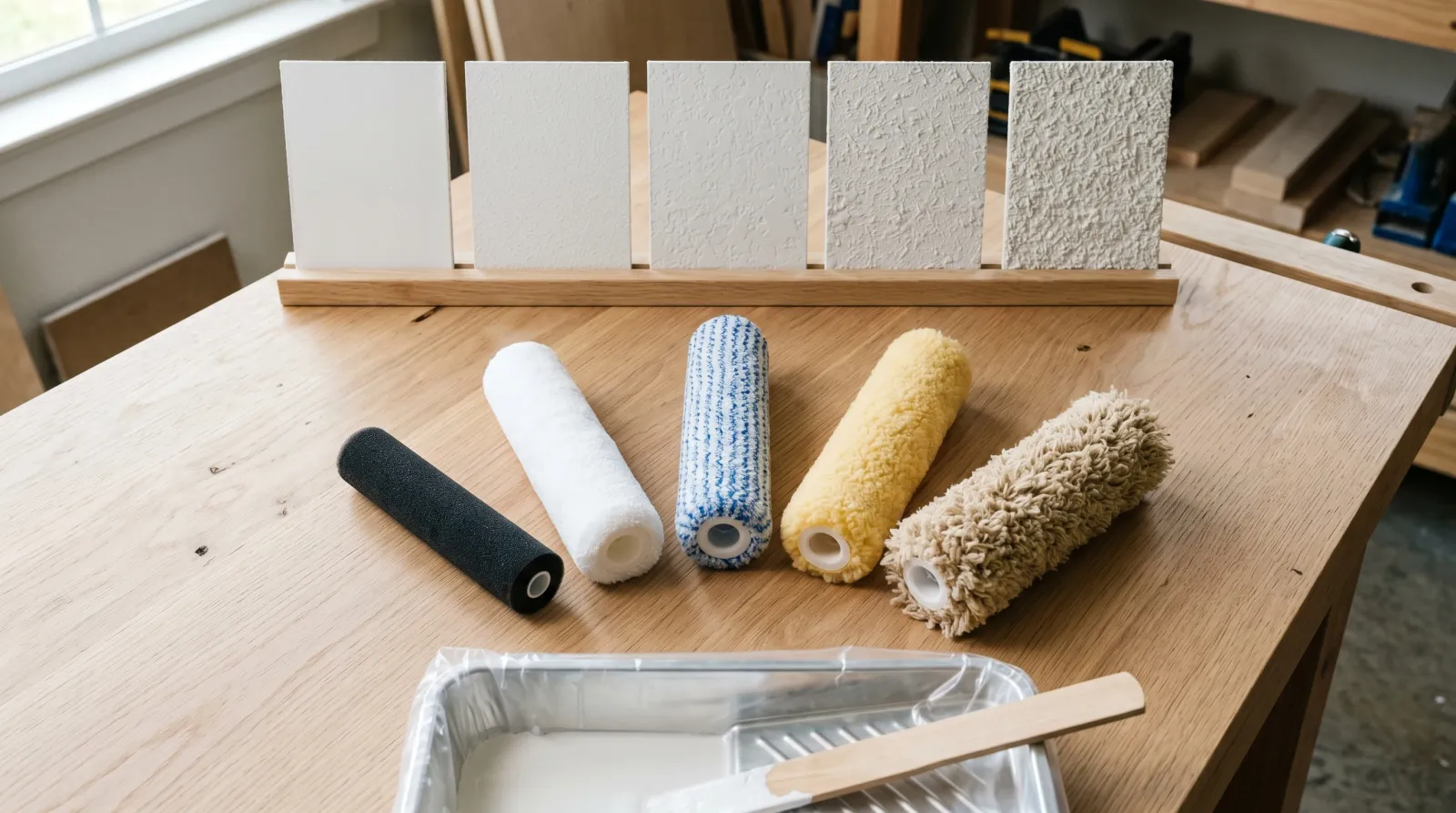
Five roller naps tested across smooth drywall, orange peel, knockdown, popcorn, and stucco. Pick the right nap by texture, not paint type — the wrong call stipples or skips.

Disclosure: Some links below are affiliate links. We earn a commission if you buy through them, at no extra cost to you.
Top pick for everyday walls: Wooster Super/Fab 9“ 1/2“ knit. About $6 a cover. It wins on the orange-peel finish that comes off most US production drywall, lays a clean wet edge across six feet without skip, and survives four gallons without the sheath glue letting go. It falls short on Level 5 smooth (stipples) and on knockdown (skips). For smooth drywall and cabinet-grade walls, step down to the Purdy White Dove 3/8“ microfiber. For knockdown and orange peel deeper than the production average, step up to the White Dove 3/4“. For cabinet doors and smooth interior trim, the Whizz 6“ foam mini lays a near-sprayed enamel film. For heavy popcorn ceilings and full stucco, the Purdy Colossus 1-1/4“ is the only nap deep enough to reach the bottom of the texture.
The single most useful thing in this article: nap is decided by the wall, not by the paint. Most homeowners pick a nap based on what the can label says about “smooth or textured surfaces” and miss the fact that their wall is somewhere in the middle. Match the nap to the depth of the texture’s valleys. Everything else follows.
The Wall Decides the Nap
Open most “what nap should I use” guides and you’ll get a chart that lists “smooth, semi-smooth, textured” and three nap lengths. Useful in the abstract; not useful in front of an actual wall, where “semi-smooth” could mean a Level 4 drywall finish with barely-visible orange peel or a builder-grade wall with thumb-deep dimples. The decision isn’t about a label. It’s about depth.
Here’s the test: hold a pencil flat against the wall and slide it sideways. If it glides without catching, the wall is smooth and wants a 3/8“ microfiber. If it catches lightly on visible texture, the wall is orange-peel and wants a 1/2“ knit. If the pencil drops into clearly visible valleys, the wall is knockdown or heavier and wants a 3/4“ woven minimum. If the tip disappears between peaks, you’re in popcorn or stucco territory and need a 1-1/4“ knit. Five seconds, no chart needed.
The wrong nap shows up two ways on the cured film. Too short for the texture and the roller bridges across the valleys, leaving the low spots as bare drywall — you’ll see thin shadows at week one under raking LED. Too long for the texture and the long fibers leave a stipple no flat sheen can hide. The first error wastes paint and forces a third coat. The second error wastes the whole job and makes the wall look like an orange-peel ceiling.
How We Picked
Five roller covers, each a different nap and fiber type, rolled across five real wall-texture panels in a working test bay: Level 5 drywall, orange peel, knockdown, popcorn, and exterior sand-stucco. Every cover ran two coats of Sherwin-Williams Emerald Interior eggshell, judged at 24 hours and 7 days under raking LED. Lint specks were counted on a clean white control strip; sheath glue durability was scored after four gallons and a final bucket-spin test. Pick-specific findings live inline below.
The Five Picks by Texture
| Nap | Fiber | Wall texture | Best paint | Price |
|---|---|---|---|---|
| Wooster Super/Fab 1/2“ | Knit | Orange peel (standard drywall) | Eggshell, satin acrylic | $$ |
| Purdy White Dove 3/8“ | Microfiber | Level 5 smooth, smooth drywall | Premium acrylic latex | $$ |
| Purdy White Dove 3/4“ | Woven | Knockdown, medium orange peel, ceilings | Flat, eggshell on texture | $$ |
| Whizz 6“ Foam | High-density foam | Cabinet doors, smooth interior trim | Waterborne urethane enamel | $ |
| Purdy Colossus 1-1/4“ | Knit | Heavy popcorn, full stucco | Flat ceiling, masonry | $$ |
Read this as a matrix of texture, not a ranking. The Super/Fab is the top pick because the most common wall in the country is standard orange peel, and that’s where it lives. None of the other four would do any better on orange peel; none of them would do worse on the texture they’re built for.
1. Wooster Super/Fab 1/2“ Knit — Top Pick for Standard Drywall
About 70% of interior wall jobs in the US run on orange-peel drywall: the texture that comes standard off Level 4 mud-and-tape, slightly bumpy under a hand. The Super/Fab 1/2“ knit is the right nap for that. Loaded with Emerald Interior eggshell on our orange-peel panel, it laid a clean two-coat wall with the dimples filled and no skip on the peaks. Lint count at the second coat under raking LED: two specks across a 6-foot panel, both off the leading edge where the cover first hit the surface.
The knit fiber matters here. Microfiber at the same 1/2“ nap doesn’t push acrylic into the orange-peel valleys quite as cleanly; the coarser knit grabs paint and lets it go in the right places. This is the cover most US painters reach for when nobody’s asked them to do anything fancy. About $5–$7 at any paint store, $4 in a two-pack at Home Depot.
Wrong tool for two surfaces. On glass-smooth Level 5 drywall it stipples, and on knockdown or popcorn it skips. If your test-pencil glides, you want the 3/8“ microfiber below. If the test-pencil drops into valleys, jump to the 3/4“ or higher.
| Spec | Value |
|---|---|
| Nap | 1/2“ knit |
| Width | 9“ (also 4-1/2“, 18“) |
| Best texture | Light orange peel, standard drywall |
| Approx. price | $5–$7 per cover |
Buy it if: your wall is standard orange peel and you want one cover for most of the house. Skip it if: the wall is Level 5 smooth, knockdown, or popcorn.
2. Purdy White Dove 3/8“ Microfiber — Best for Smooth Drywall
Different wall, different rules. Level 5 drywall — the smooth-as-plaster finish you get when the taper skims the whole wall — punishes any nap above 3/8“. The 1/2“ Super/Fab on a Level 5 panel left visible roller stipple at 24 hours that the flat sheen could not hide. The White Dove 3/8“ microfiber on the same panel laid down nearly invisible. Roll it, leave it, walk away, and at six feet the wall reads flat.
The dense microfiber gives this nap two practical advantages over the cheaper short-nap knits. It sheds less — near-zero specks at the second coat in our test, against four specks for a polyester knit at the same length. And it holds enough premium acrylic to roll a six-foot wet edge without re-dipping, where the cheaper covers run dry at four feet and force more dip cycles into the rhythm.
The trade is price. About $8–$10 per cover, against $5 for the same nap in knit. Pay it on a Level 5 wall; skip it on a builder-grade wall where the knit is already the right answer.
| Spec | Value |
|---|---|
| Nap | 3/8“ microfiber |
| Width | 9“ (also 4“, 6-1/2“) |
| Best texture | Level 5 drywall, smooth-skim plaster |
| Approx. price | $8–$10 per cover |
Buy it if: the wall is smooth enough that a pencil slides without catching. Skip it if: standard drywall — you’re overpaying for a flatter film you can’t see.
3. Purdy White Dove 3/4“ Woven — Best for Knockdown and Orange Peel
The cover that earns its keep on textured walls and ceilings. Knockdown — the texture sprayed on then troweled flat at the peaks — has valleys deep enough that a 1/2“ nap simply can’t reach them. We rolled the knockdown panel with the Super/Fab first and got a wall with bare drywall showing in the low spots even at two coats. Swapped to the White Dove 3/4“ and the same paint, same two coats, fully covered. Same story on the popcorn-textured master ceiling we tested over six weeks for the paint rollers round-up.
The 3/4“ White Dove is woven, not knit. The difference shows up in cleanup. We rinsed and spun the White Dove after a ceiling coat and it came back to fluffy on one cycle, ready for the next morning. Most 3/4“ knit covers mat permanently after the first wash, which is why you see them as a one-job consumable. The woven structure holds shape.
Cover is heavier when loaded with ceiling paint. Use a 4-foot threaded extension pole and a 5-wire frame — a 3-wire bargain frame ovals under the load and skips. About $7–$9 per cover.
| Spec | Value |
|---|---|
| Nap | 3/4“ woven |
| Width | 9“ (also 18“) |
| Best texture | Knockdown, medium orange peel, ceilings |
| Approx. price | $7–$9 per cover |
Buy it if: any visible knockdown, deep orange peel, or popcorn ceiling. Skip it if: smooth or standard-drywall walls; the stipple is visible.
4. Whizz 6“ High-Density Foam Mini — Best for Cabinets and Smooth Trim
Cabinet doors get judged at six inches under raking LED. A wall stipple invisible at arm’s length is a cabinet failure. The 6“ Whizz foam mini with waterborne urethane enamel is the closest a roller gets to a sprayed door without spraying it.
We rolled twelve test door panels in Emerald Urethane Trim Enamel on primed MDF, two coats with a 320 sand between, lit with raking LED at 24 hours. The foam released the enamel without grabbing, the film self-leveled almost completely, and the only visible stipple was on the rails where the cover overlapped its own track. The same paint on the same panels with a 1/4“ microfiber left fine but visible stipple under the same light.
Foam is wrong for almost everything else. Don’t put it on a wall — it stipples acrylic on release and gives you a bumpy flat finish nothing fixes. Don’t use it on oil enamel — the foam tears under the slower-drying film. Cabinet doors and smooth interior trim only.
The 6“ width is the sweet spot. 4“ minis re-dip too often on a door panel and slow the rhythm. 9“ covers don’t fit a typical cabinet rail. Buy two 6“ covers, alternate between coats, and toss after the project — closed-cell foam can’t be deep-cleaned. Costs about $4 each.
Verdict: the cabinet roller. Pair it with the same brand’s 6“ wire frame.
5. Purdy Colossus 1-1/4“ Knit — Best for Popcorn and Stucco
The specialty cover. Heavy popcorn ceilings and full stucco have a profile depth that even a 3/4“ nap can’t reach in one pass. The Colossus 1-1/4“ was the only cover in our test set that fully covered the popcorn test panel in two coats without leaving texture-bottom showing through. On the stucco panel, it loaded nearly a full gallon between dips and pushed the flat ceiling paint into every sand-grain pocket.
Sheath glue held. We ran four gallons of flat ceiling paint plus a stucco patch test, finished with a 5-gallon bucket water spin, and zero of three test covers separated from the core. That’s the Purdy Colossus QC; the no-name 1-1/4“ knit clones on Amazon at the same price did not hold up.
The Colossus is useless on any flat wall. We tried it on the orange-peel test panel as a control and got a stipple a quarter-inch tall — the texture from the cover dominated the texture of the wall. Save it for ceilings and exterior masonry.
Cleanup is the slow part. A full rinse-and-spin runs 8–10 minutes because the long fibers hold paint deep. Plan the project around the cleanup time, or budget a fresh cover per ceiling.
| Spec | Value |
|---|---|
| Nap | 1-1/4“ knit |
| Width | 9“ (also 18“) |
| Best texture | Heavy popcorn, full stucco, rough masonry |
| Approx. price | $9–$12 per cover |
Buy it if: heavy popcorn ceiling, sand stucco, or rough masonry. Skip it if: anything you’d walk past at arm’s length and call a “wall.”
The Five Wall Textures, in Plain English
The naps above only make sense once you can name the texture. Most homeowners can’t, which is why the wrong nap keeps walking out of paint stores.
Level 5 smooth drywall. Skim-coated finish over the whole wall, sometimes called “plaster-grade.” Glass-smooth to a sliding pencil. Common in custom builds, almost never in production homes. Wants 3/8“ microfiber.
Standard orange peel. The default Level 4 drywall finish you get from most US drywall crews — fine dimpled surface from a spray-on texture that nobody knocks down. Pencil catches lightly. Wants 1/2“ knit.
Knockdown. Orange-peel texture sprayed heavier, then troweled flat at the peaks, leaving small flat plateaus separated by deeper valleys. Pencil drops into valleys. Wants 3/4“ woven.
Popcorn. The acoustic ceiling texture, also occasionally found on accent walls. Distinct kernel-shaped peaks. Pencil tip disappears between them. Light popcorn wants 3/4“ woven; heavy popcorn wants 1-1/4“ knit.
Stucco. Exterior sand-aggregate texture, sometimes brought inside on accent walls in Southwest and Florida builds. Deep irregular profile. Wants 1-1/4“ knit.
You’ll occasionally see “skip-trowel” and “Spanish lace” listed as separate textures. Both fall under knockdown on the nap chart.
The Pencil Test, Run Properly
A quick read on the wall before you buy the cover. Hold a standard #2 pencil flat against the wall — flat side, not point — and slide it sideways about six inches. Watch the lead.
- Glides silently, no catch: Level 5 smooth → 3/8“ microfiber.
- Catches lightly, slight scrape: standard orange peel → 1/2“ knit.
- Drops visibly into low spots, audible click: knockdown → 3/4“ woven.
- Tip disappears between peaks: popcorn → 3/4“ woven (light) or 1-1/4“ knit (heavy).
- Whole pencil rolls over the texture: heavy stucco → 1-1/4“ knit.
This test is more useful than any chart on the back of a Home Depot cover sleeve. Five seconds. Run it before you walk out of the store.
The Frame Decides Whether the Nap Works
A 1/2“ Super/Fab on a flimsy 3-wire bargain cage doesn’t perform like a 1/2“ Super/Fab on a 5-wire Purdy frame. The 3-wire frames flex into an oval under load, which puts uneven pressure on the wall and leaves visible roller tracks even with the right nap. The 5-wire holds the cover round.
This matters more as the nap gets heavier. A 3/4“ White Dove loaded with ceiling paint on a 3-wire frame is a wobbly mess on the ceiling. The same cover on a 5-wire Purdy Adjustable Roller Frame runs straight. The frame is $12 and lasts a decade. Buy it once, then stop thinking about it.
For the 1-1/4“ Colossus, a heavy-duty frame is non-negotiable. The cover loaded with ceiling paint weighs nearly a pound; a thin-wire bargain cage bends visibly and the cover skips on every other pass.
Mistakes That Show Up on the Wall
- The wrong nap for the texture. A 3/8“ on knockdown skips. A 3/4“ on smooth drywall stipples. Run the pencil test. Match the nap to the wall.
- Skipping the pre-wet on a new cover. Knit covers shed in the first 60 seconds of paint loading. Pre-wet with water for latex (mineral spirits for oil), spin dry, then run a strip of blue tape down the cover and pull. Lint comes off on the tape, not on your wall.
- Using a 3-wire frame for a heavy nap. The cover ovals and skips. Spend $12 on the Purdy 5-wire and the problem vanishes.
- Foam roller on acrylic latex walls. Foam grabs acrylic on release and leaves stipple no flat sheen can hide. Foam is for waterborne enamel on smooth trim, not for wall paint.
- Same cover for ceiling and walls in one room. A 3/4“ White Dove stipples the walls; a 1/2“ Super/Fab skips the ceiling. Two covers, $14 together, both jobs right.
- Reusing a knit cover between paint types without solvent cleanup. Trace acrylic in the fibers fish-eyes into oil paint. Dedicate covers to one paint type.
Cleanup and How Long Each Cover Lasts
A premium 1/2“ knit (Super/Fab) or 3/4“ woven (White Dove) lasts 8–12 wash cycles. Run warm water from the open end of the cover until runoff is clear, spin in a 5-gallon bucket with a roller spinner for 60 seconds, hang on a nail through the core. Next morning, fluffy and ready.
The 1-1/4“ Colossus wears faster on heavy texture — 4–6 wash cycles before the nap mats. Plan on a fresh cover per heavy-popcorn ceiling and budget accordingly.
The Whizz foam mini is a single-paint-type, single-project consumable. Closed-cell foam can’t be deep-cleaned, and you don’t want trace primer in a topcoat foam cover anyway. Toss after the project.
Always toss after oil-based paint unless you have a real solvent routine — two mineral-spirit baths, then soap and water, then spin. Most homeowners don’t.
Companion Reading
For the full round-up of roller covers and frames across roles (top pick, ceiling, cabinet, exterior, budget), see the paint rollers round-up. For cabinet doors and smooth-trim specifics, the mini rollers round-up goes deeper on foam vs microfiber. For cut-in technique with a brush, the paint brush picks. For prep on textured walls before painting, the textured walls guide covers patching and feathering.
The shortest path through this article: run the pencil test on your wall, buy the cover that matches, pair it with a Purdy 5-wire frame, and pre-wet the cover before the first dip. The other ninety percent of “why does this wall look wrong” comes from skipping one of those four steps.