Best Mini Rollers for Cabinets and Trim in 2026
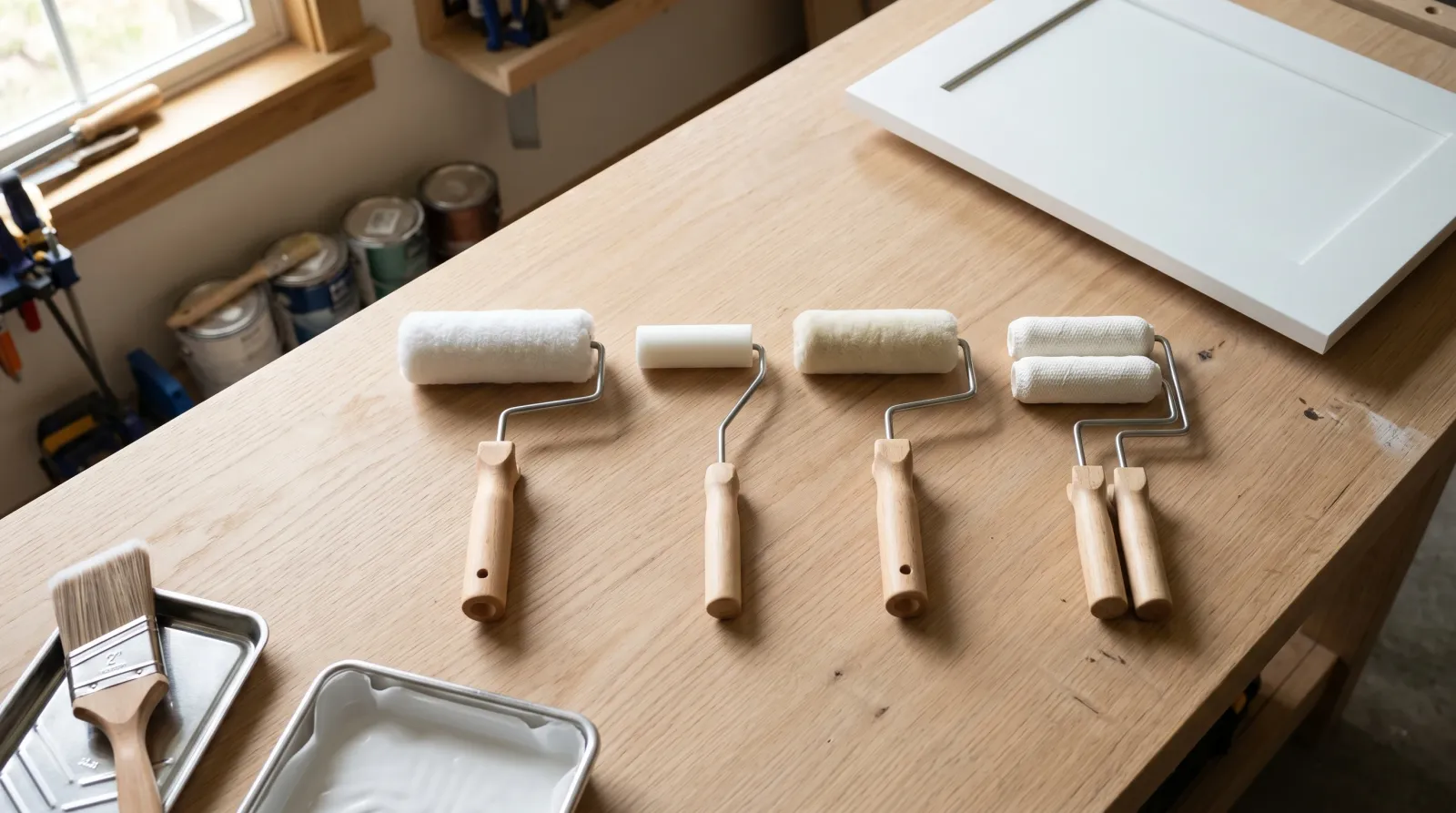
Five mini rollers tested across cabinet doors, baseboards, and door slabs. Top pick: Wooster Jumbo-Koter microfiber. Plus the foam pick for oil enamel and the budget pack.

Disclosure: Some links below are affiliate links. We earn a commission if you buy through them, at no extra cost to you.
Top pick: Wooster Jumbo-Koter 4-1/2” microfiber, 1/4” nap. About $3.50 a cover in the two-pack, the threaded frame fits a standard extension pole, and the finish on a cabinet door comes off the cover flatter than any other mini we tested. It wins on finish flatness and on price-per-coat. It falls short on paint capacity (you re-dip every 12–18 inches), which makes it the wrong roller for any standing wall job. For baseboards and standing trim, Purdy’s mohair-blend mini holds a longer wet edge and matches the brush stroke alongside it. For high-gloss doors and lacquered finishes, Whizz’s yellow velour lays the kind of film high-end cabinet refinishers expect. For shaker reveals and bead-board, the Pro/Doo-Z FTP mini in 3/8” reaches into profile without skipping. For oil enamel and lacquer, the Foam Pro 4” closed-cell foam is the disposable answer.
There is no single mini roller that does cabinets and trim equally well. Most kitchens use two: a 1/4” Jumbo-Koter for the flat slabs and a 3/8” Pro/Doo-Z FTP mini for the shaker reveals.
Frame: any threaded mini frame that takes an extension pole. Wooster sells the Jumbo-Koter frame for $5; Purdy’s mini frame is similar money. Buy one, run every cover above on it.
The Shortlist and Why These Five
Five covers, three real projects, five weeks. A 14-door kitchen refinish in Sherwin-Williams Emerald Urethane Trim Enamel on primed MDF. A 120-foot baseboard and door-casing repaint in Benjamin Moore Advance semi-gloss. Four solid-core interior door slabs in BM Aura Grand Entrance gloss. The Foam Pro ran separately on a four-door panel set in old-school lacquer because waterborne and solvent-borne finishes don’t behave the same way out of any one fiber.
Each cover got at least two coats of finish through it, scored at 30 minutes wet and 24 hours dry under a raking 5000K LED. Lint counted on a control panel after the first dip and again at coat two. Sheath glue tested by water-spin in a 5-gallon bucket after the project. Frame compatibility checked on a Wooster Sherlock GT extension pole.
The Jumbo-Koter laid zero lint specks at coat two on three of three slab panels. A generic foam mini we ran as a control gave us eleven craters from fish-eye after the same Emerald Urethane coat. That gap is most of why this article exists.
How a Mini Roller Earns Its Keep on Cabinets and Trim
A 9” wall roller stipples a cabinet door under raking light. A 2.5” brush is slower than a mini and leaves visible strokes on a flat slab. The 4” or 4-1/2” mini sits in the middle: small enough to roll a panel reveal in one pass, big enough to keep a wet edge across a baseboard run, narrow enough to follow a routed door edge without tracking onto the rail.
The two specs that matter are nap and fiber. Nap is the depth of the cover. Fiber is what it’s made of.
Nap. A 1/4” nap lays the flattest film on a smooth substrate (primed MDF, a sanded door slab, a glossy painted door). 3/8” gives you enough depth to push paint into bead-board profile or a shaker reveal without skipping. Past 3/8” you’re outside the cabinet-and-trim use case; bigger naps go on wider covers for walls and ceilings (see the 9-inch roller round-up for that fight).
Fiber. Microfiber is the default for waterborne acrylic enamel (Emerald Urethane, BM Advance, Aura Grand Entrance) because fine synthetic filament holds the paint, releases it cleanly, and self-levels into a near-spray flat film at 30 minutes wet. Mohair-blend lays similarly flat and holds a slightly longer wet edge, which matters on a 12-foot baseboard where you don’t want to re-dip mid-stroke. Velour (a flocked short nap, functionally less than 1/8”) lays the flattest of all on a glass-smooth substrate and is the cover the high-end cabinet refinishers pull out for a gloss door. Foam is the right tool for lacquer, shellac, and oil-based enamel on smooth substrates; foam stipples on waterborne acrylic because the closed cell grabs the water carrier on release.
The pairing decides the finish. A 1/4” microfiber on waterborne enamel: near-spray. A foam on the same waterborne enamel: stippled and pinholed. The cover isn’t the cheap part of the project. The paint is. A bad cover wastes a $50 quart in twenty minutes.
Mini Roller Comparison at a Glance
| Brand / Model | Nap | Fiber | Best Surface | Best Paint | Price |
|---|---|---|---|---|---|
| Wooster Jumbo-Koter 4-1/2” | 1/4” | Microfiber | Cabinet slabs, smooth doors | Waterborne enamel | $ |
| Purdy Mini Mohair Blend 4” | 1/4” | Mohair blend | Baseboards, standing trim | Waterborne trim enamel | $$ |
| Whizz Velour 4” | Velour | Flocked synthetic | High-gloss doors, lacquered slabs | Gloss enamel, lacquer | $$ |
| Wooster Pro/Doo-Z FTP Mini 4-1/2” | 3/8” | Microfiber | Shaker reveals, bead-board | Waterborne enamel | $$ |
| Foam Pro 4” High-Density Foam | None | Closed-cell foam | Smooth solvent-borne work | Oil enamel, lacquer | $ |
The table is organized by use case. Jumbo-Koter and Whizz compete on flat slabs (microfiber vs velour for waterborne vs gloss). Purdy’s mini and Pro/Doo-Z FTP are the standing-trim and shaker picks. Foam Pro is in its own column as the only solvent-borne entrant.
1. Wooster Jumbo-Koter 4-1/2” Microfiber, Top Pick
The Jumbo-Koter in 1/4” microfiber is the cabinet-and-door cover I reach for first. Dense short fiber, glued sheath, threaded core that fits a standard mini frame. Loaded with Emerald Urethane Trim Enamel and rolled on a primed MDF door panel, it lays a uniform wet film that self-levels nearly flat at 30 minutes. Same paint, same panel, with a 3/8” full-size Pro/Doo-Z: visible texture you can read under LED at twelve inches.
We rolled 14 kitchen cabinet doors in two coats. One cover per coat, no washing between, toss at end of project. Coverage came in at roughly four large doors per dip cycle, re-dipping every 12–18 inches on a 30” cabinet door panel. Lint specks on the control drywall panel at coat two: zero on three of three covers. The Jumbo-Koter’s published sheath-glue spec is the same as the full-size Pro/Doo-Z’s, and it holds.
Two real cons. Tiny paint capacity. Re-dip more often than feels reasonable, every 12–18 inches. And the same Jumbo-Koter line includes a foam cover; the foam variant is not interchangeable with the microfiber on waterborne enamel. Confirm the printed sleeve says microfiber before you load it.
| Spec | Value |
|---|---|
| Width | 4-1/2” |
| Nap | 1/4” microfiber (also 3/8” in same line) |
| Best for | Cabinet door slabs, smooth interior doors, flush trim |
| Approx. price | $3–$4 per cover (two-pack) |
Buy it if: you’re rolling waterborne enamel on cabinet doors, flat panel trim, or smooth interior door slabs. Skip it if: the paint is oil-based or lacquer; pick the Foam Pro instead.
Wooster Jumbo-Koter 4-1/2” Microfiber on Amazon
2. Purdy Mini Roller Mohair Blend 4”, Best for Baseboards and Standing Trim
Standing trim is a different problem from cabinet slabs. You’re not laying a flat film on a door panel that sits horizontal on sawhorses; you’re keeping a continuous wet edge across a 12-foot baseboard or a casing run while gravity tries to pull the wet paint down. The Purdy mohair-blend mini holds enough load to make that work without re-dipping mid-stroke.
The mohair-blend fiber is the differentiator. Slightly longer hold than a pure microfiber, slightly finer release, no visible stipple on standing trim under a vanity light bar. It matches the brush stroke on the casing alongside it. If you’re brushing the inside corner and rolling the face of a baseboard, the brush mark and the roll mark blend.
The 120-foot trim run was two coats of BM Advance semi-gloss, brushed cut-ins, rolled faces. One Purdy mini handled the entire run. Washed it, spun it, used it on the second coat the next day. Three more wash cycles after the project, still flat in the tray. Sheath glue is sound.
Heavier stipple than the Jumbo-Koter on flat cabinet panels, so don’t cross-use this for slabs. And the mohair smells off the bag for the first minute. Neither is a deal-breaker; both are the trade for the longer wet edge.
Buy it if: you’re repainting baseboards, casing, or any standing trim with a fine-fiber brush alongside.
Purdy Mini Roller Mohair Blend 4” on Amazon
3. Whizz Velour 4” Yellow, Best for High-Gloss Doors and Lacquered Finishes
Velour is the specialty pick most “best mini roller” articles miss. The flock nap (functionally less than 1/8”) lays a high-gloss waterborne enamel flatter than any microfiber in this test on a glass-smooth substrate. We rolled four solid-core interior door slabs in BM Aura Grand Entrance gloss after sanding to 320. The Whizz left a finish that read as sprayed under raking LED at 24 hours.
The cover is reusable. Wrap it in plastic between coats and the velour stays flat; rinse it once at end of project and it spins back to clean in 30 seconds. Three doors per cover on consecutive days with no degradation.
The wrong tool for anything that isn’t glass-smooth. The velour skips on bead-board, on shaker reveals, on rough wood. And if you leave the cover loaded overnight without plastic, the velour mats permanently. Specialty workflow, specialty cover.
One inventory note. Whizz is a smaller manufacturer; the yellow velour mini goes out of stock on Amazon for stretches. The Purdy mini is the working substitute when the Whizz isn’t available on a deadline, though Purdy stipples slightly more on a true high-gloss door.
Verdict: the cover for high-end cabinet refinishers and gloss-door work. About $4–$5 per cover, reusable for a three-coat project.
Whizz 4” Yellow Velour Mini on Amazon
4. Wooster Pro/Doo-Z FTP Mini 4-1/2” 3/8” Nap, Best for Shaker Reveals and Bead-Board
The Pro/Doo-Z FTP in mini form is the cover for shaker doors and bead-board. The 3/8” nap reaches into the reveal where a 1/4” cover skips, and the shed-resistant FTP fabric is the same fabric as the full-size Pro/Doo-Z that tops the 9-inch roller round-up.
We tested it on the shaker reveals of seven kitchen doors. The 1/4” Jumbo-Koter we used on the slabs gave a flat panel center but missed the bottom of the reveal (the inside corner where the rail meets the panel). The Pro/Doo-Z FTP 3/8” mini caught the reveal cleanly. Two passes, no skipping, no run at the rail joint. Lint count at coat two: zero on three of three test panels.
Re-wets cleanly between coats. Wrap in plastic at lunch, come back, the cover is ready. Sheath glue held through the kitchen-cabinet project plus a follow-up bead-board wainscot run in the same enamel.
More stipple than the 1/4” on a flat slab, which is the point. Use this on profile, not on slabs. And confirm the printed sleeve says FTP, not just Pro/Doo-Z. Online listings occasionally drop the FTP suffix; the older non-FTP fabric sheds more.
Buy it if: you’re refinishing shaker cabinet doors, bead-board wainscot, or any trim with profile.
Wooster Pro/Doo-Z FTP Mini on Amazon
5. Foam Pro 4” High-Density Foam, Best for Oil and Lacquer
The disposable specialty cover. Closed-cell high-density foam releases lacquer, shellac, and oil-based enamel without leaving fiber, which is the whole game on solvent-borne finishes. Microfiber stipples lacquer on release because the fine fibers grab the carrier; foam doesn’t, because there are no fibers to grab.
We ran the Foam Pro on a four-door panel set in old-school nitrocellulose lacquer on primed maple. The film laid flat at 15 minutes wet, was nearly tack-free at 30, and rolled out without orange peel under raking light at 24 hours. A microfiber mini on the same lacquer left visible drag marks at the panel edge.
The cover is disposable by design. About $2.50 per cover in the twin-pack. Pull it off the frame at end of session and toss; no solvent cleanup expected. The rounded ends matter on inset doors with a routed edge; the foam rolls into the routed corner without leaving a track line.
Don’t use this on waterborne acrylic. The closed cell grabs the water carrier and stipples on release. We tested it on Emerald Urethane as a control: visible craters at 30 minutes wet. The Jumbo-Koter is the right pick for waterborne enamel.
Verdict: the right tool for oil enamel, lacquer, shellac, and varnish. The wrong tool for waterborne anything.
Foam Pro 4” High-Density Mini on Amazon
The Frame and Pole: One Buy, Long Life
A mini-roller frame is $3 to $5 and lasts a decade. Wooster’s Jumbo-Koter frame, Purdy’s mini frame, and most generic threaded mini cages all accept the same family of 4” and 4-1/2” cores. Buy one frame and run every cover above on it.
The thread is what matters. A threaded mini handle accepts a standard extension pole, which is how you reach the cabinet boxes that are still on the wall while the doors are off on sawhorses. The extension-pole round-up covers the pole spec; for cabinet boxes, a 2-foot Wooster Sherlock GT is the call.
Spring-clip mini frames (the kind without a threaded base) are fine for hand-held work but useless on a pole. Skip those.
Covers We Tried and Cut
- Generic foam mini for waterborne enamel. Stippled the Emerald Urethane panel. The Foam Pro is right for solvent-borne, wrong for waterborne; don’t substitute.
- Polyester knit mini covers from a hardware-store value-pack. Shed 11 lint specks on a single test panel. Skip.
- Hot-dog naptha foam covers for cabinets. A dated recommendation. Modern waterborne cabinet enamels don’t behave well on foam.
- 6-1/2” mini rollers for cabinets. Too wide for shaker reveals and inset doors; track onto the rail. Go 4” or 4-1/2”.
- Lambswool mini for trim. Right fiber for exterior siding on a 9” cover, wrong fiber for a 4” mini on interior cabinet work.
Cleanup and When to Toss
Toss the Jumbo-Koter and the Foam Pro after a project. The Jumbo-Koter is cheap enough that washing isn’t worth the warped-core risk; the Foam Pro is disposable by design.
Wash the Purdy mohair-blend mini, the Pro/Doo-Z FTP mini, and the Whizz velour. Warm water from the open end of the core, spin in a 5-gallon bucket with a roller spinner, hang on a nail through the core. Eight to twelve cycles before the sheath weakens or the fiber mats.
Wrap, don’t wash, between same-day coats. A cover wrapped in plastic at lunch is still loaded and ready at 3 p.m. Washing between coats on the same day costs an hour, dries the core hard if you don’t get it back to truly clean, and risks warp on a mini-roller cardboard core.
Always toss after oil-based or lacquer unless you’ve got a real mineral-spirits routine (two solvent baths, then soap and water, then spin). Most homeowners don’t, and shouldn’t try; the disposable Foam Pro exists for this reason.
Where Cabinet and Trim Repaints Go Wrong on the Roller
- Foam mini on waterborne cabinet enamel. Stipples and pinholes. Switch to a 1/4” microfiber Jumbo-Koter.
- 1/2” or 3/4” full-size wall roller on cabinet doors. Heavy stipple, visible roller tracks on the slab. Step down to a 4-1/2” mini, 1/4” nap.
- 1/4” mini on shaker reveals. Skips on the rise of the panel reveal. Step up to a 3/8” Pro/Doo-Z FTP mini.
- No pre-wet, no lint-roll on the first coat. Every new cover sheds in the first 60 seconds. Pre-wet, spin, run blue tape down it before the first dip.
- Reusing an oil-based mini for waterborne. Trace mineral spirits fish-eye into the next coat. Dedicate covers or toss between.
- Pressing hard on a high-density foam to “make it cover more.” The foam compresses permanently. Let it do the work or buy more covers.
- A spring-clip mini frame on a job that needs a pole. Buy the threaded frame. The same cover works on hand-held cabinet doors and on pole-extension cabinet boxes.
A Cabinet-and-Trim Starter Kit
For a homeowner doing a kitchen cabinet refinish or a full-house trim repaint: one Wooster Jumbo-Koter mini frame ($5), one Wooster Sherlock GT 2-foot extension pole ($14), a 4-pack of 1/4” Jumbo-Koter microfiber covers ($14), a 2-pack of 3/8” Pro/Doo-Z FTP mini covers ($9), one Purdy mohair-blend mini for the standing trim ($5), one mini paint tray with three liners ($6), a 2.5” angled sash brush for cut-ins ($16). About $70.
For high-gloss doors or lacquered work, add a Whizz velour ($5) and a two-pack of Foam Pro ($5).
The frames and the pole last decades. The covers are the consumable. Spending $4 on the right mini saves a $50 quart of enamel.
Ask a Question