Best Respirator Cartridges for Painting
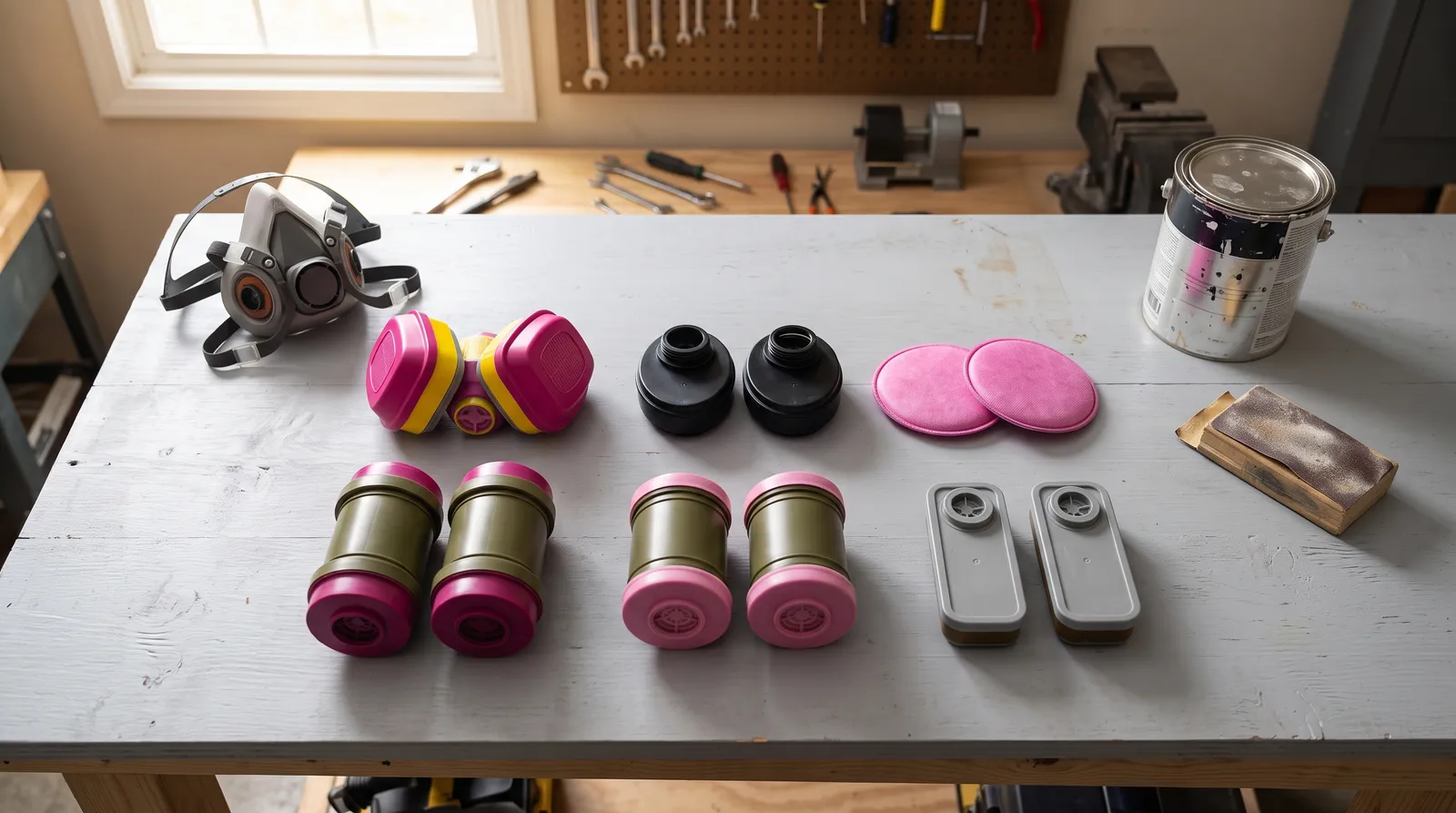
Six respirator cartridges tested across oil-based trim, an airless exterior day, cabinet lacquer, and a week of sanding. Top pick: 3M 60923 OV/AG/P100, and where each one runs out of road.

Disclosure: Some links below are affiliate links. We earn a commission if you buy through them, at no extra cost to you.
Top pick: the 3M 60923. About $20 a pair, an organic vapor/acid gas cartridge with a P100 filter bonded to the front, and the only part in this test that covers both things paint throws at you at once. Solvent vapor you can smell. Paint mist you can’t. It wins on coverage across every job I ran, from sixteen hours of alkyd trim in a closed hallway to a two-day airless exterior. It falls short on bulk, because the filter discs stand far enough forward to crowd safety glasses and catch a hard hat brim, and on price, at roughly double a plain 6001. Skip this if you only brush and roll in a ventilated room. Buy the 3M 6001 instead and keep the difference.
A cartridge is a consumable. Almost nobody treats it like one.
Read the Bands Before You Read the Brand
Two hazards come off a paint job, and one filter does not catch both.
The first is vapor. Solvent evaporating out of alkyd enamel, lacquer thinner, oil-based stain, contact adhesive. Vapor is a gas, it moves through fabric and dust filters like they aren’t there, and the only thing that stops it is an activated carbon bed inside a cartridge. That’s the black-band organic vapor cartridge, the 3M 6001 in this test.
The second is aerosol. Atomized paint from a sprayer, sanding dust, scraped lead-paint chips, drywall silica. Aerosol is a solid or liquid particle, and carbon does nothing for it. You need a mechanical filter, and for paint that means P100: the magenta one.
Combination cartridges stack both. The yellow band on a 60923 means organic vapor plus acid gas, and the magenta disc snapped on the front is the P100. That’s why it costs double.
Here is where people get hurt. A painter buys a 6001 because a video told them to, sprays a garage door with an airless, and inhales the entire mist load through a cartridge that was never designed to stop it. The carbon does its job on the solvent, the painter smells nothing, and concludes the mask is working. It’s the smell that fools you. Removing the odor removes the only feedback you had.
If you spray, you need a particulate filter. Every time. No exceptions.
What the Test Actually Looked Like
Six cartridges, five weeks, four jobs, on whatever facepiece each one is designed for. A 3M 6200 and a 7502 half mask, a 6800 full facepiece, a Honeywell North 7700, a Moldex 7000. Negative-pressure seal check before every single use, which takes four seconds and which almost nobody does.
Job one was sixteen hours of oil-based alkyd on trim and two interior doors in a 1940s hallway with one window cracked. Brush and roll, no spray, plenty of vapor. That’s the pure organic vapor test.
Job two was a two-day airless exterior on cedar siding with waterborne acrylic, preceded by a full day of scraping and sanding old paint. Vapor load low, aerosol load very high, and a hard hat in play. Anything with a tall profile got found out here.
Job three was cabinet doors in pre-catalyzed lacquer, sprayed in a garage booth with a box fan and a filtered exhaust. Four hours of trigger time across two days. Lacquer is the fastest cartridge-killer on this list. If you’re headed there, read the cabinet painting project guide first, because the booth is half the battle.
Job four was five days of prep sanding, drywall patching, and joint compound in an occupied house. Zero solvent, endless dust.
Scoring ran on six axes: odor breakthrough in working hours, breathing resistance across a shift, seal interference with safety glasses and a hard hat, downward sight line at baseboard height, mount compatibility, and cost per working hour at street prices.
One honesty note. Odor breakthrough is a subjective endpoint, and we treated it that way. No gas monitor readings were taken and none are claimed here. Anyone publishing precise breakthrough numbers for your specific garage is guessing.
How to Choose a Cartridge
Match the Cartridge to the Hazard, Not to the Brand
Solvent, brush and roll, ventilated room: organic vapor cartridge. Anything sprayed: combination OV/P100. Sanding, scraping, drywall, demolition: P100 filter alone, no vapor cartridge needed. Epoxy or amine-cured coatings in a closed space: multi gas. Two-component isocyanate urethane: none of the above, see below.
P100 Beats P95 for Paint, and the Letter Matters More Than the Number
The number is efficiency, 95 percent versus 99.97 percent against the hardest particle size to trap. The letter is the part painters get wrong. N is not oil-resistant. R is oil-resistant for one shift. P is oil-proof for extended use. Alkyd overspray and lacquer aerosol carry oil, which knocks N-series filters out of contention for spray work entirely. The price gap between P95 and P100 is a couple of dollars.
Bayonet, Thread, and Smart Are Three Separate Worlds
3M cartridges twist onto a 3M bayonet mount. Honeywell North cartridges thread into a North facepiece. Moldex Smart cartridges clip into a Moldex 7000, 7800, or 9000. None of these interchange, and there’s no adapter worth trusting. Buy the mask first, then buy cartridges for that mask forever. This is the single most common wasted purchase in the category.
Profile Decides Whether You Wear It
The most protective cartridge in the world is worthless in a drawer. A tall combination cartridge blocks your downward sight line, which means you can’t see a baseboard without bending your neck, which means by hour three you’re painting with the mask pushed up on your forehead. Low-profile filters like the 2097 sit close to the face and never fight your glasses. Factor that in.
The Change Schedule Is the Whole Ballgame
Cartridges don’t fail loudly. Organic vapor carbon fills up and then, quietly, stops working. The practical rule is to change at the first hint of solvent smell or taste, and to change anyway at roughly 30 to 40 hours of use or six months from first opening the seal, whichever lands first. Under a formal OSHA respiratory protection program a written change schedule is required, because your nose is not a legal control.
The Isocyanate Exception
Two-component urethane, automotive clear coat, and industrial 2K coatings cure with an isocyanate hardener. Isocyanates have poor warning properties: exposure can be well past the limit before you smell a thing, which removes the breakthrough signal every cartridge depends on. NIOSH and the manufacturers point to supplied-air respirators for that work. If you’re spraying 2K, rent supplied air or hire it out. This is the one place in the article where I’d rather sound preachy than be quoted later.
Comparison at a Glance
| Brand / Model | Protection | Mount | Best for | Profile | Price tier |
|---|---|---|---|---|---|
| 3M 60923 | OV/AG + P100 | 3M bayonet | Spray work, solvent paint, mixed jobs | Bulky | $$ |
| 3M 6001 | Organic vapor only | 3M bayonet | Brush and roll oil-based, adhesives | Slim | $ |
| 3M 2097 | P100 + odor relief | 3M bayonet | Sanding, scraping, drywall prep | Flat | $ |
| 3M 60926 | Multi gas/vapor + P100 | 3M bayonet | Epoxy, amine cure, formaldehyde | Tall and heavy | $$$ |
| Honeywell North 7581P100L | OV + P100 | North thread | North 5500 and 7700 owners | Medium | $$ |
| Moldex OV/AG + P100 combo | OV/AG + P100 | Moldex Smart | Moldex 7000 owners, trim sight line | Low and wide | $$ |
1. 3M 60923, Top Pick
The 60923 is the cartridge I’d hand somebody who owns one respirator and does everything with it.
Yellow body, magenta filter disc, organic vapor plus acid gas plus P100 in one part. On the lacquer cabinet job it ran the full four hours of trigger time across two days without a hint of solvent coming through, and it went back on the mask the following week for the alkyd hallway without complaint. On the exterior airless day it handled the aerosol load that would have gone straight past a bare 6001.
The real argument for it is that it removes a decision. Most homeowners and plenty of pros own one mask and one pair of cartridges, and on any given Saturday they might scrape for an hour, brush trim for two, and shoot a door with a sprayer. A combination cartridge covers all three.
Bulk is the trade-off. The filter discs stand proud of the cartridge body, which crowds safety glasses on a narrower face and catches the brim of a hard hat when you look up at a soffit. Our tester in the 6800 full facepiece stopped noticing after an hour. The tester on the ladder in a hard hat noticed all day.
Cost is the other one. You’re burning the particulate half of a combination cartridge even on days you never spray, which is money out the window if brushwork is 80 percent of what you do.
| Spec | Value |
|---|---|
| Protection | Organic vapor, acid gas, P100 particulate |
| Mount | 3M bayonet: 6000, 6500, 7500, 6800 series |
| Best for | Spray work, solvent paint, mixed prep-and-paint days |
| Service life | Change at first odor; roughly 20 to 40 hours of light spray use |
| Approx. price | $18 to $25 a pair |
Buy it if: you own one respirator, you spray sometimes, and you want one cartridge that covers the whole job. Skip it if: you brush and roll waterborne paint exclusively, in which case a 2097 is cheaper and lighter.
2. 3M 6001, Best Budget for Brush and Roll
Cheapest honest protection in the category. Under $14 a pair most places, and the lightest thing here by a wide margin.
Sixteen hours of oil-based alkyd in a closed hallway is a serious vapor load, and the 6001 handled it. Solvent smell never came through on day one. It came back faintly at the start of day two, which is exactly the behavior you’d expect from a partly loaded carbon bed after a bagged overnight, and that’s when the pair got swapped.
The mask stops registering as a mask after about twenty minutes with these on it, which sounds like a soft benefit and isn’t. Comfort is compliance. A cartridge you keep on your face for six hours protects you better than a better cartridge you push up on your forehead at hour two.
The con is one sentence long and it’s the whole review: no particulate protection at all. Spray anything with a bare 6001 and the mist goes into your lungs while the carbon strips the smell that would have warned you.
If you want to fix that without stepping up to the 60923, a 3M 5N11 P95 pre-filter and a 501 retainer clip onto the front of a 6001 for a few dollars. It’s a legitimate setup for waterborne spray. For alkyd or lacquer, go P100 and stop economizing.
Buy it if: you brush and roll oil-based enamel, stain, or varnish and you never pull a sprayer trigger. Skip it if: there’s a sprayer in the garage. You’ll use it, and you’ll forget to change cartridges first.
3. 3M 2097, Best for Sanding, Scraping, and Prep Dust
Different problem, different part.
Five days of drywall sanding and joint compound in an occupied house is the job where vapor cartridges are pure dead weight and a P100 is the only thing that matters. The 2097 is a flat pink pancake filter with a thin carbon layer added for nuisance-level odor relief, and it’s the most comfortable thing in this test by a distance. It sits close enough to the face that it never once fought a pair of safety glasses.
It’s also the right filter for scraping old paint on a pre-1978 house, where lead chips and dust are the hazard and there’s no solvent in the picture at all. See the exterior peeling paint fix for how to handle that prep without making the dust problem worse.
Two things to be clear about. The nuisance level organic vapor relief is odor relief, and 3M says so on the packaging. It knocks down the smell of fresh latex; it is not respiratory protection against solvent and it does not replace a 6001. People read “organic vapor” on the label and spray lacquer with these. Don’t.
The other is loading. Heavy drywall sanding clogs a P100 fast, and by the end of a hard day you can feel the breathing resistance climb. That’s the filter telling you it’s done its job. Replace it.
Verdict: the filter for prep week. About $12 to $16 a pair, and the pair you’ll go through fastest.
4. 3M 60926, Best for Epoxy and Two-Component Work
The specialist. Organic vapor, acid gas, ammonia, methylamine, formaldehyde, and a P100, all in one very tall cartridge.
Most painters never need this. The one job where it earns its price is garage floor epoxy in a closed garage, where the complaint isn’t solvent, it’s the amine off-gassing from the hardener side. An OV cartridge alone is not rated for it. If you’re doing a garage floor epoxy job, this is the cartridge, and the money is worth it once.
It’s genuinely uncomfortable. The cartridges are tall enough that looking down at a baseboard knocks them into your chest, and the extra carbon bed adds real breathing resistance across a shift. On the trim job it was miserable within an hour. On the floor, kneeling and looking down at a roller, it was fine.
Price is the other wall. Two to three times a 60923 for coverage most residential painters will use once a year.
And to say it again, because the marketing on these cartridges is broad enough to mislead: a multi gas cartridge is not clearance to spray isocyanate 2K urethane. Different problem, different equipment.
Buy it if: epoxy, amine-cured coatings, or formaldehyde-releasing products are on your list this year. Skip it if: you paint houses. The 60923 covers your work at a third of the cost.
5. Honeywell North 7581P100L, Best if You Already Own a North Mask
This one is a compatibility pick, and I’d rather be honest about that than pretend it beats 3M on merit.
The Honeywell North 5500 and 7700 half masks fit narrow faces better than anything 3M makes. Our smallest-faced tester has never passed a clean seal check on a 3M 6200 small and passes every time on a North 7700. For that person, the 7581P100L is the correct cartridge and 3M’s catalog is irrelevant.
The cartridge itself is a threaded OV cartridge with a P100 filter on the front. Threads seat with a positive stop, which I prefer to the bayonet twist. Breathing resistance across a full day of cut-in work stayed low enough that nobody mentioned it, which in this category counts as a compliment.
The catch is availability. You’re ordering these online or from a safety supplier, and they come in fewer multi-packs so the per-cartridge price runs higher.
Buy it if: you already own a North facepiece, or a 3M mask has never sealed on your face. Skip it if: your mask is a 3M. These will not fit and no adapter will make them.
6. Moldex OV/AG With P100 Combo, Best Low-Profile Alternative
The Moldex combo cartridge does one thing better than the 60923, and it’s the thing you notice on trim day.
The body is semi-rectangular and sits low and wide against the facepiece rather than sticking straight out. On the Moldex 7000 that translates to a downward sight line the 3M combo doesn’t give you. Painting a baseboard, cutting a floor line, or reaching under a cabinet toe kick, you can actually see the work without tipping your head.
Protection is the same class as the top pick: organic vapor, acid gas, P100. The cartridges are latex-free and PVC-free, which is a footnote for most people and the deciding factor for the small number who react to standard gaskets.
Downsides are distribution and lock-in. US retail presence is thin, so plan on ordering. And the whole thing only works if you’re on a Moldex 7000, 7800, or 9000 facepiece.
Verdict: if you’re buying a mask system from scratch and you spend your days on trim, the Moldex is worth a look before you default to 3M.
Cartridges I Passed On
- 3M 6003 (OV/AG, no filter). Real cartridge, fine product, but it splits the difference badly. If you need acid gas coverage you’re almost certainly spraying, and if you’re spraying you need the P100. Buy the 60923.
- 3M 5N11 P95 alone. Legitimate as a pre-filter over a 6001 for waterborne spray. Not enough filter for alkyd or lacquer aerosol.
- Unbranded marketplace “P100 compatible” cartridges. No NIOSH TC number, no approval, no way to verify the carbon bed. Fifteen dollars saved against a respiratory hazard you can’t see. Skip.
- Full-face gas mask kits under $40. The cartridges included are the cheapest part of a cheap package. Buy a real facepiece and real cartridges separately.
Service Life, Storage, and the Zip-Bag Question
Cartridges are consumables with an invisible fuel gauge, and that’s the whole problem.
Vapor cartridges saturate. Activated carbon adsorbs solvent until it can’t, then breakthrough begins. Nothing changes visually. The signal is smell or taste, which is why the first hint of solvent through the mask means the cartridge comes off now, not at lunch.
Particulate filters clog. Opposite failure mode. They keep working and get progressively harder to breathe through. When a filter makes you work for air, it’s finished.
The zip bag helps and doesn’t reset anything. An opened OV cartridge keeps adsorbing whatever’s in the air around it, including the solvent still off-gassing in your garage. Sealing it in a bag between shifts of a week-long job genuinely slows that passive loading. What a bag can’t do is unload the carbon. Count total hours regardless, and treat six months from first opening as a hard stop.
Sealed cartridges have a printed expiration date. Usually three to five years out. Check it before you buy, because deeply discounted cartridges are often discounted for that exact reason.
Store them cool and dry. Heat and humidity age carbon. A cartridge that spent a July in a truck bed toolbox is not the cartridge you think it is.
Realistic replacement cadence for a weekend painter: one pair of 60923 per two or three projects, one pair of 2097 per heavy prep week, and a calendar reminder at six months to throw out whatever’s on the mask.
Mistakes I Still See
- Spraying with a vapor-only cartridge. The carbon strips the smell, you feel fine, and the mist goes in anyway. Combination cartridge or P100 filter for every spray job.
- Wearing a respirator over a beard. Stubble breaks the seal, and a broken seal means the air takes the easy path around the cartridge instead of through it. No cartridge fixes a leaking face seal.
- Skipping the seal check. Cover the inlets, inhale, hold. The facepiece should collapse slightly and stay collapsed. Four seconds, every time.
- Buying North cartridges for a 3M mask. Or the reverse. The mounts don’t interchange and there’s no adapter worth trusting.
- Leaving the cartridges on the mask in the garage between jobs. They’re loading the whole time. Bag them or bin them.
- Treating the mask as the ventilation plan. Open a window, exhaust air out, take breaks outside. The respirator is the backup control, not the primary one, and in a sealed basement with heavy solvent going down it isn’t enough on its own.
- Assuming a cartridge covers everything. Air-purifying respirators clean air. They don’t supply it, and they do nothing for oxygen deficiency or carbon monoxide.
The Kit I’d Actually Buy
For a homeowner with one mask and a handful of projects a year: one 3M 7502 half facepiece, one pair of 3M 60923 for anything with solvent or a sprayer in it, one pair of 3M 2097 for prep and sanding weeks. That’s roughly $60 all in and it covers everything a house throws at you.
Add the 60926 the year you do the garage floor, and not before.
If a 3M mask has never sealed on your face, stop trying to make it work and buy a North 7700 with the 7581P100L. A cartridge that seals beats a cartridge that scores better. Then go read the respirator round-up for the facepiece side of the decision, and check the sprayer guide before you commit to spray on a job where a brush would have done.
One pair of 60923 costs about what a quart of good enamel costs. Nobody flinches at the enamel.
Ask a Question