Best Masking Film and Paper
Six masking films and papers tested through two spray jobs and a full interior repaint. Top pick: Trimaco Easy Mask Premium Masking Film, plus where each roll gives up.

Disclosure: Some links below are affiliate links. We earn a commission if you buy through them, at no extra cost to you.
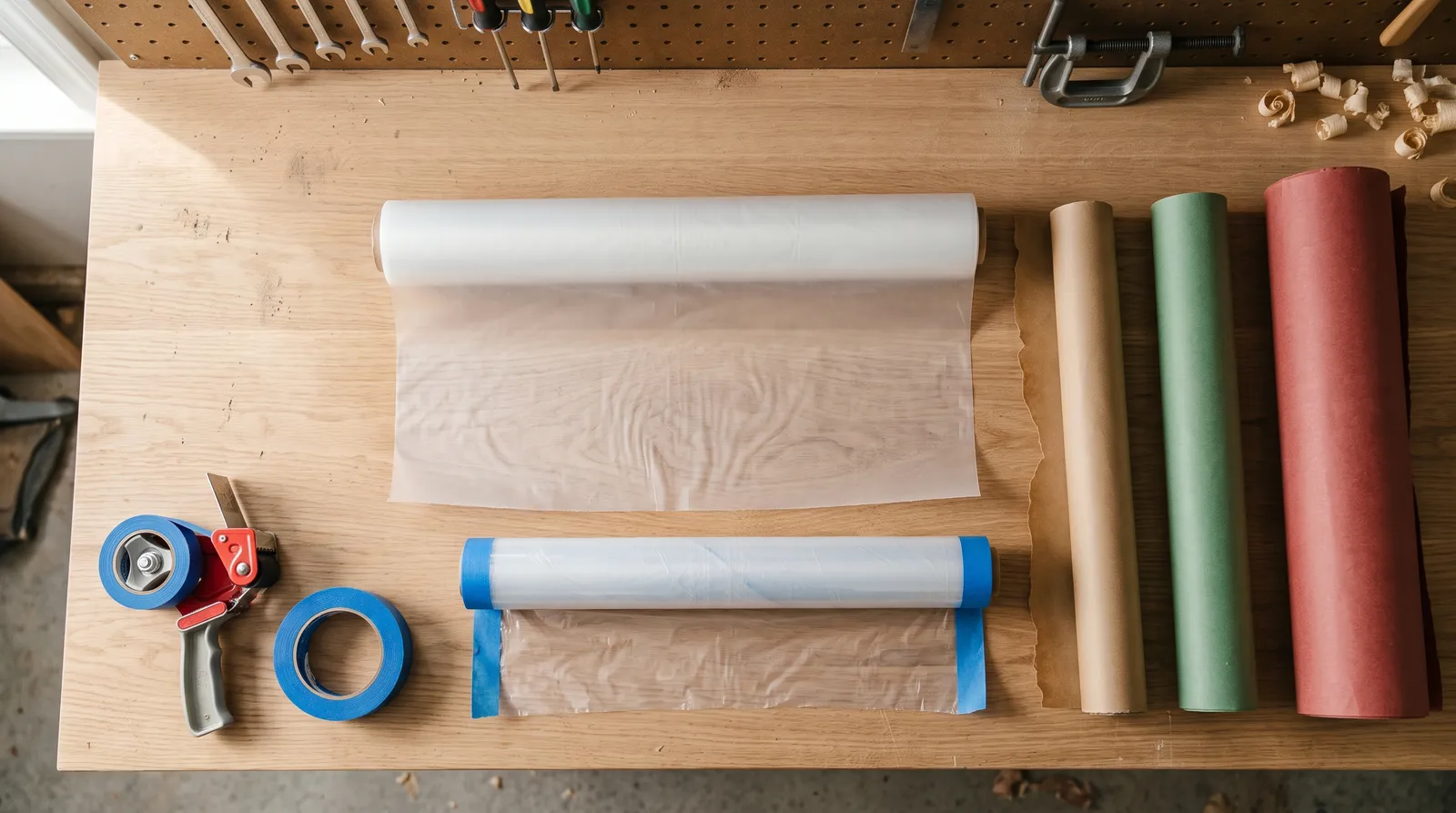
Top pick: Trimaco Easy Mask Premium Masking Film in the 99-inch width. Around $20 for a 90-foot roll, statically treated 1 mil plastic that clings to primed drywall and glass with tape only along the top edge, and the one product here that traps dry overspray instead of shedding it back into wet finish. It wins on coverage per roll and on cling. It falls short if you don’t own a hand masker, because unrolling eight feet of film by hand outdoors is miserable. If you don’t have the dispenser, buy Trimaco Tape and Drape pre-taped plastic and pay the premium. For baseboard and casing, the 12-inch Easy Mask Premium Masking Plastic is the roll that stays on the van. For lacquer and oil work, green premium masking paper. For a floor under a spray job, rosin.
Masking is where amateur spray jobs go wrong, and it’s almost never the tape’s fault. Pick the gun first in the paint sprayer round-up, then come back and mask for what it throws.
Six Rolls, Three Real Jobs
I bought all six off the shelf and ran them through a 22-door cabinet respray in waterborne enamel, a fiber-cement siding repaint sprayed airless across two windy afternoons, and a three-room interior repaint with sprayed ceilings over white-oak hardwood. Those three jobs cover the failure modes that matter: an enclosed garage where overspray hangs in the air and settles on everything, an outdoor job where wind decides whether your mask stays on the window, and a finished-floor job where the mask has to survive being walked on all day.
Five scoring axes, weighted in this order. Hold time before an edge released. Bleed-through to the protected surface. Flake-back, meaning whether dried overspray let go of the mask and landed in wet finish. Tear resistance under normal abuse. And how clean the removal was off paint that cured yesterday.
Every roll got the same 1.41-inch blue tape wherever tape was needed, so the tape stayed constant and the mask was the variable. If you want the tape conversation, that’s a separate fight and we settled it in the painter’s tape round-up and again in the FrogTape vs ScotchBlue head-to-head.
Where Masking Actually Fails
Four failure modes. I’ve watched all four ruin a day.
The edge releases. You mask a window at 9 a.m., you spray at 2 p.m., and by then the top corner has curled off the glass because the surface was dusty or the tape was pressed with a fingertip instead of a knife handle. Wide statically treated film is the most forgiving here, because the cling is doing work along the whole face rather than asking the tape line to hold a flapping sheet by itself.
Bleed-through. Brown general-purpose kraft is rated for water-based materials. Spray lacquer over it and the finish goes through the paper and onto whatever you were protecting. This is the single most common mistake I see on cabinet jobs, because brown paper is what’s stacked by the register and nobody reads the roll.
Flake-back. Overspray dries on the mask. You bump the mask. Dried paint flakes drift down and land in a wet coat. Now you’re sanding a finish you sprayed forty minutes ago. Treated films are formulated to hold overspray so it doesn’t release, and untreated poly sheeting from the hardware aisle does the opposite. On the cabinet job, the difference showed up in the second coat. Treated film gave me a clean pass. A test panel of plain poly gave me three specks I had to sand out.
Removal damage. You pull the mask and it takes the paint with it, or it takes the wallpaper, or it leaves adhesive on a stained casing. That’s usually the tape, but it’s also the mask when the mask is heavy enough to pull hard on the tape line.
A good mask solves all four for its category. A cheap one solves one and you find out which one after you spray.
Film or Paper, Decided by What’s Coming Out of the Gun
The choice gets simple once you name the material.
Waterborne enamel or latex, sprayed. Treated film on the walls and windows, plastic or paper on the trim edge. Either works on the edge; plastic is more durable and paper is cheaper. This is the standard setup for a cabinet repaint.
Lacquer, oil enamel, or conversion varnish. Film everywhere, or green premium paper if you want a paper edge. Brown kraft is out. The solvent goes through it.
Rolling walls, not spraying. You barely need film at all. A 9-inch paper edge along the baseboard and a drop cloth covers you. Buying 99-inch film to roll a bedroom is spending money to solve a problem you don’t have.
Ceilings sprayed, walls rolled later. Film the walls floor to ceiling, rosin the floor, and mask the trim with 12-inch plastic. This is the job where the wide roll pays for itself in one afternoon, and it’s mandatory if you’re going over a popcorn ceiling, where the texture throws bounce-back everywhere.
Exterior siding. Film on the windows, paper is a bad idea. One rain shower or one heavy dew and papered windows turn to pulp. Film also lets you see whether the glass got hit.
The material picks the mask. The width picks the roll.
Side by Side
| Product | Type | Width tested | Roll length | Best for | Price tier |
|---|---|---|---|---|---|
| Trimaco Easy Mask Premium Masking Film | Treated plastic film, 1 mil | 99 in | 90 ft | Walls, windows, full-room masking | $$ |
| Trimaco Easy Mask Tape and Drape | Pre-taped plastic film | 24 in | 100 ft | Fast masking with no dispenser | $$$ |
| Trimaco Easy Mask Premium Masking Plastic | Embossed plastic film, 1 mil | 12 in | 360 ft | Baseboard, casing, cabinet edges | $$ |
| Trimaco Premium Green Masking Paper | Coated kraft paper | 12 in | 180 ft | Lacquer, oil enamel, stain | $$ |
| IDL Packaging GP Painters Masking Paper | Natural kraft paper, 30 lb | 12 in | 60 yd | Budget water-based masking | $ |
| Trimaco Red Rosin Flooring Paper | Heavyweight rosin paper | 36 in | 167 ft | Floors under spray and traffic | $ |
1. Trimaco Easy Mask Premium Masking Film, Top Pick
This is the roll that does the most work per dollar on any job where a sprayer comes out of the case. Pre-folded 1 mil plastic, statically treated, 99 inches unfolded, 90 feet on the roll. Feed it through a hand masker, walk the wall, and an 8-foot wall goes floor to ceiling in one pass with a single tape line at the top.
The static treatment is the whole argument. On primed drywall, on glass, and on the factory-finished cabinet boxes in the kitchen job, the film grabbed and stayed grabbed. I checked every masked edge at the end of each session on the cabinet respray. Nothing had released except one corner over a dusty window head, and that was my fault for not wiping the sill.
Flake-back is the second argument, and it’s the one people don’t think about until it costs them. The treated face holds dry overspray. I sprayed a second coat on the cabinet doors with the walls masked in film that already had a day of dry overspray on it, brushed past the film twice on purpose, and got a clean coat. A plain poly test panel in the same garage gave up specks.
Where it gives up: the dispenser. Without a hand masker, a 99-inch roll is a two-person job and it’s genuinely bad in wind. On the siding repaint I tried hand-applying a run of it before setting up the masker, and the film wrapped itself around my forearm inside of thirty seconds. The static grip also does nothing on chalky exterior siding or bare raw wood, so on those you’re back to tape carrying the whole load. And 1 mil plastic finds every nail head. One catch and the tear runs the full sheet.
| Spec | Value |
|---|---|
| Material | 1 mil statically treated plastic film |
| Widths | 72 in and 99 in x 90 ft; 24 in and 48 in x 180 ft |
| Best for | Walls, windows, cabinet boxes, whole-room masking |
| Dispenser | Designed for hand-masking machines |
| Approx. price | $18–$26 per 99 in x 90 ft roll |
Buy it if: you own or plan to own a hand masker and you spray more than once a year. Skip it if: you roll everything and your masking is a baseboard line and a drop cloth.
2. Trimaco Easy Mask Tape and Drape, Best Without a Dispenser
The tape is already on the film. That’s the product. You press the taped edge along the top of a baseboard or the head of a window, walk it out, and the folded plastic drops open behind your hand. No machine, no second roll, no third arm.
On the interior job I masked a full run of baseboard and two doorways with the 24-inch roll in the time it took to set up the hand masker on the other side of the room. For a homeowner masking one bathroom or one kitchen, that speed is the entire value proposition, and the roll ships with a choice of tape edge, including the gentler KleenEdge PerfectEdge line for walls you don’t trust.
The trade-off is money and flexibility. Per square foot of coverage you’re paying roughly double what loose film plus a roll of tape costs, and you’re married to whatever adhesion shipped on the roll. If you hit a stretch of chalky old trim that needs a more aggressive tape, you can’t swap. Cold rooms also fight you; the fold pattern springs back until the plastic warms up.
Buy it if: you don’t own a masking machine and you’re masking a room or two, not a house.
3. Trimaco Easy Mask Premium Masking Plastic, Best for Trim and Cabinet Edges
Narrow, long, and boring in the way good jobsite consumables are boring. A 12-inch embossed plastic film, 1 mil, 360 feet on the roll. That length masks the baseboard of an average house without a reload, which is the reason it lives permanently in the box instead of getting bought per job.
Plastic beats paper on an edge for two reasons. It folds around a door casing and stays folded, and it won’t wick a wet edge around to the back the way kraft does when a run of paint comes down the face. Embossed surface holds the overspray. On the ceiling-spray day it caught a full pass of flat ceiling white on the trim edge and released none of it when I pulled the strips.
Downsides are exactly what the size implies. It’s an edge product, not a coverage product, so don’t try to protect a floor with it. And 1 mil punctures. A five-in-one in a back pocket will nick it every time you kneel.
Verdict: the roll I’d buy first if I could only buy one narrow mask. About $14–$20 for the 12-inch, and the 9-inch is worth having too.
4. Trimaco Premium Green Masking Paper, Best Paper for Solvent Work
Green paper exists because brown paper is a water-based product and half the finishes worth spraying aren’t water-based. This one is rated for water and oil-based materials including lacquers and acrylics, which is the line that matters on a cabinet job.
It tears clean across the roll by hand. That sounds minor until you’re masking a window stool one-handed on a ladder and you don’t want to find a blade. Paper also does something plastic can’t: it absorbs a heavy wet edge instead of letting it run. On a brush-and-spray hybrid day, where you’re cutting a wet line right at the mask, that absorbency saves you a run down the face of the mask and back onto the finish.
Flood it and it still soaks through. A heavy lacquer pass on one spot will find the back side, so keep the gun moving. And it’s opaque, so a papered window kills the daylight in the room and you lose your read on how the sheen is laying down. On a window I’d rather use film and keep the light.
Buy it if: you’re spraying lacquer, oil enamel, or stain and you want a paper edge. Roughly $20–$26 for a 12-inch by 180-foot roll.
5. IDL Packaging GP Painters Masking Paper, Best Budget
Around $16 for 60 yards of 30 lb natural kraft on a 1-inch core, in 9, 12, 15, and 18-inch widths. It drops into a handheld paper dispenser and does the job for water-based work. That’s the whole review.
The 9-inch is the width to buy. Baseboard masking almost never needs 12 inches, and the narrower roll fights you less around inside corners.
Water-based only. Take that seriously: run a solvent finish over natural kraft and it goes through onto whatever you were protecting. It also curls at the free edge in a humid room and lifts into the fan.
6. Trimaco Red Rosin Flooring Paper, Best Floor Paper
Rosin is the old answer and it’s still the right one for a sprayed ceiling over a finished floor. The heavyweight 36-inch roll took ladder feet, a rolling scaffold, and three rooms of foot traffic across the interior job without shredding. Plastic sheeting in the same role would have been a slip hazard the moment overspray started landing on it, and paper under a wet sole is grippy where plastic is glass.
Two hard limits. Red rosin is dyed and the dye bleeds when it gets wet, so keep it off white oak, maple, marble, and light carpet. Trimaco sells the same paper in brown for exactly this reason and brown is the safer default on anything light. Second, rosin absorbs but doesn’t block. It’s overspray and drip protection, not a spill barrier. Dump a quart on it and the boards get it.
Tape every seam. Untaped rosin slides apart under traffic inside an hour and leaves a bare stripe right where the drips land.
Buy it if: you’re spraying over a floor you’re keeping. Roughly $30–$45 for a heavyweight 36-inch roll.
Rolls I Passed On
- Hardware-store untreated poly sheeting, 0.7 mil. Cheap, and it sheds dried overspray as flakes. Fine for covering a pile of lumber, wrong for masking a room you’re spraying.
- Painter’s plastic sold as a “drop cloth” for floors. Slip hazard under wet feet. Use rosin or canvas. The drop cloth round-up makes the same case at length.
- Brown builder’s paper as a trim mask. Too heavy, doesn’t fold around casing, and it’s a floor product.
- Newspaper and grocery bags. Ink transfers, edges wick, and the sheets are the wrong size for every opening in a house.
Getting the Roll on the Wall Without Fighting It
Masking film rewards technique more than any other consumable in the truck.
Wipe the tape line first. Static cling and adhesive both die on dust. A dry microfiber pass along the top of the baseboard and the head of the window is thirty seconds that buys you the whole day. Chalky exterior siding needs a wash, not a wipe.
Burnish the tape with a hard edge. Thumb pressure isn’t enough. Run a putty knife or the plastic handle of a five-in-one along the tape line. Almost every bleed I’ve had to touch up traced back to a tape line that was pressed with a fingertip.
Let the film hang, don’t stretch it. Stretched 1 mil plastic pulls itself off the tape as it relaxes. Hang it loose and let the cling do the rest.
Static wants a little help. Press the film to the wall with a flat palm as you walk it out. That contact is what sets the cling. Film that’s only touching at the tape line will billow the moment the sprayer moves air.
Pull the mask while the paint is cured but young. Twenty-four hours is the window on most waterborne coatings. Wait a week and the film bridges the paint edge; pull it at an hour and you drag wet finish. Pull slow, at a shallow angle back against itself, and score the edge with a blade if the coat is heavy.
Fold face to face for reuse within the job. Dusty side inward, hang it over a sawhorse. Wadding it into a ball is how the overspray you carefully trapped ends up on the floor.
Mistakes That Cost a Touch-Up Day
- Brown kraft under a solvent finish. It’s a water-based product. Buy green premium paper or use film. This is the most expensive $5 anyone saves.
- Masking a whole room in film to roll it. Rolling doesn’t throw a fog. A paper edge and a drop cloth is the correct spend.
- Skipping the floor because the walls are masked. Roller spin-off and sprayer bounce-back land well behind you. On the ceiling-spray day, the rosin at the far wall had overspray on it eight feet from where I was standing.
- Taping film to fresh paint. Waterborne coatings need real cure time before tape goes on them. Tape a two-day-old wall and you’ll lift it. If you have to mask over new paint, use a delicate-surface tape edge.
- Leaving film up overnight in a sunny window. Heat plus a taped edge on a hot pane equals adhesive transfer on the glass, and now you’re scraping.
- Using red rosin on light floors. The dye bleeds wet. Brown rosin exists. Use it.
- Buying film without owning the machine. A 99-inch roll with no dispenser is a bad afternoon. Buy pre-taped plastic instead and accept the price.
A Kit That Covers a Whole Interior
For a homeowner spraying a kitchen and a couple of ceilings: one 99-inch by 90-foot roll of Easy Mask film ($22), one 12-inch by 360-foot roll of premium masking plastic ($18), one heavyweight 36-inch rosin roll ($35), and a 9-inch roll of budget kraft ($14). Call it $89, and it masks a first floor with film left over.
Add green paper only when there’s lacquer or oil in the job.
If there’s no hand masker in the garage, swap the wide film for two rolls of 24-inch Tape and Drape and expect to spend about the same for less coverage. It’s still the right call for one kitchen. It stops being the right call at three rooms, and at that point buy the machine.
The film is the cheap part of a spray job. The refinish you do because a mask let go is not.
Ask a Question