Best Infrared Paint Strippers
Five infrared paint strippers tested on lead-painted siding, sash windows, and trim. Top pick: the Speedheater Standard 1100 for safe, chemical-free removal.

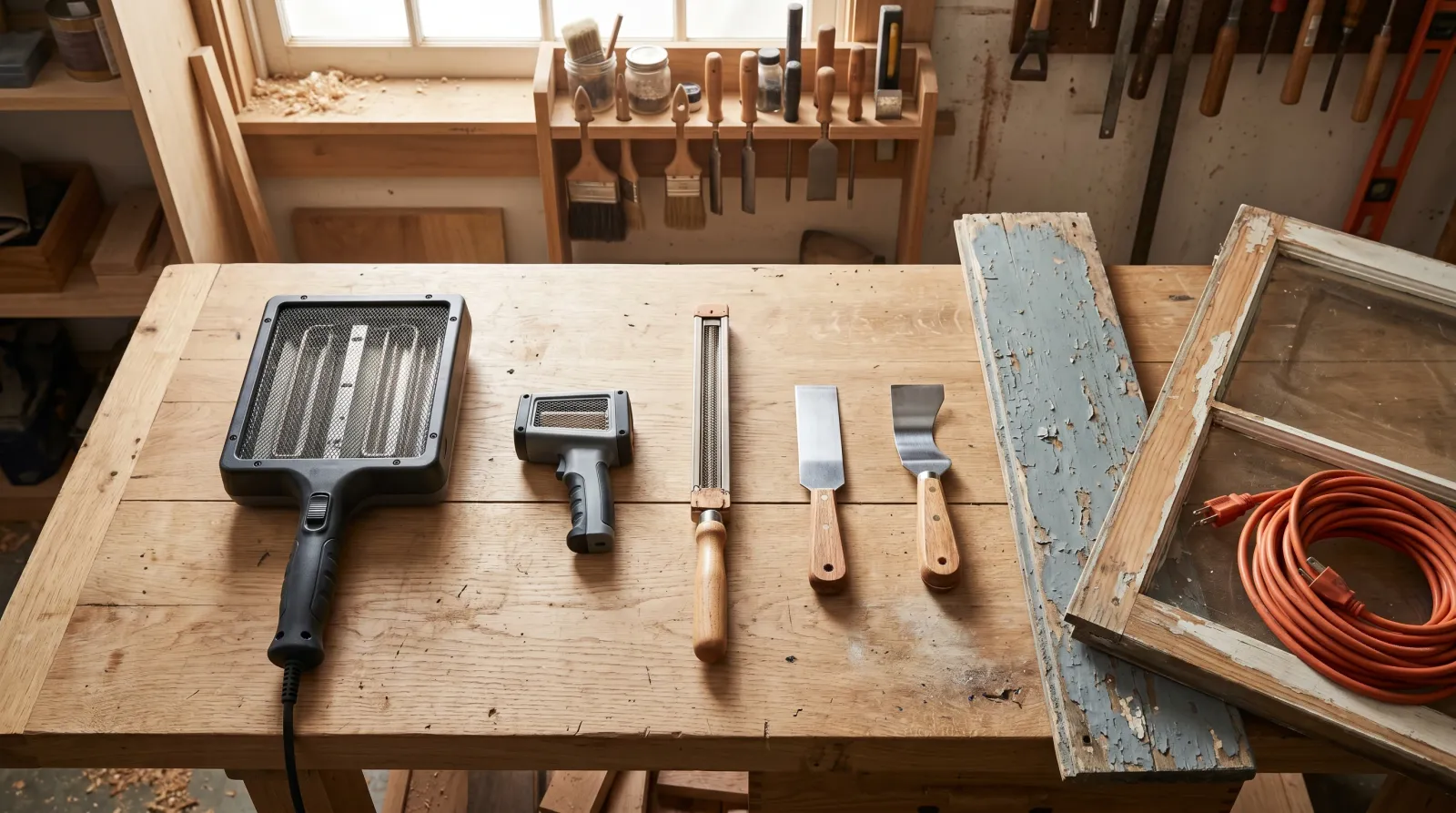
Disclosure: Some links below are affiliate links. We earn a commission if you buy through them, at no extra cost to you.
Top pick: the Speedheater Standard 1100 Kit. It runs about $560, lifts a full clapboard width in 20 to 40 seconds, and keeps the paint surface at 200 to 400F, well under the temperature where lead paint turns into fumes. It wins on large-area speed and on the safety margin that matters most on an old house. It falls short on narrow window muntins, where the small-headed Speedheater Cobra is the smarter pick. For long siding grooves and casing runs, the Speedheater Rapid Slim tracks a straight line faster. If the budget can’t reach the Speedheaters, the Silent Paint Remover is the value full-plate option from a real US supplier.
There is no single right infrared stripper.
Most old-house owners do fine with two: the 1100 for siding and doors, the Cobra for sashes and detail.
The Shortlist and Why These Five
I ran these over four weeks on a 1920s clapboard house with original double-hung sash windows. Four surfaces, every one a real condition you hit on a pre-1978 house: lead-painted cedar siding with three to five coats, sash windows with hardened glazing putty, oil-painted interior trim, and a porch door wearing latex over old alkyd. Each tool stripped its share of every surface.
Infrared is a different animal from a heat gun, and the reason this category exists is lead. A heat gun runs hot enough to vaporize lead. Infrared doesn’t. On a house built before 1978, that single fact is worth the price of admission. I weighted the testing toward the things that decide an old-house job: how hot the surface actually gets, how fast the paint lifts, how clean the scrape comes off, and whether the bare wood scorches.
Five axes, weighted in this order: surface temperature relative to the 900F lead-vapor point, lift speed per panel, scrape cleanliness, wood scorch under raking light, and build quality against the warranty. The use case anchors each role.
I checked surface temperature with an IR thermometer on every tool, on every surface, more than once. The numbers below aren’t from a spec sheet. They’re what I measured.
How Infrared Paint Removal Actually Works
A heat gun blows hot air at the paint from outside. Infrared sends radiant heat that penetrates the film and warms several layers at once, including the layer bonded to the wood. The bond softens, the paint releases as a group, and a scraper takes it off in soft sheets instead of confetti.
The reason it’s the old-house tool comes down to one number. Lead in paint turns into invisible fumes at roughly 900 to 1000F. A heat gun’s air can hit 1000 to 1100F at the nozzle. An infrared stripper holds the paint surface at 200 to 400F (the Speedheaters) or up to about 600F at the hottest heads. All of that sits under the line where lead goes airborne. You still generate lead-bearing chips and dust, so the EPA RRP precautions don’t go away. What goes away is the fume.
The trade-off is speed of a different kind. Infrared is slower to heat a small spot than a heat gun, but it heats a much larger area at once and lifts more layers per pass. On a single shutter, a heat gun wins. On a wall of clapboard, infrared wins by a wide margin.
How to Choose an Infrared Stripper
Heated Area: Match the Plate to the Work
This is the decision that matters most. A wide plate (the 1100’s 11-by-3-inch face) eats flat siding and door panels. A small head (the Cobra’s 3-by-3) gets into sash corners, bead-and-cove trim, and carved furniture. A long slim bar (the Rapid Slim’s 11.5-by-2.5) tracks a casing or a clapboard groove in one straight line.
Buy the shape that fits 80% of your job. If you’re stripping a whole house exterior, that’s the wide plate. If you’re restoring six sash windows, it’s the small head. Most people doing a full old-house restoration end up with both.
Temperature: Cooler Is Safer, but Watch the Scorch
Lower operating temperature is the headline safety feature, and it’s why the Speedheater’s 200-to-400F surface reading is the one I trust most on lead. Cooler also means a wider margin before bare softwood browns. The hotter tools work faster on stubborn alkyd but punish you if you dwell. The skill is the same on all of them: heat until the paint bubbles and dulls, then move. You heat the paint, not the wood.
Build and Warranty: This Is a $500 Tool, Treat It Like One
Infrared elements have a service life and they do fail. What you want is a US supplier who stocks replacement elements and honors a real warranty, not a gray-market import that’s a paperweight the day the element dies. The Speedheaters carry a 12-month warranty with parts available stateside. The Silent Paint Remover uses UL-listed components built for North American wiring. Counterfeit Speedheater clones float around the marketplaces; the build quality and the parts support are exactly what you lose buying one.
At-a-Glance Comparison
| Brand / Model | Heated area | Surface temp | Best for | Price tier |
|---|---|---|---|---|
| Speedheater Standard 1100 | 11” x 3” plate | 200-400F | Siding, doors, large flat areas | Premium (~$560) |
| Speedheater Cobra | 3” x 3” head | 400-600F | Sash windows, trim, detail | Premium (~$536) |
| Silent Paint Remover 1100 | Large plate | ~350F surface | Budget full-size siding work | Mid (~$495) |
| Speedheater Rapid Slim | 11.5” x 2.5” bar | 200-400F | Long siding grooves, casing | Premium (~$899) |
| Speedheater Cobra (large head) | Larger head | 400-600F | Furniture, tabletops, antiques | Premium |
1. Speedheater Standard 1100 Kit, Best Overall
The 1100 is the tool you reach for first on an exterior, and the one that turns a brutal job into a manageable one. The 11-by-3-inch infrared plate covers a full clapboard width, so you’re heating real estate, not nibbling at it. On the test siding, it softened a three-to-five-coat lead build in 20 to 40 seconds, and the paint came off in long warm sheets that I caught on the drop cloth instead of chasing as dust.
My IR thermometer read the paint surface at the low end of the 200-to-400F band through most of the work. That’s the number that sells this tool. It sits so far under the 900F lead-vapor line that the fume risk a heat gun carries simply isn’t on the table. You still wear the respirator and lay the cloths for the chips. The air stays clean.
The kit ships with the two scrapers you’d otherwise buy anyway: a straight-edged clapboard scraper for the flats and a curved profile scraper for the bead. Most infrared kits make you source scrapers separately, and the wrong scraper wastes the heat you just put in. Having both in the box is the difference between stripping the trim profile in one pass and gouging it.
Where it struggles is anything narrow. The wide plate overhangs a window muntin and wastes heat on the glass and the surrounding wood. For sashes, switch to the Cobra. And at just over four pounds, the 1100 tires your arm on overhead soffit work. A scrap of lumber to rest it on between heats saves your shoulder.
| Spec | Value |
|---|---|
| Heated area | 11” x 3” plate |
| Power | 1100W, 110-120V |
| Weight | About 4 lbs 3 oz |
| Surface temp | 200-400F |
| Approx. price | $560 (kit with two scrapers) |
Buy it if: you’re stripping a house of clapboard, doors, or flat trim and you want the safest large-area tool made. Skip it if: your job is mostly sash windows and carved detail. The Cobra is built for that.
2. Speedheater Cobra, Best for Windows and Detail
The Cobra is the one I’d hand a window restorer. It weighs a little over a pound and the 3-by-3-inch head angles into the corner of a sash, the cove of a profile, and the spot a wide plate can’t reach without cooking the glass. Heat-up is the fastest in the test: paint softens in 3 to 5 seconds, which matters when you’re working a window in short, careful moves rather than long sweeps.
The detail it’s built for is glazing putty. Old putty is rock-hard and chemical strippers barely touch it. The Cobra warms the putty line until it gives, and it lifts off the muntin without you prying at the glass. Worked right, with the head on the wood and only the edge bleeding onto the putty, you strip a sash without cracking a pane. The free-standing support bar is the quiet hero here: set the tool down aimed at the next section, pick up your scraper, and clear what just softened while the next spot heats.
The same small head that wins on detail loses on a big flat wall. You’ll be at a clapboard field a long time with a 3-inch head. And the top of its range runs to 600F, hotter than the 1100, so on bare softwood you keep it moving or it browns the grain.
| Spec | Value |
|---|---|
| Heated area | 3” x 3” head |
| Weight | Just over 1 lb |
| Heat-up | Paint softens in 3-5 seconds |
| Surface temp | 400-600F |
| Approx. price | $536 |
Buy it if: your project is sash windows, trim, furniture, or any work that lives in corners and profiles. Skip it if: you’re facing a whole exterior of flat siding. Pair it with the 1100 instead.
3. The Silent Paint Remover Model 1100, Best Value
The full-size infrared plate for the person who can’t stretch to a Speedheater. At about $495 it’s the cheapest large-area infrared stripper I’d trust from a real US supplier, and that last part is the catch worth paying for. The marketplaces are full of cheap infrared clones with no parts and no warranty. The Silent Paint Remover uses UL-listed components built for North American wiring, and Viking Sales stocks what you need when the element eventually goes.
On siding it does the core job: a large heating area lifts clapboard and flat door panels at a real pace, in the same heat-then-scrape rhythm as the 1100. For a one-house project where the Speedheater premium stings, it gets the paint off and keeps the lead out of the air.
The element runs hotter than the Speedheater’s, and my thermometer agreed. The surface read closer to 350F, with the head itself well above that. The practical effect is a shorter dwell window before bare softwood scorches. You move a beat quicker than you would with the 1100. It’s also bulkier in the hand than either the Cobra or the Rapid Slim, so detail work is not its strength.
Verdict: the value pick for full-size siding work. Buy it if the Speedheater is out of reach and you want a tool with US parts behind it. About $495.
4. Speedheater Rapid Slim, Best for Siding and Long Runs
Different shape, different job. The Rapid Slim trades the 1100’s wide plate for a long 11.5-by-2.5-inch bar, and on the right surface that bar is faster than the plate. Run it down a clapboard groove or along a window casing and it tracks the line in one continuous pass, heating the whole length at once instead of in plate-sized bites. It heats quicker than the Standard 1100 and steers easier along a straight edge.
It pulls only 4.8 amps, which sounds like a footnote until you’re working off the single 15-amp circuit an old house gives you. Less draw means fewer trips to the panel. Surface temperature sits in the same safe 200-to-400F band as the Standard 1100, so the lead margin is identical.
Two strikes. It’s the most expensive tool here by a wide margin, near $900, which is real money for a homeowner doing one house. And the narrow bar is less efficient than the 1100’s plate on wide, open wall fields where you want maximum coverage per heat. It shines on lines, not on broad flats.
Buy it if: you do siding and casing work for a living and the long-run speed earns back the price. About $899.
5. Speedheater Cobra Large Head, Best for Furniture and Antiques
The Cobra with the larger head is the furniture-stripper’s pick. A tabletop or a panel door is too big for the small 3-inch head and too detailed for a wide plate that scorches the edges. The larger Cobra head splits the difference: enough coverage to move across a tabletop at a reasonable pace, enough control to follow a chair back without browning the wood.
Low surface temperature is what saves antiques. It lifts old varnish, shellac, and milk paint without raising the grain or charring the patina you’re trying to keep. The paint comes off in soft clumps you can catch on a cloth, not fine dust you sand and breathe.
It’s still slower than a full plate on a big flat top, and turned legs and spindles need a sharp profile scraper you buy separately. For flat furniture faces, panel doors, and case pieces, it’s the controlled-heat tool.
Verdict: the antiques and furniture pick. Pair it with a good profile scraper for the turned parts.
Tools I Tried and Dropped
- Generic Amazon infrared clones. Cheap, no parts, no real warranty. The element dies and the tool is trash. Skip.
- Speedheater knock-offs sold as the real thing. Counterfeit listings copy the look and lose the build. Buy from a named US supplier.
- Standard heat guns. Right tool for one shutter, wrong tool for lead. They run hot enough to vaporize it. Covered in the heat gun round-up.
- Chemical strippers for whole exteriors. Fine for a detailed piece, miserable and expensive across a house, and the disposal is its own headache.
The Other Half of the Job: Scrapers and Cleanup
The stripper softens the paint. A scraper takes it off, and the wrong scraper wastes every second of heat you put in. A straight carbide scraper for flat clapboard, a curved profile scraper for bead and cove, a sharp pull scraper for detail. The Speedheater 1100 kit includes the first two; budget another $30 to $50 for a good profile scraper if your tool doesn’t. The paint scraper guide covers which edge to use where.
Infrared doesn’t leave bare, finished wood. It leaves a thin paint residue and a warmed grain. A light pass with 80-grit then 120-grit on an orbital sander cleans it for primer. You’re sanding clean wood, not grinding through layers, so it’s quick.
Lead Safety You Don’t Skip
Infrared removes the fume risk. It does not remove the chip-and-dust risk, and on a pre-1978 house that risk is real.
Wear a P100 respirator, not a paper dust mask. Lay 6-mil plastic to catch every chip. Mist the work lightly to keep dust down. Bag the scrapings as hazardous waste; don’t sweep them into the yard. If you’re doing this for pay, EPA RRP certification is the law. A good respirator for paint and lead work is not the place to economize.
The cooler-running tools (the Speedheaters at 200-400F) keep you furthest from the lead-vapor line. That margin is the reason to buy infrared in the first place. Don’t undo it by pulling the respirator off because the air looks clean.
Mistakes I Still See
- Treating infrared like a heat gun. It’s slower to heat a tiny spot and faster across an area. Heat a wide section, then scrape the whole thing, then move. Don’t hover on one inch.
- Dwelling until the wood browns. Heat the paint until it bubbles and dulls, then move. The second the bare wood shows, you’re cooking it.
- Skipping the respirator because there’s no smoke. No visible fume doesn’t mean no lead dust. The chips are still toxic.
- Buying a clone to save $200. The element dies, parts don’t exist, and the tool is landfill. The supplier and the warranty are the product.
- Wrong scraper for the profile. A flat scraper on a bead gouges the wood and wastes the heat. Match the scraper edge to the surface.
- Parking the head on window glass. Keep the heat on the wood, let only the edge reach the putty. Old wavy glass cracks if you cook the center of the pane.
A Setup That Earns Its Keep
For an old-house owner stripping a full exterior plus the windows: Speedheater Standard 1100 Kit for the siding and doors ($560), Speedheater Cobra for the sashes and trim ($536), a sharp profile scraper ($40), a P100 respirator ($35), and a roll of 6-mil plastic and a box of disposal bags ($30). About $1,200 for the tools that strip a whole house safely.
For a furniture and window restorer: the Cobra with the large head, a set of profile scrapers, and the respirator. Under $700.
The strippers are the cheap part next to the labor and the safety. Don’t buy the clone and inherit a fume problem you bought infrared to avoid.
Ask a Question