Best Hygrometers for Painting Weather
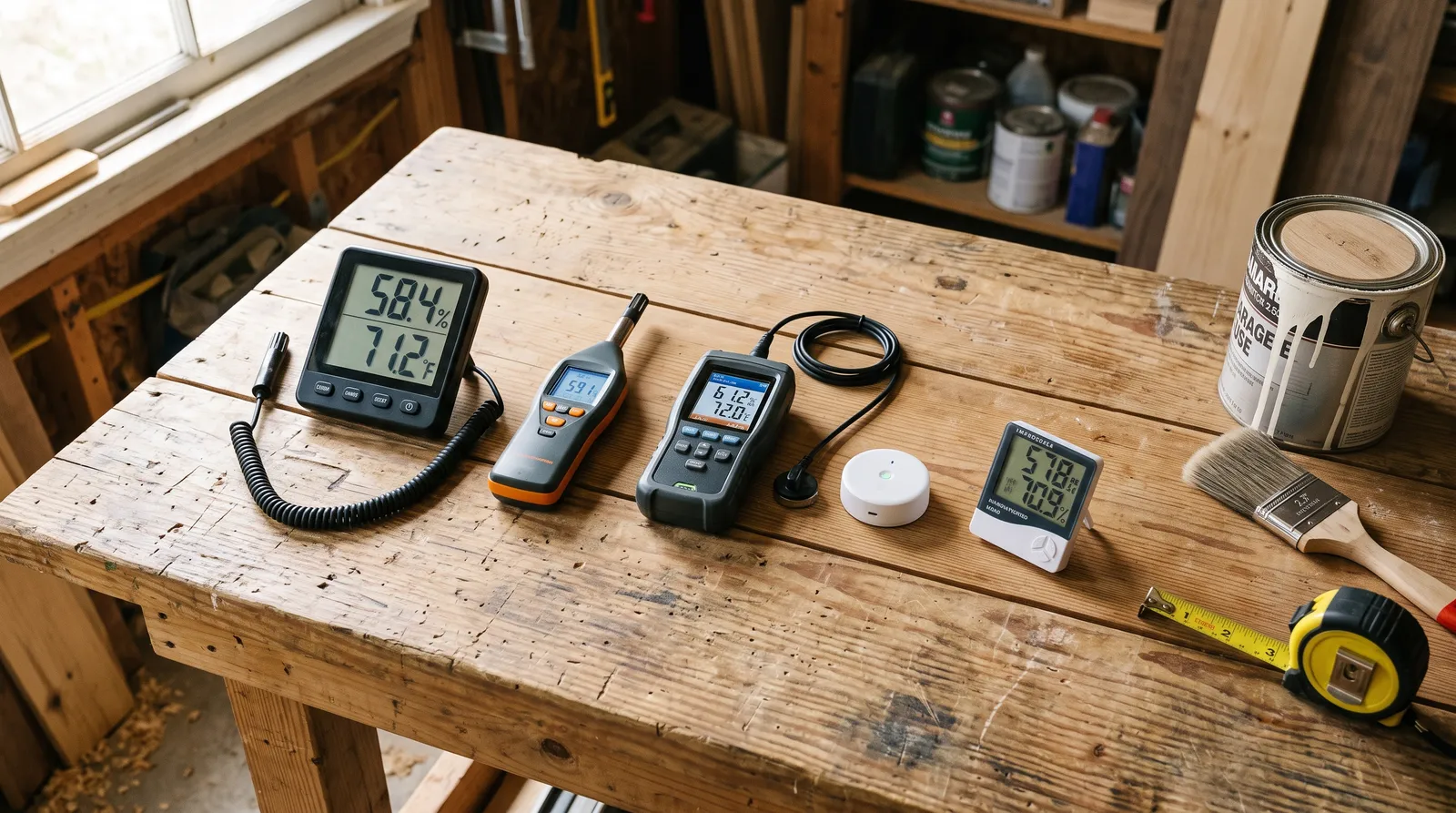
Five humidity meters tested against real painting decisions: exterior siding, cabinet enamel, and a damp basement. Top pick: Extech 445815 for the dew point reading on the same screen as the humidity.

Disclosure: Some links below are affiliate links. We earn a commission if you buy through them, at no extra cost to you.
Top pick: the Extech 445815 Big Digit Hygro-Thermometer, about $40. It wins because it puts dew point on the same screen as relative humidity, which turns the exterior go/no-go decision into one glance instead of a conversion table on your phone. The digits are large enough to read from a ladder. It falls short on accuracy, rated at plus or minus 4 percent RH, and it gives you no surface temperature at all. If you need a tighter number for a job you have to stand behind, the Extech RH390 psychrometer is rated to plus or minus 2 percent and reads dew point and wet bulb to a tenth of a degree. If you are coating steel or concrete under a spec, the DeFelsko PosiTector DPM is the only meter here that measures the surface and does the spread math for you. For a cabinet respray where the question is what happened overnight, the SensorPush HT.w logs every minute for a month. And if you just want to know whether your basement is painting-ready this weekend, the ThermoPro TP50 costs $16 and is honest about it.
Most people painting a house need one meter, not five.
Buy the 445815, hang it near the work, and stop guessing.
Why the Weather App Is Not Enough
The humidity number on your phone comes from an airport, a rooftop station, or a model, and it describes a region. Paint dries in a microclimate about six inches deep against a wall.
I have stood on a driveway in July with a phone reading 58 percent and a meter at the north wall reading 79. Shade, grass, a sprinkler that ran at dawn, and a wall that never saw sun that morning. Those are four different reasons the wall does not match the forecast, and the paint responds to the wall.
The gap runs the other way too. On a south elevation at 2 p.m. the air can be at 45 percent and the siding surface can be 130 degrees, hot enough to flash a waterborne acrylic before you can lay off a lap. The forecast will not warn you. Nothing will, except a number taken at the wall.
That is the whole argument for owning a hygrometer. It costs less than a gallon of good exterior paint and it tells you which hours of the day are actually yours.
The Three Numbers a Painter Cares About
Every meter in this test is really answering one of three questions.
Relative humidity. How saturated the air already is. This governs how fast water can leave the film. Most waterborne data sheets cap application at 85 percent RH, and in practice anything above about 70 stretches your recoat window, keeps lap marks open, and sets up surfactant leaching on dark colors. Below 30 percent you get the opposite problem, a wet edge that closes before you reach the corner.
Dew point. The temperature at which that air starts condensing. This is the number that decides exterior jobs. The rule from ASTM D3276 and SSPC-PA 7 is that the surface must sit at least 5 degrees Fahrenheit above the dew point, and be rising, not falling. Under 5 degrees of spread, moisture is condensing onto the substrate while you coat it, and you have built an adhesion failure you cannot see. It shows up as peeling exterior paint in two seasons and everyone blames the paint.
Surface temperature. What the paint actually touches. Air temperature is a proxy and a bad one. Sun-hit siding runs 30 to 40 degrees above ambient; masonry and metal hold cold hours past sunrise.
A cheap meter gives you the first. A good meter gives you the first two. Only the DPM gives you all three and subtracts them for you.
How I Ran the Test
Five meters, four jobs, April through July of 2026.
The jobs were a two-story cedar-lap exterior repaint on a west elevation, a kitchen cabinet respray in waterborne enamel, a basement floor coating over bare concrete in an unconditioned space, and a spring deck stain that saw overnight condensation four nights out of seven. Every meter was read at the same moment, at the wall face, about 5 feet off the ground. Three reads a day: early morning, mid-afternoon at peak surface temperature, and an hour before quitting time.
I logged everything by hand against the SensorPush record so I could compare the walk-up glance to the continuous curve.
Scoring axes, in the order they mattered: agreement between meters at the same moment, settle time after coming out of a truck cab, whether the meter handed me dew point or made me look it up, readability at arm’s length and from a ladder, and whether it survived a season of jobsite handling.
One disclaimer up front, because it matters. Every accuracy figure in this article is the manufacturer’s published spec. I do not have a humidity chamber and I am not going to pretend otherwise. What I can report is disagreement between meters, drift after a salt test, and whether a meter ever changed a decision on the job.
Two of them did. The 445815 stopped me from starting a west wall at 4:40 p.m. in June, and the SensorPush explained why a set of cabinet doors was still tacky the next morning when the shop had felt fine when I locked up.
Comparison at a Glance
| Meter | Reads | Published RH accuracy | Surface temp | Logging | Price tier |
|---|---|---|---|---|---|
| Extech 445815 | RH, air temp, dew point | ±4% | No | Min/max only | $$ |
| Extech RH390 | RH, air temp, dew point, wet bulb | ±2% (20–90%) | No | Min/max only | $$$ |
| DeFelsko PosiTector DPM | RH, air temp, surface temp, dew point, spread | ±3% | Yes (magnetic probe) | Yes, timed + export | $$$$ |
| SensorPush HT.w | RH, temp | ±2% typical | No | Yes, 1-min for 30+ days | $$ |
| ThermoPro TP50 | RH, temp | ±2% (30–80%) | No | High/low memory | $ |
1. Extech 445815 Big Digit Hygro-Thermometer, Top Pick
This is the meter I would buy for a house painter who owns one meter.
The case for it is the display. Three stacked readouts: relative humidity, temperature, dew point. No mode button, no scrolling, no conversion chart taped inside the van door. You look at the wall, you look at the meter, and you know whether the spread is comfortable or whether you should be packing brushes. On a June afternoon on that cedar elevation the dew point sat at 68 while the shaded siding was heading toward 73 as the sun came off it. That is a 5-degree spread and falling. I stopped at 4:40 instead of squeezing in another course, and the next morning the wall was dry and the previous day’s work had no blush.
Digit size sounds like a trivial spec until you are 14 feet up. The 445815 is the only meter here I could read from the ladder without squinting, which means I actually checked it instead of telling myself I would check it later.
The humidity alarm earns its keep indoors. Set the threshold at 80 percent, drop the unit on the floor of a basement you are coating, and it tells you across the room when conditions have gone against you. The 18-inch remote probe is a genuine convenience for crawlspaces and window wells, though the cable is short enough that the body has to sit close by.
Now the honest part. Plus or minus 4 percent RH is the loosest published spec in this round-up. For deciding between 62 and 84 percent, it does not matter. For a job where somebody is going to ask you to document conditions, it is not the tool. And it has no surface temperature channel, so on a sun-hit wall you are still guessing at the number that matters most. Pair it with a $30 infrared thermometer and that hole closes.
| Spec | Value |
|---|---|
| Reads | RH, air temperature, dew point |
| RH range | 10 to 99 percent, ±4% |
| Temp range | 14 to 140 F, ±1.8 F |
| Extras | Adjustable humidity alarm, min/max, 18-inch remote probe |
| Approx. price | $35–$45 |
Buy it if: you paint a few exteriors a year and want the dew point without doing arithmetic on a ladder. Skip it if: you need documented accuracy, or you want something that lives in a tool pouch.
2. Extech RH390 Precision Psychrometer, Best for Exterior Dew-Point Calls
Same brand, different class of instrument, and the price tells you so. About $249.
The spec that justifies it is plus or minus 2 percent RH from 20 to 90 percent. That band is where painting lives, and the RH390 is tight across all of it rather than at one convenient midpoint. Dew point and wet bulb read to a tenth of a degree, which sounds like false precision until you are working a marginal morning and the difference between a 4.2-degree spread and a 6.1-degree spread is whether you open the can.
It settles fast. Carry it from an air-conditioned cab into 88-degree outdoor air and it is stable in a couple of minutes, where a bench-style unit can take fifteen and quietly hand you the truck’s humidity in the meantime. That responsiveness is the real reason a pro carries a psychrometer.
It is also the reason I would not buy one for a house.
You are paying six times the top pick for accuracy most homeowners will never convert into a better decision. It still has no surface temperature, so the infrared thermometer is still in your other pocket. And it takes a 9V battery, which in 2026 feels like a choice somebody made in 2009.
Buy it if: you paint exteriors for money in a humid climate and marginal mornings cost you real hours. Skip it if a 4-percent spec was never your limiting factor.
3. DeFelsko PosiTector DPM, Best for Spec and Warranty Work
Different category. The DPM is not competing with the others; it is the instrument the others are approximating.
It reads relative humidity, air temperature, surface temperature through a magnetic probe, dew point, and the difference between surface temperature and dew point. That last channel is the one that matters. Every other meter here makes you take two readings from two devices and subtract them in your head on a windy scaffold. The DPM shows the spread as a number and it conforms to ASTM D3276, SSPC-PA 7, and ISO 8502-4, which is the vocabulary a coatings warranty claim is written in.
It logs on a timer and exports. On a commercial job that is not a convenience feature, it is the evidence that the wall was inside spec when you coated it.
I used it on the basement floor coating and it changed how I ran the day. The slab was reading 4 degrees above dew point at 8 a.m. and the air felt fine. Waiting until 11 for the spread to open up was the difference between a coating that bonded and one that would have delaminated in patches by fall.
The obvious con is money. This is a commercial-applicator purchase and nobody repainting their own porch should be looking at it. The interface assumes you already know why the spread matters. On interior work it is dead weight; a conditioned house does not need five channels.
| Spec | Value |
|---|---|
| Reads | RH, air temp, surface temp, dew point, surface-to-dew-point spread |
| RH accuracy | ±3% |
| Surface temp accuracy | ±0.5 C |
| Standards | ASTM D3276, SSPC-PA 7, ISO 8502-4, IMO PSPC |
| Best for | Industrial DTM, epoxy, urethane, elastomeric, marine |
Buy it if: you are billing for coatings work under a specification. Otherwise this is the wrong aisle.
4. SensorPush HT.w, Best for Watching a Room Overnight
No display. That is the first thing to understand and the reason it cannot be your only meter.
What it does instead is log at one-minute intervals and hold more than a month of data on the sensor itself, pulled to a phone over Bluetooth. Published accuracy is plus or minus 2 percent RH typical, psychrometer-class, in a water-resistant puck about the size of a light switch.
The cabinet job is where it paid. I sprayed doors in waterborne enamel on a Tuesday, the shop felt dry when I locked up, and Wednesday morning three doors were still soft enough to print a thumb. The curve explained it: the shop climbed from 51 percent to 78 percent between 1 and 4 a.m. as the outside air cooled and the slab did what slabs do. Nothing I would have caught with a glance meter, because I was asleep. After that I ran a dehumidifier overnight and the block resistance problem went away.
Same story on the deck stain. Four of seven nights the sensor showed the porch crossing into condensation territory before dawn, which is exactly the mechanism that leaves a stain job looking blotchy for reasons the homeowner blames on the product.
Cons are structural, not flaws. No display means no walk-up check, and most painting decisions are walk-up decisions. Bluetooth range is line-of-sight optimistic; through a basement slab you will want the separate WiFi gateway, which is another purchase. And it reads air only.
Verdict: the diagnostic tool, not the decision tool. Buy it alongside a display meter when you have a cure problem you cannot explain. About $70.
5. ThermoPro TP50, Best Budget
Sixteen dollars, and the published spec is plus or minus 2 percent RH from 30 to 80 percent. On paper that is tighter than the top pick.
In practice the specs are not the whole story, because a $16 sensor behind a plastic vent in a dusty room drifts and a $40 one drifts less. Mine agreed with the 445815 within a couple of points out of the box and started reading low after a month of sanding dust. A salt test brought it back into line and told me what correction to carry.
For interior work that is entirely good enough. Drop one on the basement floor, one in the bathroom, one in the room you are painting next weekend, and you have a map of your own house for the price of a quart of primer. The 10-second refresh means you watch the number move instead of waiting on it. The magnet sticks it to a furnace duct or a steel door.
No dew point is the hard limit. That makes it an interior meter, full stop, unless you enjoy converting RH and temperature by hand at the base of a ladder. The comfort icon that flashes DRY, COMFORT, or WET is aimed at houseplants and its thresholds have nothing to do with any paint data sheet, so ignore it. And the vent slot packs with drywall dust; blow it out with the same compressor you use for the sprayer.
Buy it if: you want to know whether a room is painting-ready before you buy the paint. Skip it for any exterior decision.
Meters I Considered and Cut
- Analog dial hygrometers. The $8 brass-ring type. They read whatever they read, drift permanently, and cannot be corrected in the field. There is no version of this that belongs on a paint job.
- Combination moisture meter plus hygrometer units. Convenient in theory. In practice the pin moisture function is the one you want accurate, and bundling it with a mediocre RH sensor gets you two compromises. Buy a real moisture meter separately for wood and masonry.
- Smart-home temperature sensors already in the house. Fine data, wrong location. They sit at chest height in a hallway. The coating goes on a cold slab.
- Weather station consoles with an outdoor transmitter. Genuinely useful for tracking a week of conditions, useless for the reading at the wall face you are painting right now.
Placement, Settling, and the Salt Test
Three habits separate a meter that helps from one that decorates a shelf.
Read at the surface. Humidity near a cool basement slab runs several points above the same room at chest height, and the slab is where the coating goes. Outdoors, hold the meter in shade at the wall face. Keep it off hot metal and out of the exhaust of any fan or heater you have running, or you are measuring the meter’s own microclimate.
Give it time. A meter carried from a 68-degree truck cab into 90-degree outdoor air needs several minutes before it means anything. The RH390 settles in two or three. The bench-style units can take fifteen. Walk it out, set it down, unload the ladder, then read it.
Salt-test twice a year. Half a cup of table salt, enough water to make a slurry, sealed in a zip bag with the meter for eight hours at room temperature. Saturated salt holds 75 percent RH. If the meter reads 68, you carry a plus-7 correction or you replace it. Do this in March before exterior season and again in September. It takes eight hours of doing nothing and it is the difference between a meter you trust and a meter you hope about.
Storage matters less than people think, with one exception: do not leave a hygrometer in a truck through a summer. Heat cycling is what kills the cheap capacitive sensors.
Mistakes I Keep Seeing
- Reading the phone instead of the wall. The forecast describes a region. Paint dries in a six-inch layer against a specific surface. These are not the same measurement.
- Checking humidity in the morning and never again. Dew point barely moves through a day. Surface temperature swings 40 degrees. The morning read tells you almost nothing about your 5 p.m. decision.
- Starting an exterior coat after 4 p.m. in shoulder season. The spread looks fine when you open the can and it is gone by dark. Latex needs to set before the surface drops toward dew point. Stop earlier than feels necessary.
- Trusting the comfort icon. DRY, COMFORT, and WET are calibrated for human comfort and houseplants. Waterborne enamel does not care how you feel.
- Ignoring humidity indoors because the house has HVAC. Turn the system off for a day of sanding and a closed-up house climbs fast. A basement with a dehumidifier unplugged goes past 70 percent in an afternoon.
- Blaming the paint. Surfactant leaching, blotchy stain, cabinet doors that block when you rehang them. These are almost always condition failures, not product failures. The exterior paint round-up covers which products tolerate a marginal window better, but no formula fixes a wall that was wet when you coated it.
- Using air temperature as a substitute for surface temperature. The cheapest fix on this whole list is a $30 infrared thermometer in the same pouch as the hygrometer.
What to Buy, by Job
Homeowner painting one or two rooms a year, interior only: the ThermoPro TP50, $16, and nothing else. Put it on the floor of the room the night before and check it in the morning.
Homeowner or handyman doing exteriors: the Extech 445815 plus a $30 infrared thermometer. About $70 total, and it answers every question a residential repaint will ask. This is the combination I recommend most often. Pair it with proper exterior wood prep and the two together prevent more failures than any upgrade in paint grade.
Cabinet and furniture work where cure is the risk: add the SensorPush HT.w. You will not use it every job, and the one time it explains a tacky finish it pays for itself.
Contractor working under a coatings spec on steel or concrete: the PosiTector DPM, and stop reading tool round-ups. You already knew.
The meter is not the expensive part of any of these jobs. The wall is.
Ask a Question