Best Floor Protection for Painting and Renovation
Six floor protection products tested across a full kitchen gut, a stair repaint, and two room jobs. Top pick: Ram Board. Plus the floor protection paper worth buying and the one that stains.

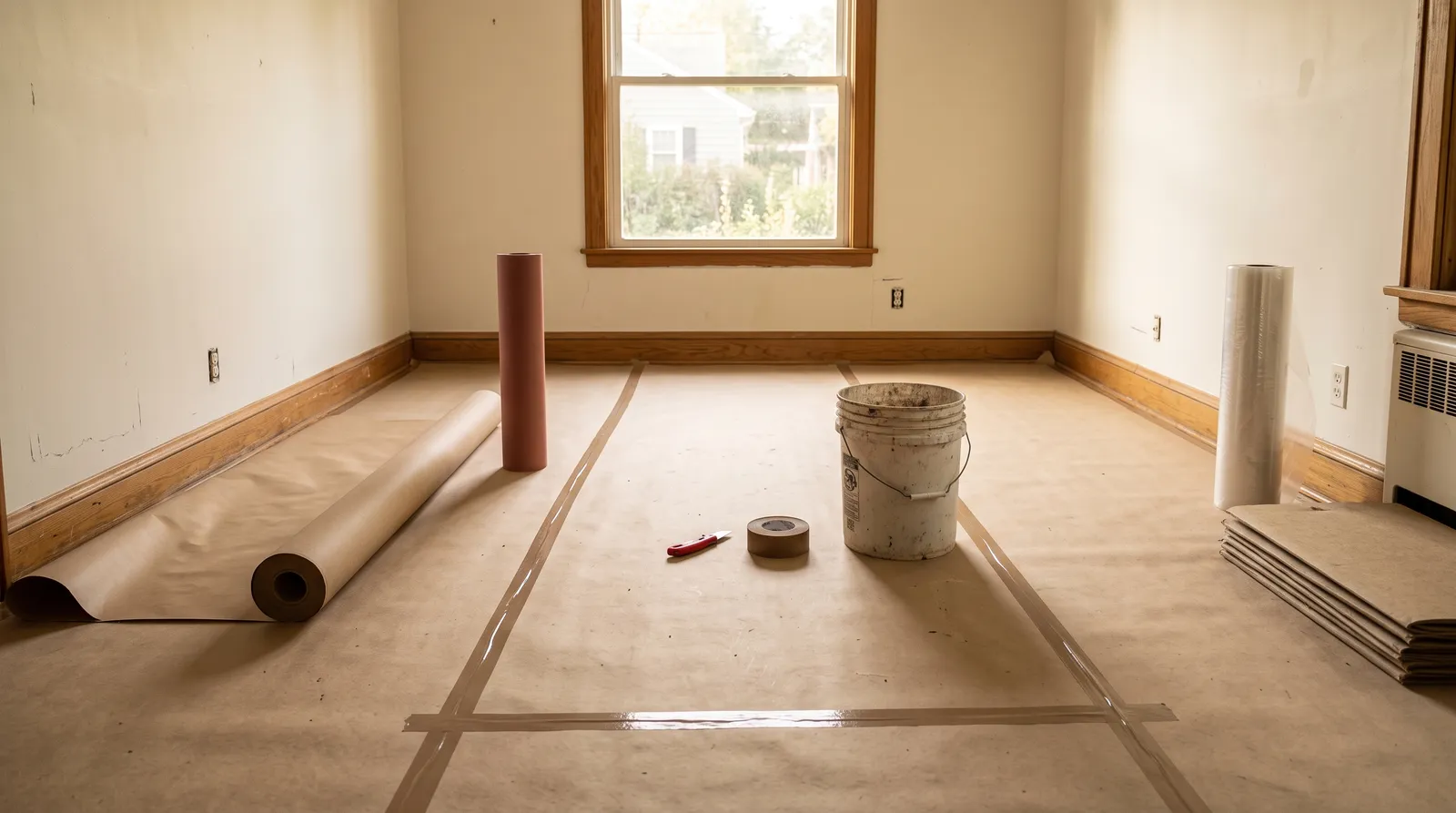
Disclosure: Some links below are affiliate links. We earn a commission if you buy through them, at no extra cost to you.
Top pick: Ram Board. About $85 for the 38 in x 100 ft roll, and it is the only cover in this test that took a full kitchen gut without a single puncture reaching the white oak underneath. Ram Board wins on spill holdout and on abuse tolerance. It falls short on weight, at 48 pounds a roll, and on price against paper. If you want the best floor protection paper instead of board, buy Trimaco X-Paper. If you want the cheapest coverage that still counts as coverage, red rosin paper does it, with a dye-bleed problem I will get to. For carpet and stairs, nothing beats an adhesive film.
The category confuses people because three different products all get called floor protection.
Paper, board, and film solve three different problems, and buying the wrong one is how floors get ruined by the thing that was supposed to save them.
What Eight Weeks of Abuse Told Us
We ran six products through four jobs between May and July. The one that mattered most was a full kitchen gut over 1998 white oak: cabinets out, a dishwasher and a range dollied through a 32-inch doorway, a wet tile saw parked in the corner, and twelve working days of boots on the floor. That job kills paper by day two.
Second job was a stair repaint. Sixteen carpeted treads plus a hardwood landing. Stairs are the condition that separates products, because gravity and foot pressure work against every cover that has no adhesive.
Third was a bedroom repaint over engineered vinyl plank, three gallons of Benjamin Moore Regal Select, two days. That is the job most readers are actually doing.
Fourth was a bathroom vanity swap on ceramic tile in a room eight feet across, which is where rolled products fight you and flat sheets win.
On top of the real jobs we ran the same bench tests on every product: one cup of water and one cup of latex poured onto a taped-down sample over a sealed white oak panel, lifted at one hour and eight hours. A 20 oz framing hammer dropped claw-down from waist height, five times. A loaded appliance dolly dragged across a taped seam. Then removal, checked for residue and dye transfer on four different floors.
Ram Board took all of it. Rosin paper failed the water test in under an hour, and it failed in a way I did not expect.
Paper, Board, or Film: Pick the Category Before the Brand
Three categories, three jobs. Get this part right and the brand question mostly answers itself.
Paper is for paint jobs. Drips, roller spatter, dust, sock traffic, a couple of days. It costs almost nothing, rolls out in ninety seconds, and recycles when you are done. It does not survive tool drops, dolly wheels, or standing liquid. Builder’s paper and X-Paper are the picks here. Rosin paper is the budget end with a caveat.
Board is for renovation. Demo, trades walking through, appliances, ladders, a project measured in weeks rather than days. It costs four to six times paper per square foot and it is the only category that reliably holds a spill for a full workday. Ram Board and Trimaco X-Board are the picks.
Film is for carpet, and only for carpet. Self-adhesive polyethylene that grabs the pile and stays there, which is the one thing paper and board cannot do on a stair tread. Trimaco’s Easy Mask Carpet Film is the pick. Read the prohibited-surface list before you buy it, because it is longer than people expect.
There is a fourth thing people reach for, which is a plastic drop cloth, and it is the wrong tool for renovation floor protection. Plastic seals moisture against the floor, walks underfoot, and goes slick the moment anything pools on it. Where plastic does earn its place is stain and epoxy work, and the drop cloth round-up covers that split in detail.
The Six, Side by Side
| Product | Type | Size | Spill holdout | Reusable | Price tier |
|---|---|---|---|---|---|
| Ram Board | Heavy board | 38 in x 100 ft, 317 sq ft | Full workday | Yes, 3–4 jobs | $$$ |
| Trimaco X-Paper | Heavy paper | 36 in x 120 ft | Minor spills only | No | $$ |
| Trimaco Red Rosin Paper | Kraft paper | 35 in x 140–200 ft | None | No | $ |
| Trimaco X-Board | Board | 35 in x 50 or 100 ft | Full workday | Yes | $$ |
| Easy Mask Carpet Film | Adhesive film | 24–48 in x 50–1,000 ft | Surface only | No | $$ |
| Ram Board Pro Sheets | Heavy board sheets | 48 x 96 in, 32 sq ft each | Full workday | Yes | $$$ |
1. Ram Board, Top Pick
Ram Board is what every remodeling contractor in my area rolls out on day one, and after the kitchen job I understand the loyalty. It is a heavy recycled fiberboard with a spill-resistant treatment the company calls Spill Guard, 38 inches wide, 100 feet to a roll, 317 square feet of coverage, 48 pounds of it.
The water test is where it separated. One cup of clean water poured on a taped-down section, left eight hours, lifted at the end of the day. The oak underneath was dry. Latex did the same thing, sitting in a skinned-over puddle on the surface until we squeegeed it into a bucket. Every paper in the test let water through inside two hours.
Then the physical abuse. Framing hammer dropped claw-down five times from waist height left dents in the fiber and no penetration. A loaded appliance dolly dragged across a taped seam creased the board along the wheel track without tearing it. Twelve days of boots, a tile saw, and two trades walking through, and when we pulled it up the floor underneath had nothing on it. Not a scuff.
The feature that earns the price is the scored line along one edge. Ram Board calls it Wall Guard. You fold a lip up against the baseboard and tape it there, and the cover protects the bottom two inches of trim along with the floor. Every failure I have seen with paper starts at that junction, where roller spatter runs down the baseboard and lands on the half inch of floor the paper never reached.
Weight is the trade-off. A 48-pound roll is a genuine carry, and getting it up a staircase is a two-person job or a bad idea. It costs roughly four times what the same length of builder’s paper costs. And it is breathable on purpose, so a standing puddle left overnight will eventually find a way through. Squeegee spills the same day.
| Spec | Value |
|---|---|
| Type | Heavy-duty recycled fiberboard, FSC certified |
| Roll | 38 in x 100 ft, 317 sq ft, 48 lb |
| Spill holdout | Full workday on water and latex |
| Surfaces | Hardwood, tile, vinyl, laminate, epoxy, concrete |
| Reuse | 3–4 jobs if cut at the room and rolled clean |
| Approx. price | $80–$95 per roll |
Buy it if: the job involves demo, trades, appliances, or more than a week, and the floor underneath is one you would pay to refinish. Skip it if: you are painting one bedroom over two days. That is a paper job and board is money you do not need to spend.
2. Trimaco X-Paper, Best Floor Protection Paper
The paper worth paying for. X-Paper runs about 1.5 times the thickness of standard builder’s paper and adds a water-resistant treatment to the face, which changes what happens when a roller flings a line of paint across the room behind you.
On plain builder’s paper, that spatter soaks in. Give it enough volume and it wicks to the floor. On X-Paper it beads and sits there. We poured a cup of latex on a sample and it held for about ninety minutes before the first sign of through-soak, which is long enough to notice a spill and deal with it. Plain kraft went through in under fifteen.
It stayed intact through the bedroom repaint over vinyl plank: three gallons, two days, a six-foot ladder repositioned probably forty times. No tears at the doorway, which is where paper usually gives up first. The extra fiber weight also means it does not curl at the cut edges the way lightweight paper does, so the perimeter tape stays put.
The face is undyed brown, and after a day of work you cannot tell a fresh drip from a dry one. Minor, but it caught me once with a wet knee. And it is still paper. A pivoting ladder foot scored it on the second day, and a dropped screwdriver went straight through. Board exists for a reason.
| Spec | Value |
|---|---|
| Type | Water-resistant heavy kraft flooring paper |
| Roll | 36 in x 120 ft |
| Thickness | ~1.5x builder’s paper |
| Spill holdout | ~90 minutes on latex |
| Surfaces | Hardwood, stairs, cabinets, countertops |
| Approx. price | $25–$35 per roll |
Buy it if: you are painting rather than renovating, and the floor is finished. This is the answer to the “floor protection paper” search for anyone whose floor matters.
3. Trimaco Red Rosin Paper, Cheapest Real Coverage
The classic, and the one I would tell most homeowners to skip.
Rosin paper is dyed kraft, sold in 140 to 200 foot rolls, and it is the cheapest way to put something between your project and your subfloor. It cuts clean, lies flat, and the heavyweight version is dense enough for a one-week job. Under sheet vinyl, under a roofing job, on plywood before the finish floor goes down, it is exactly right.
Here is the problem. The dye bleeds when it gets wet. Trimaco says so on its own product page, and warns you to test on light-colored and delicate surfaces. We put a damp rag on a rosin sample over a white vinyl plank and had pink transfer in under an hour. On a light oak sample it was faint but visible.
That risk lands squarely on the surfaces most people want to protect.
Verdict: buy it for subfloor, plywood, dark tile, and construction underlayment where cost per square foot is the whole point. Keep it off finished light floors. Undyed builder’s paper costs a dollar or two more per roll and carries none of the risk.
4. Trimaco X-Board, Best Value Board
X-Board is the answer for people who want board protection without the Ram Board roll or the Ram Board price. Roughly 2.5 times builder’s paper thickness, a Spill Block layer that stopped both water and thinned primer for a full workday in our bench test, and a 35 in x 50 ft roll option that suits one room instead of a whole house.
That 50-foot roll is the real argument. Ram Board’s 100-foot roll is sized for a jobsite. If you are protecting a single kitchen or a hallway, half a roll of X-Board costs less and weighs less, and hauling it up to a second floor is a one-person carry.
Where it gives ground is under load. We dragged the same loaded dolly across it and the board creased along the wheel line, deeper than Ram Board did, with the fiber starting to separate at the fold. It held, but a second pass would have opened it. For a paint-and-light-carpentry job that is fine. For a kitchen gut with appliances moving through, buy the thicker board.
One handling note the packaging mentions and everybody ignores: the printed side goes up. Face it down on a light floor and the ink can mark it.
Buy it if: you want spill-proof board coverage for one or two rooms and no appliance is coming through the door. About $45–$60 for the 100-foot roll.
5. Easy Mask Carpet Film, Best for Carpet and Stairs
Stairs beat every non-adhesive cover. Paper slides off the nose. Board will not bend around a tread and riser. What works is a self-adhesive film that grabs the carpet pile and stays where you press it.
Trimaco’s Easy Mask Carpet Film is 3 mil polyethylene with a low-tack adhesive backing, reverse-wound so it rolls out face-up. On the sixteen-tread stair job we ran the 24-inch width straight down the run, pressed it into each tread-riser corner with a hand, and it held for the full six days without lifting at a single nose. A dropped putty knife bounced off it instead of cutting through.
Removal came off clean. No residue, no fiber pull, no adhesive left in the pile.
The restrictions are the part to read twice. Trimaco lists hardwood, wool carpet, ceramic tile, and laminate as surfaces this film should never touch. The adhesive that makes it work on synthetic pile is the adhesive that can lift a floor finish or bond into a wool fiber. There is a separate Hard Surface Film for wood and tile, and the two are not interchangeable no matter how similar the rolls look on the shelf.
Two more things. On a stair nose it is slick under a smooth-soled shoe, so work in boots. And on freshly laid carpet, wait 72 hours before applying or the adhesive pulls fiber out of a pile that has not settled.
Buy it if: you are painting a stairwell, a hallway, or any room with carpet you are keeping. About $35–$50 for the 24 in x 200 ft roll. Skip it if: the surface is hardwood, tile, laminate, or wool. Not a preference. A prohibition.
6. Ram Board Pro Sheets, Best for Tight Rooms
Flat 4 by 8 foot sheets, 32 square feet each, 7.33 pounds apiece, roughly 40 percent thicker than the rolled product. In a bathroom eight feet across, they are noticeably faster than a roll.
Rolled board has memory. Unroll it in a small room and the last three feet curl back at you while you are trying to tape the first three. Sheets do not do that. Two of them covered the bathroom floor for the vanity swap in about four minutes, taped at the single seam, and the extra thickness meant a dropped basin wrench left a dent instead of a hole.
The catch is how they are sold. Pro Sheets are a contractor SKU, moving by the pallet, and a homeowner buying four sheets pays a per-sheet price that makes no sense against a roll. Runs longer than eight feet also mean more seams, and every seam is a tape line that can catch a boot heel.
Verdict: the right buy for bathrooms, entryways, and galley kitchens if you can source a small quantity at a fair price. Otherwise buy the roll and cut it.
What We Tried and Left Out
- Plain builder’s paper. Genuinely fine and genuinely cheap, and it is what X-Paper improves on. If your budget is the deciding factor and the floor is not precious, buy this instead of rosin paper. It just did not win a role.
- Ram Board Plus. Adds a moisture barrier film on top. Excellent for wet trades, and overkill for painting.
- Cardboard from the appliance boxes. Free, and it works for about a day. Then it dents, absorbs the first spill, and the corrugation prints a waffle pattern into anything soft underneath.
- Adhesive hard surface film on hardwood. We tested it briefly and pulled it early. Films on wood are a short-window product, and leaving one down past its rating on a polyurethane finish is a gamble I am not going to recommend to a homeowner.
- Old moving blankets. They pad well, they absorb nothing, and they slide.
Two adjacent jobs deserve a note. Concrete floors in a garage do not need any of this, because the coating going down is the protection; see the garage floor coating picks for what actually sticks. And if your project starts with steam, wallpaper removal puts more hot water on a floor in one afternoon than a paint job does in a week. Board, not paper, for that one.
Taping It Down Without Wrecking the Floor
The cover is not the risk. The tape is.
Seams get the manufacturer’s own seam tape. It is engineered to stick board to board and to release from board, and it costs a few dollars a roll. Do not substitute duct tape here. Duct tape adhesive lives on a jobsite forever and it will end up on the floor eventually.
The perimeter, where the cover meets the baseboard, gets a low-tack painter’s tape. We use 1.41-inch ScotchBlue 2090 on finished wood and vinyl. If you want the full picture on which tapes release cleanly from which surfaces, the painter’s tape testing covers it.
Nothing aggressive touches the floor finish itself. No packing tape, no standard beige masking tape, no duct tape. Trimaco and Ram Board both tell you to check with your flooring manufacturer before taping to a finished floor, and that is not legal boilerplate. Adhesive on a factory-finished prefinished hardwood can lift the topcoat, and the repair is a refinishing job.
One more habit worth building: pull the tape the same day the job ends. Adhesive that sits for three weeks in a warm room cures into the surface it is on, and a tape that would have released in a strip on day two comes off in flakes on day twenty.
Mistakes That Cost People Floors
- Rosin paper on light hardwood. The dye bleeds. The manufacturer says so. It is the single most common floor protection mistake, because rosin paper is what the hardware store puts at eye level.
- Sealed plastic over a floor that is still curing. A newly finished or newly installed floor is releasing moisture long after it feels dry to the touch, and the drying times chart shows how wide that gap gets. Trap it under non-breathable plastic and you get cloudy finish and, on wood, cupping. Every product in this test except film is breathable for that reason.
- Covering the floor and forgetting the baseboard. Roller spatter runs down trim and lands in the gap between paper and wall. Turn a lip up the baseboard and tape it there, which is exactly the problem Ram Board’s scored line solves.
- Skipping the seams. Two rolls laid side by side with no tape is a channel straight to the floor, and it is also the edge a boot catches and peels back at 4 p.m. on a Friday.
- Leaving adhesive carpet film down past 30 days. The clock is real. Past it, the adhesive stops releasing cleanly and starts taking pile with it.
- Protecting the floor and not the path. Most damage happens in the traffic lane between the front door and the work area, not in the room being painted. Run a runner the whole way, including the threshold.
- Assuming a drop cloth counts. It does not, for renovation work. Canvas absorbs, plastic slips, and neither one stops a dropped hammer.
Kits That Make Sense
A one-room repaint over a floor you care about: one roll of X-Paper and a roll of 1.41-inch ScotchBlue 2090. Around $35. Tape the perimeter, tape the seams, done in ten minutes.
A kitchen or bath renovation: one roll of Ram Board, a roll of its seam tape, plus a couple of Pro Sheets if you can get them for the tight corners. Around $110, and the roll survives to protect the next two jobs.
A stairwell or a carpeted hallway: one 24 in x 200 ft roll of Easy Mask Carpet Film. Around $40, and it is the only product on this page that will stay on a tread.
A whole-house repaint: two rolls of X-Board for the traffic lanes and work areas, X-Paper for the bedrooms, carpet film for the stairs. Around $150 for a job where a single refinishing call would run over a thousand.
The floor is the most expensive surface in the room and the one nobody budgets to protect. If you are pricing out a cabinet job, the kitchen cabinet project guide puts the protection line item where it belongs, which is before the paint. Buy the board.
Ask a Question