How to Paint a Sunroom
Painting a sunroom the right way: how to handle big windows, hot walls, and humidity so the paint actually sticks. Every term explained, every step laid out.

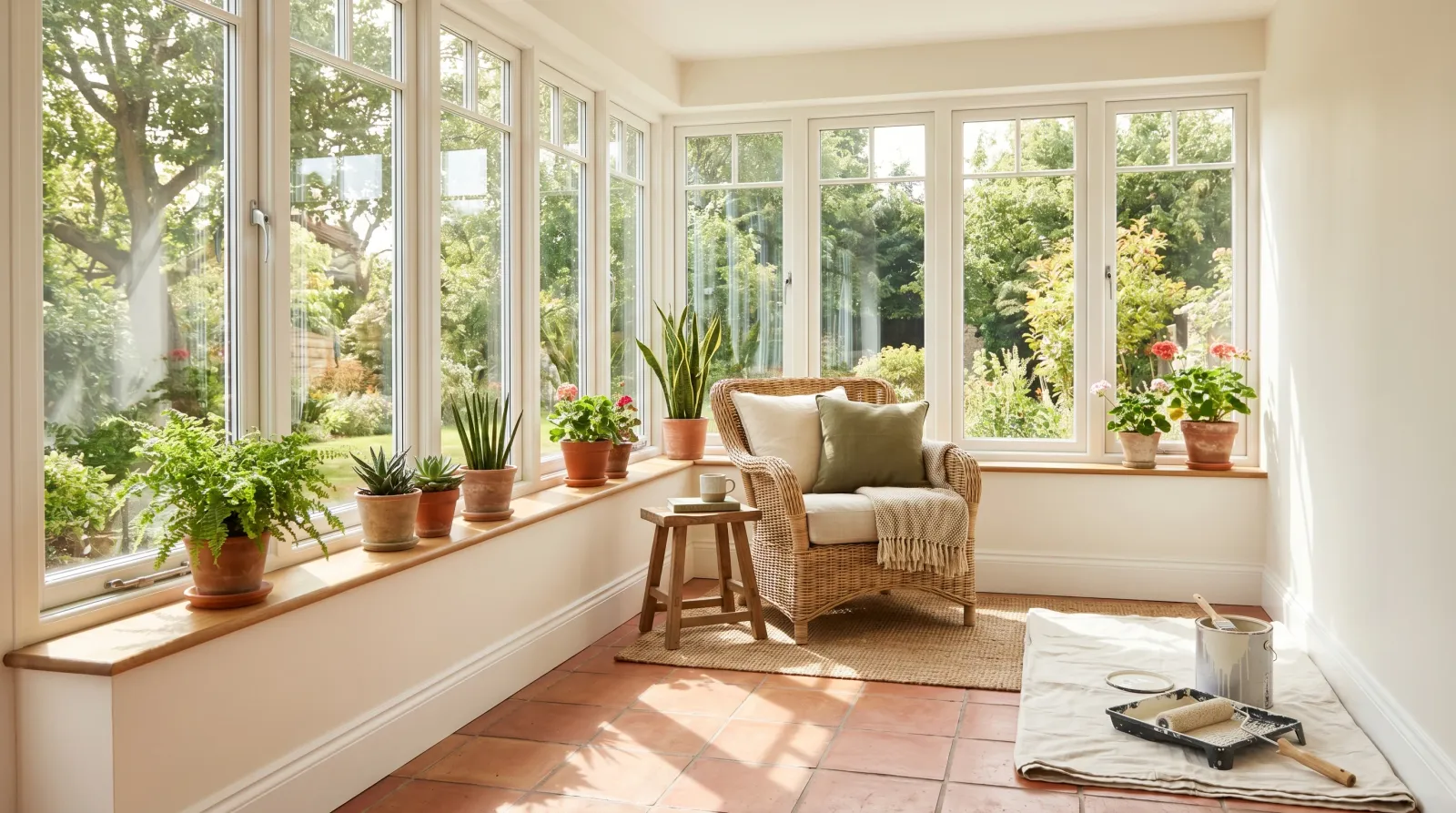
Okay, so you’ve got a sunroom, and you’ve noticed the paint is doing something weird. Peeling near the windows, maybe. Faded on the sunny wall. Or it’s just the wrong color and the whole room feels like a leftover. Painting a sunroom isn’t harder than painting any other room, but it has two things working against you that a bedroom doesn’t: the sun bakes the walls, and the windows sweat. Get those two things wrong and your fresh paint peels in a year. Get them right and it lasts.
Here’s the thing. Most of the trouble in a sunroom happens before you open the can. The prep is where the project is won or lost. So we’ll spend real time on it.
What You’ll Get
A clean, fully painted sunroom (walls, window frames, and ceiling if it’s solid) that handles the heat and humidity instead of fighting it. One weekend of work, plus a day of dry time before you move the plants back in.
Honest Take on Difficulty and Time
A typical 10×12 sunroom takes about 10 working hours over two days. It’s rated medium, not easy, for one reason: the windows. A sunroom is mostly glass, which means a lot of fiddly cutting in (painting the careful edge along the frames where a roller can’t reach) and a lot of taping. The actual wall area is small. The edge work is what eats your time.
Add the weather. You can’t paint a sunroom at 2 p.m. in July when the walls are too hot to lean against. So your real schedule bends around the temperature, not just the dry time. More on that below.
Honest Take on the Sun and the Humidity
This is the part nobody warns you about, so I will.
A sunroom is a greenhouse with furniture. On a clear afternoon the walls can climb past 100°F even when the air feels fine. Hot walls make water-based paint flash off (dry on the surface) before it has time to level out and bond underneath. That’s where lap marks and early peeling come from.
The fix is timing. Paint in the morning, before the room cooks. Touch the wall with the back of your hand. If it’s warm, wait, or close the blinds and start earlier tomorrow. Aim for a wall temperature under about 85°F.
The humidity is the second half. Overnight, warm moist air hits cool glass and condenses, then drips down onto the frames and the lower walls. That standing moisture is why sunroom paint fails at the bottom of the windows first. A satin or eggshell sheen sheds it better than flat. And a box fan moving air while the paint cures pulls the dampness out of the room so the coat sets hard. Don’t skip the fan in summer.
What You’ll Need
Paint and Primer
For the walls, a 1-gallon can in satin or eggshell (low-shine finishes, satin a touch glossier). Both wipe clean and handle moisture better than flat, which soaks up humidity and shows water marks. Pick a moisture-tolerant line. Behr Premium Plus, BM Aura, or Sherwin-Williams SuperPaint all do the job.
For the window frames and trim, a 1-quart can of semi-gloss (a shiny finish that resists condensation and wipes down). The frames take the most abuse in a sunroom, so don’t cheap out on the trim paint.
Stain-blocking primer (Zinsser BIN or KILZ Original) goes on the problem spots only. Water stains under the windows, sun-bleached patches, anywhere the old coat already peeled. Not the whole wall. Just the trouble.
If you’re stuck choosing between satin and eggshell, the sheen guide walks through it. For SKU-level picks on a paint that takes moisture, see the best moisture-tolerant paint round-up, which covers the same hold-up-to-humidity problem a sunroom has.
Tools
A 2.5-inch angled brush for cutting in around the frames. A 9-inch roller, two 3/8-inch nap sleeves, a tray, a 4-foot step ladder, a box fan, painter’s tape, spackle, a 220-grit sponge, and a razor scraper for the glass.
Buy the delicate-surface tape (green FrogTape) over the basic blue. You’ll be taping glass and freshly cleaned frames, and the gentler tape won’t pull at them. Picks live in the best painter’s tape round-up.
Step 1: Clear the Room and Patch the Walls
Move out the plants, the furniture, the rug. Sunrooms collect stuff, so give yourself room to work. Take down any blinds or shades. Cover the floor with the canvas drop cloth; canvas soaks up drips and doesn’t slide on tile the way plastic does.
Find every nail hole and crack. Press spackle in with the putty knife, scrape flush, let it dry 30 minutes, then sand smooth with the 220 sponge. DryDex goes on pink and turns white when it’s ready to sand.
Watch out for soft or bubbled spots low on the walls near the windows. That’s old moisture damage. Scrape the loose paint back to a firm edge before you patch, or the new paint peels right off with the old.
Step 2: Clean, Then Tape the Glass
Sunrooms get a film on the walls and frames from sun, dust, and the occasional spilled watering can. Wipe everything down with a damp rag and a little dish soap, then let it dry. Paint doesn’t stick to grime.
Now tape. Run painter’s tape along the edge of every pane of glass where it meets the frame. Press the edge down hard with your fingernail so paint can’t sneak under it (that sneaking is called bleed, and it leaves a fuzzy line). Yes, this is tedious. A sunroom is mostly windows, so the taping is most of the prep.
You can skip taping the glass and scrape the stray paint off later with the razor instead. Some people are faster that way. Try a small window both ways and see which you prefer. For the full breakdown on working around panes, the guide to painting near glass covers it.
Step 3: Prime the Problem Spots
Hit the water stains, the bare patches, and the sun-faded sections with primer. Brush BIN or KILZ on just those areas, feathering the edges so there’s no hard ridge. Let it dry the time on the can (BIN is fast, about 45 minutes).
The south or west wall, the one that takes the most direct sun, usually needs the most primer. That’s the wall the sun has been working on for years.
Step 4: Paint the Frames and Trim First
Start with the window frames, then any door casing or trim. Use the 2.5-inch angled brush with the semi-gloss. Dip only a third of the way in; a loaded brush drips, and drips on a window frame dry as bumps.
Brush in long smooth strokes along the length of the frame. Two thin coats beat one thick one. Let the first dry the full time on the can before the second.
Watch out for drips pooling in the bottom corner of each frame, where condensation collects in real life too. Check the corners every few minutes for the first half hour and brush out any drip while it’s still wet.
Do this part in the cool morning. The frames are right against the glass, which is the hottest surface in the room by midday.
Step 5: Cut In and Roll the Walls
Trim’s dry. Now the walls. The wall sections in a sunroom are often narrow strips between windows, so this goes fast once the cutting in is done.
Cut in a 2- to 3-inch band with the angled brush along the ceiling, the corners, and around every frame. The tape protects the glass, so brush right up to it. Then roll the open wall in W-shapes: a big W about 3 feet wide, then fill it in with up-and-down passes. Load the roller evenly on the tray ramp so it’s not dripping and not dry.
The trick in a sunroom is to work one wall section at a time and roll it before the cut-in dries, or you’ll see a line where brush meets roller. In a hot room that line shows up fast, so keep moving.
The first coat will look patchy and thin. That’s normal. You will need a second coat. Don’t panic when coat one looks bad; they all do. Wait the full dry time, then go again. The color fills in on the second pass. You’ll know it when you see it.
Step 6: Dry It Right and Reset the Room
Set the box fan on the floor pointed toward an open window or door. Moving air pulls the humidity out so the paint cures hard instead of staying soft and tacky. In a sunroom this matters more than in a normal room.
Once the last coat is dry to the touch but not bone dry, pull the tape slow at a 45-degree angle. If you skipped taping, run the razor scraper along the glass to lift any stray paint; do it before the paint fully hardens and it peels off in clean ribbons.
Wash the brushes and roller under warm water until it runs clear. Move the plants and furniture back in after 24 hours.
Common Mistakes
- Painting at midday in summer. The walls are too hot, the paint flashes off before it levels, and you get lap marks and early peeling. Paint in the morning when the wall is cool to the touch.
- Using flat paint on the walls. Flat soaks up the room’s humidity and shows water marks within months. Use satin or eggshell so the moisture beads and wipes off.
- Skipping the fan. Without air movement, the morning condensation keeps the paint soft and it never cures hard near the windows. Run a box fan through the cure.
- Painting over soft, bubbled patches near the windows. That’s moisture damage, and fresh paint peels off it fast. Scrape back to a firm edge, prime, then paint.
- Not taping or scraping the glass. Paint on the glass looks fine until the afternoon sun hits it and every smear shows. Tape the panes, or razor the glass clean while the paint is still soft.
Cure Schedule
| Time after the second coat | What’s safe |
|---|---|
| 1 hour | Pull the tape |
| 4 hours | Touch dry, keep the fan running |
| 24 hours | Plants and furniture back in |
| 48 hours | Hang anything on the walls |
| 7 days | Wipe condensation off the frames |
| 30 days | Full cure, scrubbable |
Maintenance and Touch-Ups
Sunroom walls hold up 5 to 7 years before the sunny side starts to chalk or fade, a little less than a shaded room. The window frames take the worst of the condensation and may want a touch-up every few years at the bottom corners.
Wipe the morning condensation off the frames when you see it pooling; that one habit doubles how long the trim paint lasts. For a faded spot, dab leftover wall paint with a small piece of roller (not a brush, since a brush leaves a different texture than the rolled wall). Keep a labeled quart of each color in a closet.
Cost Breakdown
| Item | $ |
|---|---|
| Wall paint, 1 gallon satin | $45 |
| Trim paint, 1 quart semi-gloss | $22 |
| Primer, 1 quart | $18 |
| Brush, roller, tray, sleeves | $35 |
| Tape, drop cloth, spackle, razor | $30 |
| Total | $150 |
Numbers are mid-tier paint (Behr Premium Plus or BM Regal Select). Budget runs about $130. Top-shelf (BM Aura, SW Emerald) lands closer to $240.
Ask a Question