What Is a Sealer (and How Is It Different From Primer)?
What is sealer, in plain chemistry. How a sealer locks down porous and bleeding surfaces, why it is not the same as primer, and when you actually need one.

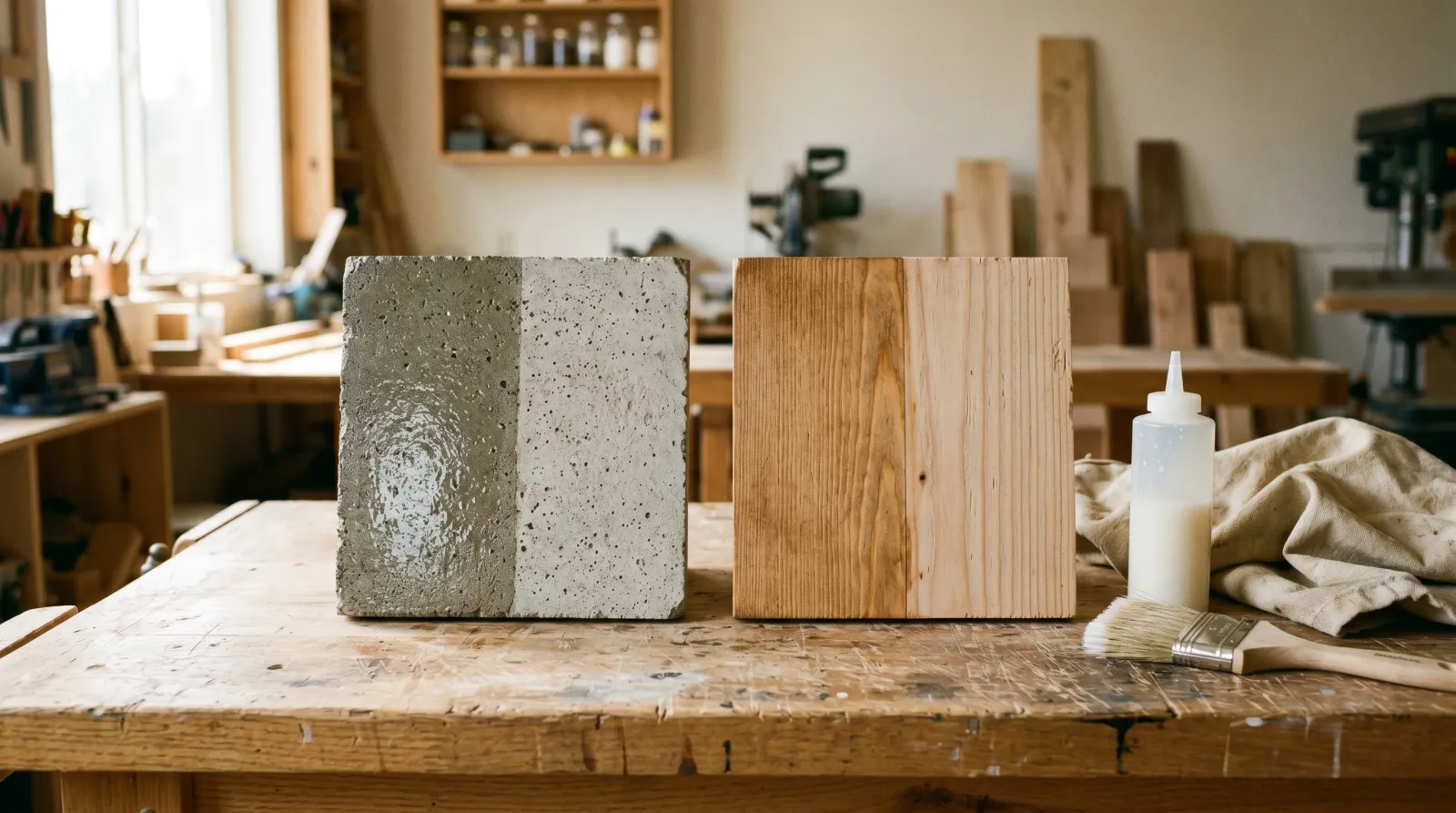
Most people meet a sealer the hard way. You paint a patched ceiling, it dries, and the patch reads duller than everything around it. Or you topcoat a concrete floor and watch the paint flake off in chips a month later. Both failures trace back to the same missing step: nobody sealed the surface first. A sealer is the coat whose only job is to stop the next coat from sinking in or peeling off. It closes the open pores or locks down a bleeding layer, so the paint that follows forms a clean, even film on top instead of disappearing into the substrate. On bare drywall a sealer cuts your topcoat from three thirsty coats down to two.
So why does everyone talk about primer instead? Because the two jobs overlap, and most cans sold as “primer” do both. A sealer seals. A primer seals and bonds. Knowing which function you actually need is what keeps you from buying the wrong can.
TL;DR
- A sealer closes porosity or locks down a bleeding/chalky surface so the next coat sits on top instead of sinking in.
- A primer does that and also builds adhesion between the substrate and your topcoat.
- Most modern “primers” (Zinsser 123, PVA, Cover Stain) are really primer-sealers that combine both functions.
- Pure sealers still exist for specialty work: clear masonry sealers, drywall sealers, knot/shellac sealers, wood conditioners.
- Some sealers are not topcoatable on their own. A clear water-repellent on brick sheds paint the same way it sheds rain.
- If the can does not list a recoat window and a compatible topcoat, prime over the sealer before you paint.
What a Sealer Actually Does
Two different problems both get solved by “sealing,” and it helps to keep them apart.
The first is porosity. Fresh drywall, joint compound, raw plaster, bare wood, and cured concrete are full of open capillary pores. Wet paint is mostly water carrying binder and pigment. Put that paint on a porous surface and the substrate pulls the water in faster than the binder can fuse into a continuous film. You get a thin, chalky, uneven coat that drinks the next coat too. A sealer fills or lines those pores first, so the topcoat keeps its water long enough for the binder to coalesce evenly. That is the same mechanism behind flashing on a patched wall, and it is why a sealer fixes it.
The second is bleed-through. Some substrates contain something that wants to migrate up into your fresh paint: tannins in cedar and redwood, the resin in pine knots, nicotine and soot on old walls, the soluble salts behind efflorescence on brick. Water-based paint reactivates these and carries them to the surface as brown or yellow stains. A stain-blocking sealer puts down a layer the contaminant cannot dissolve into or pass through. Shellac-based sealers like Zinsser BIN are the standard here because dewaxed shellac is nearly impermeable to both water-soluble and oil-soluble stains.
When to Use a Sealer
Use a sealer when:
- The surface is porous and bare: new drywall, fresh joint compound, raw plaster, bare wood, unsealed concrete or masonry.
- Something underneath will bleed through: pine or cedar knots, water stains, smoke or nicotine, marker or crayon.
- A masonry surface is chalky or dusting and you need to bind the loose surface before coating.
- You are sealing concrete against moisture or efflorescence moving up through the slab.
- A previously glossy or sealed surface needs its porosity evened out before a decorative or limewash finish.
If you are sealing bare drywall, a combined primer-sealer like Zinsser 123 or a PVA primer is the simplest answer, since the porosity and bonding jobs both need doing.
When NOT to Use a Sealer
Skip the standalone sealer when:
- You are repainting a sound, previously painted wall in a similar color. The old film already seals the substrate; clean it, maybe scuff it, and paint.
- The job calls for bonding to a glossy or slick surface (melamine, glazed tile, factory-finished metal). A sealer alone does not grip these. You need a bonding primer.
- You are reaching for a clear water-repellent on exterior brick or stone but plan to paint over it. Those penetrating sealers are designed to shed water, which means they shed paint too. Use a masonry primer-sealer instead.
- The can is a deep-tint topcoat problem. If your only issue is coverage on a saturated color, a tinted primer beats a clear sealer.
How a Sealer Compares to Primer and Paint
| Sealer | Primer | Paint | |
|---|---|---|---|
| Main job | Close pores / block bleed | Seal and bond | Color and protection |
| Adhesion to topcoat | Sometimes weak | Strong (engineered for it) | n/a |
| Pigment level | Low to none | Moderate | High |
| Topcoatable alone? | Not always | Always | n/a |
| Typical example | Clear masonry sealer, BIN, PVA | Zinsser 123, Cover Stain | Wall, trim, floor paint |
The short version: a primer is a sealer with an adhesion package added. That is why most homeowners never buy a pure sealer. The exceptions are clear masonry sealers, drywall sealers, dedicated knot sealers, and wood conditioners, all of which do one job on purpose. For the full head-to-head, see primer vs sealer, and for the chemistry of the bonding side, see what primer actually does.
The Main Sealer Families
Drywall / PVA sealers. Polyvinyl-acetate dispersions formulated to soak the open paper and compound, then leave a thin even film. Cheap, fast, low-odor. They seal but bond modestly, so they are best left under wall paint rather than under a hard-wearing topcoat.
Stain-blocking shellac sealers. Zinsser BIN is the reference. Dewaxed shellac in alcohol dries in 45 minutes and blocks tannin, water stains, smoke, and odor. It takes tint poorly and is best left white. Use it on pine knots that keep bleeding through and on stubborn ceiling stains.
Masonry / concrete sealers. Two camps. Film-forming acrylic sealers sit on top and fill the surface. Penetrating silanes and siloxanes line the pores from inside and leave a natural look. For a floor you intend to paint, you want a coating-compatible concrete primer-sealer, not a water-repellent. See how to prep and paint a concrete floor for the full sequence.
Wood conditioners. A thin sealer that partially fills soft, thirsty grain so stain absorbs evenly instead of blotching. This is a sealer used before, not after, a finish.
Common Mistakes
- Topcoating a non-topcoatable sealer. A clear penetrating water repellent on brick is built to reject liquid. Paint beads and fails on it. Read the can for a recoat window and a named compatible topcoat before you trust it.
- Using a thin sealer where you needed a bonding primer. Sealing a glossy door and then painting it is how you get a film you can peel off with your thumbnail in a week. Glossy substrates need a bonding primer, not a sealer.
- Skipping the sealer on a bleeding substrate and “just doing two coats.” Tannin and nicotine reactivate through latex no matter how many coats you stack. The stain comes back. Block it once with shellac and move on.
- Letting a penetrating concrete sealer flash off too fast. The solvent has to leave pores deep in the slab. Rushing the recoat traps it and weakens the bond. Give it the full window, often 4 to 24 hours.
- Assuming “sealer” on the label means it bonds. It seals. Whether it bonds is a separate claim printed somewhere else on the can.
Where to Buy
For combined primer-sealers that handle most drywall, wood, and masonry jobs, see the tested primer round-up. For a bare floor, match the sealer to the coating system in the concrete floor guide rather than grabbing a generic water-repellent.