What Is Marine Varnish?
Marine varnish is a flexible, UV-resistant spar finish built for wood that moves and bakes outdoors. Here is the chemistry, where it works, and where it fails.

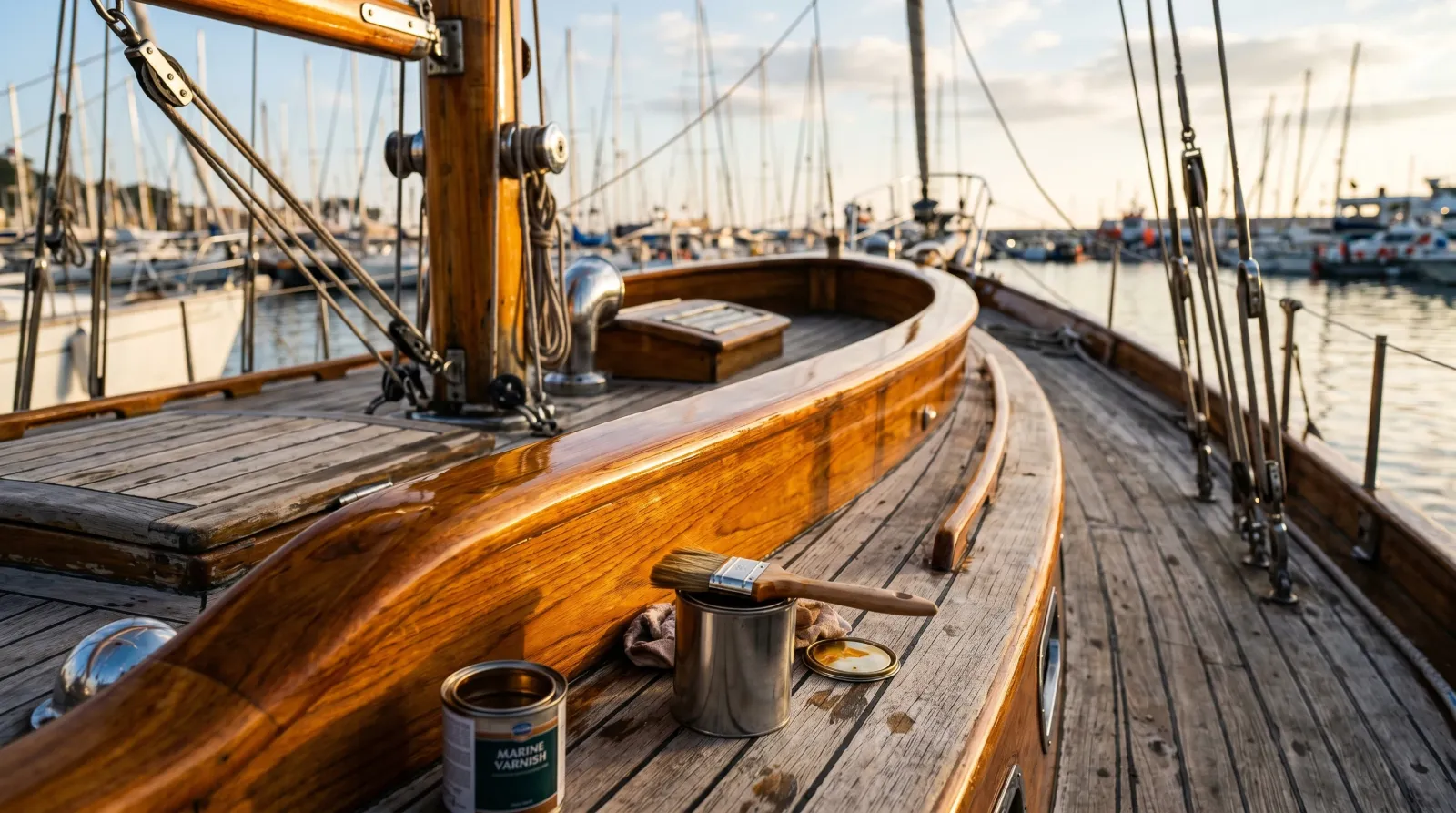
You have probably seen the failure before you ever heard the word. A front door or a boat handrail finished in something glossy and amber, and a year later the south face is cloudy, flaking, and grey underneath while the shaded side still looks fine. That is almost always a regular interior varnish put outdoors. Marine varnish is the finish built to survive the spot where the ordinary one dies.
Marine varnish, also called spar varnish, is a clear or amber-tinted wood finish formulated to stay flexible and to block ultraviolet light. It is built around long-oil alkyd or modified-oil resins, usually carries 30 to 60% solids, and is loaded with UV absorbers and a longer drying oil ratio than interior varnish. The name comes from the spars of sailing ships, where the wood flexes constantly and bakes in full sun and salt. That is the design brief: a film that moves with the wood and shrugs off sunlight.
What Makes It Different From Regular Varnish
The difference is in the resin and the additives, not the gloss.
Interior varnish and most floor polyurethane are short-oil or medium-oil formulas. They cure hard and brittle because indoor wood barely moves and never sees direct UV. Marine varnish is long-oil. More drying oil relative to resin means a softer, more elastic film. When the wood underneath swells in humidity and shrinks in dry heat, the film stretches and relaxes with it instead of cracking. The reason for that matters: a clear finish fails at the cracks first, because every crack lets water and UV reach the substrate, and once water gets under the film, adhesion goes and the finish lifts in sheets.
Then there are the UV absorbers. Sunlight is what destroys clear finishes outdoors. UV photons break the bonds in both the resin and the wood’s surface lignin, the film goes chalky and yellow-grey, and the bond to the wood fails. Marine varnish carries hindered amine light stabilizers and UV-absorbing compounds that soak up that radiation before it reaches the wood. They are sacrificial. They get consumed over time, which is the chemical reason the finish needs recoating on a schedule.
When to Use Marine Varnish
Use it for:
- Exterior wood in direct sun that you want to keep clear and showing grain: front doors, brightwork, teak trim, mahogany window frames
- Wood that moves a lot with weather, like boat rails, gunwales, and outdoor furniture
- Marine and dockside wood exposed to salt spray and constant wetting
- Any clear-coated exterior wood where you would rather see the grain than hide it under a solid stain or paint
When NOT to Use Marine Varnish
Skip it for:
- Interior floors and stair treads. Spar varnish stays too soft underfoot and scuffs; a floor-grade polyurethane cures harder. See the polyurethane vs polyacrylic breakdown for interior clear coats.
- Horizontal exterior decking you walk on. Foot traffic abrades a clear film fast, and a peeling deck finish is miserable to strip. A penetrating deck stain wears by fading instead of flaking.
- Wood you will not maintain. A clear film that nobody recoats is worse than a stain, because it fails by peeling rather than fading and forces a full strip.
- Pressure-treated lumber that is still wet from the mill. Trapped moisture pushes the film off.
How Marine Varnish Compares
| Marine varnish | Interior polyurethane | Exterior deck stain | |
|---|---|---|---|
| Film type | Flexible film on the surface | Hard film on the surface | Penetrates, little to no film |
| UV protection | High (UV absorbers) | Low to none | Moderate (from pigment) |
| Flexibility | High | Low | Not applicable |
| Hides grain | No, shows grain | No, shows grain | Partly, adds color |
| Fails by | Slow thinning, then peeling if neglected | Cracking and peeling outdoors | Fading |
| Recoat cycle | 1–3 years | 5–10 years indoors | 1–3 years |
For the indoor clear-coat decision specifically, see polyurethane vs polyacrylic.
Common Mistakes
- Too few coats. People stop at three because the wood looks finished. Three coats is half a UV barrier. Exterior brightwork wants six to eight, with the first coats thinned to penetrate.
- Recoating too late. Once the gloss goes flat and the film clouds, you are at the edge of bare wood. Scuff and add a maintenance coat at the first sign of dullness, not after it grey.
- Brushing it thick. A heavy coat traps solvent and oxygen, skins over on top, and stays tacky underneath for days. Thin coats cure fully and bond to each other.
- Putting it over an interior poly that already failed. New varnish over a cracked, lifting old film just lifts with it. Strip to bare wood and rebuild.
- Working in the cold or the damp. Oil-based spar varnish cures by oxygen uptake, which stalls below about 50 degrees and in high humidity. A coat that should be hard in a day stays gummy for a week.
What to Look For at the Store
Read the resin line on the can. A true marine spar varnish lists a long-oil alkyd or phenolic-modified oil and names UV protection on the label. “Spar urethane” is a related product that blends spar flexibility with urethane hardness; it is a fine choice for a front door that gets both sun and the occasional knock. What you want to avoid is a plain interior “polyurethane, satin” with no UV claim, which is an indoor floor finish wearing an outdoor ambition.
Watch the VOC content too. Traditional oil-based spar varnish runs high in solvent and off-gasses for days; if you are finishing an interior door inside the house, ventilate hard or choose a lower-VOC water-based exterior clear.
Ask a Question