What Is Color Drenching?
Color drenching means painting walls, trim, ceiling, and doors one single color. Here's how it works, where it sings, and where it falls flat.

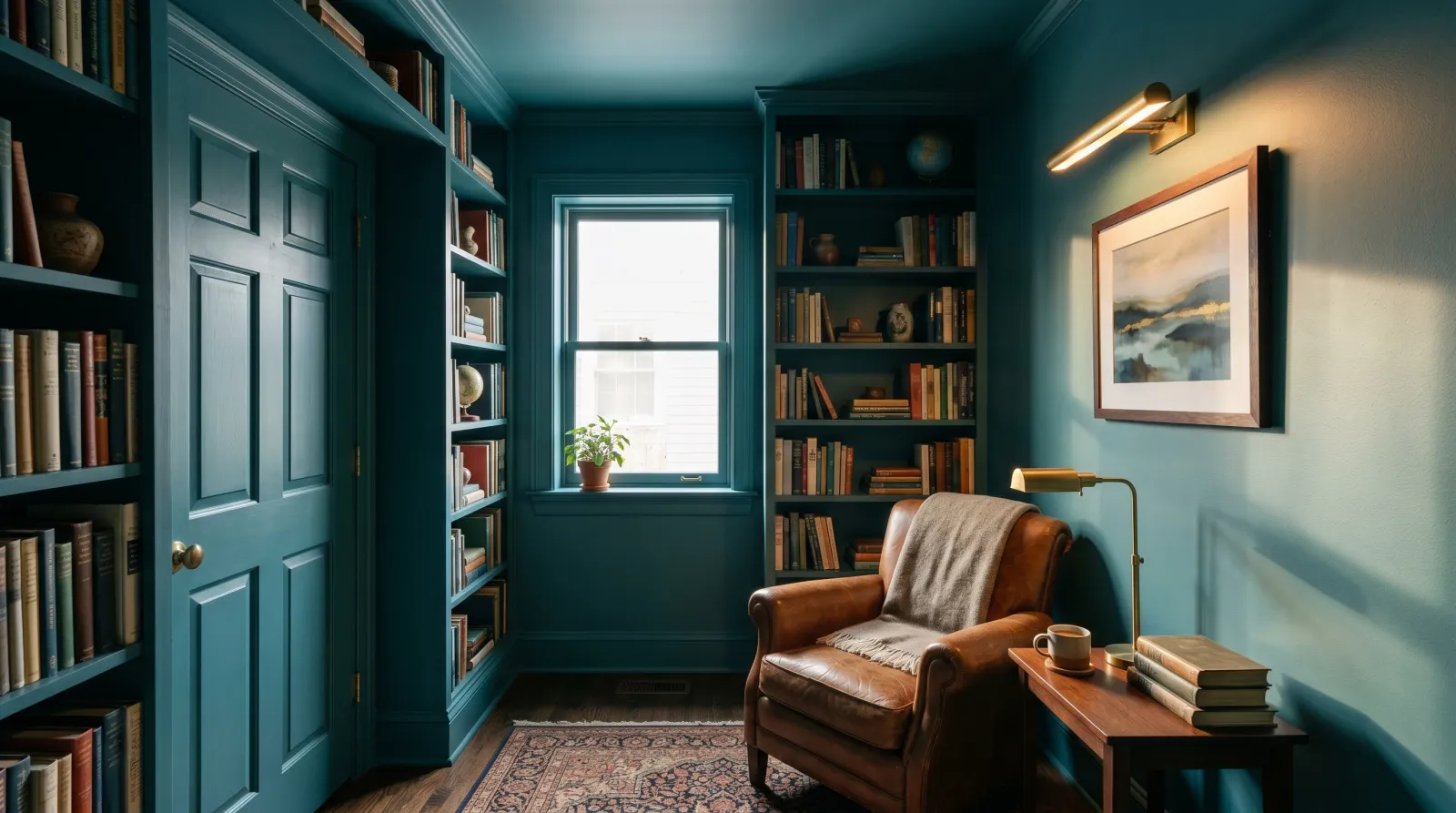
Color drenching means painting an entire room one color: walls, trim, baseboards, ceiling, and often the doors and built-ins too, all in the same hue. No white ceiling, no contrasting trim. One color, wrapped corner to corner, usually in a single matte or eggshell finish. The effect is a room that feels held rather than decorated, because the eye loses the edges it normally uses to read where one surface stops and the next begins. It’s a saturated, enveloping look that’s moved from boutique hotels into ordinary bedrooms and studies over the last few years.
TL;DR
- What it is: one color on every surface of a room — walls, trim, ceiling, doors — instead of the usual white-trim-and-ceiling default.
- Why it works: matching the trim and ceiling to the walls erases the corner lines, so the room reads bigger and quieter, not smaller.
- Best in: small rooms with a job to do — powder rooms, studies, dining rooms, deep-toned bedrooms. North-facing rooms take the deep tones beautifully.
- The finish move: keep one finish (usually matte) across everything, or step the trim up to eggshell for a whisper of sheen.
- The cost: more paint than a standard job, since you’re now coating the ceiling and all the millwork in color too.
How Color Drenching Works
Pick up a paint chip in a normal room and your eye still has anchors: the white ceiling overhead, the white baseboards at the floor, the trim around the door. Those white lines tell you exactly how big the box is. Color drenching takes them away.
When the trim and ceiling carry the same color as the walls, the corners stop announcing themselves. A deep clay or a muted blue-green pulls across the whole room as one continuous field, and the architecture goes soft at the edges. You notice the light and the color, not the seams. That’s the whole trick, and it’s why a drenched powder room can feel like a jewel box instead of a closet.
The color itself does most of the work, so undertone matters more here than almost anywhere else. A greige with a green undertone will drench warm and earthy. The same greige with a violet undertone goes cool and a little somber once it’s on five surfaces instead of one. Whatever the undertone is, drenching multiplies it.
When to Use Color Drenching
Use it for:
- Small rooms that already feel small. Powder rooms, studies, mudrooms, box bedrooms. Drenching makes them feel deliberate instead of cramped.
- North-facing rooms. Cool, flat northern light flattens pale colors into something tired. A deep drenched tone leans into that light instead of fighting it.
- Rooms with awkward angles or lots of trim. Sloped ceilings, dormers, heavy millwork, radiators. One color hides the fussiness and lets the shape read clean.
- A room you want to feel cocooning. Dining rooms for evening dinners, libraries, a main bedroom meant for rest.
When NOT to Use Color Drenching
Skip it for:
- Rooms with strong direct sun and a dark color. South and west light on a deep drenched wall can read hot and heavy by mid-afternoon. If you want drenching in a sunny room, go lighter.
- Open-plan spaces with no doorways. Drenching needs an edge to stop at. When a kitchen flows into a dining area flows into a living room with no walls between them, the color has nowhere to land and the whole floor feels swallowed.
- Rooms where you want the architecture to show. Beautiful original moldings, a carved mantel, paneled doors worth looking at — matching them to the walls makes them vanish. Sometimes the trim is the point.
- Pure white as the drench color. That’s not really drenching, it’s just an all-white room. The look depends on a color committed enough to wrap you.
How Color Drenching Compares
| Color drenching | Accent wall | Two-tone walls | Color blocking | |
|---|---|---|---|---|
| Number of colors | One | Two | Two | Two or more |
| Ceiling | Same color | White | White | Often white |
| Trim | Same color | White | White | Contrast |
| Effect | Wraps, enlarges | Focal point | Defines zones | Graphic, bold |
| Best for | Small, moody rooms | Bedrooms, offices | High ceilings | Kids’ rooms, playful spaces |
For the lower-commitment cousin, see how to handle two-tone walls, where a single color splits a wall horizontally instead of taking the whole room.
Common Mistakes
- Leaving the ceiling white. This is the one that gets people. A white ceiling over drenched walls cuts the room off at the top and kills the enveloping effect. If you’re drenching, the ceiling goes the same color. Always.
- Mixing too many finishes. Matte walls, semi-gloss trim, and a flat ceiling in the same color will catch light at three different angles and break the seamless field you painted for. Keep one finish, or step trim up gently to eggshell.
- Picking the color from a chip under store light. A drenched color shows up everywhere at once, so any undertone you didn’t notice on the 2-inch chip will be undeniable on five surfaces. Sample a board and lean it against the floor at the hour you use the room.
- Buying paint in separate trips. Walls one week, trim the next, ceiling later, and the tint formula drifts a hair each batch. On separate surfaces in the same color, even a tiny mismatch shows. Buy it all at once.
- Going too dark in a room with no light. Drenching a windowless hall or a tight bath in near-black can read as a cave rather than a cocoon. Check the LRV and lean on lamps and a lighter floor to keep usable light in the room.
What to Look For
You don’t need a special product to color drench. Any interior paint works, as long as you can get the same color in the finish you want across walls, trim, and ceiling. Most major lines (Benjamin Moore, Sherwin-Williams, Farrow & Ball, Behr) tint any color into matte, eggshell, and a trim-grade finish, so you can run one hue through all three.
A few practical notes for the buy:
- One finish is simplest. A washable matte or eggshell across every surface gives the cleanest drenched look and the fewest light-angle surprises.
- Trim-grade paint on the trim. If you do step the trim up to eggshell or satin, use a proper trim or cabinet enamel so it cures hard on the high-touch edges. The interior trim paint round-up covers which ones hold up.
- Buy enough. You’re coating more square footage than a normal repaint. Run the coverage and gallons math for the ceiling and trim, not just the walls, before you check out.
A drenched room lives or dies on the color reading right in your light, not the store’s. Pick the hue for the hour you actually sit in the room, paint a board, and let it tell you the truth before you commit five surfaces to it.
Ask a Question