How to Tint Paint Lighter or Darker (the 50% and 25% Rule)
How to tint paint lighter or darker at home: the 50 percent and 25 percent rule, why white never doubles the lightness, and when to skip it and re-tint at the store.

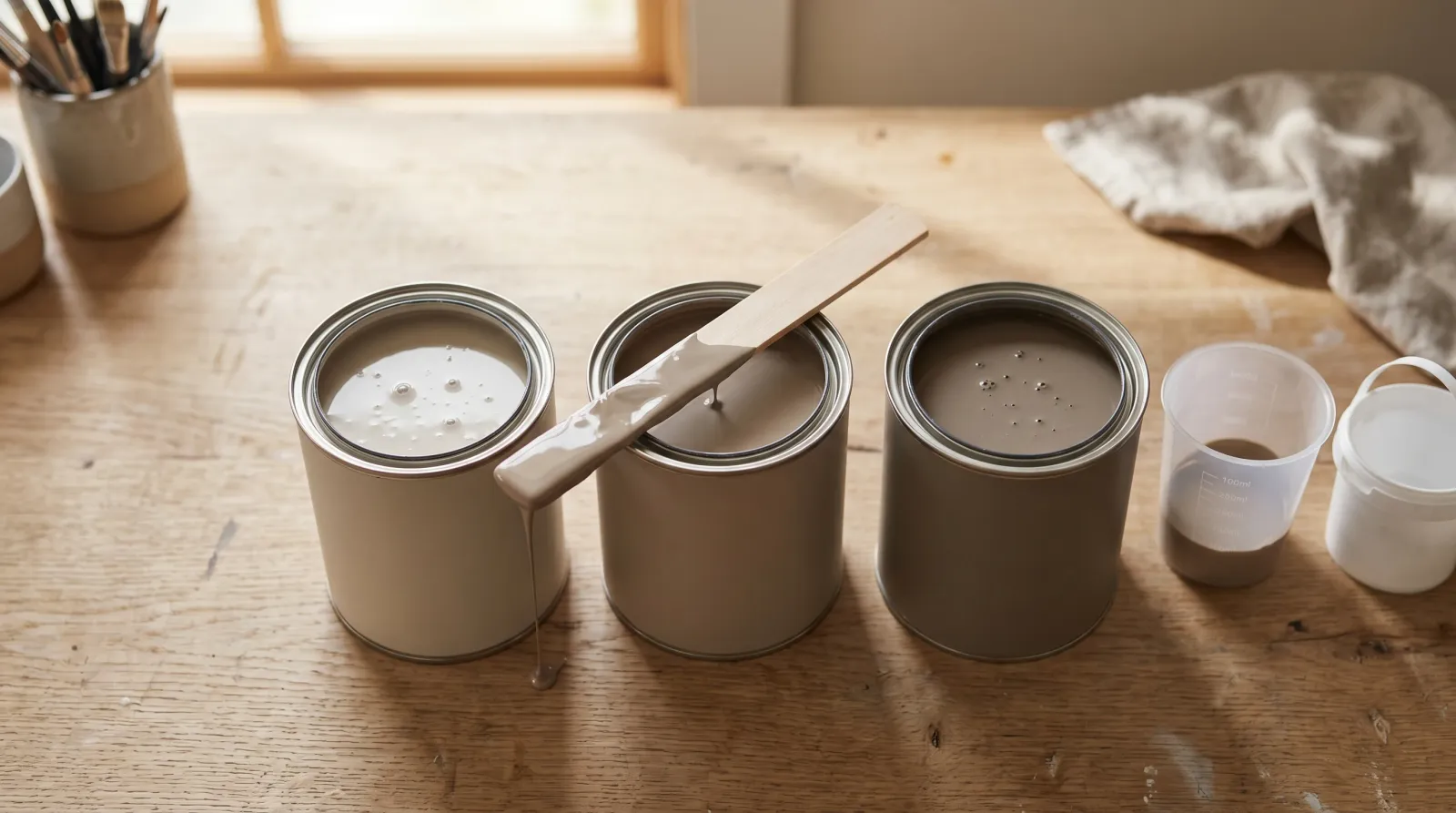
To tint paint lighter, cut it with white at roughly 50 percent of the volume for a real step lighter and 25 percent for a small nudge. So one quart of color takes about 16 ounces of white to move it a clear step, or 8 ounces to nudge it. To go darker, you do the opposite, and the opposite is not symmetrical: you add colorant or a deeper tinted paint in small doses, never more base. White is the cheap, forgiving direction. Darker is the touchy one, where four extra drops of universal tint per quart can overshoot the color you wanted.
Here’s the part the ratios hide. Lightening paint is not linear. The first half of the white you add does most of the visible work, and the second half does much less, because you’re diluting the colorant against a background that’s already getting pale. That’s why 50 percent white gets you one honest step and doubling to 100 percent white doesn’t get you two steps. The pigment-to-binder math flattens out as the mix lightens.
Why White Doesn’t Double the Lightness
A tinted paint is a fixed dose of colorant suspended in a white or pale base. When you add white, you’re not bleaching the color, you’re lowering the colorant’s concentration in the can. The relationship between colorant ratio and the lightness your eye reads is a curve, not a straight line. Halve the colorant concentration and the value rises a clear step. Halve it again and the value barely moves, because the mix is already close to the white ceiling.
This is the same logic behind why a deep accent base needs five times the colorant a pastel needs to hit a saturated color. The base sets the ceiling; the colorant sets how far below the ceiling you sit. Adding white walks you up toward the ceiling, fast at first and slowly near the top.
The practical version: don’t expect a 1:1 dose of white to produce a 1:1 jump in lightness. Add in stages, and judge each stage dry.
When to Use the 50 and 25 Rule
Use it for:
- A wall color that tested one notch too dark on the actual wall, and you have leftover white base of the same product line.
- Furniture or cabinet paint where you want a softer, washed version of a color you already bought.
- Stretching a near-empty can of an accent color into enough volume to finish a wall, accepting that it’ll read lighter.
- Custom sample mixing, where you’re hunting for a tone between two store chips and want to dial it by hand.
Use 25 percent when the color is close and you want a subtle lift. Use 50 percent when you want an obvious, see-it-from-the-doorway change.
When NOT to Tint It Yourself
Hand-tinting is a one-way door with no undo. Skip it when:
- The wall is large and you’ll ever need to touch it up. A hand-mixed batch can’t be reproduced; a store formula on the lid can, exactly, years later.
- You’re trying to go darker by more than a hair. Colorant is concentrated enough that drop counting at home overshoots easily. Let the machine pump it.
- The base is a deep or accent base. These carry so little white that adding household white can break the formula’s balance and shift the undertone hard.
- You need an exact match to an existing painted surface. A spectrophotometer at the store reads the wall and re-tints to it. Your eye against a chip can’t.
- The paint is a premium low-VOC line tinted with proprietary colorant. Mixing in a generic white can dilute the binder package and soften the cured film.
How Tinting Lighter Compares to Other Moves
People reach for four different fixes when a color is wrong. They don’t do the same thing.
| Move | What it changes | Reversible? | Best for |
|---|---|---|---|
| Add white (tint lighter) | Raises value, dilutes color | No | One step lighter, you own the white |
| Add colorant (tint darker) | Deepens value, intensifies color | No | Small darker nudge, drop by drop |
| Thin with water | Lowers viscosity and film build | No | Flow and leveling, not color |
| Store re-tint | Re-pumps the formula | Yes, repeatable | Exact, durable, future touch-ups |
Thinning gets confused with lightening because both make the can look paler in the bucket. They’re different. Water drops the paint’s viscosity and film build, so the color looks weaker on the wall only because the coat is thinner and more translucent, not because the value actually rose. Two coats bring the depth right back. White genuinely raises the value and it stays raised.
Common Mistakes
- Adding all the white at once. You can’t take it back out. Add a quarter of your planned white, stir to the bottom of the can, brush a sample, then decide on the rest.
- Judging the color wet. Latex dries a half-step different from how it looks in the bucket, and lighter mixes shift more than deep ones. Brush card stock, let it dry, hold it in the room’s real light.
- Ignoring the undertone. White dilutes the colorant ratio, and a buried undertone surfaces as the mix lightens. A greige cut hard with white can go pink or green. If you don’t know what’s hiding in your color, read the undertone guide before you cut it.
- Trying to go darker with more base. Adding more of the same tinted paint changes nothing but volume. Darker needs colorant or a deeper tinted paint, full stop.
- Mixing across product lines or sheens. A flat and a semi-gloss of the same color have different pigment volume concentrations and won’t blend to a clean, even sheen. Keep the white from the same line and sheen.
What It Looks Like
Picture three quarts of the same greige poured side by side: the original at full strength, the same color cut 25 percent white, and the same color cut 50 percent white. The 25 percent quart looks like a quieter version of the original. The 50 percent quart looks like a different, softer color a step up the strip. The jump from original to 25 percent and the jump from 25 to 50 percent are not equal sizes, even though you added the same amount of white each time. That uneven spacing is the curve, visible in a row of cans.
Where to Buy and What to Look For
For the white you’ll cut with, buy a small can of the same product line and sheen as your color, in the whitest base that line sells (usually labeled “ultra white” or “white base”). That keeps the binder, sheen, and film chemistry consistent so the mix cures as one paint, not two stirred together.
For accurate matching instead of guessing, our color matcher tool finds buyable paints near a target color across brands, which is faster and more repeatable than hand-tinting toward a chip. And before you mix a whole gallon, run your real coverage so you don’t over-tint a batch you can’t finish; the coverage and gallons calculator gives you the square-foot math. For furniture, where hand-tinting a custom soft tone actually makes sense, the best furniture paint round-up covers the lines that take a hand-mix well.
If the color is going on a wall you’ll ever touch up, skip the bucket and take the can back to the store. The machine keeps the formula. Your hand doesn’t.
Ask a Question