How to Paint Redwood — Tannin Bleed and Color Holdback
How to paint redwood without tannin bleed: why Cover Stain or BIN beat acrylic primer, the six-month weather rule, and the color call that hides what the primer misses.

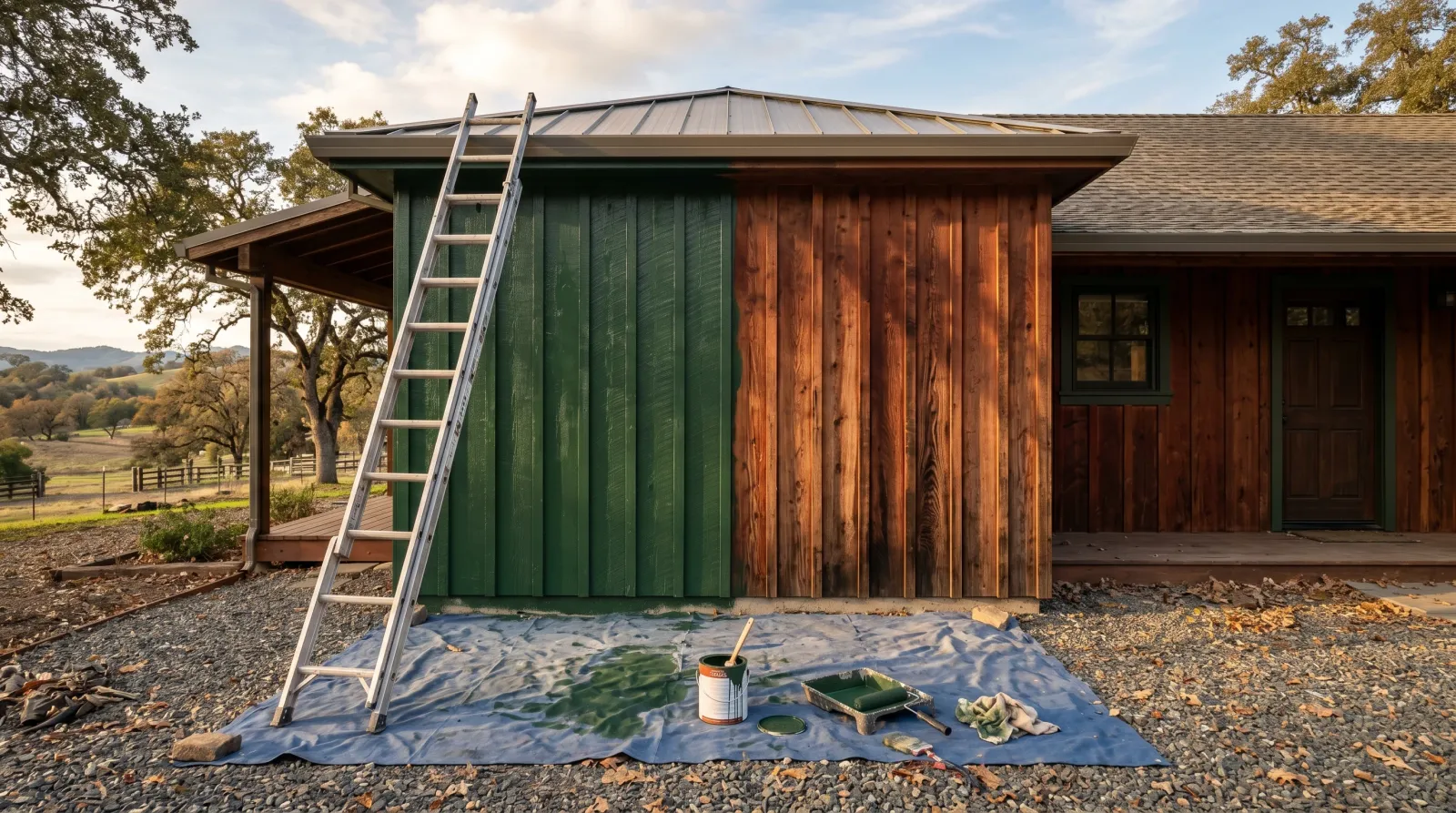
Redwood bleeds worse than cedar. Skip the alkyd primer and you’ll see pink rings through your white siding inside a year. The fix isn’t a better topcoat. It’s the primer underneath, the cut ends nobody primes, and the color call you make before either.
TL;DR
- Wait or prime: six months of weathering on fresh redwood, or Zinsser Cover Stain or BIN the first week
- Never: acrylic primer alone on bare redwood. Tannin walks right through it
- Color call: dark hides bleed; whites need Cover Stain plus a tinted basecoat
- Back-prime: every cut end gets Cover Stain before it sees water
- Paint: 100% acrylic exterior, two coats, satin on siding, semi-gloss on trim
- Cure: 30 days before pressure-washing
- Skill: hard. The primer call and the color call together drive the whole job
What Redwood Is and Why It Bleeds
Coast redwood is a softwood loaded with natural tannin and extractives that resist rot and insects. Those same extractives are water-soluble, and water-soluble means they ride right out through an acrylic primer.
Redwood comes off the mill with a thin glossy layer called mill glaze, polished by the planer blades and slick enough that acrylic primer can’t bite into it. Old-growth heartwood is darker and richer in tannin than second-growth sapwood. Both bleed. Old-growth bleeds twice as hard.
Why Redwood Is Different From Cedar
Cedar bleeds tannin. Redwood bleeds more of it, and the bleed comes out a deeper rust-pink instead of cedar’s amber. Old-growth is the worst case. Sometimes one coat of Cover Stain isn’t enough and you’ll see bleed through the primer itself before the topcoat goes on.
Redwood also gets used in vertical board-and-batten more than cedar does. The batten edges are the failure zone, and the back-prime step matters even more than on cedar lap.
Materials and Tools
- 100% acrylic exterior paint (Benjamin Moore Aura Exterior, Sherwin-Williams Emerald Exterior, or Behr Marquee Exterior)
- Zinsser Cover Stain alkyd primer (the default for bare redwood)
- Zinsser BIN shellac primer (for the worst tannin patches and any spot bleed-through)
- Tinted basecoat (a gray or warm-tan tinted primer if your topcoat is white or pastel)
- Stretchy elastomeric caulk (Sashco Big Stretch, OSI Quad Max, or DAP Dynaflex Ultra)
- Deck cleaner or TSP; bleach for mildew
- Pressure washer (1,200 PSI ceiling on redwood, softer than fir), 25-degree tip
- 80- and 120-grit sanding blocks, random-orbit sander
- 2-inch and 2.5-inch angled sash brushes (Wooster Silver Tip or Purdy XL)
- 1/2-inch nap roller for smooth redwood, 3/4-inch for rough-sawn
- Airless sprayer (515 or 517 tip) plus a second person to back-brush
- N95 minimum, eye protection, gloves
- Lead test kit ($15) on any redwood painted before 1978
Color and Sheen: Pick Before You Prime
This is the call most homeowners get backwards. Pick the color first, then pick the primer system to match.
Deep greens, hunter, navy, charcoal, oxblood, dark browns: the color hides any tannin halo well enough that one full coat of Cover Stain plus two topcoats holds for a decade. The pigment load swallows the bleed.
Mid-tones (warm grays, muted blues, sage): Cover Stain plus a tinted basecoat plus two topcoats. The tinted basecoat masks any bleed the primer let through.
Whites, off-whites, pastels: the high-risk category. You need Cover Stain plus a gray-tinted basecoat plus two coats of white topcoat. Skip the tinted basecoat under a white finish and the tannin shows up as pink shadow lines along the grain inside one summer. Or commit to BIN shellac primer instead of Cover Stain on the worst boards and skip the tinted basecoat.
Sheen drives fade rate. Flat fades fastest because the binder load is lowest. Satin holds roughly 30% longer than flat. Semi-gloss holds about twice the field life of flat on a south face in zone 9. Default to satin on siding, semi-gloss on trim, flat only on shaded north walls. Gloss looks plastic on rough-sawn redwood; skip it.
Step 1: Decide the Primer Path
This is the call that drives the whole job, and most people get it wrong.
Fresh redwood, painted today: Zinsser Cover Stain across the field, BIN on the darkest grain and worst knots. Oil-based alkyd, blocks tannin, recoats in two hours. Not acrylic bonding primer. Not “self-priming” exterior. Not the new low-VOC water-based stain-blockers. Cover Stain or BIN, nothing else.
Fresh redwood, willing to wait: leave it to weather for six full months. Sun, rain, dew cycles. The surface tannin leaches out and the mill glaze breaks down. After six months you can prime with a quality acrylic exterior primer and the bleed risk drops to near zero. Pretty rare that a homeowner waits. Most don’t.
Previously painted redwood: depends on the existing film. If it’s sound and not chalking, acrylic bonding primer is fine over patched areas. Bare patches still need Cover Stain. Redwood that’s been painted for years is still redwood underneath, and the moment paint flakes off, the tannin is right back at the surface.
Self-priming exterior is a marketing claim. Your bare redwood still needs the stain-blocker.
Step 2: Wash the Wall
Cover the plants. Mask the windows. Mix deck cleaner per label, or TSP at half a cup per gallon. For mildew, brush on 3:1 water-to-bleach with a splash of dish soap, dwell 15 minutes, rinse.
Pressure wash at 1,200 PSI maximum, 25-degree tip, 18 inches off the wall. Higher pressure fuzzes the grain into a fur coat you’ll fight forever. Work top down. Angle across the seams, never into them.
Then 72 hours of warm dry weather. Primer over wet redwood blisters off in a month. Moisture meter under 15% before you prime.
Step 3: Sand and Spot-Repair

120-grit across the field to knock down the mill glaze, 80-grit to feather any old paint edges flat.
On fresh redwood the whole wall gets a light 120-grit pass. You’re not removing material. You’re cutting the mill glaze so the primer bites. Tack-cloth the dust.
On previously painted redwood, scrape every loose flake with a 2-inch scraper, then feather the bare-paint edges with 80-grit until they sit flush with the surrounding paint. A sharp ring of bare wood telegraphs through two finish coats as a visible rectangle.
Splits and cracks get exterior wood filler. Sand flat at 30 minutes. Rotted boards you cut out and replace.
Pre-1978 home? Test scraped chips for lead before sanding. Lead-Safe RRP rules apply if positive: wet-scraping only, contained drop cloths, HEPA cleanup, P100 respirator.
Step 4: Spot-Prime the Hot Zones

BIN on the darkest heartwood and knots, Cover Stain on the rest. Spot-prime before the full primer coat.
Knots and the darkest heartwood are their own war. Resin in the knot keeps moving with temperature, and any primer that doesn’t seal it gets pushed off in a heat wave. The rust halo around an unprimed knot shows up by the second summer.
Brush BIN shellac primer over every knot and over the darkest grain lines with a 2-inch sash. BIN dries in 45 minutes and blocks resin nothing else stops. It’s brittle on exterior over time, so keep it to spot work. Two thin coats over a fat knot, sanded between with 220.
Cover Stain handles the lighter spots: small bare patches, repaired filler, cut ends visible in the field. One coat is enough.
Brush marks at this stage don’t matter. The full primer covers them.
Step 5: Caulk the Seams
Caulk after spot-priming, before full primer. Caulk bonds better to a primed surface, and the spot-primer seals any tannin in the joint.
Run a bead in every seam where two boards meet: corner trim joints, window and door casings, the batten edges on board-and-batten, the interlock on lap siding. Redwood doesn’t move as much as cedar, but it still moves. Sashco Big Stretch is my default. Moves 500% without splitting. OSI Quad Max and DAP Dynaflex Ultra also rated for siding. Standard acrylic caulk is rated for 25% movement and tears apart inside three winters.
Tool the bead flat with a wet finger. Wipe excess while it’s wet.
Step 6: Full Prime the Wall
Cover Stain goes over the whole field of bare redwood. On previously painted redwood that’s still sound, switch to a quality exterior acrylic primer over the old paint, with Cover Stain still hitting any bare-wood patches.
Brush the cut-in with a 2.5-inch angled sash. Roll the field with a 1/2-inch nap on smooth redwood, 3/4-inch on rough-sawn. Or spray and back-brush with two people. Spray-only on redwood fails because the primer sits on top of the grain instead of in it.
Cover Stain is touch-dry in 2 hours, recoatable in 2. Bare redwood drinks the first coat. Look at the wall in raking sun before you call primer done. If you see pink or rust telegraphing through the primer film, that’s tannin coming up. Hit those spots with BIN before the topcoat.
The Tinted Basecoat Step for Whites and Pastels
If your topcoat is white, off-white, or any pastel, you need a tinted basecoat between Cover Stain and your finish. Order the topcoat manufacturer’s primer or any quality acrylic exterior primer, tinted gray or warm tan at 25% to 50% of the topcoat color depth.
The tinted basecoat does two things. It masks any micro-bleed the Cover Stain let through. And it gives your white topcoat something to grip that isn’t shiny alkyd primer.
Skip this step under a white topcoat and you’ll see pink grain shadow inside one summer. No way around it.
Back-Prime Every Cut End
Water wicks into redwood end-grain faster than into any other part of the board. It freezes inside, splits the wood, pushes the topcoat off from underneath. Five years later you’ve got split board ends along the bottom course.
Every cut end you create gets a brushed coat of Cover Stain before it’s installed or exposed. Field cuts, ripped boards, mitered corners, the bottom edges of vertical battens. On a wall already up, prime every visible cut end you can reach.
Installing new redwood siding? Prime all six faces of every board on the ground before it goes up. Most-skipped step on new redwood, and the one that bites in five years.
Step 7: Two Finish Coats

100% acrylic exterior, two coats, satin on siding. Stop at the end of a board run, never mid-wall.
100% acrylic exterior. Aura, Emerald, or Marquee. All three carry the binder load to handle UV and seasonal movement. Contractor-grade exterior chalks fast on a south-facing redwood wall.
Brush the cut-in first, roll behind it while the cut is still wet. Keep a wet edge. Don’t stop in the middle of a wall. Stopping mid-wall is how you get lap marks the second the morning sun hits them.
Watch the dew point. Most 100% acrylics want 50°F minimum, 90°F maximum, and at least 5°F above dew point. South-facing redwood in direct sun runs 30°F hotter than the air. Paint flashes the solvent before the film levels, and you end up with a dead-looking coat. Early morning or late afternoon on the south face, never noon.
Sixteen hours between coats. Some cans say four. Don’t believe them on exterior redwood.
The second coat fills holidays and builds the mil thickness the manufacturer specs (4 mils wet, 1.5 dry, per coat). Look at the wall in raking morning sun before you call it done.
Step 8: Cure
Touch-dry in 2 to 4 hours, recoat in 16, full cure 30 days. During cure, no pressure-washing, no ladders against the wall, no sprinklers onto it. A soft film picks up dirt that locks in.
Common Mistakes
- Acrylic primer on bare redwood. Pink or rust halos by month six. Cover Stain or wait six months.
- White topcoat over Cover Stain with no tinted basecoat. Pink grain shadow shows through inside one summer. Tint the basecoat or use BIN.
- Skipping BIN on the darkest heartwood lines. Rust halos along the grain by spring. No shortcut on old-growth redwood.
- Spray-only on rough-sawn redwood. Paint sits on top of the texture, not in it. Three years to failure. Back-brush or back-roll behind every pass.
- Standard acrylic caulk in redwood seams. Movement rating too low. Stretchy elastomeric only.
- Painting wet redwood. Boards look dry on the surface but hold moisture inside for days after a rain. Meter under 15% before you prime.
- No back-priming the batten bottoms. Water wicks into end-grain, freezes, splits the batten. Topcoat peels at year five.
- Flat sheen on a south face. Chalks and fades inside three years. Satin minimum on any wall with afternoon sun.
Maintenance and Longevity
Painted redwood lasts 10 to 12 years on north and east faces, 7 to 9 on south. Early failure signs: chalking on the south face, mildew on the north, split batten bottoms at the lowest course. Most failures trace back to the primer call, not the topcoat.
Wash the wall annually with a soap injector and a soft pole brush. No pressure washing in the first year. After year one, 1,000 PSI on a 40-degree tip is the ceiling. Re-caulk any failed seam the season it shows. South-face refresh at year seven if it’s chalking ahead of the rest.
For SKU picks on the topcoat, see the exterior wood paint round-up. For the stain-blocking primer category, see the primer picks.
Will it bite you in two years? Only if you skipped Cover Stain, picked a white topcoat without a tinted basecoat, or left a batten bottom raw to drink water all winter. Get those three right and the wall holds for a decade.
Ask a Question